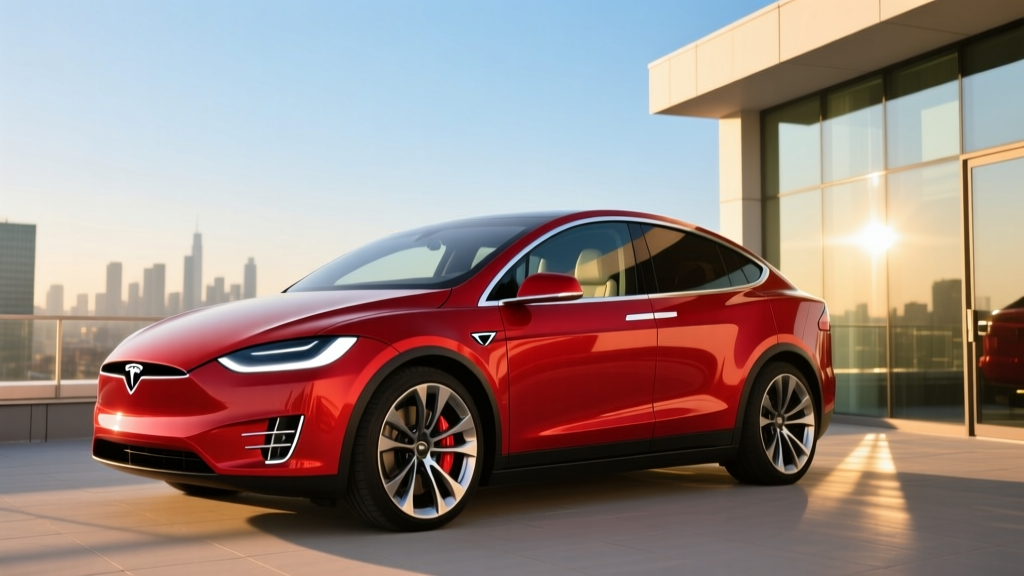
There's no mistaking a red Tesla Model X on the road. The Ultra Red multi-coat finish (a $2,500 upgrade) turns Tesla's flagship three-row SUV into a genuine head-turner — but beneath the striking paint lies a vehicle that demands a buyer's-guide level of scrutiny. At over $80,000 before incentives, the 2026 Model X is a serious financial commitment, and its unique falcon-wing doors, aging interior architecture, and specific charging characteristics mean it isn't the right luxury EV for everyone.
This review breaks down the 2026 Tesla Model X — with a focus on the Ultra Red configuration buyers are searching for — covering real-world range, charging speeds, total ownership cost, tax-credit eligibility, and how it stacks up against the Rivian R1S, BMW iX, and Mercedes EQS SUV.
Quick Verdict: Who Should Buy the Red Tesla Model X?
Choose the Model X if: You need three rows, Supercharger access, and sub-4-second 0-60 performance in a luxury package, and you can charge at home.
Look elsewhere if: You prioritize interior material quality (BMW iX), need serious off-road capability (Rivian R1S), or want a lower entry price (Model Y, Ioniq 9).
The Model X remains the only electric three-row SUV with access to Tesla's 20,000+ Supercharger network natively (NACS connector), and its dual-motor AWD powertrain delivers effortless highway passing power. But the cabin materials don't match the price tag, and the falcon-wing doors, while dramatic, add complexity and occasional sensor-related quirks in tight garages.
Range, Battery, and Real-World Efficiency
| Spec | Long Range (Dual Motor) | Plaid (Tri-Motor) |
|---|---|---|
| EPA Range | 326 miles | 300 miles |
| Battery (usable) | ~100 kWh, NMC | ~100 kWh, NMC |
| Drivetrain | Dual-Motor AWD | Tri-Motor AWD |
| Horsepower | 670 hp | 1,020 hp |
| 0-60 mph | 3.8 sec | 2.5 sec |
| MPGe (combined) | 102 MPGe | 98 MPGe |
| Efficiency | 33 kWh/100 mi | 35 kWh/100 mi |
| Towing Capacity | 5,000 lbs | 5,000 lbs |
The Model X uses a nickel-manganese-cobalt (NMC) battery pack with approximately 100 kWh of usable capacity. Tesla does not publish exact pack figures, but independent teardowns and EPA-cycle calculations confirm this range. NMC chemistry offers high energy density — essential for a heavy three-row SUV — but it is more sensitive to sustained 100% states of charge than LFP packs. For daily driving, set your charge limit to 80-90% and reserve 100% for road trips.
Real-World Range: What the EPA Sticker Doesn't Tell You
EPA Long Range: 326 miles | EPA Plaid: 300 miles
Expect in practice: Highway cruising at 70-75 mph drops range to roughly 265-280 miles (Long Range) and 245-260 miles (Plaid). The Model X's tall, wide profile and ~5,100-lb curb weight create real aerodynamic drag at speed.
Cold-weather caveat: In sub-freezing conditions (20-30°F), expect a 20-30% reduction — bringing Long Range down to ~230-260 miles without preconditioning. Always precondition the battery via the Tesla app before departing in cold weather; this warms the pack and recovers significant range.
Efficiency figures from fueleconomy.gov show the Long Range at 102 MPGe combined (33 kWh/100 mi), which is respectable for a vehicle this size but trails the more aerodynamic BMW iX xDrive50 (86 MPGe combined with a smaller footprint). The Plaid's extra motor and performance tuning reduce efficiency slightly to roughly 98 MPGe.
Charging Speed: DC Fast Charge and Home Level 2
| Level | Power / Rate | Speed | Notes |
|---|---|---|---|
| Level 1 (120V) | ~1.4 kW | ~3-4 mi/hr | Emergency/trickle only |
| Level 2 (240V, 48A) | 11.5 kW | ~34 mi/hr | Full charge in ~10 hrs |
| DC Fast (V3 Supercharger) | Peak 250 kW | 10-80% in ~30 min | NACS connector native |
| DC Fast (V4 Supercharger) | Peak 250 kW (vehicle-limited) | 10-80% in ~30 min | Older architecture caps rate |
The Model X charges at a peak of 250 kW on Tesla V3 and V4 Superchargers. However, this is peak — not sustained. The charge curve tapers significantly above 60% state of charge, and the 10-80% session takes approximately 30 minutes. This is slower than newer 800V-architecture rivals: the Hyundai Ioniq 9 and Kia EV9 GT achieve 10-80% in roughly 18-20 minutes at 350 kW chargers, and the Porsche Cayenne EV (when available) targets even faster times.
For home charging, the Model X accepts up to 11.5 kW on a 240V/48A Level 2 circuit (such as a Tesla Wall Connector on a 60A breaker). This adds about 34 miles of range per hour and fully replenishes the pack overnight in roughly 10 hours. If your home has a 200A electrical panel, a Level 2 install typically runs $800-$1,500 including equipment and electrician labor. Older homes with 100A panels may need a $2,000-$4,000 panel upgrade — factor this into your purchase budget.
The Model X uses the NACS (North American Charging Standard) connector natively, meaning direct plug-in access to every Tesla Supercharger stall. For non-Tesla CCS networks (Electrify America, EVgo), you'll need Tesla's CCS adapter ($175), which enables charging at most third-party DC stations, though speeds may be limited by adapter throughput.
Performance and Driving Dynamics
The dual-motor Long Range Model X produces 670 combined horsepower and hits 60 mph in 3.8 seconds — a remarkable figure for a three-row SUV weighing over 5,000 lbs. The tri-motor Plaid variant pushes 1,020 hp and reaches 60 mph in 2.5 seconds, making it one of the quickest production SUVs ever built.
On the road, the air suspension (standard on all trims) provides a comfortable, adaptive ride with up to 8.2 inches of ground clearance in its highest setting. The steering is precise but light — this is a grand tourer, not a sports car, despite the Plaid badge. Body roll is well-controlled for its class, but the sheer mass is noticeable in tight urban corners.
Regenerative braking offers two modes: standard (strong, approaching one-pedal driving in most scenarios) and low. The Model X does not offer a true one-pedal mode that brings the car to a complete stop and holds it — you'll still need the brake pedal at stoplights, unlike some competitors.
Interior, Cargo, and Technology
The Model X seats up to seven passengers in its standard 2-3-2 configuration, with an optional six-seat layout (2-2-2) featuring second-row captain's chairs. Cargo volume is generous: 75.4 cubic feet behind the first row with the second and third rows folded, and a 6.5-cubic-foot front trunk (frunk).
| Measurement | Value |
|---|---|
| Front Legroom | 41.2 in |
| Second-Row Legroom | 38.4 in |
| Third-Row Legroom | 32.7 in |
| Cargo (all rows up) | 15.8 cu ft |
| Cargo (behind 1st row) | 75.4 cu ft |
| Frunk | 6.5 cu ft |
The 17-inch center touchscreen (landscape orientation, updated in recent model years) runs Tesla's proprietary infotainment OS — fast, responsive, and packed with features including streaming apps, a built-in browser, and Sentry Mode dashcam recording. However, the interior materials remain a frequent criticism: synthetic leather and minimal physical controls feel dated compared to the BMW iX's premium cabin or the Rivian R1S's adventure-oriented design.
The yoke-style steering wheel (now optional alongside a conventional round wheel) continues to divide owners. For city driving and parking maneuvers, the conventional wheel is the pragmatic choice; the yoke suits highway cruising but requires adaptation for low-speed turns.
Standout tech: Autopilot (standard) provides SAE Level 2 lane-centering and adaptive cruise control. Full Self-Driving (Supervised), a $8,000 option, adds automatic lane changes, traffic light/stop sign recognition, and parking assist. FSD remains Level 2 — the driver must stay fully engaged and hands-on/near-wheel at all times. It is not autonomous driving.
ADAS Limitation Warning: Tesla Autopilot and FSD (Supervised) are SAE Level 2 driver-assistance systems. They do NOT make the vehicle self-driving. The driver is legally responsible for all vehicle operation and must maintain active supervision at all times. Performance degrades in heavy rain, construction zones, faded lane markings, and unmapped roads.
Pricing, Tax Credits, and Ownership Cost
| Trim | Base MSRP | Ultra Red Add-On | §30D Credit Eligible? |
|---|---|---|---|
| Long Range | $79,990 | +$2,500 | No — exceeds MSRP cap |
| Plaid | $94,990 | +$2,500 | No — exceeds MSRP cap |
Here's the critical detail many buyers miss: the Tesla Model X does not qualify for the $7,500 federal EV tax credit under IRS §30D. The credit imposes an MSRP cap of $80,000 for SUVs, and even the base Long Range at $79,990 is functionally excluded once destination fees ($1,390) push the total above the threshold. The Ultra Red paint option ($2,500) makes the situation even more clear-cut.
Additionally, §30D has buyer income caps ($150,000 single / $300,000 joint MAGI) and battery critical-mineral sourcing requirements that change annually. Always verify current eligibility on IRS.gov before assuming credit availability.
5-Year Ownership Cost Estimate (Long Range, 15,000 mi/yr):
| Category | Estimated Cost |
|---|---|
| Purchase (after delivery, before state incentives) | ~$84,000 |
| Home Level 2 Charger Install | $1,000-$2,500 |
| Electricity (5 yrs, $0.14/kWh avg) | ~$7,350 |
| Insurance (5 yrs, national avg) | ~$17,500 |
| Maintenance (tires, cabin filter, fluid top-offs) | ~$2,500 |
| Estimated Depreciation (5 yrs) | ~$30,000-$35,000 |
Insurance is notably expensive for the Model X — averaging $3,500-$4,500/year nationally, with Plaid models often exceeding $5,000/year. Get a quote before committing. On the positive side, maintenance costs are dramatically lower than a comparable gas SUV: no oil changes, no transmission fluid, and regenerative braking extends pad life significantly.
Warranty and Battery Longevity
Tesla covers the Model X with the following warranty:
- Basic Vehicle: 4 years / 50,000 miles
- Battery & Drive Units: 8 years / 150,000 miles (whichever comes first), with a minimum 70% capacity retention guarantee
The 150,000-mile battery warranty is competitive with the industry standard for premium EVs. Real-world NMC degradation data from Tesla's fleet reports show approximately 10-12% capacity loss at 100,000 miles under normal use patterns, with the curve flattening afterward. Avoiding frequent 100% charges and DC fast-charging exclusively will help preserve long-term State of Health (SoH).
If the pack does require replacement outside warranty, Tesla battery replacements for the Model X currently run $18,000-$25,000 depending on configuration — a figure worth knowing for high-mileage buyers planning 10+ years of ownership.
Pros, Cons, and the Competition
Pros
- NACS Supercharger network — best public charging infrastructure in the US
- Class-leading acceleration (3.8s Long Range, 2.5s Plaid)
- Genuine three-row seating with 75+ cu ft cargo
- Over-the-air updates continuously add features
- Falcon-wing doors ease third-row access in tight spaces
- 5,000-lb towing capacity
Cons
- Interior quality lags BMW iX, Mercedes EQS SUV at this price
- No federal §30D tax credit (MSRP cap exclusion)
- 250 kW peak DC charge rate trails 800V competitors
- Insurance premiums significantly above class average
- Falcon-wing door sensors can be finicky in low-clearance garages
- FSD ($8,000) remains Level 2 — not autonomous
Key competitors to cross-shop:
- Rivian R1S (Dual-Motor): ~$75,900, 352-mi range, genuine off-road capability, more adventurous interior. Lacks Supercharger access natively but uses NACS as of 2025+.
- BMW iX xDrive50: ~$87,250, 307-mi range, superior interior luxury, faster 10-80% charging. Only two rows.
- Mercedes EQS 450 SUV: ~$104,400, 305-mi range, flagship luxury. Significantly more expensive.
- Kia EV9 GT-Line AWD: ~$73,900, 270-mi range, three rows, much lower price. Less performance and range.
Frequently Asked Questions
What is the real-world range of the red Tesla Model X?
The EPA rates the 2026 Model X Long Range at 326 miles and the Plaid at 300 miles. In real-world highway driving at 70-75 mph, expect 265-280 miles (Long Range) and 245-260 miles (Plaid). In freezing temperatures, range drops an additional 20-30% unless you precondition the battery.
How fast does the Tesla Model X charge at home and on the road?
On a home Level 2 charger (240V, 48A), the Model X charges at 11.5 kW, adding roughly 34 miles of range per hour and fully recharging overnight in about 10 hours. On a Tesla V3 Supercharger, it peaks at 250 kW DC and reaches 10-80% in approximately 30 minutes. The charge curve tapers above 60% SoC, so the last 20% takes noticeably longer.
Does the Tesla Model X qualify for the federal EV tax credit?
No. The 2026 Model X does not qualify for the $7,500 IRS §30D federal tax credit because its MSRP (starting at $79,990 + destination) exceeds the $80,000 SUV cap. Additionally, income limits ($150K single / $300K joint) and battery-sourcing requirements further restrict eligibility. Check fueleconomy.gov for the latest qualifying vehicle list.
Is the Tesla Model X worth buying over the Rivian R1S or BMW iX?
It depends on your priorities. Choose the Model X for Supercharger access, three-row seating, and extreme acceleration. Choose the Rivian R1S for off-road capability and a more modern interior at a lower price. Choose the BMW iX for superior cabin luxury and faster charging, but accept two-row-only seating.
How much does Ultra Red paint cost on the Model X?
Ultra Red is a $2,500 multi-coat premium paint option on the 2026 Model X. It replaces the previous Red Multi-Coat and offers deeper, more saturated color under direct light. It does not affect range or performance.
What is the battery warranty on the Tesla Model X?
Tesla covers the Model X battery and drive units for 8 years or 150,000 miles, whichever comes first, with a guaranteed minimum 70% capacity retention over that period. This is competitive with other premium EV manufacturers.
Sources: EPA fueleconomy.gov, Tesla Model X specifications, IRS §30D Clean Vehicle Credits. Pricing and credit rules reflect 2026 model year and are subject to change. Always confirm with your tax professional and Tesla directly before purchasing.