Quick Answer: Are Custom Electric Tugs Worth the Switch?
Bottom line: Custom electric tugs — battery-electric tow tractors built for airport ground support, warehouse logistics, and heavy industrial towing — typically cost 30-50% more upfront than diesel equivalents ($45,000–$120,000 vs. $30,000–$80,000) but deliver 60-75% lower energy costs per operating hour and dramatically reduced maintenance. For fleets running 6+ hours daily with depot-based charging access, payback occurs in 3–5 years. For low-utilization or off-grid operations, diesel or hybrid tugs may still be the pragmatic choice.
Custom electric tugs are not consumer vehicles — they're purpose-built industrial equipment. Manufacturers like Textron GSE, Eagle Tugs, Lectrus, and Harlan build these machines to spec for airline ground handlers, Amazon fulfillment campuses, port authorities, and auto plants. If you're evaluating a fleet electrification project, this guide covers what matters: battery capacity and chemistry, real-world drawbar pull, charging infrastructure, total cost of ownership, and when electric makes financial sense versus sticking with diesel.
What Are Custom Electric Tugs — and Who Needs Them?
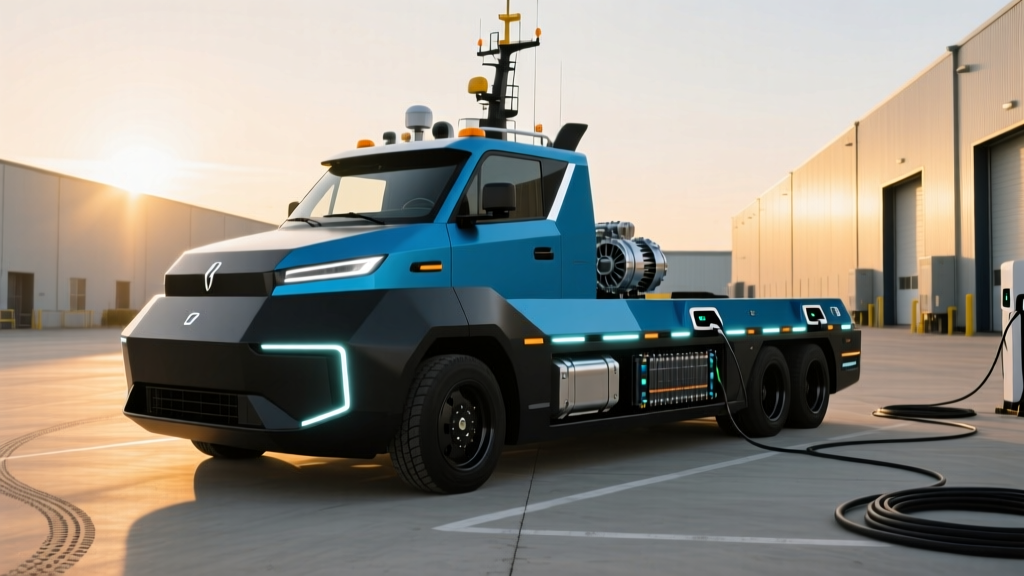
A custom electric tug is a battery-electric tow tractor designed for low-speed, high-torque pulling. Unlike highway EVs, these machines prioritize drawbar pull (measured in pounds of tractive effort) over range. Typical applications include:
- Airport ground support: Pushing back aircraft, towing baggage carts, moving ground power units
- Warehouse & distribution: Pulling multi-trailer trains across fulfillment campuses
- Manufacturing plants: Moving heavy assemblies along production lines
- Ports & rail yards: Spotting containers and rail cars at low speed
The "custom" element matters. Fleet buyers specify battery capacity (typically 40–150 kWh), charger type, hitch configuration, cab enclosure, and towing capacity (5,000–80,000+ lbs GCW). Most units use LFP (lithium iron phosphate) battery chemistry for its thermal stability, long cycle life (3,000–5,000+ cycles), and tolerance for opportunity charging — critical for shift-based operations that can't afford to park a tug for a full charge cycle.
Electric vs. Diesel Tugs: Head-to-Head Comparison
| Metric | Electric Tug (LFP) | Diesel Tug (Tier 4 Final) |
|---|---|---|
| Base Purchase Price | $55,000–$120,000 | $30,000–$80,000 |
| Energy Cost per Hour | $1.50–$4.00 (electricity) | $8.00–$15.00 (diesel fuel) |
| Maintenance Cost per Year | $800–$1,500 | $3,500–$6,000 |
| Emissions | Zero tailpipe; grid-dependent upstream | NOx, PM, CO₂ at point of use |
| Noise Level | 55–65 dB(A) | 80–95 dB(A) |
| Operational Range (per shift) | 30–60 miles equivalent / 6–10 hrs | Unlimited with refueling |
| Refuel / Recharge Time | 1–4 hrs (Level 2); 20–40 min (DC fast) | 5–10 min (diesel fill) |
| Typical Lifespan | 10–15 years (battery swap at ~8 yrs) | 8–12 years |
The numbers tell a clear story: electric tugs win on operating cost and noise but lose on upfront capital and refueling flexibility. A diesel tug can refuel in minutes and run indefinitely; an electric tug must return to a depot charger. For operations with predictable routes and scheduled breaks — airline ground handling, for example — this constraint is manageable. For spot-towing across a sprawling port with no charging infrastructure nearby, diesel retains the edge.
Real Costs: 5-Year Total Cost of Ownership
| Cost Category | Electric Tug | Diesel Tug |
|---|---|---|
| Purchase Price | $85,000 | $55,000 |
| Charging Infrastructure (shared) | $12,000 (amortized per unit) | $0 |
| Energy / Fuel (5 yrs, 2,000 hrs/yr) | $25,000 | $110,000 |
| Maintenance (5 yrs) | $6,000 | $22,000 |
| Battery Replacement (year 8) | $0 in 5-yr window | N/A |
| Federal / State Incentives | –$15,000 to –$40,000* | $0 |
| 5-Year Net Cost | $113,000 – $138,000 | $187,000 |
*Incentive amounts vary by jurisdiction and program. Federal incentives for off-road industrial EVs differ from the §30D consumer credit. Consult the IRS EV credit guidance and your state's clean-fleet programs. A qualified tax professional should verify eligibility.
The crossover point is clear: by year 4–5, the electric tug's lower operating costs offset its higher purchase price — especially when incentives apply. The critical variable is utilization. A tug running 2,000+ hours per year burns through diesel savings fast. One running 500 hours annually may never recoup the upfront premium.
Battery, Charging, and Infrastructure: What Fleet Buyers Must Plan
Specifying an electric tug's battery isn't like choosing a Tesla's range package. Industrial tugs are spec'd around kWh capacity (energy stored) and kW charge rate (how fast energy flows back in) — these terms are not interchangeable.
- kWh (kilowatt-hours): The battery's energy capacity. A 60 kWh battery in a tug pulling 20,000 lbs might deliver 6–8 hours of operation. An 80–100 kWh pack extends this to 8–10 hours.
- kW (kilowatts): The charge rate. A 19.2 kW Level 2 charger refills a 60 kWh battery in roughly 3.5 hours. A 50 kW DC fast charger can do 10–80% in about 50 minutes.
Most custom electric tugs charge via CCS1 or industrial-grade J1772 Level 2 connectors. Some manufacturers offer proprietary high-current connectors for rapid opportunity charging during shift changes. Before ordering a single electric tug, confirm your depot's electrical panel can support the required amperage. A typical 4-tug charging depot needs 200–400 amps of dedicated 480V three-phase service — a panel upgrade can add $15,000–$50,000 to the project.
For cold-climate operations (below 20°F), LFP batteries lose 15–25% of usable capacity unless equipped with active thermal management. Specify battery heaters in the build if your tugs operate outdoors in northern winters.
Common Misconceptions About Electric Tugs
| Myth | Fact |
|---|---|
| "Electric tugs can't pull as hard as diesel." | Electric motors deliver peak torque at 0 RPM. Many electric tugs match or exceed diesel drawbar pull at low speeds — the exact operating range for towing. |
| "The battery will die in 3 years." | LFP chemistry delivers 3,000–5,000+ full cycles before reaching 80% state of health. At one cycle per day, that's 8–14 years before meaningful degradation. |
| "Charging takes too long for shift work." | Opportunity charging during 30-minute breaks at 50 kW DC adds ~25–30 kWh — enough for 3–4 more hours of towing. Planned break-time charging eliminates the problem. |
| "There are no incentives for industrial EVs." | Federal and state clean-fleet programs, EPA DERA grants, and utility make-ready programs can offset 20–50% of total project cost. Check EPA DERA for current funding. |
| "You need a full solar array to make it green." | Even on a grid-average mix, electric tugs produce 40–60% less lifecycle CO₂ than diesel equivalents per the EPA's EV lifecycle analysis. |
Decision Framework: Should Your Fleet Go Electric?
Choose an electric tug if:
- Your tugs operate 6+ hours per day, 5+ days per week (high utilization justifies the capital premium)
- You have depot-based operations with predictable return-to-base patterns and scheduled breaks for opportunity charging
- Noise restrictions apply (indoor warehouses, nighttime airport operations, residential-adjacent facilities)
- Zero tailpipe emissions are required for indoor air quality or corporate sustainability mandates
- Your electrical infrastructure can support Level 2 or DC fast charging without a costly panel upgrade
- State or utility incentives are available to offset the purchase premium
Stick with diesel (or evaluate a hybrid) if:
- Tugs are used fewer than 500 hours per year (the upfront premium won't pay back)
- Operations are spread across multiple remote sites with no charging infrastructure
- You need 24/7 continuous operation with no downtime for charging and no opportunity for shift-break charging
- Ambient temperatures regularly drop below 0°F and battery thermal management adds unacceptable cost or weight
- Your fleet is small (1–2 units) and the per-unit infrastructure cost is prohibitive
What First-Time Electric Tug Buyers Should Know
If this is your fleet's first electrification project, plan for more than just the vehicle:
- Electrical site survey first. Before requesting quotes, have a licensed electrician assess your depot's panel capacity, conduit runs, and transformer headroom. This determines how many chargers you can install and at what amperage.
- Right-size the battery. Overspecifying kWh adds weight, cost, and charge time. Log your current diesel tugs' daily operating hours and fuel consumption, then work with the manufacturer to model energy draw for your specific towing loads and terrain.
- Specify LFP chemistry. For industrial applications with daily deep cycling, LFP outlasts NMC and is inherently more thermally stable — reducing fire risk in confined maintenance areas.
- Negotiate battery warranty. Look for 8-year / 10,000-cycle warranties with a guaranteed 70–80% state-of-health floor. Some manufacturers offer battery-as-a-service leasing to eliminate replacement risk entirely.
- Train operators on regen behavior. Electric tugs use regenerative braking, which changes the feel of deceleration when towing heavy loads. Operators accustomed to diesel engine braking need a brief adaptation period.
Frequently Asked Questions
How much does a custom electric tug cost in 2026?
Depending on battery size, towing capacity, and cab configuration, custom electric tugs range from $45,000 (light-duty, 40 kWh, 10,000-lb tow rating) to $120,000+ (heavy-duty, 100+ kWh, 60,000+ lb aircraft pushback). Add $3,000–$8,000 per unit for Level 2 charging equipment and $5,000–$25,000 for electrical infrastructure upgrades.
What is the battery lifespan of an electric tug?
LFP batteries in industrial tugs are rated for 3,000–5,000 full charge cycles before degrading to 80% capacity. At one full cycle per day, that translates to 8–14 years. Replacement battery packs typically cost $12,000–$30,000 depending on kWh capacity, though many fleets never reach replacement within the tug's service life.
Do electric tugs qualify for federal tax credits?
The §30D consumer EV tax credit applies to on-road vehicles, not off-road industrial equipment. However, electric tugs may qualify for the 45W Commercial Clean Vehicle Credit (up to $40,000 for vehicles over 14,000 lbs GVWR used in commercial fleets), EPA DERA grants, state clean-fleet incentives, and utility make-ready programs. Consult a tax professional and check current IRS guidance for eligibility.
Can electric tugs operate in extreme cold?
Yes, but with caveats. LFP batteries lose 15–25% of usable capacity below 20°F unless equipped with active thermal management (battery heaters). Specify heated battery enclosures in cold-climate builds. Some fleets in northern regions maintain a small diesel backup for extreme cold snaps below –10°F.
How long does it take to charge an electric tug?
On a 19.2 kW Level 2 charger, a 60 kWh battery charges from empty to full in approximately 3.5 hours. On a 50 kW DC fast charger, the same battery reaches 80% in roughly 50 minutes. Charge times scale linearly with battery size — a 100 kWh pack takes proportionally longer. Note that charging slows significantly above 80% state of charge due to the battery's charge curve taper, which protects cell longevity.
What maintenance do electric tugs require?
Far less than diesel. No oil changes, no fuel filters, no DPF regeneration, no transmission fluid. Annual maintenance typically covers brake inspections (regen braking reduces wear by 50–70%), coolant checks for the battery thermal management system, tire rotation, and electrical connection inspections. Budget $800–$1,500 per unit per year versus $3,500–$6,000 for diesel.