If you've been researching Level 2 home charging equipment, you've likely encountered the term "red-eye charger" — a search trend that's picking up speed as more EV owners look for reliable, high-output wall units. But what exactly is a red-eye charger, how does it compare to mainstream Level 2 stations like the ChargePoint Home Flex or Tesla Wall Connector, and is it the right fit for your garage? This guide breaks down the specs, installation requirements, connector compatibility, and real-world charging economics so you can decide whether to add one to your shortlist.
What Is a Red-Eye Charger?
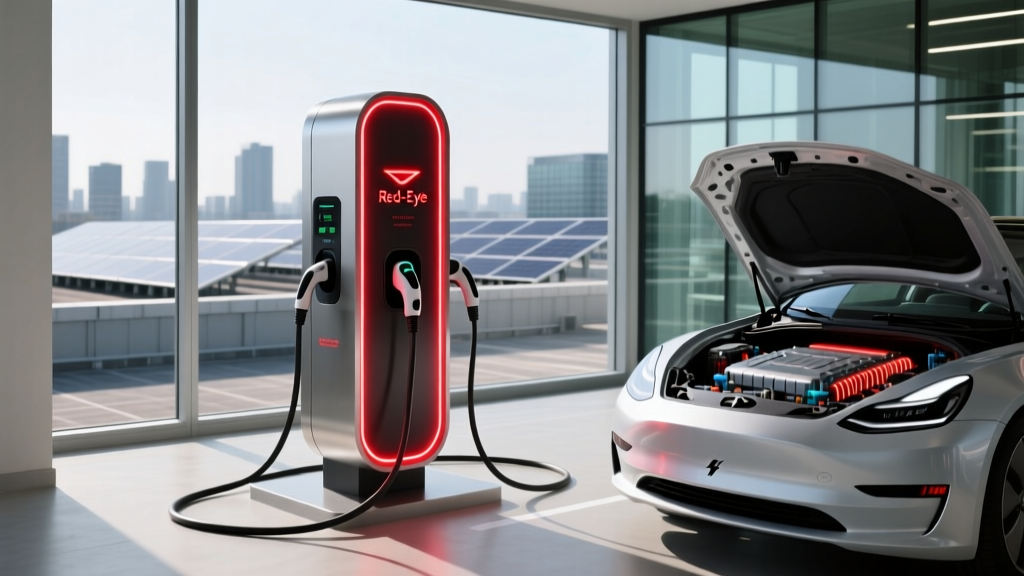
The "red-eye charger" label generally refers to a category of high-output Level 2 EVSE (Electric Vehicle Supply Equipment) characterized by a distinctive red status LED or illuminated ring — a design cue borrowed from industrial equipment signaling active power delivery. While not a single brand, the term has become shorthand among EV forums and Reddit communities for 40A to 48A hardwired or NEMA 14-50 plug-in wall chargers that prioritize fast Level 2 throughput, robust cable management, and smart scheduling features.
These units typically deliver between 9.6 kW and 11.5 kW of continuous power on a 240V circuit, adding roughly 30 to 44 miles of range per hour of charging — enough to fully replenish a 75 kWh battery pack overnight. For context, that's roughly 4x faster than a standard 120V Level 1 outlet.
Charging Levels Explained: Speeds in kW and Miles Per Hour
Before evaluating any specific charger, it's essential to understand the three charging tiers available to EV owners. Note the critical distinction: kW (kilowatts) measures power — the rate at which energy flows — while kWh (kilowatt-hours) measures energy — the total capacity of your battery. A 48A charger delivering 11.5 kW will add 11.5 kWh of energy to your battery in one hour (minus minor efficiency losses).
| Level | Voltage | Max Power (kW) | Miles of Range Added/Hour | Typical Use |
|---|---|---|---|---|
| Level 1 | 120V AC | 1.4 kW | 3–5 mi/hr | Overnight top-off, PHEVs, emergencies |
| Level 2 | 240V AC | 7.2–11.5 kW | 20–44 mi/hr | Daily home/workplace charging |
| DC Fast | 400–800V DC | 50–350 kW | 150–1,000+ mi/hr | Road trips, public stations |
A red-eye charger sits at the top of the Level 2 tier. For a vehicle like the Hyundai Ioniq 5 (84 kWh usable battery, EPA 305 miles), a full 10–80% charge at 11.5 kW takes approximately 5.5 hours. A Tesla Model Y Long Range (75 kWh usable, EPA 310 miles) reaches 10–80% in roughly 5 hours under the same conditions. Compare that to a 350 kW DC fast charger, which can deliver 10–80% in about 18–25 minutes depending on the vehicle's charge curve — but DC fast charging should be used sparingly to preserve long-term battery health.
How Much Does It Cost to Install a Home EV Charger?
Installation cost is the single biggest variable in home charging setup, and it depends heavily on your home's electrical panel capacity, the distance from the panel to the charger location, and local permitting requirements. Here's a realistic breakdown for a typical 48A hardwired Level 2 charger installation in 2026:
| Component | Low Estimate | High Estimate | Notes |
|---|---|---|---|
| Charger Equipment (40–48A) | $400 | $750 | Hardwired units tend to be cheaper than plug-in |
| Electrician Labor (2–6 hours) | $500 | $2,000 | Varies by region and run complexity |
| Electrical Permit | $50 | $250 | Required in most jurisdictions |
| Panel Upgrade (if needed) | $1,500 | $4,000 | Needed if existing panel lacks capacity for a 60A circuit |
| Total (no panel upgrade) | $950 | $3,000 | Most homes with 200A service fall here |
| Total (with panel upgrade) | $2,450 | $7,000 | Older homes with 100A service |
A 48A charger requires a dedicated 60A circuit (the National Electrical Code requires circuits to be rated at 125% of continuous load). If your home has a 200A panel with available breaker slots and sufficient calculated load capacity, you'll likely avoid a panel upgrade. Homes with 100A service or panels already near capacity — common in pre-1990 construction — will need an upgrade to 200A or even 400A service. Always have a licensed electrician perform a load calculation before committing to equipment.
Connector Compatibility: NACS, CCS, and CHAdeMO
As of 2026, the North American charging connector landscape has consolidated heavily around NACS (North American Charging Standard), the connector pioneered by Tesla and now adopted by Ford, GM, Hyundai, Kia, Rivian, and most major automakers. CCS1 is still found on older models and some European-market vehicles, while CHAdeMO is effectively legacy — found primarily on the Nissan Leaf, which has been discontinued.
| Connector | Compatible Brands | Adapter Needed? |
|---|---|---|
| NACS (Tesla) | Tesla, Ford, GM, Hyundai, Kia, Rivian, Volvo, Polestar, BMW (newer) | No — native on most 2025+ models |
| CCS1 | VW ID.4 (pre-2025), older BMW i4/iX, older Hyundai/Kia | CCS-to-NACS adapter for Tesla Superchargers (~$200–$300) |
| CHAdeMO | Nissan Leaf (discontinued), Mitsubishi Outlander PHEV (older) | Limited public availability; plan for CCS/NACS adapter |
Most red-eye charger models ship with a NACS connector as standard, with CCS1 available as an option or via adapter. If you own a CCS1-equipped vehicle, verify that your chosen charger either includes a CCS cable or supports the J3400 (NACS) adapter your automaker may provide. For Level 2 home charging, the connector difference matters less than it does for DC fast charging — you're charging in your own garage, so a dedicated cable for your vehicle is the simplest solution.
Equipment Recommendations: Top Level 2 Chargers Compared
Here's how the leading 40–48A Level 2 chargers stack up in 2026, including models commonly associated with the red-eye charger search:
| Charger | Max Power | Amperage | Cable Length | Connector | Smart Features | Price (MSRP) |
|---|---|---|---|---|---|---|
| ChargePoint Home Flex | 12 kW | Up to 50A | 23 ft | NACS or CCS1 | App scheduling, Alexa, load sharing | $699 |
| Tesla Wall Connector | 11.5 kW | 48A | 24 ft | NACS | Wi-Fi updates, power sharing, Tesla app | $475 |
| Emporia Vue EV Charger | 11.5 kW | 48A | 24 ft | NACS | Energy monitoring, solar integration, scheduling | $399 |
| Grizzl-E Smart | 10 kW | 40A | 24 ft | NACS or J1772 | App control, OCPP support, extreme weather rated | $549 |
| Wallbox Pulsar Plus | 11.5 kW | 48A | 25 ft | NACS or J1772 | App, Power Boost load management | $649 |
For most EV owners, the Emporia Vue offers the best value at $399 with full 48A output and energy monitoring — a feature that helps you track exactly how many kWh you're consuming and optimize for off-peak utility rates. The Tesla Wall Connector remains the gold standard for Tesla owners, with seamless integration and the longest proven track record. The Grizzl-E is the top pick for extreme climates, rated to -40°F, making it ideal for unheated garages in northern states.
How Much Does Charging Cost Per Mile vs. Gas?
The economics of EV charging depend on your local electricity rates, whether you can charge at home on off-peak hours, and how often you rely on public DC fast charging. Here's a realistic cost comparison using a 2026 Hyundai Ioniq 5 (3.5 miles per kWh efficiency) versus a comparable gas SUV averaging 28 MPG combined:
| Scenario | Rate | Cost per kWh | Cost per Mile | Annual Cost (12,000 mi) |
|---|---|---|---|---|
| Home Off-Peak (Time-of-Use) | Residential TOU | $0.09/kWh | $0.026/mi | $312 |
| Home Standard Rate | Residential flat | $0.16/kWh | $0.046/mi | $552 |
| Public Level 2 (ChargePoint, EVgo) | Commercial | $0.30/kWh | $0.086/mi | $1,032 |
| DC Fast Charging (Electrify America) | DCFC network | $0.48/kWh | $0.137/mi | $1,644 |
| Gasoline (28 MPG combined) | $3.40/gallon | — | $0.121/mi | $1,452 |
The takeaway: home charging on off-peak rates delivers fuel costs at roughly one-fifth the cost of gasoline. Even at standard residential rates, you're paying less than half per mile. The economics flip if you rely entirely on DC fast charging — at $0.48/kWh, you're paying more per mile than gas. This is why home charger installation is the single most impactful financial decision an EV owner can make.
For the latest electricity rates in your area, check the U.S. Energy Information Administration state-by-state data.
What Electrical Upgrades Might I Need?
Before purchasing any 40A or 48A charger, schedule an electrical assessment. Here are the key factors your electrician will evaluate:
- Panel capacity: A 48A charger requires a 60A breaker. Your panel must have both physical space for a double-pole 60A breaker and sufficient calculated load headroom. The NEC requires that continuous loads not exceed 80% of the circuit rating.
- Service amperage: Homes with 100A service often lack headroom for a 60A EV circuit alongside existing loads (HVAC, electric range, dryer). A 200A panel is generally sufficient; 400A service is increasingly common in new construction with multiple EVs.
- Wire gauge and run length: A 60A circuit requires 6 AWG copper wire (or 4 AWG aluminum). Longer runs from the panel to the charger location increase material cost and may require larger gauge wire to prevent voltage drop.
- GFCI protection: The 2023 NEC (adopted in most states by 2026) requires GFCI protection for all EV receptacles. Hardwired chargers may be exempt depending on local code interpretation — your electrician will confirm.
- Outdoor rating: If installing in an uncovered carport or exterior wall, ensure the charger carries a NEMA 4 or IP65 weather resistance rating. All chargers listed above meet this standard.
Safety, Code, and Smart Features to Look For
Beyond raw power output, modern Level 2 chargers include features that protect both your home's electrical system and your vehicle's battery:
- Load management / sharing: If you plan to charge two EVs simultaneously, chargers like the Tesla Wall Connector and Wallbox Pulsar Plus support power sharing — splitting available amperage between two units on a single circuit, avoiding the need for a second 60A breaker.
- Scheduled charging: Most smart chargers allow you to set charging windows (e.g., 11 PM – 6 AM) to take advantage of off-peak utility rates. Some integrate directly with utility demand-response programs for additional bill credits.
- Energy monitoring: Chargers like the Emporia Vue provide real-time kWh tracking, letting you verify exactly how much energy each charging session consumes — invaluable for tax credit documentation and utility rebate applications.
- UL listing: Only purchase chargers that carry a UL (Underwriters Laboratories) or ETL listing. Non-listed chargers purchased from overseas marketplaces may lack critical safety protections and can void your homeowner's insurance in the event of an electrical fire.
For detailed NEC requirements, the National Fire Protection Association publishes the full National Electrical Code, and your local building department can confirm which edition your jurisdiction has adopted.
Frequently Asked Questions
Is a red-eye charger the same as a Tesla Supercharger?
No. A red-eye charger is a Level 2 home wall unit delivering up to 11.5 kW on 240V AC. A Tesla Supercharger is a DC fast charging station delivering 150–350 kW on 400–800V DC. Level 2 is designed for overnight home charging; Superchargers are for highway road trips. You can't install a Supercharger at home.
Can I use a 48A charger on a 50A circuit?
No. Per the NEC, continuous loads (defined as operating for 3+ hours, which EV charging always qualifies as) cannot exceed 80% of the circuit rating. A 48A charger requires a 60A circuit (48A ÷ 0.80 = 60A). Attempting to run a 48A charger on a 50A breaker will trip the breaker and creates a fire hazard.
Do I qualify for a tax credit on home charger installation?
The federal Alternative Fuel Vehicle Refueling Property Credit (IRS Form 8911) covers 30% of home charger equipment and installation costs, up to $1,000. However, eligibility depends on your census tract meeting specific low-income or non-urban criteria. Consult a tax professional to verify eligibility for your specific address.
How long does a 10–80% charge take at home on Level 2?
At 11.5 kW (48A), expect approximately 5–6 hours for a 75–85 kWh battery to charge from 10% to 80%. At 9.6 kW (40A), add roughly 30–45 minutes. This is more than sufficient for overnight charging — plug in at 10 PM, and you'll have 80% by 4–5 AM.
Should I hardwire or use a NEMA 14-50 plug?
Hardwiring is generally preferred for 48A chargers: it eliminates the receptacle as a potential failure point, avoids the NEC GFCI requirement for receptacles (in many jurisdictions), and provides a cleaner installation. A NEMA 14-50 plug offers portability — you can take the charger when you move — but is limited to 40A continuous (50A circuit × 80%). For maximum charging speed and reliability, hardwire on a 60A circuit.