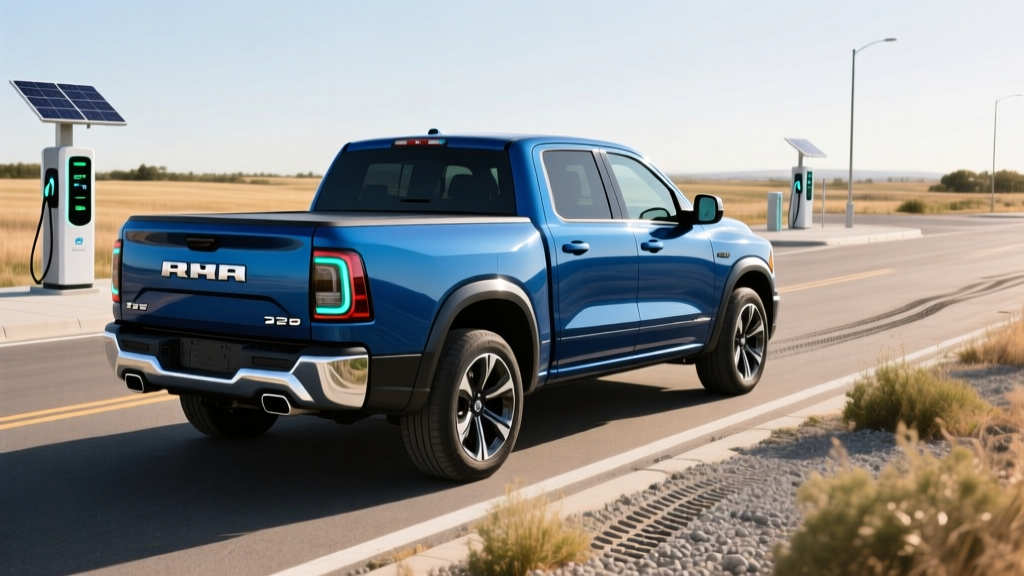
Quick Answer: Is the Ram 1500 REV Worth It?
The 2026 Ram 1500 REV is a full-size battery-electric pickup targeting up to 350 miles of EPA-estimated range (with the optional larger battery pack), up to 14,000 lbs of towing capacity, and a starting MSRP around $52,995 before incentives. It competes directly with the Ford F-150 Lightning and Chevrolet Silverado EV. The REV makes the most financial sense for buyers who can charge at home, drive under 300 miles daily, and qualify for the federal §30D tax credit (up to $7,500 at point of sale, subject to income, MSRP caps, and battery-sourcing rules). If you frequently tow heavy loads over long distances or live in a charging desert, a gas or hybrid Ram 1500 may still be the better fit.
What Is the Ram 1500 REV and Who Is It For?
The Ram 1500 REV is Stellantis's first battery-electric full-size pickup, built on the new STLA Frame platform. Unlike the Ford F-150 Lightning, which adapted an existing truck architecture, the REV uses a dedicated EV skateboard with a body-on-frame construction familiar to truck buyers. It arrives for the 2026 model year in multiple trims, from the work-oriented Tradesman to the luxury-oriented Laramie and Limited.
Ram has positioned the REV to address the two biggest concerns truck buyers voice about electric pickups: range under load and towing capability. The available dual-motor all-wheel-drive powertrain produces an estimated 654 horsepower and 620 lb-ft of torque, with a 0–60 mph time in the low-4-second range for higher trims.
The REV targets a specific buyer profile: homeowners or fleet operators with predictable daily routes, access to Level 2 or DC fast charging, and a need for truck utility without daily fuel costs. It is not designed as a long-haul towing rig for cross-country trips with a 10,000-lb trailer — no electric pickup currently excels at that use case.
Range, Battery, and Real-World Expectations
The Ram 1500 REV offers two battery configurations:
| Specification | Standard Battery (AWD) | Extended Battery (AWD) |
|---|---|---|
| Battery Capacity (usable) | ~168 kWh (est.) | ~229 kWh (est.) |
| Battery Chemistry | NMC (Nickel Manganese Cobalt) | NMC |
| EPA Range (Target) | ~230 miles | ~350 miles |
| Real-World Highway Range | ~180–200 miles | ~275–300 miles |
| Cold-Weather Range (20°F) | ~150–170 miles | ~230–260 miles |
| Towing Range (7,000-lb trailer) | ~110–140 miles | ~170–210 miles |
| Powertrain | Dual-motor AWD | Dual-motor AWD |
| Horsepower | 654 hp | 654 hp |
| Torque | 620 lb-ft | 620 lb-ft |
| Max Towing Capacity | Up to 14,000 lbs | Up to 14,000 lbs |
| Max Payload | Up to 2,700 lbs | Up to 2,600 lbs |
Real-World Range Reality Check
The EPA range sticker assumes a mix of city and highway driving at moderate temperatures with no payload. In practice:
- Highway driving at 75 mph: Expect 15–20% less range than the EPA sticker. The extended battery delivers roughly 275–300 real highway miles.
- Cold weather (below 30°F): Battery chemistry and cabin heating reduce range by 20–35%. Preconditioning while plugged in mitigates this significantly.
- Towing: Pulling a 7,000-lb travel trailer can cut range by 45–55%. Plan charging stops every 120–170 miles when towing.
- Charge curve taper: DC fast charging slows significantly above 80% state of charge (SoC). Plan to charge from 10–80% for the fastest sessions.
Charging Speeds and Infrastructure
The REV supports up to 350 kW peak DC fast charging on the extended battery pack, one of the highest peak rates in the electric truck segment. Ram has confirmed the truck will use the NACS (North American Charging Standard) connector, giving it native access to the Tesla Supercharger network — a significant infrastructure advantage over CCS-equipped competitors.
| Charging Level | Power (kW) | Estimated Miles Added/Hour | Typical Use Case |
|---|---|---|---|
| Level 1 (120V household) | ~1.4 kW | ~3–4 miles/hr | Emergency / overnight trickle |
| Level 2 (240V home, 48A) | ~11.5 kW | ~28–33 miles/hr | Daily home charging |
| Level 2 (240V, 80A) | ~19.2 kW | ~48–55 miles/hr | Faster home / depot charging |
| DC Fast (350 kW peak) | Up to 350 kW | 10–80% in ~30 min (ext. battery) | Road trips, quick top-ups |
Home charging reality: Most REV owners will want a Level 2 home charger (240V, 48-amp or higher circuit). A full charge on the extended battery at 11.5 kW takes roughly 20 hours from empty — fine for daily use since most drivers won't deplete the full pack. Installation costs typically range from $800 to $2,500 depending on your electrical panel capacity and the distance from panel to charger location. Homes with 100-amp service may need a panel upgrade ($1,500–$3,000+).
Vehicle-to-Home (V2H) and Vehicle-to-Load (V2L): The REV supports bidirectional charging, meaning it can power tools at a job site or provide backup power to your home during an outage. Ram advertises up to 7.2 kW of off-board power output.
EV Ram 1500 vs. Gas Ram 1500: Cost Breakdown
The core question for truck buyers is whether the higher upfront cost of the REV pays off through fuel and maintenance savings. Here's a five-year comparison based on 15,000 miles driven annually.
| Cost Category | 2026 Ram 1500 REV (AWD Tradesman) | 2026 Ram 1500 Gas (AWD Tradesman, 3.6L V6) |
|---|---|---|
| Base MSRP | ~$52,995 | ~$42,995 |
| Federal Tax Credit (§30D) | Up to $7,500 (if eligible) | $0 |
| Effective Purchase Price | ~$45,495 | ~$42,995 |
| Fuel/Energy Cost (5 yr, 75k mi) | ~$5,400 (home L2 at $0.14/kWh) | ~$11,250 (at $3.50/gal, 19 MPG combined) |
| Maintenance (5 yr) | ~$1,200 | ~$3,500 |
| Insurance (5 yr est.) | ~$9,000 | ~$7,500 |
| Estimated Depreciation (5 yr) | ~$22,000 | ~$18,000 |
| Total 5-Year Cost of Ownership | ~$83,095 | ~$83,245 |
Key takeaway: At current fuel and electricity prices, the REV's higher purchase price is nearly offset within five years by fuel and maintenance savings — especially if you qualify for the full $7,500 federal credit. The breakeven point shifts faster with higher gas prices or if you have access to free/cheap workplace charging. However, insurance costs tend to run 15–25% higher for EVs, and depreciation remains uncertain for newer EV truck models.
Federal Tax Credit and Incentive Eligibility
The Ram 1500 REV, as a domestically assembled vehicle, is positioned to qualify for the IRS §30D Clean Vehicle Credit — up to $7,500 available as a point-of-sale rebate (transferred to the dealer at purchase). However, eligibility is not automatic.
§30D Credit Requirements (2026 Tax Year)
- MSRP cap: Vans, SUVs, and pickup trucks must have an MSRP at or below $80,000. The REV's base trims qualify; fully loaded Limited trims may approach or exceed the cap.
- Buyer income limits: Modified adjusted gross income (MAGI) must not exceed $150,000 (single), $225,000 (head of household), or $300,000 (joint filers).
- Battery sourcing: A percentage of critical minerals and battery components must be sourced from the U.S. or free-trade-agreement countries. These thresholds tighten annually — verify current-year compliance on fueleconomy.gov before purchasing.
- Final assembly: Must occur in North America. The REV is assembled in the U.S., meeting this requirement.
- One-time use: The credit is limited to one vehicle per taxpayer per year (VIN-locked).
Always confirm eligibility with a tax professional and check the latest IRS qualified-vehicle list before signing a purchase agreement. Rules and sourcing requirements have changed multiple times since the Inflation Reduction Act took effect.
Common Misconceptions About the EV Ram 1500
| Myth | Fact |
|---|---|
| "Electric trucks can't tow anything useful." | The REV is rated for up to 14,000 lbs — comparable to many gas V8 configurations. The limitation is towing range, not towing capacity. |
| "The battery will need replacing in 5 years." | Ram backs the battery with an 8-year/100,000-mile warranty (minimum 70% capacity retention). NMC batteries in liquid-cooled packs typically retain 85–90% capacity at 100k miles based on industry data. |
| "Charging takes hours, so it's impractical." | Home Level 2 charging happens overnight while you sleep. DC fast charging adds 10–80% in roughly 30 minutes on a 350 kW station — enough time for a meal break. |
| "EVs are worse in cold weather." | Range drops 20–35% in sub-freezing temperatures, yes. But EVs start instantly in cold weather (no cranking), and preconditioning while plugged in minimizes range loss. The REV's heat pump (if equipped) further reduces cabin-heating energy draw. |
| "The power grid can't handle electric trucks." | Most REV charging occurs overnight during off-peak hours. A single Level 2 charger draws about the same as an electric oven. Smart charging and time-of-use rates manage grid load effectively. |
Ownership Considerations: Is the REV Right for Your Situation?
Beyond the spec sheet, real-world EV truck ownership depends on your specific circumstances. Here's what to evaluate honestly before ordering:
Home Charging Access
This is the single biggest factor in EV satisfaction. If you can install a Level 2 charger in your garage or driveway, the REV becomes a "wake up with a full tank" vehicle every morning. If you rely exclusively on public charging, the experience is less convenient and more expensive — public DC fast charging typically costs $0.30–$0.50/kWh versus $0.10–$0.16/kWh for home electricity. Renters and apartment dwellers should check whether their property offers EV charging or whether workplace charging is available.
Driving Patterns
The standard battery's ~230-mile EPA range comfortably covers most daily commutes and errands with a large buffer. The extended battery's ~350-mile range adds flexibility for longer regional trips. If you regularly drive 250+ miles one-way without a charging stop opportunity, a gas or hybrid truck remains more practical for now.
Climate
Buyers in northern states should budget for 20–35% winter range loss. Garage parking and preconditioning help significantly. The REV's large battery pack provides more absolute range buffer in cold weather than smaller EVs, but the physics of lithium-ion chemistry in cold temperatures apply to all BEVs.
Towing and Payload Frequency
If you tow a boat to the lake 10 times a year within 100 miles of home, the REV handles that easily. If you tow a 9,000-lb RV cross-country every summer, the charging-stop frequency (every ~130–170 miles towing) will add substantial trip time. For heavy, frequent, long-distance towing, a diesel or gas truck still wins on convenience.
Decision Framework: Should You Buy the Ram 1500 REV?
Choose the Ram 1500 REV if:
- You have reliable home Level 2 charging (or can install it)
- Your daily driving is under 250 miles
- You want to eliminate gas costs and reduce maintenance visits
- You tow locally or on short trips more often than cross-country
- You value instant torque, quiet operation, and V2L/V2H capability
- You qualify for the federal tax credit, narrowing the price gap
Stick with a gas or hybrid Ram 1500 if:
- You cannot install a home charger and lack workplace charging
- You regularly tow heavy loads over 200+ miles without convenient fast-charging stops
- You live in a region with sparse DC fast-charging infrastructure
- Your budget is firmly under $45,000 and you need a truck immediately
- You exceed the income caps for the §30D tax credit and the price premium is prohibitive
Warranty and Long-Term Battery Health
Ram provides the following coverage for the 1500 REV:
- Battery warranty: 8 years / 100,000 miles (guaranteeing minimum 70% state of health)
- Powertrain warranty: 5 years / 60,000 miles
- Bumper-to-bumper: 3 years / 36,000 miles
- Roadside assistance: 5 years / 60,000 miles
To maximize battery longevity, Ram recommends keeping state of charge between 20% and 80% for daily use and limiting DC fast charging to road trips. The liquid-cooled thermal management system actively protects the pack during high-power charging and extreme temperatures. For buyers concerned about long-term battery replacement costs, out-of-warranty NMC pack replacements for full-size EV trucks currently range from $15,000 to $25,000 — though costs are expected to decline as battery manufacturing scales.
Frequently Asked Questions
What is the real-world range of the Ram 1500 REV when towing?
Expect roughly 110–140 miles on the standard battery and 170–210 miles on the extended battery when towing a 7,000-lb trailer at highway speeds. Heavier trailers, headwinds, and hilly terrain reduce range further. Always plan charging stops conservatively when towing.
Does the Ram 1500 REV qualify for the $7,500 federal tax credit?
It is designed to qualify, but eligibility depends on your income (MAGI caps apply), the specific trim's MSRP (must be ≤$80,000 for trucks), and current-year battery-sourcing requirements. Check the IRS qualified vehicles list and consult a tax professional before purchasing.
Can I use Tesla Superchargers with the Ram 1500 REV?
Yes. The REV uses the NACS connector natively, giving it direct access to the Tesla Supercharger network — currently the largest and most reliable DC fast-charging network in the U.S. with over 25,000 stalls.
How much does it cost to charge the Ram 1500 REV at home?
A full charge on the extended battery (~229 kWh) at the national average residential electricity rate of ~$0.16/kWh costs approximately $36.64. For comparison, filling a gas Ram 1500's 26-gallon tank at $3.50/gallon costs $91. Most daily driving requires only a partial charge, costing a few dollars per day.
Is the Ram 1500 REV good for off-roading?
The REV offers all-wheel drive with torque vectoring, good ground clearance, and available off-road packages on certain trims. Electric motors provide instant low-speed torque that excels in technical off-road situations. However, off-roading consumes battery faster than highway driving, so plan range accordingly in remote areas without charging.
What happens if the battery fails out of warranty?
Complete battery failure is rare in liquid-cooled packs. More commonly, batteries gradually lose capacity over time (degradation). If a replacement is needed out of warranty, expect costs between $15,000 and $25,000 for a full-size truck pack. Individual module repairs may be cheaper. Third-party EV battery repair shops are emerging as a lower-cost alternative to dealer replacement.
How does the Ram 1500 REV compare to the Ford F-150 Lightning?
The REV targets a longer maximum range (~350 vs. ~320 miles for the Lightning's extended battery) and comparable towing capacity. The REV's NACS connector provides native Supercharger access, while the Lightning uses CCS (though adapters are available). Pricing is competitive, with both starting in the low-to-mid $50,000s. The Lightning has been on sale longer, giving it a more established track record and resale data. For a detailed comparison, see our EPA efficiency data for both models.