The Short Answer on the Ram 1500 REV
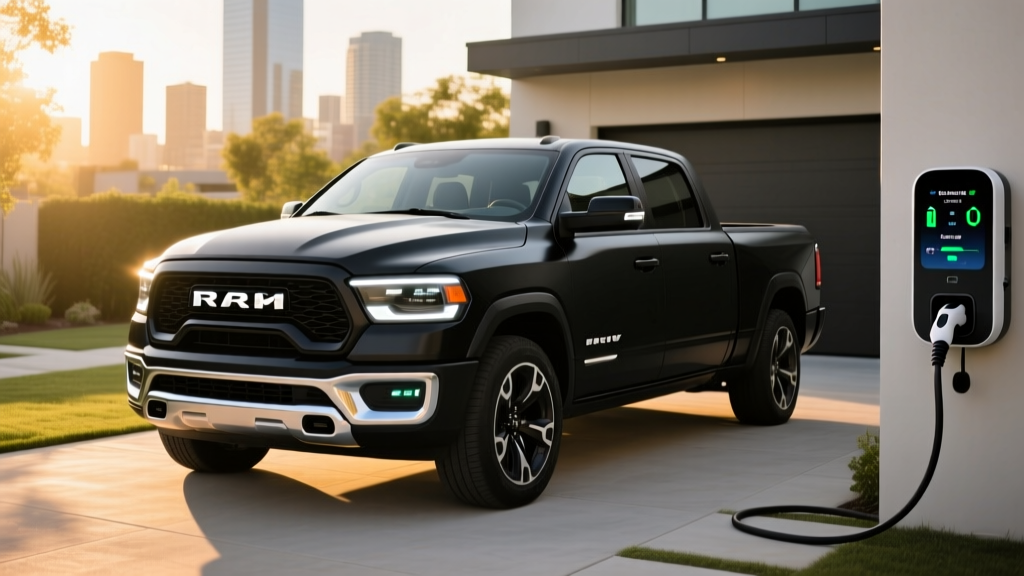
The 2026 Ram 1500 REV is not a battery-electric truck — it's an extended-range electric vehicle (EREV). Ram canceled the pure-BEV variant in late 2024 and pivoted the nameplate to the REV (Range Extended Vehicle), which pairs a battery-electric drivetrain with a 3.6-liter Pentastar V6 onboard generator. Targeted electric-only range is up to 145 miles on the larger battery pack, with total combined range exceeding 690 miles. The smaller pack targets 145 miles of EV range as well (final EPA certification pending). Starting MSRP is expected around $58,000 before destination, placing it squarely against the Ford F-150 PowerBoost hybrid, Toyota Tundra i-FORCE MAX, and Chevrolet Silverado EV. For buyers who want electric commuting without long-haul range anxiety, the REV is the most pragmatic full-size pickup solution on the market for 2026.
What Is the Ram 1500 REV — and Why It's Not a Pure EV
Ram's original plan was to launch a fully battery-electric 1500 with up to 500 miles of EPA range. That truck was shelved. What replaced it is an EREV architecture: the wheels are always driven by electric motors, but a gasoline engine acts solely as a generator to recharge the battery on the fly. Think of it as a massive Chevy Volt in a full-size truck body.
This distinction matters for buyers cross-shopping the segment:
- Pure BEV (e.g., Rivian R1T, Chevy Silverado EV): Zero tailpipe emissions, largest batteries, longest charge times, no gas backup.
- EREV (Ram 1500 REV): Electric daily driving with a gas generator for long trips; you still buy gasoline but far less of it.
- PHEV (Ford F-150 PowerBoost, Toyota Tundra hybrid): Gas engine directly drives the wheels with electric assist; shorter EV-only range (typically 20–40 miles).
The REV's architecture gives it a unique position: up to 145 miles of electric-only driving covers the vast majority of daily commutes and errands, while the onboard generator eliminates the range-anxiety penalty that pure EVs impose on road trips and towing.
Range, Battery, and Charging Specs
Ram has confirmed two battery pack sizes for the 1500 REV. Here are the preliminary specifications (final EPA figures expected closer to delivery):
| Spec | Standard Pack | Max Pack |
|---|---|---|
| Battery capacity (usable, est.) | ~92 kWh | ~173 kWh |
| EV-only range (target) | ~145 miles | ~145 miles* |
| Total range with generator | ~690 miles | ~690+ miles |
| DC fast charge peak rate | ~175 kW | ~175 kW |
| 10–80% DC charge time (est.) | ~28 min | ~55 min |
| Level 2 charge rate | 11.5 kW | 11.5 kW |
| Level 2 full charge time | ~8 hrs | ~15 hrs |
| Battery chemistry | NMC (est.) | NMC (est.) |
*The Max Pack's larger battery primarily extends generator-off range under heavy loads and towing rather than dramatically increasing EV-only miles in standard driving. Ram has not published final EPA breakdowns.
Real-World Range Reality Check
The 145-mile EV-only target is measured under ideal conditions. Expect the following adjustments in practice:
- Highway driving (70+ mph): ~110–125 miles EV-only before the generator kicks in.
- Cold weather (below 32°F): ~95–115 miles EV-only; lithium-ion batteries lose 15–30% efficiency in freezing temperatures.
- Towing/hauling: EV-only range drops sharply to ~60–80 miles depending on trailer weight; the generator will activate sooner.
The generator handoff is seamless — most drivers won't notice the transition. But if your goal is zero gasoline consumption, the REV only delivers that on shorter trips.
Performance and Powertrain Numbers
Because the REV's wheels are always driven by electric motors, it delivers the instant torque characteristic that makes EVs feel quicker than their horsepower numbers suggest:
| Spec | Figure |
|---|---|
| Drivetrain | Dual-motor AWD (standard) |
| Horsepower (combined) | ~654 hp |
| Torque | ~620 lb-ft |
| 0–60 mph | ~4.4 seconds |
| Max towing capacity | ~11,000 lbs (target) |
| Max payload | ~2,625 lbs (target) |
| Onboard generator | 3.6L Pentastar V6, ~130 kW output |
| ProPower-style outlet | Up to 7.2 kW onboard power (V2L capable) |
The 7.2 kW onboard power outlet is a standout feature for job-site and tailgate use — it can run power tools, a portable welder, or a full campsite setup without a separate generator. Ram calls this system RAMBOX Power, integrated into the bed rail storage.
Pricing, Trims, and Tax Credit Eligibility
The 2026 Ram 1500 REV is expected in five trims. Here's the projected pricing structure:
| Trim | Est. MSRP | Notes |
|---|---|---|
| Tradesman | ~$58,000 | Standard pack; fleet/work-oriented |
| Big Horn / Lone Star | ~$63,000 | Mid-tier; most popular retail trim |
| Laramie | ~$69,000 | Premium interior; available Max Pack |
| Limited | ~$79,000 | Fully loaded luxury |
| Tungsten | ~$87,000 | Top-of-line; Max Pack standard |
All prices are pre-destination (~$2,095) and before incentives.
Federal §30D Tax Credit — What REV Buyers Need to Know
The Ram 1500 REV qualifies as a plug-in hybrid/EREV under IRS rules, making it potentially eligible for up to $7,500 in federal tax credits. However, eligibility depends on several conditions that change annually. Per IRS clean vehicle credit guidelines:
- MSRP cap: Vans, SUVs, and pickups are capped at $80,000 MSRP. The Tungsten trim at ~$87,000 likely exceeds this cap; lower trims should qualify.
- Buyer income limits: AGI must not exceed $150,000 (single), $225,000 (head of household), or $300,000 (joint).
- Battery sourcing: Critical minerals and battery components must meet escalating domestic-content thresholds that tighten each year through 2030.
- Point-of-sale transfer: You can transfer the credit to the dealer for an immediate price reduction at purchase, or claim it on your tax return.
- Assembled in North America: Final assembly must occur in the U.S., Canada, or Mexico (Ram's Sterling Heights, MI plant qualifies).
Always consult a tax professional and verify current-year eligibility on irs.gov before purchase — rules and sourcing requirements shift annually.
Cost of Ownership: REV vs. Gas vs. Pure EV Trucks
The real question for truck buyers is whether the REV saves money over five years. Here's a comparison using the Ram 1500 REV Tradesman (~$58,000), a gas Ram 1500 Hemi V8 (~$48,000), and a Chevy Silverado EV (~$55,000). Assumptions: 15,000 miles/year, 70% of miles on EV-only mode, $3.40/gal gas, $0.16/kWh electricity.
| Category (5-Year) | Gas Ram 1500 | Ram 1500 REV | Silverado EV |
|---|---|---|---|
| Purchase price (MSRP) | $48,000 | $58,000 | $55,000 |
| Federal tax credit | $0 | Up to $7,500 | Up to $7,500 |
| Net purchase cost | $48,000 | $50,500 | $47,500 |
| Fuel/energy (5 yrs) | $12,750 | $5,100 | $3,600 |
| Maintenance (5 yrs) | $4,200 | $3,100 | $2,800 |
| Insurance (5 yrs, est.) | $9,500 | $10,800 | $10,200 |
| Total 5-Year Cost | $74,450 | $69,500 | $64,100 |
| Cost per mile | $0.99 | $0.93 | $0.85 |
Sources: fueleconomy.gov for gas truck MPG (19 combined); AAA maintenance averages; industry insurance estimates. Actual costs vary by state, driving habits, and electricity rates.
Key takeaway: The REV saves roughly $5,000 over five years compared to the gas Ram 1500, primarily through reduced fuel and maintenance costs. The Silverado EV saves more, but only if you never need the range flexibility a generator provides. If you tow frequently or drive in areas with sparse charging infrastructure, the REV's gas backup has tangible value that pure EVs can't match.
Real-World Ownership: What First-Time Buyers Must Consider
Home Charging Is (Mostly) Essential
The REV's 145-mile EV range is compelling only if you can recharge overnight. On a standard 120V outlet (Level 1), you'll recover roughly 4–5 miles of range per hour — meaning a full recharge of the standard pack takes nearly a full day. A Level 2 home charger (240V, 11.5 kW) is strongly recommended:
- Equipment cost: $400–$800 for a quality Level 2 charger (ChargePoint, Emporia, Wallbox).
- Electrical installation: $800–$2,500 for a dedicated 60A circuit, depending on panel proximity and local labor rates. Older homes may need a panel upgrade ($1,500–$3,500).
- Permit fees: $50–$250 depending on your municipality.
Total home-charging setup: $1,250–$6,550. If you can't install a home charger (apartment, street parking), the REV still works — you'll just burn more gasoline and rely on public Level 2 or DC fast chargers.
Cold-Weather Performance
The onboard generator is a major advantage in cold climates. Pure EVs can lose 20–40% of range in sub-freezing temperatures because the battery must power cabin heating. The REV's gas generator produces waste heat that can warm the cabin, reducing the efficiency penalty. Expect EV-only range to drop to ~95–115 miles in winter, but total range remains robust because the generator compensates.
Insurance and Depreciation
EVs and EREVs carry insurance premiums 15–25% higher than equivalent gas vehicles due to higher repair costs and battery replacement risk. Budget $200–$400 more per year. Depreciation data for the REV doesn't exist yet, but EREVs historically depreciate slightly faster than proven gas trucks in the first three years, then stabilize.
Common Misconceptions About the Ram 1500 REV
| Myth | Fact |
|---|---|
| "It's a fully electric truck with no gas engine." | It's an EREV with a 3.6L V6 onboard generator. You will buy gasoline for longer trips. |
| "The gas engine drives the wheels." | No — the V6 only generates electricity. Electric motors always drive the wheels. |
| "I'll never need to change oil." | The generator engine still requires oil changes, though less frequently than a conventional truck since it runs fewer hours. |
| "It qualifies for the full $7,500 tax credit automatically." | Credit depends on MSRP caps, buyer income, and battery-sourcing rules that change annually. Verify on irs.gov. |
| "I can tow my boat on electric power alone." | Towing dramatically reduces EV-only range to ~60–80 miles. The generator will run frequently under heavy loads. |
| "Level 2 charging is optional." | Without home Level 2, you'll burn significantly more gasoline and lose the primary economic benefit of the EREV architecture. |
Decision Framework: Is the Ram 1500 REV Right for You?
Choose the Ram 1500 REV If:
- Your daily commute and errands total under 100 miles and you have home Level 2 charging.
- You regularly take road trips of 300+ miles and don't want to plan around DC fast-charging stops.
- You tow occasionally but not daily — the generator handles long towing runs without range panic.
- You want EV-like instant torque and quiet operation for daily driving without the pure-EV infrastructure risk.
- You live in a region with cold winters where pure EV range loss is a genuine concern.
Choose a Gas or Hybrid Truck Instead If:
- You can't install a home charger and lack reliable public charging nearby.
- You tow heavy loads (8,000+ lbs) daily — the REV's EV range under load is limited, and you'll burn gas constantly anyway.
- Your budget is under $55,000 and you need a work truck now (the gas Ram 1500 Tradesman starts ~$40K).
Choose a Pure BEV Truck Instead If:
- You want zero gasoline purchases and zero tailpipe emissions in all driving scenarios.
- Your daily driving is under 250 miles and you have access to reliable DC fast charging for road trips.
- You want to minimize long-term maintenance (no gas engine = no oil changes, no spark plugs, no exhaust system).
Frequently Asked Questions
When will the Ram 1500 REV be available to buy?
Ram has targeted late 2025 for initial production, with broader retail availability in early-to-mid 2026. Reservation holders receive priority. Check ramtrucks.com for the latest delivery timeline, as EREV production schedules have shifted multiple times.
How much does it cost to charge the Ram 1500 REV at home?
At the U.S. average residential rate of ~$0.16/kWh, fully recharging the ~92 kWh standard pack costs roughly $14.70. That delivers ~145 miles of EV range, or about $0.10 per mile — roughly one-third the per-mile fuel cost of the gas Ram 1500 at $3.40/gallon and 19 MPG combined.
Does the REV's gas engine need premium fuel?
Ram specifies regular 87-octane unleaded for the 3.6L Pentastar generator engine. Since the engine operates primarily as a generator at optimized RPM ranges, fuel efficiency is better than the same engine in a conventional drivetrain.
What is the battery warranty?
Stellantis typically provides an 8-year/100,000-mile warranty on high-voltage battery packs for its electrified vehicles, covering defects and capacity loss below a specified threshold (typically 70% state of health). Final REV warranty terms will be confirmed at launch.
Can the Ram 1500 REV power my house during an outage?
The REV features up to 7.2 kW of onboard power via bed-mounted outlets (V2L — vehicle-to-load), which can run appliances, tools, and lighting. Full vehicle-to-home (V2H) bi-directional capability has not been confirmed for the REV at launch. The 7.2 kW output is sufficient for most job-site and emergency needs but won't power an entire home simultaneously like Ford's Pro Power Onboard with home integration.
How does the REV compare to the Ford F-150 PowerBoost hybrid?
The F-150 PowerBoost is a traditional parallel hybrid — the gas engine and electric motor both drive the wheels, and EV-only range is limited to roughly 25 miles at low speeds. The REV offers substantially more electric-only driving (145 miles vs. ~25 miles), making it far more efficient for daily commuting. However, the PowerBoost starts ~$10,000 lower and has a proven, mature powertrain with established reliability data. The REV is the better choice for buyers who want EV-daily and gas-backup; the PowerBoost suits buyers who want a conventional truck with modest efficiency gains.