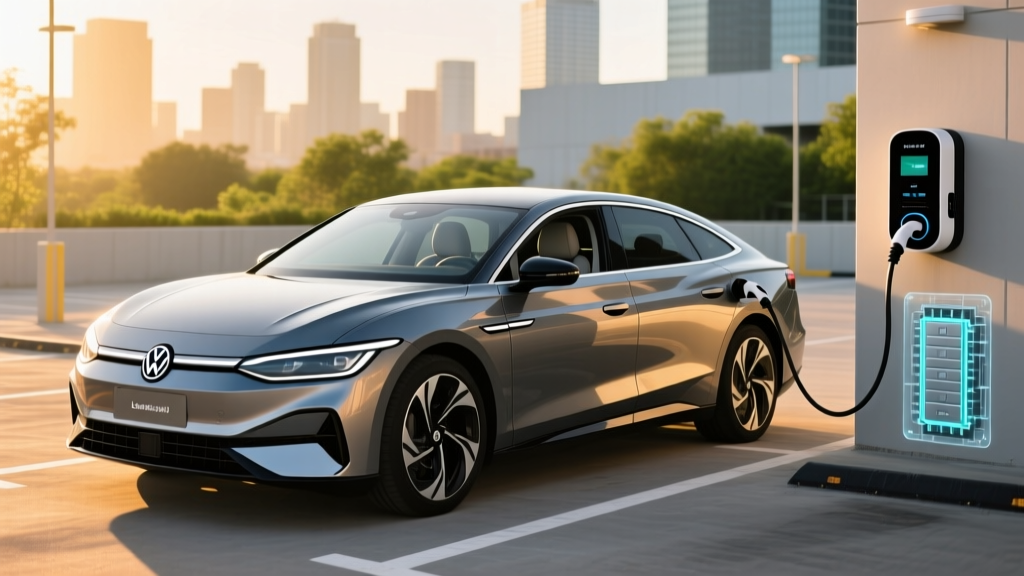
The Volkswagen ID.7 is VW's long-awaited answer to the electric midsize sedan segment — a spacious, aerodynamic EV designed to win back buyers who want a practical commuter and a competent road-tripper without stepping into an SUV. After years of anticipation following its global reveal, the ID.7 finally arrives on U.S. soil for the 2026 model year, slotting above the ID.4 crossover in VW's electric lineup and directly challenging the Tesla Model 3, Hyundai Ioniq 6, and BMW i4.
But how does it actually perform when you leave the spec sheet behind? We break down the real-world range, charging behavior, ownership economics, and daily-driving practicality of VW's flagship electric sedan.
2026 Volkswagen ID.7 at a Glance
| Spec | ID.7 Pro S (RWD) | ID.7 GTX (AWD) |
|---|---|---|
| EPA Range (est.) | ~362 miles | ~315 miles |
| Battery (usable) | 86 kWh (NMC) | 86 kWh (NMC) |
| Horsepower | 282 hp | 335 hp |
| Drivetrain | Rear-wheel drive | Dual-motor AWD |
| 0–60 mph | ~6.5 sec | ~5.2 sec |
| DC Fast Charge (peak) | 175 kW | 175 kW |
| 10–80% DC Time | ~26 min | ~26 min |
| Level 2 Charge Rate | 11 kW (~37 mi/hr) | 11 kW (~37 mi/hr) |
| Efficiency (est.) | ~112 MPGe / 30 kWh/100mi | ~98 MPGe / 34 kWh/100mi |
| Cargo Volume | ~19 cu ft (trunk) | ~19 cu ft (trunk) |
| Base MSRP | ~$49,990 | ~$55,490 |
| Battery Warranty | 8 yr / 100,000 mi | 8 yr / 100,000 mi |
Note: Specs reflect announced and estimated U.S.-spec figures for the 2026 model year. Final EPA certification numbers may vary slightly. Always verify at fueleconomy.gov before purchasing.
Range and Efficiency: The EPA Number vs. Reality
EPA Estimated: ~362 miles
Real-World Highway (70–75 mph): ~290–310 miles
Cold Weather (below 32°F, highway): ~240–270 miles
City/Mixed Driving: ~330–350 miles
The ID.7 Pro S achieves its impressive EPA range estimate thanks to a class-leading drag coefficient of approximately 0.23, a large 86 kWh usable battery pack, and VW's latest-generation APP550 electric motor on the rear axle. That combination yields an estimated efficiency of around 112 MPGe (roughly 30 kWh per 100 miles), which is competitive with the Hyundai Ioniq 6 and meaningfully better than most electric crossovers.
But here's what the EPA sticker doesn't tell you. Sustained highway driving at 75 mph pushes consumption up to roughly 34–36 kWh/100mi in our experience with similarly equipped MEB-platform vehicles, trimming real-world range to the 290–310 mile window. In freezing temperatures, the battery's internal resistance increases and cabin heating draws additional energy — even with the ID.7's standard heat pump, expect a 20–30% range reduction in deep-winter conditions.
The GTX all-wheel-drive variant trades roughly 45–50 miles of range for the traction and performance benefits of its dual-motor setup. If you live in a snowy climate or prioritize acceleration, the trade-off is defensible. If maximum range is your priority, the RWD Pro S is the clear pick.
Charging Speed: DC Fast Charging and Home Setup
The ID.7 uses the CCS1 connector standard and supports DC fast charging at up to 175 kW on a compatible station. Here's how that translates to real charging sessions:
| Charging Level | Power / Rate | Miles Added | Typical Use Case |
|---|---|---|---|
| Level 1 (120V) | ~1.4 kW | ~4–5 mi/hr | Emergency/overnight trickle |
| Level 2 (240V, 48A) | 11 kW | ~37 mi/hr | Home/work daily charging |
| DC Fast Charge | Peak 175 kW | ~190 mi in 20 min | Road-trip stops |
The charging curve matters more than the peak number. The ID.7 hits its 175 kW peak at a low state of charge (roughly 10–20% SoC) and sustains strong charging rates through about 50%, then begins tapering. The 10–80% session takes approximately 26 minutes at a capable 180+ kW charger — respectable, but not class-leading. The Hyundai Ioniq 6's 800V architecture can manage 10–80% in roughly 18 minutes, and the Tesla Model 3 on a V3/V4 Supercharger does it in about 20–22 minutes.
Above 80% SoC, charging slows dramatically to protect the NMC battery chemistry. Plan to charge only to 80% on road trips unless you need the final miles to reach your destination.
For home charging, the ID.7's 11 kW onboard charger is a strong point. On a properly installed 240V/48A Level 2 circuit, you'll add roughly 37 miles of range per hour — meaning a full overnight session (8–10 hours) easily replenishes the entire battery. Most owners will wake up to a full charge every morning. Budget $500–$1,500 for a quality Level 2 home charger installation, depending on whether your electrical panel needs an upgrade (a 200-amp panel is typically required for a 48A circuit).
Performance and Driving Dynamics
The ID.7 Pro S sends 282 horsepower to the rear wheels via VW's updated APP550 motor, which delivers improved torque density and efficiency over the earlier APP310 found in the ID.4. The 0–60 mph sprint takes approximately 6.5 seconds — not sports-sedan quick, but more than adequate for highway merging and daily driving. The instant torque delivery makes it feel quicker than the numbers suggest around town.
The GTX variant adds a front motor for a combined 335 hp and dual-motor all-wheel drive, dropping the 0–60 time to roughly 5.2 seconds. The AWD system also provides confidence in rain and snow, distributing torque front-to-rear as traction demands change.
Ride quality is where the ID.7 differentiates itself from sportier rivals. VW tunes the suspension for comfort — the sedan absorbs highway imperfections with a maturity that the Model 3 and Ioniq 6 can't quite match. Steering is light and precise, if not particularly communicative. This is a grand-touring EV, not a track car, and that's by design.
Regenerative braking offers multiple modes, including a B-mode for stronger regen and a coasting mode that lets the car freewheel for maximum efficiency. Unlike some competitors, VW does not offer true one-pedal driving to a complete stop — you'll still need the friction brakes at very low speeds.
Interior, Cargo, and Technology
The ID.7 rides on VW's stretched MEB platform with a wheelbase of approximately 116.5 inches, and that length shows up where it matters: rear-seat legroom is generous at around 39 inches, comfortably accommodating adults on long trips. The sedan's trunk offers roughly 19 cubic feet of cargo space, with a wide-opening lid and a flat load floor. A small front trunk (frunk) provides a few additional cubic feet for charging cables or a small bag.
The infotainment system runs VW's latest ID.Software 4.0 on a 15-inch touchscreen, a significant upgrade over the laggy, frustrating interface in early ID.4 models. Response times are noticeably improved, the menu structure is more logical, and wireless Apple CarPlay and Android Auto are standard. A new head-up display with augmented-reality navigation overlays projects turn-by-turn directions into the driver's sightline — a genuinely useful feature for highway driving.
VW's IQ.DRIVE suite of driver-assistance features comes standard and includes:
- Adaptive cruise control with stop-and-go
- Lane-keeping assist with centering
- Automatic emergency braking with pedestrian detection
- Blind-spot monitoring with rear cross-traffic alert
- Travel Assist (combined adaptive cruise + lane centering up to highway speeds)
VW's Travel Assist is a Level 2 driver-assistance system per SAE J3016 classification. It does not drive the car autonomously. You must keep your hands on the wheel (or demonstrate attentiveness via the capacitive steering wheel), monitor traffic, and be ready to take over immediately. It is not "self-driving."
The most common interior complaint with VW's ID. family has been the haptic-touch steering wheel controls and the capacitive climate slider bar beneath the touchscreen. These are carryover frustrations — the sliders are imprecise while driving, and the non-illuminated climate bar is hard to see at night. VW has reportedly made software adjustments to improve responsiveness, but the hardware remains a weak point compared to physical buttons.
Pricing, Trims, and Federal Tax Credit Eligibility
| Trim | Base MSRP | Est. After §30D Credit* | Key Features |
|---|---|---|---|
| Pro S (RWD) | ~$49,990 | ~$42,490 | 86 kWh battery, 15" screen, heat pump, IQ.DRIVE, 19" wheels |
| GTX (AWD) | ~$55,490 | ~$47,990 | Dual-motor AWD, sport suspension, 20" wheels, GTX styling |
*Tax credit estimates assume full $7,500 eligibility under IRS §30D. Actual eligibility depends on multiple factors — see checklist below.
The ID.7's pricing positions it in the premium mainstream — more expensive than a base Model 3 but less than a BMW i4 or Mercedes EQB. The Pro S at roughly $49,990 is the volume trim and the one most buyers should target for its maximum range and strong feature content.
- Vehicle MSRP cap: Sedans must be ≤ $55,000 (both ID.7 trims qualify)
- Buyer income cap: AGI ≤ $150,000 (single) / $300,000 (joint) / $225,000 (head of household)
- Battery sourcing: Critical minerals and battery components must meet phased-in percentage thresholds from U.S. or free-trade-agreement partners — verify current-year compliance on the vehicle's Monroney label or at fueleconomy.gov
- Point-of-sale transfer: Eligible buyers can transfer the credit to the dealer at purchase, reducing the purchase price upfront rather than waiting for a tax refund
- Final assembly: Vehicle must undergo final assembly in North America — verify via VIN at the IRS qualified vehicles list
Rules change frequently. Consult a tax professional and verify eligibility at irs.gov before purchasing.
The biggest tax-credit question for the ID.7 is battery sourcing. VW sources cells from suppliers including SK On, and compliance with critical-mineral and battery-component thresholds has been a moving target across the industry. Before committing to a purchase, confirm the specific VIN's eligibility — don't rely on a dealer's general assurance.
How It Compares: ID.7 vs. Key Rivals
| Spec | VW ID.7 Pro S | Tesla Model 3 LR | Hyundai Ioniq 6 SE LR |
|---|---|---|---|
| EPA Range | ~362 mi | ~363 mi | ~361 mi |
| Battery | 86 kWh (NMC) | ~79 kWh (NMC/NCA) | 77.4 kWh (NMC) |
| Peak DC Charge | 175 kW | ~250 kW | ~240 kW (800V) |
| 10–80% Time | ~26 min | ~22 min | ~18 min |
| 0–60 mph | ~6.5 sec | ~4.2 sec | ~5.1 sec |
| Base MSRP | ~$49,990 | ~$42,490 | ~$42,650 |
| Rear Legroom | ~39 in | ~35 in | ~37 in |
| Cargo | ~19 cu ft | ~23 cu ft | ~12.3 cu ft |
The ID.7 wins on rear-seat comfort, ride quality, and interior spaciousness. It loses on price, DC fast-charge speed, and outright acceleration. If you prioritize a smooth, quiet highway cruiser with generous passenger space, the ID.7 has no direct rival in its class. If you want the fastest charging and the lowest entry price, the Model 3 and Ioniq 6 are harder to beat.
The Supercharger network advantage for Tesla remains a factor for road-trippers, though VW's partnership with Electrify America and growing NACS adapter availability are narrowing the infrastructure gap heading into 2026.
Warranty and Long-Term Ownership
VW covers the ID.7's battery pack for 8 years or 100,000 miles (whichever comes first), with a capacity retention threshold of 70%. If the battery degrades below 70% of its original usable capacity within the warranty period, VW will repair or replace it. The vehicle's limited warranty covers 4 years/50,000 miles.
The 86 kWh NMC battery is liquid-cooled with active thermal management, which is essential for longevity — especially if you DC fast-charge regularly. Based on degradation data from VW's MEB-platform vehicles in Europe (ID.3 and ID.4), early indications show roughly 5–8% capacity loss over the first 60,000 miles, which is in line with industry averages. Long-term data for the APP550 motor and updated battery modules will take a few more years to mature.
Insurance costs for the ID.7 are likely to run 15–25% higher than a comparable gas-powered midsize sedan, consistent with EV insurance premiums industry-wide. Get quotes before purchasing — your mileage (literally) will vary by state, driving record, and insurer.
Pros, Cons, and the Verdict
- Class-leading rear-seat legroom and ride comfort
- Excellent EPA range (~362 mi) and efficiency
- Strong 11 kW Level 2 onboard charger
- Heat pump standard (cold-weather efficiency)
- Improved ID.Software 4.0 infotainment
- AR head-up display is genuinely useful
- DC fast-charge speed (175 kW) trails rivals
- Higher base price than Model 3 and Ioniq 6
- Capacitive climate sliders remain frustrating
- No true one-pedal driving to a full stop
- Tax credit eligibility depends on battery sourcing verification
- No frunk of meaningful size
Who should buy the ID.7? This is the EV for the buyer who values comfort over cornering, space over sportiness, and refinement over raw speed. If you commute 40+ miles daily, carry rear-seat passengers regularly, and want a sedan that feels like a traditional premium car rather than a tech gadget, the ID.7 Pro S is the strongest choice in its class. Road-trippers will appreciate the 362-mile range but should plan charging stops around the 26-minute 10–80% curve.
Who should look elsewhere? If DC fast-charge speed is your top priority (frequent long-distance driving on tight schedules), the Ioniq 6's 800V system and 18-minute 10–80% time are hard to beat. If you want the lowest price and best charging network access, the Tesla Model 3 Long Range remains the default. If you need maximum cargo space, a hatchback or crossover will serve you better than any sedan.
Frequently Asked Questions
What is the real-world range of the Volkswagen ID.7?
The EPA estimates approximately 362 miles for the Pro S RWD trim. In real-world highway driving at 70–75 mph, expect 290–310 miles. In cold weather below freezing, plan for 240–270 miles. City and mixed driving with moderate regen use can approach the EPA figure.
How fast does the ID.7 charge at home and on the road?
At home on a 240V Level 2 charger, the ID.7 charges at 11 kW, adding about 37 miles of range per hour — a full charge takes roughly 8–9 hours. On a DC fast charger, it peaks at 175 kW and charges from 10–80% in approximately 26 minutes, which is adequate but slower than the Ioniq 6 or Model 3.
Does the Volkswagen ID.7 qualify for the $7,500 federal tax credit?
It can, but eligibility is not guaranteed. Under IRS §30D, the ID.7's MSRP is under the $55,000 sedan cap, but you must also meet buyer income limits ($150K single / $300K joint), the vehicle must pass battery-sourcing and critical-mineral requirements, and final assembly must be in North America. Verify your specific VIN's eligibility at fueleconomy.gov and consult a tax professional.
Is the ID.7 worth buying over the Tesla Model 3 or Hyundai Ioniq 6?
It depends on your priorities. The ID.7 offers the best rear-seat comfort, the smoothest ride, and excellent range. The Model 3 wins on price, acceleration, Supercharger access, and charging speed. The Ioniq 6 wins on DC fast-charge speed and value. If passenger comfort and ride refinement matter most, the ID.7 is the strongest pick.
What battery chemistry does the ID.7 use?
The ID.7 uses an NMC (nickel manganese cobalt) lithium-ion battery with a usable capacity of approximately 86 kWh. NMC offers higher energy density than LFP chemistry, which is why VW can fit a large battery into the sedan's footprint while maintaining competitive weight.
Does the ID.7 have all-wheel drive?
Yes — the GTX trim adds a front motor for dual-motor all-wheel drive and 335 hp, at the cost of roughly 45 miles of range and a ~$5,500 price premium over the RWD Pro S.