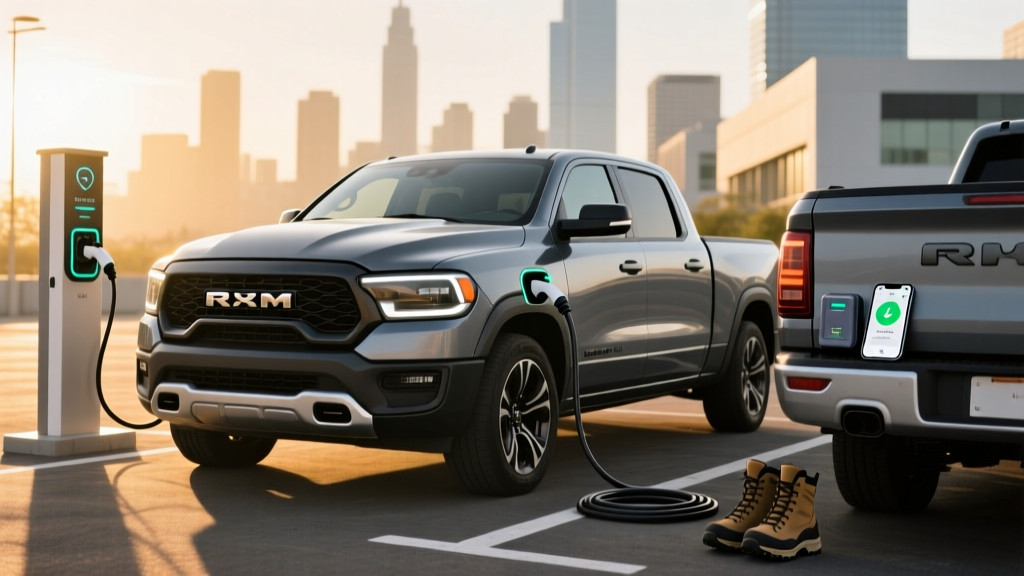
The electric pickup segment has no shortage of fully battery-electric options, but the 2026 Ram 1500 REV takes a different path. Instead of committing to a massive battery and hoping the charging infrastructure catches up, Ram offers an Extended Range Electric Vehicle (EREV) variant that pairs a 92 kWh battery pack with an onboard 3.6-liter Pentastar V6 generator. The result is a truck that drives like an EV for daily commuting—silent, instant torque, zero tailpipe emissions on battery power—while eliminating range anxiety on long hauls and job-site duty. If you've been searching for EREV cars that can genuinely replace a full-size gas truck without compromise, the Ram 1500 REV EREV demands a serious look.
This review covers the EREV variant specifically (Ram also sells a pure BEV version with up to 355 miles of EPA range). We'll break down the real-world range you can expect, charging speeds that surprise in both directions, the nuanced federal tax credit picture, and whether this truck earns its spot in your driveway over the Ford F-150 Lightning or Chevrolet Silverado EV.
Quick Verdict: Who the Ram 1500 REV EREV Is For
The Ram 1500 REV EREV targets a specific buyer: someone who wants electric daily driving with the security of a gas range-extender for road trips, towing, or remote work sites where charging is sparse. It's not a compliance vehicle. It's a pragmatic bridge between full electrification and the reality that America's DC fast-charging network still has gaps—especially for truck owners who tow or drive rural routes.
- You drive 40-80 miles daily and can charge at home overnight
- You tow or take road trips where DC chargers are unreliable or absent
- You want EV torque and quiet operation without range anxiety
- You need a full-size truck bed and 10,000-lb towing capacity
- You want zero gasoline use (the BEV Ram 1500 REV or F-150 Lightning may suit better)
- You primarily drive in urban areas with robust public charging
- You want the lowest possible purchase price (the EREV starts higher than gas equivalents)
Range & Efficiency: EPA Numbers vs. Real-World Reality
The Ram 1500 REV EREV carries a 92 kWh usable battery (NMC lithium-ion chemistry) that delivers an EPA-estimated 110 miles of pure electric range before the onboard 3.6L V6 generator kicks in. Once the battery depletes to its buffer threshold, the generator charges the battery while you drive, extending total range to an EPA-estimated 690 miles combined.
EPA Electric-Only: 110 miles
Expect in real-world driving: 85–100 miles electric (highway speeds above 70 mph reduce range by ~15–20%). In cold weather (below 30°F), expect 70–85 miles electric due to battery chemistry limitations and cabin heating demand.
EPA Total (EV + Generator): 690 miles
Real-world total: 580–640 miles depending on terrain, speed, and climate control usage.
Efficiency on battery power is rated at 2.0 kWh/mile (50 MPGe combined), which is competitive for a full-size electric truck. When running on the generator, fuel economy drops to approximately 18–20 MPG combined—better than most gas-only half-ton trucks under load, but not Prius territory. The generator runs at optimized RPM for efficiency rather than responding directly to throttle input, which helps.
| Metric | Value |
|---|---|
| EPA Electric Range | 110 miles |
| EPA Total Range (EV + Generator) | 690 miles |
| Battery Capacity (Usable) | 92 kWh (NMC) |
| Electric Efficiency | 2.0 kWh/mile (50 MPGe) |
| Generator Fuel Economy | ~18–20 MPG combined |
| Fuel Tank Capacity | 26 gallons |
| Cold-Weather Electric Range (est.) | 70–85 miles |
Charging Speed: DC Fast Charge and Home Level 2
The Ram 1500 REV EREV supports DC fast charging at up to 50 kW peak—a figure that raises eyebrows given the 145+ kW capability of the pure BEV variant. The lower charge rate reflects the smaller battery and the EREV's design philosophy: this truck is built to generate its own range extension on the go, so ultra-fast public charging is less critical.
On a 50 kW DC fast charger, expect a 10–80% charge in approximately 45 minutes. That's leisurely by modern EV standards, but consider the use case: if you're on a road trip, the generator eliminates the need for charging stops entirely. If you're topping up at a grocery store charger, 50 kW adds roughly 30 miles of electric range in 20 minutes.
For home charging, the onboard AC charger accepts up to 11.5 kW on Level 2 (240V), which replenishes the full 92 kWh battery in about 9.5 hours. That means an overnight charge is easily achievable on a home Level 2 wall connector. Ram includes a dual-level charging cord (Level 1 at 120V and Level 2 at 240V with the appropriate outlet), though most buyers will want a dedicated wall unit for daily convenience.
| Charging Level | Power | Speed / Time | Connector |
|---|---|---|---|
| Level 1 (120V) | ~1.3 kW | ~3 mi/hr (70+ hrs full) | NACS (Tesla-style) |
| Level 2 (240V) | 11.5 kW | ~25 mi/hr (~9.5 hrs full) | NACS |
| DC Fast Charge | 50 kW peak | 10–80% in ~45 min | NACS (Supercharger compatible) |
Charging curve note: The 50 kW peak rate is sustained from roughly 10–55% State of Charge, then tapers to approximately 30 kW through 80%, and further to under 15 kW above 90%. This taper is standard for NMC chemistry to protect battery longevity, but it means the last 20% of a DC fast charge takes disproportionately long. For daily driving, charging to 80% at home overnight is the practical sweet spot.
Ram has adopted the NACS (North American Charging Standard) connector, meaning the REV EREV has native access to Tesla Supercharger stations—a significant infrastructure advantage over CCS-equipped trucks that require adapters. See Ram's official REV page for the latest charging specifications.
Performance: Torque, Towing, and the EREV Drivetrain
The Ram 1500 REV EREV uses a dual-motor all-wheel-drive setup producing 654 horsepower and 620 lb-ft of torque. The 0–60 mph sprint takes an estimated 4.4 seconds—impressive for a 6,800-lb truck, and a reminder that electric motors deliver peak torque from zero RPM.
The 3.6-liter Pentastar V6 generator produces 175 kW of electrical output but does not drive the wheels directly. This series-hybrid architecture means the driving experience is purely electric at all times: smooth, linear acceleration with no transmission shifts. The generator starts automatically when the battery reaches its buffer (approximately 15% State of Charge) or when the driver selects "eSave" mode to preserve battery for a specific destination (useful for entering zero-emission zones or quiet campgrounds).
Towing capacity is rated at 10,000 pounds with the proper equipment package, and payload capacity reaches 1,800 pounds. When towing near max capacity, expect electric-only range to drop to 40–55 miles before the generator engages. Fuel economy while towing heavy loads on generator power drops to approximately 12–14 MPG—typical for the segment under load.
| Metric | Value |
|---|---|
| Drivetrain | Dual-motor AWD |
| Horsepower | 654 HP |
| Torque | 620 lb-ft |
| 0–60 mph | 4.4 seconds (est.) |
| Max Towing Capacity | 10,000 lbs |
| Max Payload | 1,800 lbs |
| Generator Engine | 3.6L V6 Pentastar (175 kW output) |
Interior, Cargo, and Technology
The Ram 1500 REV EREV shares its interior architecture with the redesigned fifth-generation Ram 1500, which means class-leading materials and a tech-forward cabin. The centerpiece is a 14.5-inch infotainment touchscreen running Stellantis' Uconnect 5 system, with an available 10.25-inch passenger-side display and a 12.3-inch digital instrument cluster.
Cargo space remains uncompromised by the EREV powertrain. The 5-foot-7 bed (standard on Crew Cab) offers 61.5 cubic feet of volume, and Ram includes a front trunk (frunk) with approximately 15 cubic feet of lockable storage—useful for tools, charging cables, or groceries. The frunk includes a 120V outlet for job-site power.
Passenger space in the Crew Cab is generous: 40.9 inches of front legroom and 45.2 inches of rear legroom, making the back seat genuinely comfortable for adults on long trips. Rear-seat passengers also get available heated and ventilated seats, USB-C ports, and a dedicated climate zone.
Driver-assistance technology includes Ram's Active Driving Assist (SAE Level 2), which provides hands-on lane centering and adaptive cruise control on highways. This is not autonomous driving—the driver must remain engaged and hands on the wheel at all times. Available features also include a digital rearview mirror, 360-degree camera system, and trailer reverse steering assist, which is invaluable when backing a 25-foot trailer into a campsite.
Notable drawback: The Ram 1500 REV EREV does not currently offer hands-free Level 2+ driving (like GM's Super Cruise or Ford's BlueCruise). Ram's Active Driving Assist requires hands-on-wheel contact, which some competitors have surpassed with eye-monitoring systems that allow hands-free operation on mapped highways.
Pricing, Trims, and Federal Tax Credit Eligibility
The 2026 Ram 1500 REV EREV starts at a base MSRP of $58,095 (Tradesman trim, before destination charge of $2,095). Well-equipped models in Laramie or Limited trims can reach $78,000–$85,000 before options.
| Trim Level | Base MSRP | Est. After §30D Credit* |
|---|---|---|
| Tradesman | $58,095 | $50,595 |
| Big Horn / Lone Star | $63,495 | $55,995 |
| Laramie | $70,095 | $62,595 |
| Limited | $84,995 | $77,495 |
*Tax credit estimates assume full $7,500 eligibility under IRS §30D. Actual credit depends on buyer income, battery component sourcing, and MSRP caps. Consult a tax professional.
The Ram 1500 REV EREV may qualify for up to $7,500 in federal tax credits, but eligibility is not automatic. Key requirements per IRS guidelines:
- MSRP Cap: Vans, SUVs, and pickup trucks must have an MSRP at or below $80,000. Tradesman, Big Horn, and Laramie trims qualify; the Limited trim ($84,995) exceeds the cap and is ineligible.
- Buyer Income Cap: Modified adjusted gross income (MAGI) must not exceed $150,000 (single), $225,000 (head of household), or $300,000 (joint filers).
- Battery Sourcing: The vehicle must meet critical mineral and battery component requirements that phase in stricter thresholds each year. Ram has confirmed North American battery assembly for the REV, but final critical-mineral sourcing compliance for 2026 should be verified on the DOE's fueleconomy.gov tax credit page before purchase.
- Point-of-Sale Transfer: Eligible buyers can transfer the credit to the dealer at purchase, reducing the sale price directly rather than waiting for a tax refund.
EREV Classification Note: Under §30D, the Ram 1500 REV EREV qualifies as a plug-in hybrid electric vehicle (PHEV) because it has both a battery and an onboard generator. It must still meet the same 7 kWh minimum battery capacity requirement (it exceeds this at 92 kWh). Confirm eligibility with your dealer and tax advisor at time of purchase, as sourcing rules tighten annually.
Warranty and Long-Term Ownership
Ram backs the 1500 REV EREV with a competitive warranty package. The battery pack is covered for 8 years or 100,000 miles (whichever comes first), with a capacity retention threshold of 70%—meaning if the battery degrades below 70% of its original 92 kWh capacity within the warranty period, Ram will repair or replace it. The 3.6L generator engine and power electronics carry the same 8-year/100,000-mile coverage.
The basic vehicle warranty is 3 years/36,000 miles (bumper-to-bumper), with a 5-year/60,000-mile powertrain warranty covering the drive motors, transmission, and structural components. Roadside assistance is included for 5 years/60,000 miles.
For long-term ownership cost context, Ram estimates annual maintenance savings of $800–$1,200 compared to a gas-only Ram 1500, thanks to regenerative braking (less brake pad wear), no oil changes for the electric drivetrain, and fewer moving parts. The generator engine does require standard maintenance (oil changes, spark plugs, air filter) but runs significantly fewer hours than a conventional truck engine since it only activates when the battery depletes.
Pros and Cons: The Honest Assessment
- 690 miles total range eliminates range anxiety for towing and road trips
- 654 HP and instant electric torque deliver thrilling acceleration for a full-size truck
- 110 miles of EV range covers most daily commutes on battery alone
- Native NACS connector grants Tesla Supercharger access without adapters
- Class-leading interior quality and tech with 14.5-inch display
- 10,000-lb towing capacity matches gas Ram 1500 capability
- Frunk with 120V outlet adds job-site utility
- 50 kW DC fast charging is slow compared to BEV rivals (F-150 Lightning: 150 kW+)
- Generator adds weight (~300 lbs more than BEV variant) and mechanical complexity
- Still uses gasoline—defeats the purpose for buyers seeking zero tailpipe emissions
- Limited trim ($84,995) exceeds $80K MSRP cap, disqualifying from §30D tax credit
- No hands-free Level 2+ driving assist (trails Ford BlueCruise and GM Super Cruise)
- Fuel economy on generator power (~18–20 MPG) is modest, not transformative
- Higher base price than equivalent gas Ram 1500 by $15,000+
How It Compares: Ram 1500 REV EREV vs. Key Rivals
| Attribute | Ram 1500 REV EREV | Ford F-150 Lightning (Ext. Range) | Chevy Silverado EV (4WT) |
|---|---|---|---|
| Powertrain | EREV (Battery + V6 Generator) | BEV (Battery only) | BEV (Battery only) |
| EPA Electric Range | 110 mi (690 total) | 320 mi | 380 mi |
| Battery Capacity | 92 kWh | 131 kWh | 200+ kWh |
| DC Fast Charge (Peak) | 50 kW | 150 kW | 350 kW |
| 0–60 mph | 4.4 sec | 3.8 sec | 4.5 sec |
| Max Towing | 10,000 lbs | 10,000 lbs | 10,000 lbs |
| Base MSRP | $58,095 | $59,995 | $59,900 |
| Hands-Free L2+ Driving | No | Yes (BlueCruise) | Yes (Super Cruise) |
| Native NACS Connector | Yes | Yes (2025+) | Yes (2025+) |
Bottom line on competition: If you drive in areas with robust DC charging infrastructure and want zero gasoline use, the F-150 Lightning Extended Range or Silverado EV are strong BEV alternatives with faster charging and longer electric range. But if your routes take you through charging deserts, you tow frequently, or you simply want the security blanket of an onboard generator, the Ram 1500 REV EREV occupies a unique position among EREV cars and trucks as the only full-size pickup offering this powertrain configuration.
Frequently Asked Questions
What exactly is an EREV, and how does it differ from a plug-in hybrid?
An Extended Range Electric Vehicle (EREV) like the Ram 1500 REV EREV uses an onboard gasoline engine solely as a generator to charge the battery—it never directly drives the wheels. This differs from a conventional plug-in hybrid (PHEV) like the Toyota RAV4 Prime, where the gas engine can both charge the battery and mechanically drive the wheels. The EREV architecture delivers a pure electric driving experience at all times, with the generator acting as a mobile power plant when the battery depletes.
Can I drive the Ram 1500 REV EREV without ever using gasoline?
Yes—if your daily driving stays within the 85–110 mile electric range and you charge at home every night, you could go weeks or months without the generator activating. The truck will prompt you to run the generator periodically (approximately every 30 days) to exercise the engine and prevent fuel degradation, but this uses minimal gasoline. For zero-gasoline driving, consider the pure BEV Ram 1500 REV variant instead.
How much does home charging cost compared to gasoline?
At the national average electricity rate of $0.17/kWh, fully charging the 92 kWh battery costs approximately $15.64, delivering 85–110 miles of range. That works out to roughly $0.15–$0.18 per mile on electricity. Compare that to gasoline at $3.40/gallon and 18 MPG (generator mode), which costs approximately $0.19 per mile. The savings are modest on a per-mile basis, but the daily driving experience on battery power is noticeably smoother and quieter. Home solar or time-of-use electricity rates can further reduce charging costs.
Does the Ram 1500 REV EREV qualify for the $7,500 federal tax credit?
It may, depending on your income, the specific trim's MSRP, and current battery-sourcing rules. Trims at or below $80,000 MSRP (Tradesman, Big Horn, Laramie) meet the price cap. Your MAGI must fall under IRS thresholds ($150K single, $300K joint). Battery critical-mineral and component sourcing rules must also be satisfied—verify current eligibility on fueleconomy.gov and consult a tax professional before relying on the credit.
What happens if the generator breaks—can I still drive the truck?
If the 3.6L generator fails, the truck can still operate on battery power alone until the battery depletes, at which point it will need to be towed or charged. This is no different from a BEV running out of charge. The generator is covered under the 8-year/100,000-mile powertrain warranty, and the Pentastar V6 is one of Stellantis' most proven engines with millions of units in service, reducing the likelihood of major failure.
Is the Ram 1500 REV EREV worth buying over a gas Ram 1500?
It depends on your priorities. The EREV costs approximately $15,000–$20,000 more than a comparably equipped gas Ram 1500, but delivers dramatically better acceleration, quieter daily driving, lower fuel costs for commutes under 110 miles, and the ability to power tools or appliances via the frunk's 120V outlet. If you drive 15,000+ miles annually and can charge at home, the payback period (after tax credits) is approximately 6–8 years on fuel savings alone. If you drive less or cannot install home charging, the gas Ram 1500 remains the more economical choice.