Quick Verdict: The Ram 1500 REV at a Glance
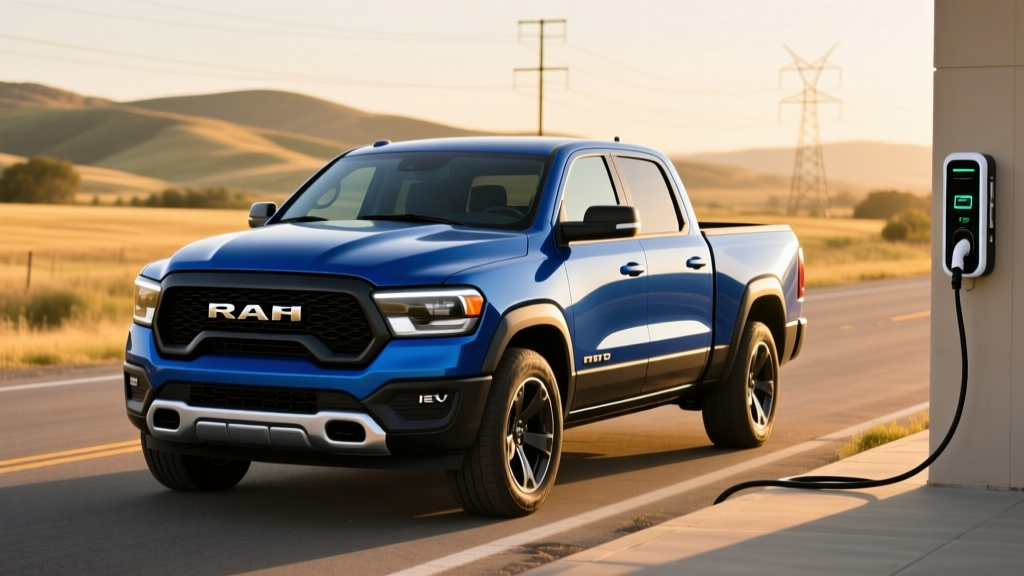
The 2026 Ram 1500 REV is Stellantis's long-awaited answer to the Ford F-150 Lightning, Chevrolet Silverado EV, and Rivian R1T. Built on the dedicated STLA Frame platform, it pairs a dual-motor all-wheel-drive powertrain with a massive battery pack and a class-leading payload proposition. After months of delays from its original late-2024 target, the REV is now reaching driveways — and the question for buyers is whether the wait produced a truck that justifies its premium positioning.
Spoiler: it's a serious contender for buyers who prioritize range and interior tech, but its charging speed and weight draw legitimate scrutiny against the more established Lightning. Here's every number that matters.
| Spec | Value |
|---|---|
| EPA Range (Standard Pack) | ~350 miles |
| EPA Range (Max Pack) | ~500 miles (est.) |
| Battery Capacity (Standard) | ~168 kWh usable (NMC) |
| Battery Capacity (Max) | ~229 kWh usable (NMC) |
| Drivetrain | Dual-motor AWD |
| Horsepower | 654 hp |
| Torque | 620 lb-ft |
| 0–60 mph | ~4.4 seconds |
| Max DC Fast Charge | 150 kW (Standard) / 150 kW (Max) |
| 10–80% DC Charge Time | ~45 min (Standard) |
| Level 2 Home Charge Rate | 11.5 kW (~25 mi/hr) |
| Towing Capacity | Up to 14,000 lbs (Max Pack) |
| Payload | Up to 2,700 lbs |
| Base MSRP | $58,095 (Tradesman) |
| Battery Warranty | 8 years / 100,000 miles |
Range and Efficiency: EPA Sticker vs. Reality
The Ram 1500 REV Standard Pack targets an EPA-estimated 350 miles of range, while the Max Pack variant aims for a headline-grabbing 500 miles. Those numbers place it at the top of the electric truck segment on paper — the F-150 Lightning Extended Range tops out at 320 miles, and the Silverado EV 4WT hits 440 miles.
EPA 350 miles (Standard Pack) is measured under mixed city/highway conditions at moderate temperatures. In practice, expect:
- Highway-only (70–75 mph): ~280–310 miles. The REV's boxy aerodynamics and 7,000+ lb curb weight work against it at sustained speed.
- Cold weather (below 30°F): ~240–270 miles. NMC chemistry loses roughly 20–30% range in freezing conditions, even with the REV's heat pump and battery preconditioning.
- Towing (5,000+ lb trailer): ~150–180 miles. Electric trucks lose roughly 50% of range under heavy tow loads — physics, not a Ram flaw.
- City/commuter driving: 350+ miles is achievable thanks to regenerative braking recovery.
The Max Pack's 500-mile claim, if EPA-confirmed, would make it the longest-range EV sold in the U.S. But real-world highway and cold-weather figures will likely land closer to 380–420 miles — still exceptional, but manage expectations.
Efficiency is rated around 70 MPGe combined (approximately 48 kWh/100 miles) for the Standard Pack. That's thirstier than the F-150 Lightning (~70 MPGe / 43 kWh/100mi) owing to the REV's greater mass. For a truck this size, it's competitive — but efficiency-minded buyers should note that every kilowatt-hour in a 168 kWh pack costs real money to replenish.
Charging Speed: The REV's Most Debated Spec
Charging capability is where the Ram 1500 REV draws its most pointed criticism. The Standard Pack supports a peak DC fast-charge rate of approximately 150 kW, and the Max Pack is expected at a similar ceiling. Ram has not published a sustained charge curve, which matters more than peak numbers.
| Charge Level | Power | Speed (Approx.) | Notes |
|---|---|---|---|
| Level 1 (120V household) | ~1.4 kW | ~3 mi/hr | Emergency/trickle only; full recharge takes days |
| Level 2 (240V home, 48A) | 11.5 kW | ~25 mi/hr | Full Standard Pack charge in ~15 hours |
| DC Fast Charge (peak) | 150 kW | ~170 mi in 30 min | 10–80% in ~45 min (Standard Pack) |
Here's the context buyers need: a 168 kWh battery at 150 kW peak will not charge quickly by modern EV standards. The Hyundai Ioniq 5, with its 800V architecture and 77.4 kWh pack, hits 10–80% in 18 minutes at 240 kW. The F-150 Lightning Extended Range (131 kWh) charges 15–80% in roughly 41 minutes at 150 kW. The REV's larger battery means more time at the plug.
Charge curve taper is critical. Like all lithium-ion packs, the REV's charge rate will drop significantly above 80% State of Charge (SoC). Ram has not disclosed the taper profile, but expect sustained rates closer to 80–100 kW through the middle of the curve. On a road trip, plan for 45–55 minute stops every 250–280 highway miles.
For home charging, the 11.5 kW onboard charger is solid. A 48-amp Level 2 wall connector on a 60-amp circuit adds roughly 25 miles per hour — enough to fully replenish overnight for most commuters. Installation costs for a Level 2 home setup typically run $800–$2,000 depending on panel capacity and conduit distance; a 200-amp panel upgrade can add $1,500–$3,000.
Performance and Capability
The dual-motor AWD powertrain delivers 654 horsepower and 620 lb-ft of torque, launching the REV to 60 mph in approximately 4.4 seconds. That's brisk for a full-size truck — roughly on par with the F-150 Lightning Lariat (563 hp, 4.0 sec with the smaller battery) and well ahead of any gas V-6 in the segment.
Instant electric torque gives the REV a distinctive feel off the line and when merging, but the truck's substantial weight (likely 7,200–7,800 lbs depending on pack) is noticeable in corners and during braking. Regenerative braking is adjustable through the infotainment system, with a one-pedal driving mode available.
Towing and payload are where Ram stakes its truck credibility:
- Max towing: 14,000 lbs (Max Pack, properly equipped) — competitive with the Silverado EV and above the Lightning's 10,000-lb ceiling.
- Max payload: 2,700 lbs — strong for the electric truck class.
- Bed length: 5'7" standard with a midgate option that extends load floor into the cab.
- Frunk (front trunk): Approximately 15 cu ft of enclosed, lockable, drainable storage — a practical advantage over gas trucks.
For towing-heavy buyers, understand that a 10,000+ lb trailer will cut effective range to roughly 150–180 miles and demand frequent DC charging stops. The REV is capable, but long-distance towing in any EV remains a patience exercise.
Interior, Tech, and Driver Assistance
The REV's cabin is where Ram differentiates most aggressively from the competition. The centerpiece is an available 14.5-inch touchscreen running Uconnect 5, alongside a 12.3-inch digital cluster and an optional 10.25-inch passenger display. The system supports wireless Apple CarPlay and Android Auto, over-the-air updates, and integrated trailering apps.
Interior dimensions are generous, leveraging the STLA Frame's flat floor:
- Front legroom: ~40.9 inches
- Rear legroom (Crew Cab): ~45.2 inches — among the best in the segment
- Behind rear-seat storage: In-cabin storage compartments and available RamBox-style lockable bed-side bins
Driver-assistance tech includes adaptive cruise control with stop-and-go, lane-centering steering, blind-spot monitoring with trailer coverage, and a 360-degree camera system. These features constitute an SAE Level 2 driver-assist system — the driver must remain engaged with hands on the wheel and eyes on the road. This is not autonomous driving.
Notable drawbacks: early reports suggest the REV's sheer width (over 82 inches excluding mirrors) makes tight urban parking lots a challenge, and the heavy curb weight is felt over sharp pavement transitions. Ride quality is generally composed thanks to the available air suspension, but it's not as plush as the Ram 1500 gas model's coil-spring setup at lower speeds.
Pricing, Trims, and Federal Tax Credit Eligibility
The 2026 Ram 1500 REV lineup spans from the work-oriented Tradesman to the luxury-focused Limited. Pricing has shifted upward from initial announcements — a pattern common across the EV truck segment as battery costs and supply chains stabilized.
| Trim | Base MSRP | Federal Credit Potential | Effective Price |
|---|---|---|---|
| Tradesman (Standard Pack) | $58,095 | Up to $7,500* | ~$50,595* |
| Big Horn / Lonestar | $63,095 | Up to $7,500* | ~$55,595* |
| Laramie | $73,095 | Up to $7,500* | ~$65,595* |
| Limited (Max Pack) | $85,095 | Up to $7,500* | ~$77,595* |
*Federal §30D tax credit eligibility depends on buyer income, MSRP caps, battery-sourcing requirements, and point-of-sale transfer rules. Consult a tax professional and verify current rules at IRS.gov.
- MSRP cap: Trucks/vans/SUVs must be ≤$80,000 MSRP. The REV Limited may exceed this — verify trim pricing.
- Buyer income cap: Modified AGI ≤$300,000 (joint), ≤$225,000 (head of household), ≤$150,000 (individual).
- Battery sourcing: Critical minerals and battery component requirements phase in annually. Verify current-year compliance on the specific VIN at fueleconomy.gov.
- Point-of-sale transfer: Eligible buyers can apply the credit as a down-payment reduction at the dealer rather than waiting for tax filing.
- Domestic assembly: The REV is assembled in the U.S. (Sterling Heights, MI), satisfying this requirement.
For buyers who find the MSRP cap restrictive, the commercial clean vehicle credit (§45W) may apply for business-use purchases — consult a tax professional for eligibility.
Warranty and Ownership Costs
Ram backs the REV's battery pack and electric drivetrain with an 8-year / 100,000-mile warranty, consistent with the federal mandate for EV components. The battery warranty guarantees that capacity retention will not fall below 70% during the coverage period — a standard threshold across the industry.
The limited vehicle warranty covers 3 years / 36,000 miles bumper-to-bumper, with 5 years / 60,000 miles on the powertrain. These terms are competitive with Ford and GM, though Rivian offers a more comprehensive 5-year / 60,000-mile bumper-to-bumper.
Ownership cost considerations:
- Electricity cost: At $0.16/kWh (national average), fully charging the 168 kWh Standard Pack costs roughly $27 — equivalent to about 7 gallons of gas. Over 15,000 miles/year, expect $700–$900 in home electricity costs vs. $1,800–$2,200 in gas for a comparable V-8 truck.
- Insurance: EV truck premiums run 15–25% higher than gas equivalents. Expect $2,200–$3,000/year depending on trim and driving record.
- Maintenance: No oil changes, minimal brake wear (regen handles most deceleration), no transmission fluid. Expect $200–$400/year vs. $600–$900 for a gas truck.
- Depreciation: EV truck resale values remain volatile. Early F-150 Lightning depreciation was steep; the REV's long-term retention is unproven.
How the Ram 1500 REV Stacks Up
| Spec | 2026 Ram 1500 REV (Std) | 2025 Ford F-150 Lightning (Ext) | 2025 Chevy Silverado EV (4WT) |
|---|---|---|---|
| EPA Range | ~350 mi | 320 mi | 440 mi |
| Battery | ~168 kWh NMC | 131 kWh NMC | ~200 kWh NMC |
| Peak DC Charge | 150 kW | 150 kW | 350 kW |
| 10–80% Time | ~45 min | ~41 min | ~30 min |
| Horsepower | 654 hp | 563 hp | 510 hp |
| 0–60 mph | ~4.4 sec | ~4.0 sec | ~5.5 sec |
| Max Tow | 14,000 lbs | 10,000 lbs | 12,500 lbs |
| Starting MSRP | $58,095 | $59,995 | $57,900 |
The Silverado EV's 350 kW charging capability on GM's Ultium platform is a significant road-trip advantage. The Lightning benefits from years of real-world ownership data and a mature Supercharger network integration. The REV counters with the highest horsepower, strong towing, and the most spacious rear cabin.
- Class-leading 500-mile range option (Max Pack)
- 654 hp dual-motor powertrain is the most powerful in the segment
- Best-in-class rear-seat legroom and interior tech
- 14,000-lb max towing exceeds Lightning and Silverado EV
- Drainable, lockable frunk with genuine utility
- U.S.-built, strong federal tax credit potential on lower trims
- 150 kW peak DC charging is slow for a 168+ kWh pack
- 10–80% charge time (~45 min) lags behind 800V competitors
- Limited trim MSRP may exceed $80K §30D cap
- Heavy curb weight impacts efficiency and handling
- No proven long-term reliability data (first model year)
- Real-world highway range significantly below EPA sticker
Who Should Buy the Ram 1500 REV?
- You need maximum towing capacity in an electric truck (14,000 lbs).
- Interior space and rear-seat comfort are top priorities (family hauling, crew transport).
- You mostly charge at home and drive under 250 miles daily — the slower DC charging matters less.
- You want the longest possible range option (Max Pack at ~500 miles EPA) for occasional road trips.
- You value Ram's Uconnect interface and interior build quality over Ford's or GM's approach.
- DC fast-charge speed is critical to your road-trip routine — the Silverado EV at 350 kW is meaningfully faster.
- You want proven multi-year ownership data — the F-150 Lightning has years of real-world track record.
- Your budget is under $55,000 after credits — the REV's base price is steep, and the best value trims may sell out quickly.
- You prioritize agility and driving dynamics — the REV's 7,500+ lb weight is noticeable on twisty roads.
Frequently Asked Questions
What is the real-world range of the Ram 1500 REV?
The EPA estimates approximately 350 miles for the Standard Pack and up to 500 miles for the Max Pack. In real-world highway driving at 70–75 mph, expect 280–310 miles from the Standard Pack and roughly 380–420 miles from the Max Pack. Cold weather (below 30°F) reduces range by an additional 20–30%. Towing cuts range roughly in half regardless of pack size.
How fast does the Ram 1500 REV charge at home and on the road?
On a DC fast charger, the REV peaks at approximately 150 kW, achieving a 10–80% charge in roughly 45 minutes for the Standard Pack. At home on a 240V Level 2 charger (11.5 kW / 48 amps), it adds about 25 miles of range per hour, fully replenishing the Standard Pack in approximately 15 hours. Level 1 (120V) trickle charging adds only about 3 miles per hour and is suitable only for emergencies.
How much does the Ram 1500 REV cost after federal tax credits?
The Tradesman trim starts at $58,095 and could drop to approximately $50,595 with the full $7,500 federal §30D credit applied. However, eligibility depends on buyer income (≤$300K joint AGI), the truck's MSRP (must be ≤$80K for trucks), and battery-sourcing compliance. Higher trims like the Limited at $85,095 may exceed the MSRP cap and become ineligible. Always verify eligibility for your specific VIN and tax situation at IRS.gov and with a qualified tax professional.
Is the Ram 1500 REV worth buying over the Ford F-150 Lightning?
It depends on priorities. The REV offers more horsepower (654 vs. 563), higher max towing (14,000 vs. 10,000 lbs), a more spacious rear cabin, and a longer available range (500 vs. 320 miles). The Lightning counters with faster real-world charging relative to its battery size, years of proven ownership data, broader dealer service familiarity, and a slightly lower entry price. If towing and interior space are paramount, the REV has the edge. If charging speed and proven reliability matter more, the Lightning remains the safer bet.
Does the Ram 1500 REV qualify for the $7,500 federal EV tax credit?
Lower trims (Tradesman, Big Horn) priced under the $80,000 MSRP cap are strong candidates for the full $7,500 credit, provided the buyer meets income limits and the battery satisfies critical-mineral and component sourcing rules for the current tax year. The Limited trim at $85,095 likely exceeds the MSRP cap and would be ineligible for §30D. Battery-sourcing requirements tighten annually — confirm your specific vehicle's eligibility on fueleconomy.gov before purchasing. The credit can be transferred at the point of sale as a down-payment reduction.
What is the battery warranty on the Ram 1500 REV?
Ram covers the battery pack and electric powertrain for 8 years or 100,000 miles, whichever comes first. The warranty guarantees that battery capacity will not degrade below 70% of its original capacity during the coverage period. The bumper-to-bumper limited warranty covers 3 years / 36,000 miles.
Can the Ram 1500 REV tow a camper or boat?
Yes. The Max Pack variant is rated for up to 14,000 lbs of towing when properly equipped, making it capable of pulling most travel trailers, boat trailers, and horse trailers in the segment. However, towing at or near max capacity will reduce effective range to approximately 150–180 miles and require frequent DC fast-charging stops on longer trips. Plan routes around charger availability using the REV's integrated trailering navigation.