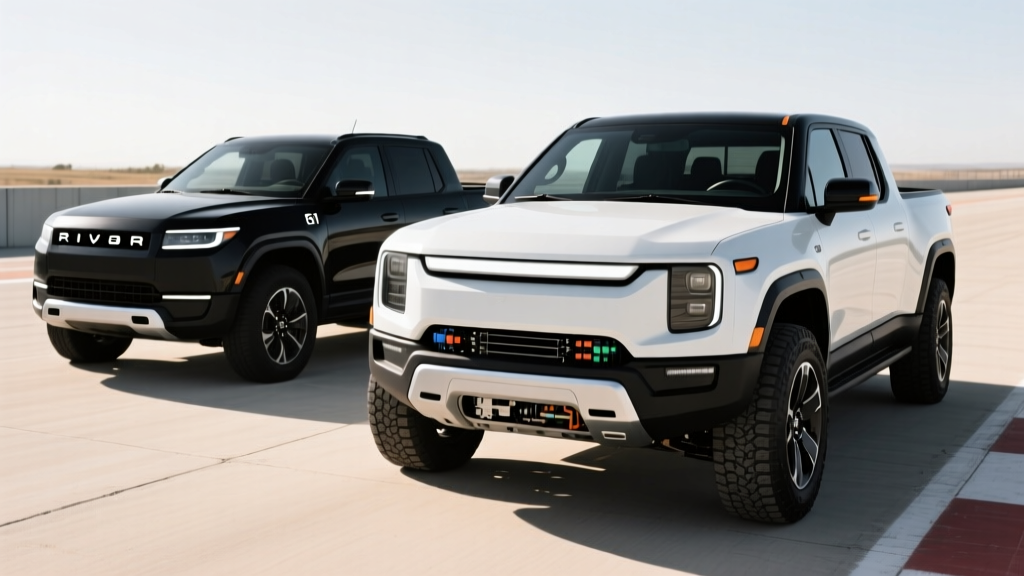
The short answer: If you tow under 7,000 lbs, drive mostly within 200 miles of home, and can install a Level 2 charger, a 2026 electric pick up truck will save you $4,000–$8,000 over five years versus a gas equivalent. If you regularly tow heavy trailers long distances or lack reliable home charging, a hybrid truck (like the F-150 PowerBoost) remains the pragmatic choice. Today's leading electric trucks — the Rivian R1T, Ford F-150 Lightning, Chevrolet Silverado EV, and GMC Sierra EV — offer 320–440 miles of EPA range, up to 10,000 lbs of towing, and DC fast charging from 190 to 350 kW. But real-world range drops 30–50% under heavy towing, and upfront pricing starts around $55,000 before incentives.
The 2026 Electric Pickup Truck Landscape at a Glance
The electric truck market has matured significantly since the first Rivian R1T and F-150 Lightning deliveries in 2022. For 2026, buyers now choose among four production platforms with proven track records, while GM's Silverado EV and Sierra EV have moved from early-adopter curiosities to mainstream options with expanded trim availability. Tesla's Cybertruck continues production in higher volumes, though its polarizing design limits its buyer pool.
Here's how the major contenders stack up on the numbers that matter:
| Model | EPA Range | Battery (kWh usable) | Peak DC Charge (kW) | 10–80% Time | Max Tow (lbs) | 0–60 mph | Base MSRP |
|---|---|---|---|---|---|---|---|
| Rivian R1T (Dual Max) | 415 mi | 149 kWh (NMC) | 220 kW | ~28 min | 11,000 | 3.5 sec | $87,700 |
| Rivian R1T (Dual Standard) | 270 mi | 106 kWh (LFP) | 200 kW | ~25 min | 11,000 | 4.5 sec | $69,900 |
| Ford F-150 Lightning (Ext. Range) | 320 mi | 131 kWh (NMC) | 190 kW | ~35 min | 10,000 | 4.0 sec | $62,995 |
| Chevrolet Silverado EV (4WT) | 440 mi | 200 kWh (NMC) | 350 kW | ~20 min | 10,000 | 4.5 sec | $55,900 |
| GMC Sierra EV (Denali) | 440 mi | 200 kWh (NMC) | 350 kW | ~20 min | 10,000 | 4.5 sec | $79,400 |
| Tesla Cybertruck (AWD) | 340 mi | 123 kWh (NMC) | 250 kW | ~22 min | 11,000 | 4.1 sec | $79,990 |
Sources: EPA fueleconomy.gov, manufacturer press sites. EPA range varies by trim and wheel size. Real-world highway range typically 15–25% below EPA. Towing range reduction addressed below.
Range Reality: EPA Stickers vs. the Highway and the Trailer
This is where most electric truck buyers miscalculate. The EPA range figure you see on the window sticker represents a blended driving cycle — some city, some highway, moderate temperatures, no payload. Real-world conditions, especially in a truck, diverge sharply.
Real-World Range Expectations (Unladen, No Trailer)
- Highway driving at 70–75 mph: Subtract 15–20% from EPA. A Silverado EV rated at 440 miles delivers roughly 350–375 miles on an interstate run.
- Cold weather (below 32°F): Subtract 20–30% depending on cabin heat usage. That 320-mile F-150 Lightning becomes a 225–255-mile truck in a Minnesota January.
- With a 5,000-lb trailer: Subtract 35–50%. An R1T Max Pack rated at 415 miles EPA may deliver only 210–270 miles towing on flat terrain at 65 mph. Hilly terrain worsens this further.
The physics are unforgiving: aerodynamic drag scales with the square of speed, and a boxy trailer creates a turbulent air pocket that no amount of battery capacity fully overcomes. This isn't a flaw in electric trucks — it's the same reality gas trucks face, where towing MPGs collapse from 20 to 8–10 mpg. The difference is that gas trucks can refuel a depleted tank in 5 minutes at any station, while an electric truck towing needs strategic DC fast-charger planning.
Practical takeaway: If your typical towing trip is under 150 miles one-way (300 miles round-trip), any of these trucks handle it with a charge buffer. Beyond 200 miles towing, you'll need a mid-route DC fast-charge stop, adding 25–40 minutes.
Charging Infrastructure: Home, Public, and the Towing Question
Electric truck ownership lives or dies on charging access. These are large batteries — 106 to 200 kWh usable — which means Level 1 (120V) charging is essentially useless (adding 2–4 miles per hour), and even Level 2 home charging requires planning.
| Level | Power (kW) | Miles Added/Hour | Full Charge Time (131 kWh battery) | Use Case |
|---|---|---|---|---|
| Level 1 (120V) | 1.4–1.9 kW | 3–5 mi/hr | 65+ hours | Emergency/trickle only |
| Level 2 (240V, 48A) | 11.5 kW | 25–35 mi/hr | ~11 hours | Overnight home charging |
| Level 2 (240V, 80A) | 19.2 kW | 40–55 mi/hr | ~7 hours | Fast home / depot charging |
| DC Fast (190 kW) | 190 kW peak | ~500+ mi/hr | 10–80% in ~35 min | Road trips, F-150 Lightning |
| DC Fast (350 kW) | 350 kW peak | ~800+ mi/hr | 10–80% in ~20 min | Road trips, Silverado/Sierra EV |
Home Charging Installation: What It Actually Costs
You'll need a 240V circuit — typically a NEMA 14-50 outlet (50A) or a hardwired wall connector (up to 80A). Here's what homeowners actually pay:
| Item | Cost Range | Notes |
|---|---|---|
| Level 2 charger (hardware) | $500–$800 | ChargePoint Home Flex, Wallbox Pulsar Plus, or OEM unit |
| Electrician labor (standard install) | $800–$2,000 | Run from panel to garage/carport, ~20–40 ft |
| Electrical panel upgrade (if needed) | $1,500–$3,500 | Required if existing panel is 100A or has no spare capacity |
| Permits and inspection | $100–$400 | Varies by municipality |
| Total (no panel upgrade) | $1,400–$3,200 | Most homes with 200A service |
| Total (with panel upgrade) | $2,900–$6,700 | Older homes, 100A service |
Critical note: Always hire a licensed electrician for final specifications. A 48A charger requires a 60A circuit (NEC 80% continuous-load rule). An 80A charger requires a 100A circuit and likely a panel upgrade in older homes. Federal tax credit under IRC §25C may cover 30% of home charging equipment and installation costs, up to $1,000.
Public Charging for Trucks: The Size Problem
Not all DC fast-charging stalls accommodate a 20-foot truck with a trailer. Many Electrify America and EVgo stations have standard car-sized pull-through or pull-in spots that make truck charging awkward or impossible with a trailer attached. Rivian's Adventure Network and Tesla Superchargers (now open to non-Tesla EVs via the NACS connector or Magic Dock adapter) tend to have better truck-friendly layouts, but coverage varies regionally. Plan stops using apps like PlugShare and A Better Routeplanner, filtering for pull-through stalls.
Cost of Ownership: Electric Truck vs. Gas Truck Over 5 Years
This is where electric trucks make their strongest case — or fall apart, depending on your situation. Let's compare a Ford F-150 Lightning (Extended Range, ~$63,000 MSRP) against a comparably equipped F-150 3.5L EcoBoost gas truck (~$55,000 MSRP) over 5 years and 75,000 miles.
| Category | F-150 Lightning (EV) | F-150 EcoBoost (Gas) | Difference |
|---|---|---|---|
| Purchase price (MSRP) | $62,995 | $55,000 | +$7,995 EV |
| Federal tax credit (§30D, if eligible) | −$7,500 | $0 | −$7,500 EV |
| Net purchase price | $55,495 | $55,000 | +$495 EV |
| Fuel/energy (75,000 mi) | $5,400 (home L2 at $0.14/kWh) | $11,250 (17 mpg avg at $3.40/gal) | −$5,850 EV |
| Maintenance | $1,800 (tires, cabin filter, wipers, fluid top-offs) | $4,200 (oil changes, filters, brakes, spark plugs) | −$2,400 EV |
| Insurance (avg premium delta) | +$1,500 over 5 yrs | Baseline | +$1,500 EV |
| Depreciation (est. 5-yr) | −$28,000 | −$24,000 | −$4,000 EV |
| Net 5-Year Cost | $36,195 | $46,450 | −$10,255 EV savings |
Assumptions: Buyer qualifies for full $7,500 §30D credit. Electricity rate $0.14/kWh national average. Gas truck averages 17 mpg combined (real-world mixed driving with payload). EV insurance premiums run 10–15% higher on average. Depreciation figures based on current resale trends — EV depreciation remains volatile. IRS §30D credit eligibility depends on MSRP caps ($80,000 for trucks), buyer income limits ($300K joint / $150K single), and battery sourcing requirements that vary by model year.
When the Math Flips Against Electric
The EV advantage narrows or disappears if:
- You rely on public DC fast charging exclusively. At $0.35–$0.55/kWh, your 75,000-mile energy cost jumps to $10,800–$17,000, erasing most fuel savings.
- You don't qualify for the §30D credit. Income above thresholds, or the specific truck's battery sourcing doesn't meet current-year critical-mineral requirements, and that $7,500 vanishes.
- You tow frequently over long distances. Energy consumption while towing can triple, pushing per-mile costs above gas in some scenarios.
- You live in an apartment or lack home charging access. Public-only charging is expensive, inconvenient for a large battery, and time-consuming.
Towing, Payload, and Work Capability: The Honest Assessment
Electric trucks deliver genuine advantages for certain work profiles and real limitations for others.
Where Electric Trucks Excel at Work
- Instant torque. The F-150 Lightning's 580 lb-ft is available at 0 rpm, making low-speed trailer maneuvering and hill starts effortless. No turbo lag, no transmission hunting.
- Pro Power Onboard / V2L. The F-150 Lightning offers up to 9.6 kW of onboard power (240V outlets in the bed), enough to run job-site tools, a welder, or power a home during an outage. The Silverado EV offers similar vehicle-to-load capability. This eliminates the need for a separate gas generator.
- Frunk storage. The F-150 Lightning's 14.1 cu-ft front trunk is lockable, weatherproof, and ideal for tools or gear you want separate from the bed.
- Low operating cost for fleet use. Short-radius delivery, utility work, and construction-site trucks that return to a depot nightly see the strongest economics — cheap overnight charging, minimal maintenance, and onboard power offset generator costs.
Where Electric Trucks Fall Short
- Long-distance heavy towing. As noted, towing range collapses. A contractor pulling a 7,000-lb equipment trailer 250 miles one-way faces at least one 30-minute DC fast-charge stop, and potentially two in cold weather.
- Weight. These trucks are heavy. The F-150 Lightning weighs ~6,500 lbs; the Silverado EV tops 8,800 lbs. That weight reduces payload capacity (the Silverado EV 4WT's payload is ~1,800 lbs) and increases tire wear — expect to replace tires every 25,000–35,000 miles, and truck-rated EV tires cost $300–$500 each.
- Off-road limitations. While the Rivian R1T is genuinely capable off-road (quad-motor torque vectoring, adjustable air suspension with 14.9 inches of ground clearance), the F-150 Lightning and Silverado EV are primarily on-road trucks. Serious trail use risks battery-pack damage, and replacement costs are steep ($15,000–$25,000 out of warranty).
Tax Credits, Incentives, and What You Actually Pay
Federal and state incentives can dramatically change the purchase equation, but the rules are specific and change frequently.
§30D Federal Clean Vehicle Credit: Key Requirements (2026)
- Credit amount: Up to $7,500 ($3,750 for critical minerals + $3,750 for battery components).
- MSRP cap: Trucks/vans/SUVs must have an MSRP at or below $80,000. This excludes higher-trim Rivian R1T and Cybertruck configurations.
- Buyer income cap: AGI must not exceed $300,000 (joint), $225,000 (head of household), or $150,000 (single).
- Battery sourcing: Required percentages of critical minerals and battery components must be sourced from the US or FTA partners. These thresholds increase annually — a truck that qualified in 2025 may not qualify in 2026. Check the specific VIN on fueleconomy.gov.
- Point-of-sale transfer: You can transfer the credit to the dealer at purchase, reducing your out-of-pocket cost immediately rather than waiting for tax filing.
- Final assembly: Vehicle must undergo final assembly in North America. All trucks listed above qualify.
State incentives vary widely and may stack with federal credits. California's CVRP, Colorado's state tax credit, and various utility rebates can add $2,000–$7,500. Check your state energy office and local utility for current programs.
Common Misconceptions About Electric Trucks
| Myth | Fact |
|---|---|
| "Electric trucks can't tow." | They tow up to 11,000 lbs with instant torque. The limitation is range under tow, not capability. A 400-mile truck becomes a 200–250-mile truck with a heavy trailer. |
| "The battery will need replacing in 5 years." | Modern NMC and LFP packs are warrantied for 8 years/100,000 miles at 70% capacity retention minimum. Real-world degradation data from early F-150 Lightnings and R1Ts shows ~5–8% loss over 100,000 miles. Full replacement (rare) costs $15,000–$25,000. |
| "Charging takes too long." | Home Level 2 charging happens overnight while you sleep — 10–11 hours from empty for a 131 kWh pack. DC fast charging adds 200+ miles in 20–30 minutes for road trips. You spend less total time "refueling" than gas truck owners when home charging is your primary method. |
| "They're worse in cold weather." | Range drops 20–30% in freezing temps — a real and significant loss. But electric trucks start instantly (no cold cranking), cabin heating is immediate with a heat pump, and preconditioning the battery before DC fast charging restores much of the charging speed penalty. |
| "The grid can't handle it." | Most home charging happens overnight during off-peak hours, when grid capacity is underutilized. A Level 2 charger draws about the same as an electric oven. A single truck charging at home is not a grid burden; mass adoption will require infrastructure investment, which is underway. |
Decision Framework: Which Electric Truck (or Should You Wait)?
Choose an electric truck if:
- You have home charging access (garage, carport, or dedicated driveway outlet) or a workplace charger.
- Your daily driving is under 200 miles round-trip, with occasional longer road trips.
- You tow under 7,000 lbs and mostly within 150 miles one-way.
- You value low operating costs, quiet operation, instant torque, and onboard power (V2L).
- You qualify for the §30D federal credit and/or state incentives, bringing the net price close to a gas equivalent.
Choose a hybrid truck (F-150 PowerBoost, Silverado 3.0L Duramax) if:
- You regularly tow over 7,000 lbs on trips exceeding 200 miles.
- You lack reliable home or workplace charging access.
- You operate in remote areas far from DC fast-charging infrastructure.
- Your budget is firmly under $55,000 and you don't qualify for incentives.
- You need maximum payload and minimum vehicle weight for commercial use.
Model-specific picks:
- Best overall value: Chevrolet Silverado EV 4WT — 440 miles EPA, 350 kW charging, starting at $55,900, eligible for the full §30D credit. The range and charging speed lead the segment.
- Best for adventure/off-road: Rivian R1T — quad-motor torque vectoring, air suspension, genuine trail capability, and the most refined interior in the segment. But starting above $69,900, credit eligibility is trim-dependent.
- Best for fleet/commercial: Ford F-150 Lightning — proven platform, Pro Power Onboard, extensive dealer network, and strong commercial upfitter support.
- Best for tech enthusiasts: Tesla Cybertruck — 48V architecture, steer-by-wire, and the most distinctive design. Polarizing, and service-center availability remains limited outside major metros.
Frequently Asked Questions
What happens to an electric truck's range when towing a trailer?
Expect a 35–50% range reduction when towing a 5,000–7,000 lb trailer at highway speeds. A truck rated at 400 miles EPA unladen will deliver approximately 200–260 miles with a trailer. The reduction comes from increased aerodynamic drag (the trailer creates a low-pressure wake) and the additional rolling mass. Grade changes amplify this — climbing a mountain pass with a trailer can consume 2–3x the energy of flat driving.
How long do electric truck batteries last, and what does replacement cost?
All major manufacturers warranty their battery packs for 8 years or 100,000 miles (whichever comes first) with a minimum 70% capacity retention. Real-world data from early-adopter trucks suggests 5–10% degradation over 100,000 miles for NMC chemistry. LFP packs (like the R1T Standard) degrade even less. Out-of-warranty replacement costs range from $15,000 to $25,000 depending on the pack, but complete pack failures are rare — individual module replacement is often possible at lower cost.
Can I charge an electric truck from a standard 120V household outlet?
Technically yes, but practically no. A 120V outlet delivers 1.4–1.9 kW, adding only 3–5 miles of range per hour. Fully recharging a 131 kWh F-150 Lightning battery from empty would take over 65 hours. Level 1 is useful only for maintaining charge on a parked truck or adding 30–40 miles overnight if your daily driving is minimal. A 240V Level 2 installation is strongly recommended for any electric truck owner.
Do electric trucks qualify for the $7,500 federal tax credit?
Several do, but eligibility depends on the specific model, trim, battery sourcing, your income, and the truck's MSRP. Under IRS §30D rules, trucks must have an MSRP at or below $80,000, and buyer AGI must not exceed $300,000 (joint) or $150,000 (single). Battery critical-mineral and component sourcing thresholds increase annually, so a truck that qualifies in one model year may not in the next. Always verify the specific VIN on fueleconomy.gov before purchasing. The credit can be transferred to the dealer at point of sale, reducing your purchase price directly.
Are electric trucks good in snow and cold weather?
They perform well mechanically — electric motors don't struggle with cold starts, AWD systems provide excellent traction, and the low center of gravity (battery pack under the floor) improves stability. The main penalty is range: expect 20–30% less range in sustained below-freezing temperatures due to battery chemistry limitations and cabin-heating energy use. Trucks with heat pumps (Rivian R1T, Silverado EV) lose less range than those relying solely on resistive heating. Preconditioning the battery and cabin while still plugged in mitigates much of the cold-weather impact.