The Short Answer on Proterra Electric Buses
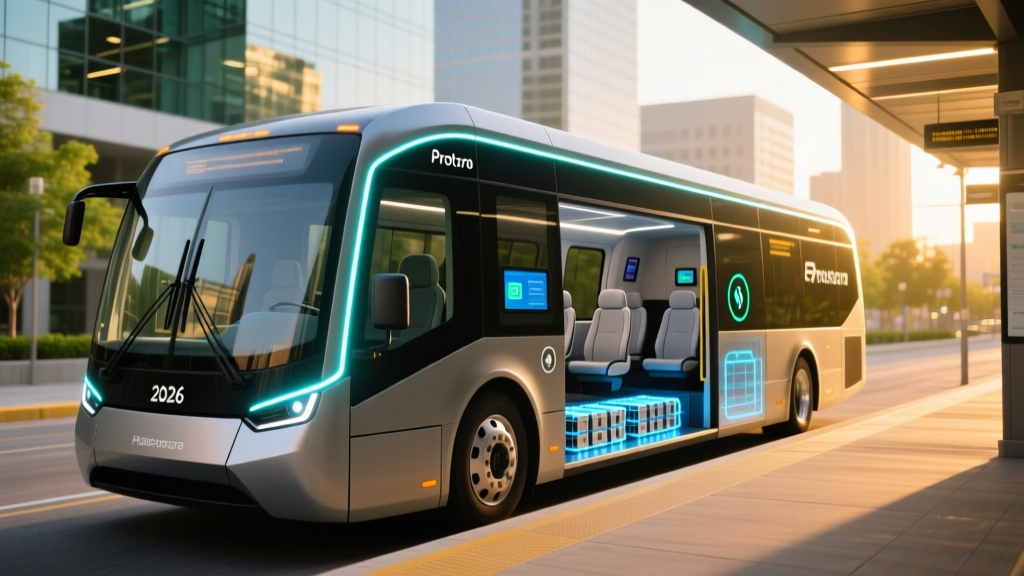
Proterra's ZX5 transit bus (the company's flagship after its 2024 restructuring) offers up to 329 miles of EPA-estimated range with the largest battery pack option — the highest in the North American heavy-duty transit segment. Base pricing for a 40-foot ZX5 starts around $750,000 before federal and state incentives, compared to roughly $500,000-$550,000 for a comparable clean-diesel bus. However, the total cost of ownership over 12 years typically favors the electric bus by $150,000-$400,000 depending on route duty cycles, electricity rates, and available grant funding. Fleet operators should prioritize route analysis (daily mileage, terrain, climate) and depot charging infrastructure before committing to a purchase order.
Proterra's Current Product Lineup and Key Specifications
Following Proterra's emergence from Chapter 11 bankruptcy in late 2023 — where its battery manufacturing and fleet charging divisions were sold off — the transit bus business continued under restructured ownership. The ZX5 platform remains the core product for North American transit agencies in 2026, available in 35-foot and 40-foot configurations with multiple battery pack options.
| Specification | ZX5 35-ft | ZX5 40-ft (Standard) | ZX5 40-ft (Max Range) |
|---|---|---|---|
| Battery Capacity (usable) | 220 kWh (LTO/NMC) | 440 kWh (NMC) | 660 kWh (NMC) |
| EPA Estimated Range | ~138 mi | ~232 mi | ~329 mi |
| Real-World Range (mixed route, moderate climate) | ~105-120 mi | ~180-200 mi | ~260-290 mi |
| Peak DC Fast Charge Rate | 166 kW | 205 kW | 205 kW |
| Charge Time (0-100%, depot plug-in) | ~2.5 hours | ~4.5 hours | ~6.5 hours |
| Electric Motor Output | 250 kW (335 hp) | 250 kW (335 hp) | 250 kW (335 hp) |
| Gross Vehicle Weight Rating | 39,000 lbs | 43,000 lbs | 44,800 lbs |
| Passenger Capacity (seated/standing) | 32 / 54 | 39 / 68 | 37 / 64 |
| Base MSRP (approx.) | ~$680,000 | ~$750,000 | ~$830,000 |
| Battery Warranty | 12 years / 500,000 mi | 12 years / 500,000 mi | 12 years / 500,000 mi |
Real-world range caveat: The EPA's heavy-duty transit bus test cycle (Altoona testing protocol) produces range figures under controlled conditions. In actual fleet operation, expect 15-25% range reduction due to passenger loading (a full bus at GVWR consumes significantly more energy per mile), HVAC usage (especially heating in sub-freezing climates where electric resistance or heat-pump cabin heating can draw 15-30 kW continuously), hilly terrain, and stop-and-go route patterns with frequent door cycles. Agencies in northern climates like Minneapolis or Boston should plan routes around the lower bound of the real-world range estimate, particularly in January and February.
Electric Bus vs. Diesel Bus: Total Cost of Ownership Breakdown
The upfront premium for a Proterra ZX5 over a comparable diesel transit bus (such as the New Flyer XD40 or Gillig Low Floor diesel) is substantial — typically $200,000-$300,000 per vehicle. But fleet total cost of ownership (TCO) tells a different story over a standard 12-year transit bus lifecycle, primarily due to fuel and maintenance savings.
| Cost Category | Proterra ZX5 (Electric) | Diesel Transit Bus | Notes |
|---|---|---|---|
| Vehicle Purchase Price | $750,000 | $525,000 | Before any grants or incentives |
| Federal / State Incentives | -$285,000 | -$25,000 | EPA Clean School Bus / FTA Low-No grants; varies by program year |
| Net Vehicle Cost | $465,000 | $500,000 | |
| Charging Infrastructure (per bus share) | $85,000 | $0 | Depot charger, switchgear, transformer upgrade allocation |
| Fuel / Electricity (12 years, 50,000 mi/yr) | $108,000 | $345,600 | Electric: $0.12/kWh avg; Diesel: $3.60/gal at 4.8 mpg |
| Maintenance (12 years) | $115,000 | $265,000 | EV: no engine, transmission, exhaust aftertreatment; brake regen extends pad life |
| Battery Replacement (mid-life) | $0 - $120,000 | $0 | Depends on warranty terms and degradation at year 8-10 |
| Insurance (12 years) | $96,000 | $84,000 | EV premiums run 10-15% higher on average |
| Total 12-Year TCO | $869,000 - $989,000 | $1,194,600 |
The critical variable is grant funding. The EPA's Clean School Bus Program, FTA Low-No (Low or No Emission Vehicle) grants, and state-level programs like California's Hybrid and Zero-Emission Truck and Bus Voucher Incentive Project (HVIP) can offset $150,000-$350,000 of the purchase price. Agencies that secure competitive grant funding often find the electric bus reaches cost parity or beats diesel on TCO within 6-8 years. Without grants, the payback period extends to 10-14 years and becomes highly sensitive to local electricity rates and diesel price fluctuations.
For context, diesel fuel cost volatility is a genuine TCO risk. A $1.00/gallon increase in diesel price adds approximately $105,000 to 12-year fuel costs for a single bus running 50,000 miles annually. Electricity rates, while rising, have been more predictable under utility commercial tariff structures.
Charging Infrastructure: What Fleet Operators Must Plan For
The single biggest mistake first-time electric bus buyers make is underestimating depot charging infrastructure cost and lead time. A Proterra ZX5 with the 660 kWh pack needs substantial electrical capacity — a 10-bus depot charging at 150 kW per stall requires approximately 1.5 MW of dedicated electrical service, often necessitating a new utility transformer, switchgear upgrades, and potentially a medium-voltage service connection.
| Component | Cost Range | Details |
|---|---|---|
| DC Fast Chargers (150 kW, CCS1) | $75,000 - $120,000 each | Proterra or third-party (ABB, ChargePoint, BTC Power) |
| Electrical Panel / Switchgear | $80,000 - $200,000 | Depends on existing service capacity |
| Utility Transformer Upgrade | $50,000 - $350,000 | Varies enormously; some utilities co-invest |
| Trenching, Conduit, Wiring | $40,000 - $120,000 | Distance from service point to charger pads |
| Permits, Engineering, Inspections | $25,000 - $75,000 | Local jurisdiction and utility interconnection review |
| Charge Management Software | $5,000 - $15,000 / year | Staggered charging to manage demand charges |
| Total (10-bus depot) | $850,000 - $2,100,000 | $85,000 - $210,000 per bus allocated |
Lead time warning: Utility interconnection studies and transformer procurement in 2026 are running 12-24 months in many regions. Smart fleet operators begin the utility engagement process 18 months before planned bus delivery. Some utilities now offer "make-ready" programs that cover the cost of infrastructure up to the charger pad — check with your local investor-owned utility or municipal electric provider.
The Proterra ZX5 uses the CCS1 connector standard for DC fast charging. Depot charging is typically done overnight using a mix of Level 2 (19.2 kW AC, adding ~20 kWh/hour) for top-up and DC fast charging (50-150 kW) for full charges. Most agencies charge overnight at lower power levels to minimize utility demand charges, which can add $10-$20/kW per month to commercial electricity bills. Charge management software that staggers charging across the fleet — rather than plugging in all buses simultaneously at 6 PM — is essential for cost control.
Cold-Weather Performance and Route Planning Realities
Battery electric buses face their toughest challenge in cold climates. Cabin heating in a 40-foot transit bus carrying 60+ passengers requires substantial energy — a Proterra ZX5 uses an all-electric HVAC system that can draw 15-30 kW in heating mode during sub-freezing operation. This parasitic load directly reduces propulsion range.
Testing data from agencies in cold climates shows the following range impacts:
- Moderate cold (32-45°F): 10-15% range reduction vs. mild-weather baseline
- Cold (10-32°F): 20-35% range reduction
- Severe cold (below 10°F): 35-50% range reduction in worst-case scenarios
For a ZX5 40-ft with the 440 kWh pack rated at 232 miles EPA, a January route day in Chicago might yield only 150-170 usable miles. This means agencies with routes exceeding 130 miles per day in cold climates should spec the 660 kWh max-range pack or plan mid-day opportunity charging. Several agencies have installed on-route pantograph or plug-in fast chargers at transit centers to extend effective daily range.
Proterra's battery thermal management system includes active liquid heating and cooling, which precondition the pack for optimal charge acceptance and protect against lithium plating during cold-weather charging. Fleet operators should program depot chargers to begin preconditioning batteries 1-2 hours before scheduled departure — this improves both range and regenerative braking availability in the first miles of operation.
Federal and State Incentives: What's Available in 2026
The incentive landscape for heavy-duty electric buses differs significantly from the light-duty §30D consumer tax credit that applies to passenger vehicles. Transit agencies — particularly public entities — typically cannot use federal tax credits directly, so the incentive structure relies on grant programs and point-of-sale mechanisms.
- IRA §45W Commercial Clean Vehicle Credit: Up to $40,000 for vehicles over 14,000 lbs GVWR. Available to tax-paying fleet operators (private transit companies, school bus contractors). Subject to battery sourcing requirements similar to §30D.
- EPA Clean School Bus Program: Rebates up to $375,000 per zero-emission school bus plus $55,000 for infrastructure, funded through 2026 via the Infrastructure Investment and Jobs Act. Administered via annual lottery/application cycles.
- FTA Low-No Grant Program: Competitive grants covering up to 85% of vehicle purchase and 90% of infrastructure for public transit agencies. Awards range from $2M-$20M+ per application cycle.
- State Voucher Programs: California HVIP ($120,000-$240,000 per bus), New York Truck Voucher Incentive Program, and similar programs in Massachusetts, New Jersey, and Colorado. Funding levels and availability vary annually.
Consult the EPA Clean School Bus Program page and the FTA Low-No program for current application deadlines and eligibility rules. These programs are competitive and oversubscribed — begin the application process 12-18 months before planned procurement.
Common Misconceptions About Electric Transit Buses
| Myth | Fact |
|---|---|
| "Electric buses can't handle a full day's route." | The ZX5 40-ft with 660 kWh delivers 260-290 real-world miles — sufficient for ~85% of US transit routes averaging 150-180 miles/day. Longer routes require mid-day charging or the max-range pack. |
| "Battery replacement will bankrupt the agency." | Proterra's 12-year/500,000-mile warranty covers capacity below 70%. NMC degradation data from in-service fleets shows ~8-12% capacity loss at year 8. Mid-life replacement, if needed, costs $100,000-$150,000 but is increasingly rare under warranty. |
| "Electric buses are worse for the environment because of battery mining." | Lifecycle analyses by the International Council on Clean Transportation (ICCT) show electric buses produce 40-60% fewer greenhouse gas emissions over their lifetime vs. diesel, even on US grid mixes with significant fossil fuel generation. As the grid decarbonizes, this advantage grows. |
| "Charging takes too long for transit operations." | Overnight depot charging (4-6 hours for a full charge) aligns with standard bus layover schedules. Opportunity charging at 150-200 kW adds ~80 miles in 30 minutes. Most agencies report zero operational disruption with proper planning. |
| "Proterra went bankrupt, so parts and support are gone." | Proterra's transit bus division emerged from restructuring and continues manufacturing, parts supply, and warranty support. However, fleet buyers should negotiate long-term parts availability clauses into purchase agreements as a prudent safeguard. |
Decision Framework: Should Your Fleet Go Electric with Proterra?
Choose the Proterra ZX5 if:
- Your average daily route mileage is under 220 miles (or under 160 miles in cold-climate regions)
- You have depot space with access to utility power upgrades (or a utility willing to co-invest in make-ready infrastructure)
- You can secure EPA, FTA, or state grant funding to offset the purchase premium
- Your agency has a 12-year or longer vehicle lifecycle plan (to capture full TCO savings)
- Local air quality mandates or zero-emission fleet transition timelines require electrification
- Your electricity rates are below $0.18/kWh (commercial/industrial average), making fuel savings decisive
Consider diesel, CNG, or a competitor (New Flyer XE40, BYD K9M, Gillig EV) if:
- Routes regularly exceed 250 miles/day with no opportunity for mid-day charging
- Your depot is in a utility territory with 3+ year interconnection timelines and no make-ready program
- No grant funding is available and your budget cannot absorb the $200,000+ upfront premium
- You operate in extreme cold (sustained -20°F or below) where range loss exceeds 40%
- You need immediate delivery — Proterra order backlogs can run 12-18 months, and competitors may have shorter lead times
- Your fleet is fewer than 5 buses, making infrastructure cost-per-bus disproportionately high
First-Time Electric Bus Buyer Checklist
If your agency is procuring its first battery-electric transit buses, work through these steps in order — skipping any of them is the most common source of costly delays:
- Route analysis: Map every route's daily mileage, elevation profile, passenger loading patterns, and ambient temperature range. Identify the 10th-percentile worst-case day (coldest, highest ridership, longest detour). Size the battery pack for that day, not the average.
- Utility engagement: Contact your utility's commercial/EV team before issuing an RFP. Get a preliminary interconnection study and make-ready cost estimate. This single step determines your infrastructure budget and timeline.
- Grant applications: Apply to EPA Clean School Bus, FTA Low-No, and state programs 12-18 months before procurement. Many agencies hire grant-writing consultants specializing in zero-emission transit — the ROI on a successful $300,000 grant is obvious.
- Depot site assessment: Evaluate charger placement, cable reach to each bus parking position, fire code setbacks, and ADA access. Engage a licensed electrical engineer with EV infrastructure experience.
- Staff training: Maintenance technicians need high-voltage safety certification (NFPA 70E) and OEM-specific training on Proterra's powertrain and battery systems. Budget $15,000-$25,000 per technician for initial training.
- Data and telematics: Specify fleet management software that tracks State of Charge (SoC), State of Health (SoH), energy consumption per route, and charger utilization from day one. This data is essential for warranty claims and future procurement decisions.
Frequently Asked Questions
What is the real-world range of a Proterra ZX5 electric bus?
The EPA-rated range is up to 329 miles for the 40-foot model with the 660 kWh battery pack. In real-world mixed-route operation with passenger loads and HVAC use, expect 260-290 miles in moderate weather and 170-220 miles in cold weather (below 32°F). The standard 440 kWh pack delivers approximately 180-200 real-world miles in moderate conditions.
How long does it take to charge a Proterra electric bus?
Using a 150 kW DC fast charger (CCS1 connector), the 440 kWh pack charges from 0-100% in approximately 3.5-4 hours. The 660 kWh pack takes 5-6.5 hours. Most agencies charge overnight during off-peak electricity rate windows. A 30-minute opportunity charge at 150 kW adds roughly 60-80 miles of range.
How does the Proterra ZX5 compare to competitors like the New Flyer XE40 or BYD K9M?
The ZX5's 329-mile max range leads the segment — the New Flyer XE40 tops out around 220-240 miles EPA with its largest pack, and the BYD K9M offers approximately 200-220 miles. However, Proterra's post-restructuring production capacity and delivery timelines may be less certain than New Flyer's established manufacturing base. Price points are broadly comparable at $700,000-$900,000 depending on battery configuration. Agencies should evaluate delivery lead time, local dealer support, and parts availability alongside raw specifications.
What happens if the battery degrades before the 12-year warranty expires?
Proterra warrants the battery pack to retain at least 70% of original capacity for 12 years or 500,000 miles. If degradation exceeds this threshold, Proterra is responsible for repair or replacement. Fleet data from early adopters suggests NMC packs in transit bus duty cycles lose approximately 1.5-2% capacity per year, meaning most packs retain 76-82% at year 10 — well above the warranty floor. Active thermal management and avoiding sustained 100% SoC storage help maximize longevity.
Can Proterra electric buses handle hilly routes?
Yes, but with an energy consumption penalty. Regenerative braking on descents recovers 20-30% of the energy used climbing hills, but net consumption on hilly routes runs 15-25% higher than flat terrain. Agencies with significant elevation change (e.g., San Francisco, Seattle, Pittsburgh) should spec the larger battery pack and model route energy consumption using Proterra's route simulation tools before committing to a configuration.
Are federal tax credits available for electric transit buses?
The IRA's §45W Commercial Clean Vehicle Credit provides up to $40,000 for heavy-duty zero-emission vehicles, but it is only usable by tax-paying entities (private fleet operators, not most public transit agencies). Public agencies rely primarily on EPA Clean School Bus rebates, FTA Low-No grants, and state incentive programs. Consult your procurement team and a tax professional familiar with IRA provisions to determine eligibility.