Quick Verdict: The Taycan Wagon Does It All — at a Premium
The Porsche Taycan Cross Turismo — the wagon-bodied variant of Stuttgart's flagship electric sedan — occupies a rare space in the EV market: a performance car that genuinely adds utility over its sedan sibling. For 2026, Porsche has refined the lineup with improved efficiency, a revised battery pack, and sustained access to its 800-volt electrical architecture that remains among the fastest-charging platforms available to consumers.
With EPA range stretching to 292 miles on the most efficient trim, a peak DC fast-charge rate of 320 kW, and cargo volume that genuinely accommodates family road-trip luggage, the Taycan wagon answers the question many performance EV buyers ask: Can I have the driving dynamics without sacrificing practicality? The answer is yes — provided your budget starts north of $105,000.
| Spec | Taycan 4 Cross Turismo | Taycan 4S Cross Turismo | Taycan Turbo Cross Turismo |
|---|---|---|---|
| EPA Range | 292 mi | 279 mi | 274 mi |
| Usable Battery | 89 kWh (NMC) | 89 kWh (NMC) | 89 kWh (NMC) |
| Horsepower (Launch Control) | 429 hp | 562 hp | 710 hp |
| 0–60 mph | 4.5 sec | 3.7 sec | 2.6 sec |
| Drivetrain | AWD (dual-motor) | AWD (dual-motor) | AWD (dual-motor) |
| Peak DC Charge Rate | 320 kW | 320 kW | 320 kW |
| 10–80% DCFC Time | ~18 min | ~18 min | ~18 min |
| Level 2 Charge Rate | 11 kW (AC) | 11 kW (AC) | 11 kW (AC) |
| MPGe (combined) | 83 MPGe | 79 MPGe | 77 MPGe |
| Cargo (rear seats up / folded) | 15.7 / 42.8 cu ft | 15.7 / 42.8 cu ft | 15.7 / 42.8 cu ft |
| Base MSRP | $105,300 | $121,500 | $168,400 |
Range & Efficiency: EPA Numbers vs. Real-World Expectations
The 2026 Taycan Cross Turismo lineup uses Porsche's updated Performance Battery Plus, a nickel-manganese-cobalt (NMC) lithium-ion pack with 89 kWh of usable capacity. The base Taycan 4 Cross Turismo achieves an EPA-estimated 292 miles, while the higher-output 4S and Turbo variants trade some efficiency for power, landing at 279 and 274 miles respectively.
These are meaningful improvements over the pre-refresh Taycan wagon, which maxed out around 250 miles EPA. Porsche achieved the gain through a revised rear motor with higher efficiency, improved thermal management, and more aggressive regenerative braking recuperation (now up to 400 kW of regen power).
The EPA's 292-mile figure for the Taycan 4 Cross Turismo is achievable in mixed suburban driving at moderate temperatures. Expect approximately 250–265 miles on sustained highway trips at 70–75 mph, and plan for 200–220 miles in freezing winter conditions (below 32°F) where battery chemistry and cabin heating draw additional energy. Porsche's thermal management system — which includes a heat pump standard on all trims — helps mitigate cold-weather losses compared to older EVs, but physics still applies.
Efficiency is rated at 83 MPGe combined for the Taycan 4, translating to roughly 31 kWh per 100 miles. That's slightly behind the Tesla Model S Long Range (120 MPGe combined) but competitive with similarly sized luxury performance EVs like the Audi e-tron GT. The Taycan's 800V architecture enables higher sustained speeds on the Autobahn, but that engineering priority does cost some efficiency versus efficiency-optimized competitors.
Charging: 800-Volt Architecture Delivers Class-Leading Speed
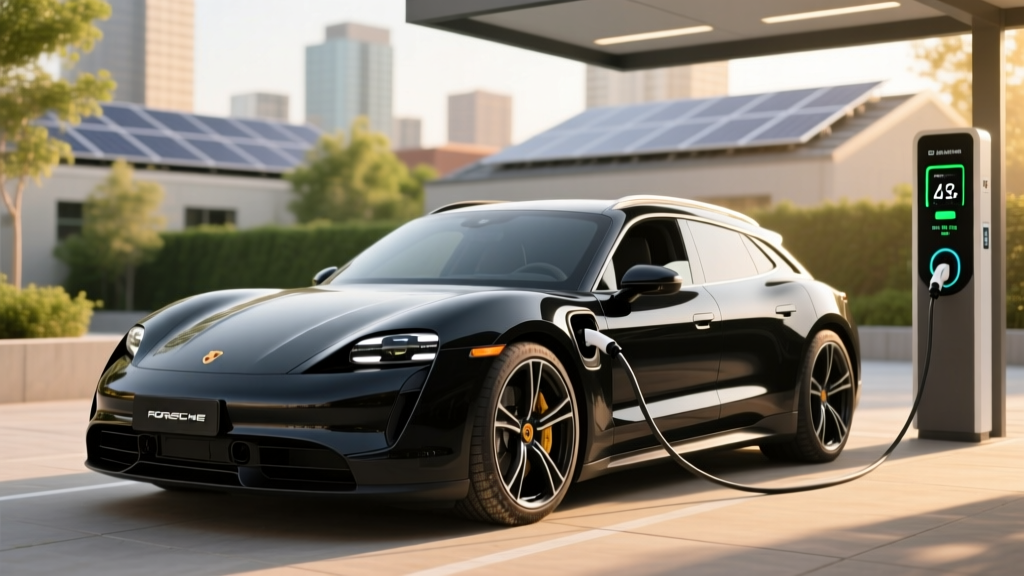
The Taycan wagon's 800-volt electrical system remains one of its most compelling technical advantages. At a compatible 350 kW DC fast charger (such as Electrify America's latest stalls or Tesla Superchargers with a NACS adapter), the Taycan Cross Turismo peaks at 320 kW — among the highest sustained charge rates of any production EV.
Porsche's charge curve is notably flat compared to many competitors. Where some EVs spike to a peak kW figure and taper aggressively after 50% state of charge (SoC), the Taycan holds above 200 kW through roughly 60% SoC before gradually stepping down. This means the 10–80% charge time of approximately 18 minutes is genuinely representative of real-world charging sessions, not just a laboratory best-case scenario.
| Charging Level | Power / Voltage | Miles of Range Added | Typical Session Time |
|---|---|---|---|
| Level 1 (120V household) | 1.4 kW | ~4 mi/hr | ~65 hours (0–100%) |
| Level 2 (240V home, 48A) | 11 kW | ~32 mi/hr | ~8.5 hours (0–100%) |
| DC Fast Charge (350 kW station) | Up to 320 kW peak | ~170 mi in 10 min | ~18 min (10–80%) |
| DC Fast Charge (150 kW station) | Up to 150 kW | ~80 mi in 10 min | ~32 min (10–80%) |
For home charging, the Taycan accepts up to 11 kW on Level 2 AC power. With a properly installed 240V/48-amp hardwired wall connector (requiring a 60-amp dedicated circuit), you'll add roughly 32 miles of range per hour of charging. A full overnight charge from 20% to 100% takes about 7–8 hours — sufficient for daily replenishment for virtually all commuting patterns.
Connector note: For 2026, Porsche equips the Taycan with the NACS (Tesla-style) charge port in North America, replacing the previous CCS1 connector. This grants native access to Tesla's Supercharger network — a significant practical advantage for road-trip charging. For legacy CCS stations, a NACS-to-CCS adapter is included.
Performance: Sports Car DNA in a Wagon Body
The Taycan Cross Turismo shares its powertrain architecture with the sedan, meaning every variant gets a dual-motor all-wheel-drive layout with Porsche's two-speed transmission on the rear axle. That rear two-speed gearbox — unique among production EVs — allows the Taycan to deliver explosive acceleration from standstill while maintaining high top-end speed without the motor running out of breath.
The Taycan 4 Cross Turismo produces 429 horsepower with Launch Control engaged, reaching 60 mph in 4.5 seconds. Step up to the 4S and you get 562 hp and a 3.7-second sprint. The Turbo variant — which, in Porsche's EV naming convention, denotes the top performance tier rather than a turbocharged engine — delivers 710 hp and a ferocious 2.6-second 0–60 time, placing it firmly in supercar territory.
What separates the Taycan wagon from faster-on-paper competitors is chassis tuning. Porsche's adaptive air suspension with Porsche Active Suspension Management (PASM) is standard, and the raised ride height of the Cross Turismo (20mm higher than the sedan) doesn't meaningfully compromise the car's cornering composure. The steering feel, brake modulation, and weight transfer management remain benchmarks for the electric performance segment. Regenerative braking blends seamlessly with the mechanical brakes — a calibration challenge many EV makers still struggle with.
Interior, Cargo & Technology
The Cross Turismo's wagon roofline yields tangible utility gains over the Taycan sedan. Rear headroom improves by approximately 1.8 inches, and the cargo area behind the second row measures 15.7 cubic feet — roughly 3 more cubes than the sedan's trunk. Fold the 60/40 rear seats and you unlock 42.8 cubic feet, enough for a week's worth of luggage for a family of four or a full set of golf clubs with room to spare.
A front trunk (frunk) adds 2.9 cubic feet of additional storage — useful for charging cables or a small bag. Total combined cargo capacity with seats folded reaches approximately 45.7 cubic feet.
The interior features Porsche's updated PCM (Porsche Communication Management) infotainment system with a 12.6-inch curved digital instrument cluster and a 10.9-inch central touchscreen. An optional 10.9-inch passenger display is available. Wireless Apple CarPlay and Android Auto are standard. The center console uses haptic touch controls — a design choice that looks clean but can be frustrating to operate while driving, as there's limited tactile feedback.
Driver assistance: The Taycan Cross Turismo includes Porsche InnoDrive with adaptive cruise control, lane-keeping assist, and traffic-sign recognition. This is an SAE Level 2 driver-assistance system — it does not drive itself. The driver must keep hands on the wheel and remain engaged. Porsche's system is competent on highways but more conservative than Tesla's Autopilot or GM's Super Cruise, and it lacks hands-free operation on mapped highways.
Pricing, Trims & Federal Tax Credit Eligibility
The 2026 Taycan Cross Turismo starts at $105,300 for the Taycan 4 (including destination). The 4S begins at $121,500, and the Turbo opens at $168,400. Options can add $15,000–$30,000+ quickly — Porsche's options list is extensive and expensive, with premium paint colors alone running $820–$3,270.
A realistically equipped Taycan 4S Cross Turismo — with metallic paint, the Premium Package, adaptive cruise, and 20-inch wheels — typically lands in the $135,000–$140,000 range before incentives.
| Trim | Base MSRP | Federal §30D Credit | Effective Starting Price |
|---|---|---|---|
| Taycan 4 Cross Turismo | $105,300 | Up to $7,500* | ~$97,800* |
| Taycan 4S Cross Turismo | $121,500 | Up to $7,500* | ~$114,000* |
| Taycan Turbo Cross Turismo | $168,400 | Up to $7,500* | ~$160,900* |
*Subject to IRS §30D eligibility rules. See details below.
Federal tax credit eligibility — critical caveats: The Taycan Cross Turismo's eligibility for the IRS §30D clean vehicle credit (up to $7,500) depends on several factors that buyers must verify at point of purchase:
- MSRP cap: The Taycan Cross Turismo is classified as an SUV/wagon for §30D purposes, meaning the MSRP cap is $80,000. The base Taycan 4 Cross Turismo at $105,300 exceeds this cap, which means no trim currently qualifies for the new-vehicle §30D credit.
- Buyer income limits: Even if pricing qualified, adjusted gross income must not exceed $300,000 (joint filers), $225,000 (head of household), or $150,000 (single).
- Battery sourcing: Critical mineral and battery component sourcing requirements must be met, which Porsche has historically satisfied for North American-market Taycans.
- Point-of-sale transfer: If eligible, the credit can be applied at purchase as a down-payment reduction rather than claimed on your tax return.
Given the MSRP cap issue, most Taycan Cross Turismo buyers will not qualify for the federal new-vehicle credit. However, the commercial clean vehicle credit (§45W) may be available if the vehicle is purchased through a qualifying business entity — consult a tax professional for structuring advice. Some states offer additional rebates that are not subject to the same MSRP restrictions; check your state's energy office for current programs.
Ownership Costs: Warranty, Maintenance & Insurance
Porsche provides a 4-year/50,000-mile limited vehicle warranty and an 8-year/100,000-mile battery warranty. The battery warranty guarantees that the high-voltage pack will retain at least 70% of its original capacity during the coverage period — consistent with industry norms from BMW, Mercedes, and Audi, though slightly behind Hyundai/Kia's 10-year/100,000-mile coverage.
Maintenance costs are lower than a comparable gasoline Porsche Panamera — no oil changes, no spark plugs, no transmission fluid services. Porsche recommends a cabin air filter replacement and brake fluid check annually, plus tire rotation every 10,000 miles. Expect roughly $400–$600 per year in scheduled maintenance.
Insurance premiums run higher than the segment average. Based on 2026 data, expect annual premiums of $3,200–$4,800 depending on your driving record, location, and coverage level. The Turbo variant commands the highest premiums due to its replacement-cost valuation and performance profile.
Tire wear is a notable ownership cost for the Taycan wagon. The car's weight (approximately 5,100 lbs for the 4S) combined with its instant torque delivery accelerates tire wear compared to lighter EVs. Expect to replace tires every 20,000–30,000 miles, with a set of Porsche-approved N-rated tires running $1,200–$2,000.
How It Compares: Taycan Wagon vs. Key Rivals
The Taycan Cross Turismo competes in a small but growing segment of luxury electric wagons and lifted performance EVs:
- Audi e-tron GT (wagon variant, if available): Shares the J1 platform with the Taycan but typically offers slightly less cargo space and a softer performance tune. The e-tron GT's charging speed is similar but its real-world range trails slightly.
- Tesla Model S (with rear liftgate practicality): The Model S Long Range offers superior EPA range (402 mi) and lower pricing, but its interior build quality and driving dynamics don't match Porsche's execution. The Model S also benefits from Tesla's native Supercharger ecosystem without adapters.
- Mercedes-Benz EQE SUV: Not a true wagon but a crossover competitor. The EQE offers a more comfort-oriented ride and comparable luxury but lacks the Taycan's performance engagement and charging speed.
- BMW i5 Touring: Expected for the US market, the i5 Touring would be a direct competitor with BMW's latest eDrive technology, though likely with lower peak power output.
The Taycan Cross Turismo wins on driving dynamics, charging speed, and build quality. It loses on pure range efficiency, interior digital features, and price-to-content ratio. For buyers who prioritize how a car drives over how many features it packs per dollar, the Porsche remains the segment benchmark.
Who Should Buy the Taycan Cross Turismo?
This EV is best suited for:
- Performance-oriented EV buyers who want sports-car handling with genuine daily-driver practicality and don't view 270+ miles of range as limiting given their charging access.
- Two-car households where the Taycan wagon serves as the premium daily driver and road-trip vehicle, with home Level 2 charging making fueling effortless.
- Current Porsche owners transitioning from a Panamera Sport Turismo or Cayenne who want to maintain the brand's driving character in an electric package.
- Outdoor-active professionals who need cargo space for gear (ski equipment, cycling, photography) and value the raised ride height and available roof rails of the Cross Turismo.
It is not the right choice for buyers who prioritize maximum range per dollar, need third-row seating, or are shopping primarily for the lowest total cost of ownership in the luxury EV segment.
Pros
- Class-leading 320 kW DC fast charging with flat charge curve
- Best-in-segment driving dynamics and steering feel
- Genuine wagon cargo utility (42.8 cu ft seats folded)
- 800V architecture with NACS native port for 2026
- Heat pump standard for cold-weather efficiency
- Two-speed rear transmission for sustained high-speed performance
Cons
- Base price exceeds $105K; no federal §30D credit due to MSRP cap
- Real-world highway range drops to ~250 mi; cold weather further reduces
- Infotainment haptic controls frustrating while driving
- ADAS less advanced than Tesla Autopilot or GM Super Cruise
- Heavy vehicle accelerates tire wear (20K–30K mi replacement cycle)
- Options add cost rapidly — $140K+ realistic for mid-tier trim
Frequently Asked Questions
What is the real-world range of the Porsche Taycan wagon?
The EPA rates the 2026 Taycan 4 Cross Turismo at 292 miles. In real-world highway driving at 70–75 mph, expect 250–265 miles. In freezing temperatures (below 32°F), plan for 200–220 miles. The Taycan's heat pump and thermal preconditioning help, but cold weather and sustained high speeds reduce range for all EVs.
How fast does the Taycan Cross Turismo charge?
At a 350 kW DC fast charger, the Taycan wagon peaks at 320 kW and charges from 10% to 80% in approximately 18 minutes. At home on a Level 2 (240V, 48-amp) charger, it accepts 11 kW and adds about 32 miles of range per hour, fully charging overnight in roughly 8 hours.
Does the Taycan Cross Turismo qualify for the federal EV tax credit?
As of 2026, the Taycan Cross Turismo's base MSRP of $105,300+ exceeds the IRS §30D $80,000 MSRP cap for SUVs/wagons, meaning it does not qualify for the $7,500 new-vehicle credit. Business buyers may explore the §45W commercial credit. Check state-level incentives, which may not have MSRP caps.
Is the Taycan wagon worth buying over the sedan?
If you value rear-seat headroom and cargo flexibility, yes. The Cross Turismo adds roughly 3 cubic feet of cargo space, 1.8 inches of rear headroom, and 20mm of ground clearance over the sedan. The performance and range differences are negligible. The wagon carries a modest $4,000–$5,000 price premium over equivalent sedan trims.
What battery chemistry does the Taycan use?
The 2026 Taycan Cross Turismo uses an NMC (nickel-manganese-cobalt) lithium-ion battery with 89 kWh of usable capacity. NMC offers higher energy density than LFP (lithium iron phosphate), which is important for a performance vehicle where weight and packaging matter. The battery is covered by an 8-year/100,000-mile warranty with a 70% capacity retention guarantee.
How does the Taycan wagon compare to the Tesla Model S on road trips?
The Tesla Model S Long Range offers substantially more EPA range (402 mi vs. 292 mi) and native Supercharger access. The Taycan charges faster at compatible stations (320 kW peak vs. ~250 kW for Model S) but has fewer compatible 350 kW stations. For road trips in areas with dense Supercharger coverage, the Model S is more convenient. For driving engagement and build quality, the Taycan is the clear winner.
Sources: EPA fuel-economy data via fueleconomy.gov; Porsche North America official specifications; IRS §30D guidance at irs.gov.