Quick Verdict: Two Very Different Electric Performance Sedans
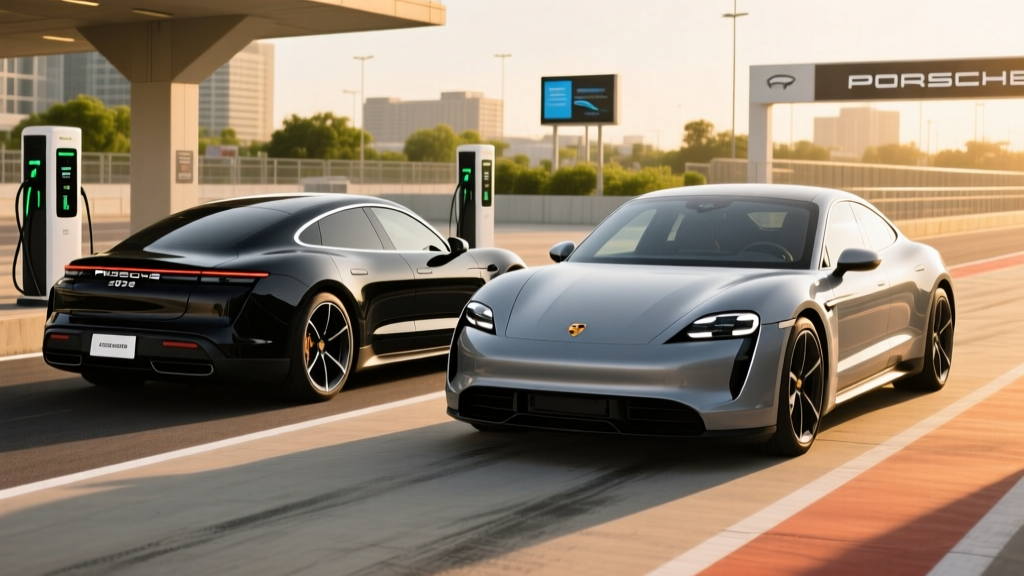
The search for porsche tesla usually means one thing: you're cross-shopping the 2026 Porsche Taycan against the Tesla Model S. Both are low-slung, dual-motor electric sedans with supercar-rivaling acceleration, but they diverge sharply on philosophy. The Taycan prioritizes chassis dynamics, 800-volt charging architecture, and build quality. The Model S leans on the Supercharger network, over-the-air feature updates, and a starting price roughly $20,000 lower. Neither is the wrong answer — they simply reward different owners.
Choose the Porsche Taycan if: you value steering feel, sustained high-speed composure, and 800V DC fast charging that peaks above 320 kW on the right hardware.
Choose the Tesla Model S if: you want access to 17,000+ Superchargers, more rear-seat and cargo space, and a lower entry price with comparable straight-line speed.
Side-by-Side Spec Table: Taycan vs Model S (2026)
| Specification | 2026 Porsche Taycan 4S | 2026 Tesla Model S Long Range |
|---|---|---|
| EPA Range | 318 mi (Performance Battery Plus) | 402 mi |
| Real-World Highway Range | ~255–275 mi | ~330–350 mi |
| Battery (Usable) | 97.0 kWh, NMC (Performance Plus pack) | ~100 kWh, NMC (4680 cells) |
| Max DC Fast Charge | 320 kW (800V architecture) | 250 kW (V3 Supercharger) |
| 10–80% DCFC Time | ~18 minutes | ~27 minutes |
| Level 2 Home Charge | 19.2 kW onboard (~60 mi/hr) | 11.5 kW onboard (~34 mi/hr) |
| 0–60 mph | 3.5 sec (Launch Control) | 3.1 sec |
| Horsepower | 590 hp (overboost) | 670 hp |
| Drivetrain | Dual-motor AWD, 2-speed rear axle | Dual-motor AWD |
| MPGe (Combined) | 83 MPGe | 120 MPGe |
| Efficiency | 41 kWh/100 mi | 28 kWh/100 mi |
| Cargo (Trunk + Frunk) | 14.3 cu ft (rear) + 2.9 cu ft (frunk) | 28.0 cu ft (rear hatch) + 3.1 cu ft (frunk) |
| Rear Legroom | 32.7 in | 35.4 in |
| Base MSRP | $103,800 | $79,990 |
| Federal Tax Credit (§30D) | Not eligible (MSRP & sourcing) | Not eligible (MSRP cap) |
| Battery Warranty | 8 yr / 100,000 mi (70% retention) | 8 yr / 150,000 mi (70% retention) |
Range & Efficiency: Tesla Wins on Miles, Porsche Wins on Replenishment Speed
EPA vs. Reality — Porsche Taycan 4S: The EPA sticker reads 318 miles with the Performance Battery Plus pack. On a 70-mph highway loop in moderate temperatures, expect 255–275 miles. In freezing conditions with cabin heat, plan for 220–240 miles.
EPA vs. Reality — Tesla Model S LR: The 402-mile EPA figure is among the highest of any sedan sold today. Real-world highway driving yields roughly 330–350 miles; cold-weather highway drops to ~280–300 miles.
The Model S's efficiency advantage is substantial: 28 kWh per 100 miles versus the Taycan's 41 kWh/100 mi. That's partly the Tesla's lighter curb weight (~4,561 lb vs ~5,121 lb for the Taycan 4S) and its single-speed reduction gear. The Taycan's 2-speed rear axle improves launch feel but adds mass and parasitic loss.
Where the Porsche claws back ground is at the charger. Its 800-volt electrical architecture — a segment first — accepts up to 320 kW at compatible DC fast chargers. On an Electrify America 350-kW pedestal with proper battery preconditioning, the Taycan 4S can add 10–80% in roughly 18 minutes. The Model S, capped at 250 kW on V3 Superchargers, takes about 27 minutes for the same 10–80% session. If your road trips involve frequent 15-minute stops, the Porsche's charge curve is a tangible advantage.
However, Tesla's Supercharger network remains the gold standard for plug-and-charge reliability. As of early 2026, there are over 17,000 Supercharger stalls in North America. Taycan owners rely on Electrify America, EVgo, and the growing NACS-adapter ecosystem — functional but less seamless than Tesla's integrated experience.
Charging Deep Dive: Home, DCFC, and Connector Compatibility
| Charging Level | Porsche Taycan 4S | Tesla Model S LR |
|---|---|---|
| Level 1 (120V, 12A) | ~1.4 kW / ~4 mi/hr | ~1.4 kW / ~5 mi/hr |
| Level 2 (240V, 48A) | 19.2 kW / ~60 mi/hr | 11.5 kW / ~34 mi/hr |
| Level 2 (240V, 80A — Taycan max) | 19.2 kW / ~60 mi/hr | N/A (11.5 kW onboard cap) |
| DC Fast Charge (peak) | 320 kW / ~18 min 10–80% | 250 kW / ~27 min 10–80% |
| Connector (2026 MY) | NACS (native, starting 2025 MY) | NACS (native) |
Both vehicles now ship with the NACS (North American Charging Standard) port as of the 2025–2026 model years, eliminating the CCS-to-NACS adapter hassle that plagued early Taycan owners. At home, the Taycan's 19.2-kW onboard charger is a standout — it can fully replenish the 97-kWh battery in about 5.5 hours on a properly wired 80-amp circuit. The Model S caps at 11.5 kW, meaning a full charge takes closer to 9 hours on a 48-amp Level 2 wall connector.
Home install note: The Taycan's 19.2-kW charging demands a 100-amp breaker and 80-amp continuous circuit — many homes will require a panel upgrade ($1,500–$3,500). The Model S's 11.5-kW draw works on a more common 60-amp breaker / 48-amp circuit. Always consult a licensed electrician before committing to equipment.
Both vehicles support battery preconditioning — the Taycan activates it when a DC fast charger is entered into navigation, warming the pack to ~35°C (95°F) for optimal charge acceptance. Skipping preconditioning can add 5–8 minutes to a 10–80% session in cold weather.
Performance: Launch, Handling, and the Two-Second Question
On paper, the Model S Long Range hits 60 mph in 3.1 seconds versus the Taycan 4S's 3.5 seconds. If you step up to the Taycan Turbo S (2.4 sec, $190,900) or the Model S Plaid (1.99 sec, $89,990), both enter hypercar territory. But straight-line numbers only tell part of the story.
The Taycan's 2-speed rear transmission gives it a visceral launch character — there's a perceptible shift around 55 mph that no other EV replicates. Its steering is communicative, its brake pedal blends regen and friction braking seamlessly, and its adaptive air suspension keeps the body flat through high-speed sweepers. On a back road or track, the Taycan feels like a sports car that happens to be electric.
The Model S is brutally quick but more isolated. The yoke steering (standard; round wheel now a no-cost option) takes adaptation, and the chassis, while competent, prioritizes grand-touring comfort over corner-carving feedback. The Plaid's tri-motor setup delivers extraordinary traction, but at 4,766 pounds, you feel the mass during direction changes.
Interior, Tech & Driver Assistance
Both cabins are screen-dominant, but the execution differs. The Taycan uses a curved 16.8-inch driver display, a 10.9-inch center touchscreen, and an optional 10.9-inch passenger screen. Material quality is exceptional — available leather, Race-Tex (microfiber), and real aluminum or wood trim. The haptic-feedback climate strip below the center screen looks sleek but draws fingerprints and lacks the tactile precision of physical knobs.
The Model S centers on a 17-inch landscape touchscreen that controls nearly everything, supplemented by a small rear passenger display. Build quality has improved markedly since the 2021 refresh, with ventilated seats, premium audio, and a yoke or round wheel. The glass roof lets in enormous light but can raise cabin temperatures in summer — the Taycan's available solar-panel glass roof is a clever alternative that trickle-charges the 12V battery.
Driver assistance: Both vehicles offer SAE Level 2 driver-assist systems. Tesla's Autopilot (standard) and available FSD (Supervised) handle lane centering, adaptive cruise, and automatic lane changes on highways. Porsche's InnoDrive with Active Lane Keeping provides adaptive cruise with predictive speed adjustment based on navigation data (curves, roundabouts, speed limits). Neither system is "self-driving" — both require continuous driver supervision per NHTSA guidelines.
ADAS Reality Check: Tesla FSD (Supervised) and Porsche InnoDrive are both SAE Level 2 systems. The driver must keep hands on or near the wheel and eyes on the road at all times. These are not autonomous driving systems. Only Level 4 robotaxi services (Waymo, Zoox) operate without a human driver in geofenced areas.
Pricing, Trims & Federal Tax Credit Eligibility
| Trim | 2026 MSRP | Federal §30D Credit | Effective Price |
|---|---|---|---|
| Taycan (base, RWD) | $92,250 | $0 (MSRP cap) | $92,250 |
| Taycan 4S | $103,800 | $0 (MSRP cap) | $103,800 |
| Taycan Turbo | $163,800 | $0 | $163,800 |
| Taycan Turbo S | $190,900 | $0 | $190,900 |
| Model S Long Range | $79,990 | $0 (MSRP cap) | $79,990 |
| Model S Plaid | $89,990 | $0 (MSRP cap) | $89,990 |
Neither the Taycan nor the Model S qualifies for the IRS §30D federal EV tax credit in 2026. The reasons differ:
- Sedan MSRP cap: §30D limits new EV credits to sedans priced at or below $55,000. Both vehicles exceed this threshold at every trim level.
- Battery sourcing: Even if pricing were eligible, the Taycan's battery cells (sourced from LG Energy Solution and CATL with varying supply chains) and the Model S's critical-mineral sourcing may not satisfy the escalating domestic-content requirements for 2026.
- Buyer income cap: §30D also limits eligibility to taxpayers with AGI at or below $150,000 (single) or $300,000 (joint). Many buyers in this price range exceed those limits.
State incentives may apply. States like California, Colorado, and Massachusetts offer additional rebates or HOV-lane access that can offset cost. Check your state's energy office or DMV for current programs.
Ownership Costs: Warranty, Insurance & Depreciation
Both vehicles carry 8-year battery and powertrain warranties, but mileage limits differ: Porsche covers 100,000 miles, while Tesla extends to 150,000 miles. Both guarantee a minimum of 70% battery capacity retention over the warranty period — a threshold that, based on current degradation data from fueleconomy.gov and owner surveys, most packs clear comfortably past 150,000 miles.
Insurance is a meaningful expense for both. Average annual premiums for the Taycan 4S run $3,200–$4,100 depending on state and driver profile; the Model S Long Range averages $2,800–$3,600. Tesla's own insurance program (available in most states) uses real-time driving data and can be 15–25% cheaper for safe drivers.
Depreciation favors the Model S slightly, which retains roughly 52–56% of value after three years versus the Taycan's 48–52%. Both suffer the luxury-EV depreciation curve, which is steeper than mainstream EVs due to rapid tech iteration and high initial MSRPs.
Pros & Cons at a Glance
Porsche Taycan 4S — Pros
- Class-leading 320-kW DC fast charging (10–80% in ~18 min)
- 19.2-kW onboard Level 2 charger (fastest in segment)
- Superior steering feel, chassis balance, and brake blending
- Premium interior materials and build quality
- 2-speed rear axle gives unique launch character
Porsche Taycan 4S — Cons
- 318-mi EPA range trails Model S by 84 miles
- Lower efficiency (41 kWh/100 mi) means higher electricity cost
- Tight rear seat (32.7 in legroom) and modest 14.3 cu ft trunk
- $103,800 starting price with no federal tax credit
- Requires 80-amp home circuit for max Level 2 speed
Tesla Model S LR — Pros
- 402-mi EPA range — one of the longest of any EV sedan
- 120 MPGe combined; 28 kWh/100 mi is highly efficient
- Native Supercharger network access (17,000+ stalls)
- 28.0 cu ft hatchback cargo area + 35.4 in rear legroom
- $79,990 starting price — $23,810 less than Taycan 4S
Tesla Model S LR — Cons
- 250-kW DCFC cap (10–80% in ~27 min) is slower than Taycan
- 11.5-kW onboard charger limits home charging speed
- Less communicative steering and chassis feedback
- Minimal physical controls — everything routed through touchscreen
- No federal tax credit (exceeds $55K sedan MSRP cap)
Who Should Buy Which?
The Porsche Taycan is best for: driving enthusiasts who prioritize handling precision, charging speed over total range, and interior craftsmanship. If your typical road trip involves 200-mile legs with a planned fast-charge stop, the Taycan's 320-kW replenishment makes it remarkably practical. It's also the pick for buyers who want a performance sedan that doesn't look or feel like a tech appliance.
The Tesla Model S is best for: efficiency-focused commuters, families needing usable rear seats and hatchback cargo space, and road trippers who value Supercharger convenience over peak charge speed. If you regularly drive 300+ miles between stops, the Model S's 402-mile range is a genuine stress reducer. It's also the value play — saving nearly $24,000 at base price buys a lot of home-charging infrastructure or insurance coverage.
Frequently Asked Questions
What is the real-world range of the Porsche Taycan and Tesla Model S?
The Taycan 4S (318-mi EPA) delivers roughly 255–275 miles on the highway in mild weather, dropping to 220–240 miles in freezing conditions. The Model S Long Range (402-mi EPA) achieves 330–350 highway miles in moderate temps and 280–300 in cold weather. Both figures assume 70–75 mph cruising with climate control active.
How fast do they charge at home and on the road?
At home on Level 2, the Taycan adds ~60 miles per hour at its 19.2-kW max, while the Model S adds ~34 miles per hour at 11.5 kW. On DC fast chargers, the Taycan peaks at 320 kW (10–80% in ~18 min) versus the Model S at 250 kW (~27 min). Both now use the NACS connector natively.
Do either qualify for the $7,500 federal EV tax credit?
No. Both exceed the $55,000 MSRP cap for sedans under IRS §30D rules. Additionally, buyer income limits ($150K single / $300K joint AGI) and battery critical-mineral sourcing requirements further restrict eligibility. Consult a tax professional and check IRS.gov for the latest rules.
Is the Porsche Taycan worth the premium over the Tesla Model S?
If driving dynamics, charging speed, and interior quality are your top priorities, the Taycan's ~$24,000 premium is justified. If range, efficiency, cargo space, and value matter more, the Model S is the stronger choice. Neither is objectively better — they optimize for different owners.
Which has better long-term battery reliability?
Both use NMC (nickel-manganese-cobalt) chemistry with liquid thermal management and are warranted for 8 years. Tesla covers 150,000 miles to Porsche's 100,000. Real-world degradation data from high-mileage owners of both platforms shows ~8–12% capacity loss at 100,000 miles — well within warranty thresholds.
Can I use Tesla Superchargers with the Porsche Taycan?
Yes. Starting with the 2025 model year, the Taycan ships with a native NACS port, granting access to Tesla's Supercharger network without an adapter. Earlier model-year Taycans with CCS ports require a Tesla-approved CCS-to-NACS adapter, available from Porsche dealers.