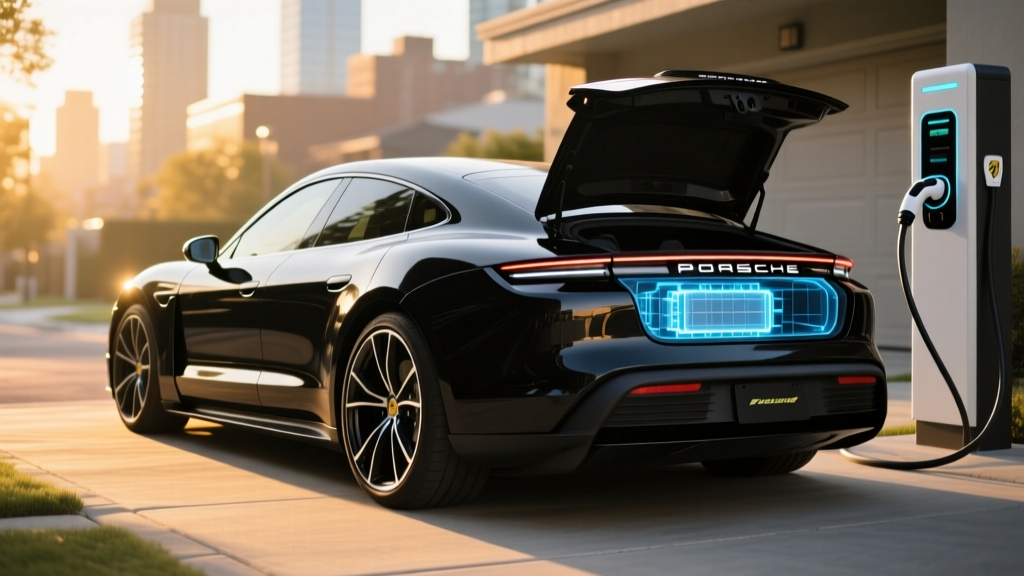
The 2026 Porsche Taycan Turbo S sits at the apex of the electric sports sedan segment—a vehicle that attempts to reconcile a 952-horsepower dual-motor powertrain with daily-drivable efficiency and long-distance charging practicality. After the significant 2025 refresh that introduced the larger Performance Battery Plus and dramatically improved charging speeds, the 2026 model year carries forward with minor equipment adjustments and updated pricing. For buyers researching the Porsche Taycan Turbo S as a potential purchase, the real questions extend well beyond the 2.4-second 0-60 time: What's the actual highway range? How does the 320 kW peak charge rate translate to real charging stops? And does a six-figure EV sports sedan qualify for any federal incentives?
This review covers every spec that matters for ownership, with the real-world caveats that manufacturer brochures leave out.
Quick Verdict: Who Should Buy the Taycan Turbo S?
The Taycan Turbo S is engineered for a specific buyer: someone who prioritizes driving dynamics, sustained performance, and 800-volt charging architecture above maximum range or cargo practicality. It excels as a grand-touring daily driver for enthusiasts who want repeatable track-capable performance without sacrificing long-distance road-trip capability. It is not the right choice for buyers who need maximum rear-seat space, frunk utility, or the longest possible range per charge. Competitors like the Tesla Model S Plaid offer more range for less money; the Lucid Air Sapphire delivers comparable performance with superior efficiency. The Taycan Turbo S justifies its premium through chassis tuning, build quality, and the most repeatable high-performance acceleration in the segment.
Range, Battery, and Real-World Efficiency
EPA Estimated Range: 292 miles (with Performance Battery Plus, 19" wheels)
Real-World Highway (70-75 mph): Expect 230–255 miles in moderate temperatures
Cold-Weather Highway (below 32°F): Expect 195–220 miles without preconditioning
City/Commuting (with regen): 270–290 miles achievable
The 2026 Taycan Turbo S uses Porsche's updated Performance Battery Plus pack with a usable capacity of 105 kWh (109.3 kWh gross). The battery employs NMC (nickel manganese cobalt) chemistry in a cell-to-module configuration, chosen for its high energy density and power delivery characteristics—critical for a vehicle that can discharge at rates exceeding 700 kW during launch control activations.
The EPA's 292-mile rating applies to the sedan body style equipped with 19-inch wheels. Opting for the available 20-inch or 21-inch wheel packages reduces that figure by approximately 10-15 miles due to increased rolling resistance and unsprung weight. The Cross Turismo (wagon) variant sacrifices roughly 8-12 miles of range due to its less aerodynamic profile.
Efficiency on the combined EPA cycle rates at 79 MPGe, translating to approximately 43 kWh per 100 miles. In real-world highway driving at 75 mph, expect consumption closer to 48-52 kWh/100mi—the Taycan Turbo S's performance-oriented tire compound, aggressive aero tuning for downforce rather than pure drag reduction, and 5,000+ pound curb weight all work against highway efficiency. This is a meaningful consideration: on a 300-mile road trip at interstate speeds, you will plan one DC fast-charge stop.
| Spec | Value |
|---|---|
| EPA Range (19" wheels) | 292 miles |
| Battery (Usable / Gross) | 105 kWh / 109.3 kWh — NMC |
| Drivetrain | Dual-motor AWD |
| Horsepower (Launch Control) | 952 hp (710 kW) |
| 0-60 mph | 2.4 seconds |
| Top Speed | 162 mph (electronically limited) |
| Max DC Fast Charge | 320 kW (peak) |
| 10-80% DC Charge Time | ~18 minutes |
| Level 2 AC Charge Rate | 11.0 kW (standard) / 19.2 kW (optional onboard charger) |
| Combined Efficiency | 79 MPGe / 43 kWh/100mi |
| Base MSRP | $190,900 |
Charging Speed: DC Fast, Level 2, and the 800-Volt Advantage
The Taycan's 800-volt architecture remains one of its most significant engineering advantages. While most EVs use 400V systems that peak at 150-250 kW on DC fast chargers, the Taycan Turbo S can accept up to 320 kW at compatible chargers—though this peak is only sustainable for a narrow portion of the charge curve.
| Charging Level | Power (kW) | Miles Added/Hour | Time (10-80%) |
|---|---|---|---|
| Level 1 (120V / 12A) | ~1.4 kW | ~3 mi/hr | ~56 hours |
| Level 2 (240V / 48A, 11 kW onboard) | 11.0 kW | ~24 mi/hr | ~9.5 hours |
| Level 2 (240V / 80A, 19.2 kW onboard) | 19.2 kW | ~42 mi/hr | ~5.5 hours |
| DC Fast (150 kW station) | 150 kW | ~320 mi/hr | ~33 minutes |
| DC Fast (350 kW station) | 320 kW (peak) | ~690 mi/hr (peak) | ~18 minutes |
Charging curve reality: The 320 kW peak is achievable between approximately 10-30% state of charge, assuming battery preconditioning is active and ambient temperatures are favorable (60-85°F). Above 50% SoC, the rate tapers to roughly 200 kW, and above 80% it drops sharply to protect battery longevity—typical of NMC chemistry. On a 350 kW Electrify America or IONITY station, the 10-80% charge completes in approximately 18 minutes. On more common 150 kW infrastructure, plan for 30-35 minutes.
The Taycan Turbo S uses the CCS (Combined Charging System) connector in North America, though Porsche has confirmed NACS adapter availability for Tesla Supercharger network access. Preconditioning activates automatically when a DC fast charger is set as a navigation destination, warming or cooling the battery pack to its optimal charging temperature window.
For home charging, the standard 11 kW onboard charger adds roughly 24 miles of range per hour—adequate for overnight replenishment of daily driving. The optional 19.2 kW onboard charger (a $1,620 upgrade) cuts that time nearly in half and is recommended for buyers who regularly deplete more than 150 miles per day.
Performance: 952 Horsepower, Repeatable Launches
The dual-motor AWD powertrain produces 952 horsepower (710 kW) and 828 lb-ft of torque when Launch Control is engaged—a 178-hp increase over the previous-generation Turbo S made possible by the updated rear motor and higher-discharge battery calibration. The 0-60 mph time of 2.4 seconds is among the quickest of any production vehicle, and more importantly, Porsche's thermal management system allows consecutive launch-control starts without power degradation—something many competitors cannot claim.
The two-speed transmission on the rear axle (first gear for maximum acceleration, second gear for efficiency and top speed) is a distinguishing engineering choice that contributes to both the violent off-the-line performance and reasonable highway efficiency. Top speed is electronically limited to 162 mph.
Adaptive air suspension with Porsche Active Suspension Management (PASM), rear-axle steering, and Porsche Dynamic Chassis Control (PDCC) active anti-roll bars are all standard on the Turbo S. The result is a vehicle that manages its 5,145-pound curb weight with composure that defies physics—body roll is nearly eliminated in Sport Plus mode, and the torque-vectoring system delivers power to the axle with the most traction in real time.
Interior, Cargo, and Daily Practicality
The Taycan Turbo S interior follows Porsche's design language with a curved 16.8-inch digital instrument cluster, a 10.9-inch central infotainment touchscreen, and an optional 10.9-inch passenger display. The center console houses a secondary 8.4-inch touchscreen for climate and handwriting input. Apple CarPlay and Android Auto are wireless; a 14-speaker Bose surround system is standard, with a 21-speaker Burmester system available.
Where the Taycan Turbo S concedes ground to rivals is cargo and rear-seat space:
- Front trunk (frunk): 2.9 cu ft — enough for a charging cable bag and a small duffel
- Rear trunk (sedan): 14.3 cu ft — competitive with a compact sedan, not a luxury GT
- Rear legroom: 32.7 inches — adequate for adults on shorter trips, tight for tall passengers on long hauls
- Rear headroom: 37.8 inches (sedan); Cross Turismo variant adds 0.9 inches
The rear seat is best suited for two passengers; the center position is essentially a padded armrest. For buyers who regularly carry rear-seat adults or need substantial cargo capacity, the Taycan Cross Turismo (wagon) or a competitor like the Lucid Air (which offers 32 cu ft of trunk space) will serve better.
Pricing, Trims, and Federal Tax Credit Eligibility
The 2026 Porsche Taycan Turbo S sedan starts at a base MSRP of $190,900, including the $1,650 destination charge. The Turbo S Cross Turismo starts at $197,400. Porsche's options structure can push a well-equipped Turbo S past $220,000 with additions like the Burmester audio ($5,810), Porsche InnoDrive with adaptive cruise ($2,500), rear-axle steering (standard on Turbo S), and various leather/trim packages.
| Item | Amount |
|---|---|
| Base MSRP (Sedan) | $190,900 |
| Base MSRP (Cross Turismo) | $197,400 |
| Typical As-Tested Price | $205,000 – $220,000 |
| Federal §30D Tax Credit | Not eligible — exceeds $55,000 sedan MSRP cap |
| State/Local Incentives | Varies by jurisdiction; check DSIRE and state energy office |
Federal tax credit reality: Under IRS §30D rules, the Taycan Turbo S does not qualify for the $7,500 federal EV tax credit. The credit's MSRP cap for sedans is $55,000, and the Taycan Turbo S at $190,900 exceeds this by a factor of nearly four. This is a non-negotiable statutory limitation—not a battery-sourcing or income-cap issue. Buyers should not factor any federal credit into their purchase math. State-level incentives (where available) may apply; consult your state energy office or the DSIRE incentive database for current local programs. For the latest IRS rules, refer to IRS.gov §30D guidance.
Driver Assistance and Technology
The Taycan Turbo S includes Porsche InnoDrive as an available upgrade—a predictive adaptive cruise and lane-keeping system that uses navigation data, traffic sign recognition, and radar to adjust speed for upcoming curves, intersections, and speed limits. This is an SAE Level 2 driver-assistance system, meaning the driver must remain fully engaged with hands on the wheel and eyes on the road at all times. It is not autonomous or self-driving.
Porsche InnoDrive and all Taycan driver-assist features operate at SAE Level 2. The driver is legally and operationally responsible for the vehicle at all times. Hands-on-wheel monitoring is enforced. This is not comparable to Level 4 robotaxi services like Waymo.
Standard safety features include forward collision warning with automatic emergency braking, lane departure warning, surround-view camera, and night vision assist with pedestrian detection. The Taycan has not been crash-tested by NHTSA as of early 2026; IIHS ratings should be consulted when available.
Warranty, Battery Longevity, and Ownership Costs
Porsche covers the Taycan Turbo S with the following warranty structure:
- Limited vehicle warranty: 4 years / 50,000 miles
- Battery warranty: 8 years / 100,000 miles (retains ≥70% capacity)
- Powertrain warranty: 8 years / 100,000 miles
- Corrosion perforation: 12 years / unlimited miles
The 70% capacity retention threshold on the battery warranty is industry-standard for premium EVs. Real-world degradation data for the updated 105 kWh NMC pack is still maturing (the larger pack debuted for the 2025 model year), but early fleet data and Porsche's thermal management track record suggest 8-12% degradation over 100,000 miles is a reasonable expectation for mixed-use driving with regular DC fast charging.
Ownership costs skew high. Insurance premiums for the Taycan Turbo S average 30-50% above comparable internal-combustion Porsche 911 models, driven by repair-cost data and the vehicle's MSRP. Scheduled maintenance is lighter than a gas equivalent (no oil changes, fewer brake replacements thanks to aggressive regen), but Porsche's service labor rates and parts pricing apply. Tire replacement is a significant line item: the Michelin Pilot Sport EV tires fitted to 21-inch wheels run approximately $450-$550 per corner and may need replacement at 15,000-20,000 miles under spirited driving.
Pros and Cons
- Class-leading repeatable launch performance (no power fade on consecutive starts)
- 800V architecture enables 320 kW peak DC charging — among the fastest in production
- Exceptional chassis composure and steering feel for a 5,100+ lb EV
- Build quality, materials, and fit/finish at the top of the EV sedan segment
- Two-speed rear transmission optimizes both acceleration and highway efficiency
- EPA range (292 mi) trails Tesla Model S and Lucid Air significantly
- Rear seat and cargo space are tight for the price point
- No federal tax credit eligibility — MSRP far exceeds §30D cap
- Insurance and tire replacement costs are substantial
- CCS native connector requires adapter for Tesla Supercharger access
- Infotainment system lags behind Tesla and Lucid in responsiveness
How It Stacks Up: Taycan Turbo S vs. Key Competitors
| Spec | Porsche Taycan Turbo S | Tesla Model S Plaid | Lucid Air Sapphire |
|---|---|---|---|
| Base MSRP | $190,900 | $108,490 | $250,500 |
| EPA Range | 292 mi | 396 mi | 427 mi |
| Horsepower | 952 hp | 1,020 hp | 1,234 hp |
| 0-60 mph | 2.4 sec | 1.99 sec | 1.89 sec |
| Peak DC Charge | 320 kW | 250 kW | 300+ kW |
| Cargo (trunk + frunk) | 17.2 cu ft | 28.0 cu ft | 32.0 cu ft |
| Federal Tax Credit | No (MSRP cap) | No (MSRP cap) | No (MSRP cap) |
Choose the Taycan Turbo S if: You prioritize chassis dynamics, steering feel, and build quality above all else, and you accept the range and price trade-offs. The Porsche is the driver's choice—its steering communication and suspension tuning remain unmatched in the EV sedan segment.
Choose the Model S Plaid if: You want the best combination of straight-line speed, range, and value. The Plaid is quicker, goes 100+ miles farther per charge, and costs $82,000 less—though interior materials and ride refinement don't match Porsche's standard.
Choose the Lucid Air Sapphire if: Budget is not a constraint and you want the most powerful production sedan available with class-leading range and efficiency. The Sapphire is a technical showcase, but its $250K+ price and limited service network are significant considerations.
Frequently Asked Questions
What is the real-world range of the Porsche Taycan Turbo S?
The EPA rates the 2026 Taycan Turbo S at 292 miles with 19-inch wheels. In real-world highway driving at 70-75 mph in moderate temperatures, expect 230-255 miles before needing to charge. Cold weather (below 32°F) without battery preconditioning can drop usable range to 195-220 miles. City driving with regenerative braking recovers more energy, making 270+ miles achievable in stop-and-go commuting.
How fast does the Taycan Turbo S charge at home and on the road?
On a 350 kW DC fast charger with battery preconditioning active, the 10-80% charge takes approximately 18 minutes (320 kW peak). On a 150 kW charger, plan for 30-35 minutes. At home on a standard 48-amp Level 2 circuit (11 kW), the Taycan adds about 24 miles of range per hour, or roughly 230 miles overnight in 10 hours. The optional 19.2 kW onboard charger cuts home charging time nearly in half.
Does the Porsche Taycan Turbo S qualify for the federal EV tax credit?
No. Under IRS §30D rules, new EV sedans must have an MSRP at or below $55,000 to qualify for the $7,500 federal tax credit. The Taycan Turbo S at $190,900 exceeds this cap by a wide margin. There are no workarounds. State and local incentives may still apply depending on your jurisdiction—check the DSIRE database and your state energy office for details.
Is the Taycan Turbo S worth buying over a Tesla Model S Plaid?
It depends on what you value. The Model S Plaid is quicker (1.99s 0-60), has 104 more miles of EPA range, and costs $82,000 less. The Taycan Turbo S offers superior steering feel, more repeatable performance under thermal stress, higher-quality interior materials, and 800V charging that outpaces the Tesla on compatible infrastructure. If driving dynamics and build quality are your priorities, the Porsche premium is justified. If range-per-dollar and straight-line speed dominate your decision, the Plaid wins on paper.
What is the battery warranty, and how long will the Taycan's battery last?
Porsche warranties the battery for 8 years or 100,000 miles, guaranteeing at least 70% of original capacity retention. NMC chemistry with Porsche's active liquid thermal management typically shows 8-12% degradation over 100,000 miles in mixed driving. Battery replacement (out of warranty) is estimated at $25,000-$35,000 based on current parts pricing, though this figure is expected to decline as battery costs continue to fall industry-wide.
What connector does the Taycan Turbo S use for charging?
The 2026 Taycan Turbo S uses the CCS1 (Combined Charging System) connector native to North America for DC fast charging, and a J1772 inlet for Level 2 AC charging. Porsche offers a NACS adapter for access to the Tesla Supercharger network, which is increasingly important as Tesla's network remains the largest and most reliable DC fast-charging infrastructure in the U.S.
Sources: fueleconomy.gov (EPA range/efficiency data), IRS.gov (§30D tax credit rules), Porsche USA official specifications. Pricing and specifications reflect 2026 model year as published; verify with your local Porsche dealer before purchase. Tax credit eligibility is subject to change—consult a tax professional.