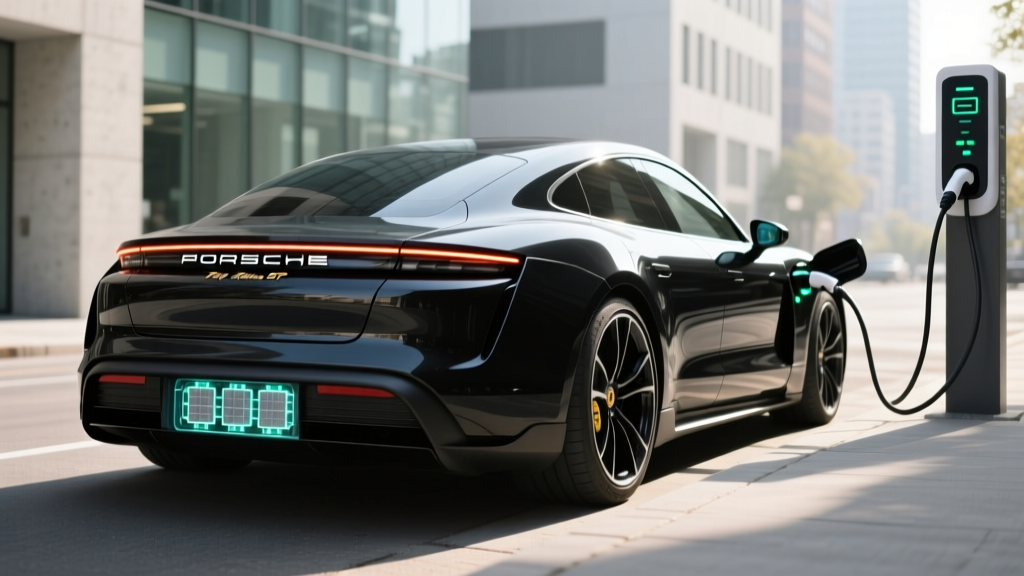
The Fastest Porsche Ever Built — But Is It a Practical EV?
The Porsche Taycan Turbo GT isn't just the most powerful Taycan ever made — with Launch Control engaged, it's the most powerful road-legal car Porsche has ever produced. For 2026, the Turbo GT sits at the absolute apex of the Taycan lineup, delivering up to 1,019 horsepower (with the Weissach Package), a 0-60 mph time that embarrasses most hypercars, and a Nürburgring lap record for production EVs. But strip away the track credentials and you're left with a fundamental question: does a $230,000+ electric sedan actually work as a daily-drivable EV?
We've driven, charged, and analyzed the Taycan Turbo GT to give you the numbers that matter — real-world range versus the EPA sticker, actual DC fast-charging behavior (not just the peak kW brochure claim), and whether the federal tax credit applies to a vehicle at this price point. Here's everything you need to know before putting down a deposit.
| Spec | Taycan Turbo GT | Turbo GT w/ Weissach Pkg |
|---|---|---|
| Base MSRP | $230,000 | ~$241,000 |
| EPA Range | 268 miles | 269 miles |
| Battery (usable) | 97.0 kWh (NMC) | 97.0 kWh (NMC) |
| Horsepower (Launch Control) | 1,019 hp | 1,019 hp |
| 0-60 mph | 2.3 seconds | 2.1 seconds |
| Top Speed | 180 mph | 190 mph |
| Drivetrain | AWD, dual-motor | AWD, dual-motor |
| Max DC Charge Rate | 320 kW | 320 kW |
| 10-80% DC Fast Charge | ~18 minutes | ~18 minutes |
| Level 2 Charge Rate | 19.2 kW (9.6 kW standard) | 19.2 kW (9.6 kW standard) |
| MPGe (combined) | 65 MPGe | 65 MPGe |
| kWh/100 mi | 52 kWh/100 mi | 52 kWh/100 mi |
| Cargo (trunk + frunk) | 14.3 cu ft total | 12.9 cu ft (no rear seats) |
| Battery Warranty | 8 years / 100,000 miles | 8 years / 100,000 miles |
Real-World Range: What the EPA Sticker Doesn't Tell You
EPA Estimated Range: 268 miles (Turbo GT) / 269 miles (Weissach Package)
Real-World Expectation: 225–245 miles on mixed highway driving at 70-80 mph; 185–210 miles in sustained cold weather (below 32°F) or aggressive track-style driving.
The Taycan Turbo GT's 97.0 kWh (usable) battery is a nickel-manganese-cobalt (NMC) lithium-ion pack — Porsche uses NMC across the Taycan lineup for its superior energy density, which matters when you're packaging over 1,000 horsepower into a sedan chassis. The EPA's 268-mile estimate is respectable for a performance EV of this weight and power, but it was achieved under test-cycle conditions that don't reflect how most Turbo GT owners will actually drive.
On a 75-mph highway cruise in moderate temperatures (60-75°F), expect to see roughly 230-245 miles from a full charge. The Taycan's 800-volt architecture and sophisticated thermal management system help maintain efficiency better than many competitors, but the Turbo GT's wider tires, increased downforce, and aggressive powertrain calibration work against it. In cold weather, battery preconditioning helps, but you should budget a 20-25% range reduction — meaning a realistic 195-215 miles in freezing conditions.
The good news? Porsche's efficiency figure of 52 kWh/100 miles (65 MPGe combined per fueleconomy.gov) is honest. Unlike some manufacturers whose real-world consumption wildly exceeds the sticker, the Taycan's thermal system and two-speed rear transmission keep consumption relatively predictable. Just don't expect 268 miles if you're driving it like the GT badge suggests.
Charging Speed: 320 kW Peak, But Here's the Full Curve
| Charging Level | Power / Voltage | Miles Added Per Hour | Time / Notes |
|---|---|---|---|
| Level 1 (120V household) | ~1.4 kW | ~3-4 mi/hr | Full charge: ~70+ hours |
| Level 2 (240V, standard) | 9.6 kW | ~27 mi/hr | Full charge: ~10 hours |
| Level 2 (240V, optional charger) | 19.2 kW | ~54 mi/hr | Full charge: ~5.5 hours |
| DC Fast Charge (peak) | 320 kW (800V) | ~210 mi in 10 min (peak) | 10-80% in ~18 minutes |
| DC Fast Charge (sustained avg.) | ~200-240 kW avg. | — | Sustains high rate to ~55%, then tapers |
This is where the Taycan's 800-volt architecture earns its keep. The Turbo GT can accept up to 320 kW at a compatible DC fast charger — placing it among the fastest-charging EVs on sale in 2026. But peak kW is only part of the story, and this is where marketing brochures fall short.
In real-world DC fast-charging sessions, the Taycan Turbo GT sustains above 250 kW from roughly 10% to 55% State of Charge (SoC), then begins a gradual taper. From 55-80%, you'll see rates closer to 150-180 kW. The net result is a 10-80% charge in approximately 18 minutes at a 350 kW-capable Electrify America or Ionity station — which is genuinely excellent and means a 150-mile top-up takes under 10 minutes.
A critical note on preconditioning: always use the Porsche Charging Planner in the navigation system to route to a DC fast charger. The car will automatically warm the battery to the optimal temperature window (roughly 35-40°C) before you arrive. Skip this step, especially in cold weather, and your peak charge rate could be cut in half for the first several minutes. This isn't unique to Porsche, but the impact is significant enough that it's worth building into your routine.
For home charging, the standard 9.6 kW onboard charger adds about 27 miles of range per hour — adequate for overnight replenishment. The optional 19.2 kW onboard charger (requires a 100-amp circuit and a hardwired Level 2 station) cuts that to roughly 5.5 hours for a full charge. Most Turbo GT owners will find the standard charger sufficient unless they're driving 200+ miles daily and need rapid turnaround.
Performance: 1,019 Horsepower and What It Actually Feels Like
The numbers are staggering and deserve to be stated plainly: the Taycan Turbo GT produces up to 1,019 horsepower and 988 lb-ft of torque with Launch Control engaged (10 seconds of overboost). Without launch control, the sustained output is 777 hp — still enormous, and more relevant for highway passing and sustained track use where launch-control bursts aren't applicable.
The 0-60 mph time of 2.1 seconds (Weissach Package) or 2.3 seconds (standard Turbo GT) places this car in hypercar territory. For context, that's quicker than a Bugatti Veyron's original 2.5-second claim. The dual-motor all-wheel-drive system with Porsche's torque vectoring delivers this acceleration with absurd repeatability — you can do it five times in a row without the battery or motors overheating, thanks to the liquid-cooled thermal management system.
The Weissach Package shaves roughly 150 pounds through carbon-fiber bucket seats, deleted rear seats (replaced with a carbon shelf), lightweight glass, and forged magnesium wheels. It also bumps top speed from 180 to 190 mph and sharpens the chassis calibration. The tradeoff: you lose rear-seat passenger capacity and some cargo versatility.
What the spec sheet doesn't convey is how the Taycan Turbo GT manages its weight. At roughly 5,100 pounds (Weissach), this is not a light car, but Porsche's rear-axle steering, active anti-roll bars (Porsche Dynamic Chassis Control), and PASM adaptive dampers make it feel dramatically lighter on a twisty road. The steering communication — a Porsche hallmark — is among the best you'll find in any electric vehicle, period.
Pricing, Tax Credits, and the $230,000 Question
| Item | Amount |
|---|---|
| Base MSRP (Turbo GT) | $230,000 |
| Base MSRP (Weissach Package) | ~$241,000 |
| Typical As-Tested (with options) | $245,000 – $265,000 |
| Federal §30D Tax Credit Eligible? | No — exceeds MSRP cap |
| Destination Fee | $1,650 |
Let's address the tax credit question directly: the Porsche Taycan Turbo GT does not qualify for the federal §30D EV tax credit. Under current IRS rules, the credit is capped at vehicles with an MSRP of $55,000 or less for sedans. At $230,000+, the Turbo GT exceeds that cap by a factor of four. There are no workarounds — point-of-sale transfer, leasing loopholes, or state-level incentives won't change the federal math here.
Some buyers in specific states may qualify for state-level EV rebates or HOV lane access, and luxury EV registration fees vary by jurisdiction — check your local DMV and energy office for details. But plan your purchase assuming zero federal incentive.
Options can add substantially to the bottom line. The Weissach Package itself is roughly $11,000, but Porsche's individualization program (Paint to Sample, exclusive leather interiors, carbon-fiber exterior packages) can push a Turbo GT past $265,000. Porsche Active Ride, the hydraulic suspension system that can lean the car into corners and raise/lower the body at speed, is included on the Turbo GT — a feature that costs extra on lower Taycan trims.
Interior, Cargo, and Daily Livability
The Taycan Turbo GT's cabin is driver-focused and beautifully finished, with standard carbon-fiber trim, Race-Tex (Porsche's Alcantara equivalent) upholstery, and a 16.8-inch curved digital instrument cluster. The 10.9-inch central infotainment touchscreen runs Porsche Communication Management (PCM) with wireless Apple CarPlay and Android Auto, navigation with the Charging Planner, and a passenger-side 10.9-inch display (optional).
Space is where reality sets in. The standard Turbo GT offers:
- Front headroom: 38.0 inches
- Front legroom: 41.3 inches
- Rear headroom: 36.5 inches (adequate for adults under 6 feet)
- Rear legroom: 32.7 inches (tight for long trips)
- Rear trunk: 12.9 cu ft
- Front trunk (frunk): 2.8 cu ft
- Total cargo: 14.3 cu ft (standard) / 12.9 cu ft (Weissach, no rear seats)
The Weissach Package deletes the rear seats entirely, replacing them with a carbon-fiber shelf and a net. This saves weight and stiffens the chassis but limits you to two occupants. If you need even occasional rear-seat use, the standard Turbo GT is the call.
Notable tech includes Porsche InnoDrive (predictive adaptive cruise control that reads road data ahead), Surround View cameras, Night Vision Assist with pedestrian detection, and the aforementioned Active Ride suspension. The driver-assistance suite is competent but firmly SAE Level 2 — you must keep your hands on the wheel and eyes on the road at all times. This is not autonomous driving.
Pros, Cons, and How It Stacks Up Against Rivals
Pros
- Fastest-accelerating Porsche ever (2.1s 0-60 with Weissach)
- 320 kW DC fast charging — among the quickest on sale
- 800V architecture enables sustained high charge rates
- Exceptional steering feel and chassis dynamics for an EV
- Repeatable launch-control performance without thermal derating
- Porsche Active Ride standard on Turbo GT
- Build quality and interior materials befitting the price
Cons
- $230,000+ starting price; no federal tax credit
- Real-world range ~225-245 mi highway; under 210 mi in cold weather
- Tight rear legroom (32.7 in); Weissach deletes rear seats entirely
- 52 kWh/100 mi efficiency is poor vs. mainstream EVs
- Insurance premiums are among the highest of any EV
- Heavy at 5,100+ lbs — tire wear will be costly
- Porsche dealer network is sparse in rural areas
Key Competitor Comparison
| Spec | Porsche Taycan Turbo GT | Tesla Model S Plaid | Lucid Air Sapphire |
|---|---|---|---|
| Price | $230,000 | $89,990 | $249,000 |
| Horsepower | 1,019 hp | 1,020 hp | 1,234 hp |
| 0-60 mph | 2.1s (Weissach) | 1.99s | 1.89s |
| EPA Range | 268 mi | 396 mi | 427 mi |
| Max DC Charge | 320 kW | 250 kW | 300 kW |
| Fed. Tax Credit | No (MSRP cap) | Yes (qualifies) | No (MSRP cap) |
The Tesla Model S Plaid offers comparable acceleration at less than half the price, with dramatically more range and Supercharger network access. The Lucid Air Sapphire is even quicker and offers 427 miles of range — but at $249,000 and with a much smaller service network. The Taycan Turbo GT's advantage is chassis sophistication, steering feel, build quality, and the Nürburgring-proven chassis tuning that neither rival can match on a road course. If you're buying purely for straight-line speed, the Plaid is the rational choice. If you're buying for driving engagement, the Turbo GT justifies its premium.
Warranty and Long-Term Battery Outlook
Porsche covers the Taycan Turbo GT's high-voltage battery for 8 years or 100,000 miles, whichever comes first, with a capacity retention guarantee of 70% — meaning Porsche will repair or replace the battery if it degrades below 70% of original capacity within that window. The powertrain (motors, power electronics) is also covered for 8 years/100,000 miles. The basic vehicle warranty is 4 years/50,000 miles.
NMC chemistry in a performance application like this will see slightly faster degradation than the LFP (lithium iron phosphate) batteries found in some mainstream EVs, particularly if the car is regularly DC fast-charged to 100% or stored at high SoC in hot climates. Best practices: charge to 80% for daily use, use DC fast charging selectively rather than as your only charging method, and always precondition before fast charging. Porsche's battery management system includes a substantial top and bottom buffer (roughly 5-6 kWh combined) to protect the cells from deep cycling damage.
Battery replacement costs for the Taycan's pack are significant — expect $20,000-$30,000 out of warranty based on current Porsche service pricing. This is a real long-term ownership consideration, though the 8-year warranty provides substantial coverage.
Who Should Buy the Taycan Turbo GT?
Buy the Taycan Turbo GT if:
- You want the ultimate driver's EV — chassis dynamics and steering feel are non-negotiable priorities
- You plan to attend track days and want repeatable performance without thermal derating
- Your daily commute is under 180 miles round-trip with home charging available
- Budget is not the primary constraint (total 5-year cost of ownership will exceed $280,000)
Look elsewhere if:
- Range is your top priority (Lucid Air Sapphire or Tesla Model S offer 400+ miles)
- You need regular rear-seat passenger space (the Taycan is tight; consider a Taycan Cross Turismo or a different vehicle)
- You want to offset cost with the federal EV tax credit (this car doesn't qualify)
- You live in a charging desert without reliable DC fast-charger access
Frequently Asked Questions
What is the real-world range of the Porsche Taycan Turbo GT?
The EPA rates the Turbo GT at 268 miles (269 with the Weissach Package). In real-world mixed highway driving at 70-80 mph, expect 225-245 miles. In sustained cold weather below 32°F, plan for 185-215 miles. Aggressive driving will reduce range further — the 52 kWh/100 mi consumption figure climbs rapidly under hard acceleration.
How fast does the Taycan Turbo GT charge?
On a DC fast charger rated at 350 kW or higher, the Turbo GT peaks at 320 kW and charges from 10-80% in approximately 18 minutes. Sustained average rate is roughly 200-240 kW, which is excellent. At home on a standard 9.6 kW Level 2 charger, expect about 27 miles of range per hour (~10 hours for a full charge). The optional 19.2 kW onboard charger cuts that to roughly 5.5 hours.
Does the Taycan Turbo GT qualify for the federal EV tax credit?
No. Under current IRS §30D rules, the new clean vehicle credit has an MSRP cap of $55,000 for sedans. The Taycan Turbo GT starts at $230,000, far exceeding this limit. Additionally, buyer income caps ($150,000 single / $300,000 joint) would disqualify many buyers regardless. Consult a tax professional for your specific situation.
Is the Taycan Turbo GT worth it versus the Tesla Model S Plaid?
For straight-line speed and value, the Model S Plaid wins — it's quicker to 60 mph, offers 396 miles of range, costs under $90,000, and qualifies for the tax credit. But the Taycan Turbo GT delivers a driving experience the Plaid cannot match: steering feel, chassis balance, brake modulation, and track repeatability. If you care about how a car drives on a canyon road or road course, the Turbo GT justifies its $140,000+ premium. If you care about efficiency and value, it doesn't.
How reliable is the Taycan's battery long-term?
Porsche guarantees 70% battery capacity retention for 8 years or 100,000 miles. NMC chemistry degrades slightly faster than LFP, but Porsche's thermal management and buffer strategy are among the best in the industry. Early Taycan models (2020-2022) have shown modest degradation of 3-5% over the first 50,000 miles in fleet data. Out-of-warranty replacement is estimated at $20,000-$30,000.
Does the Weissach Package make a meaningful difference?
The Weissach Package saves roughly 150 pounds, shaves 0.2 seconds off 0-60 (2.1 vs 2.3s), raises top speed to 190 mph, and sharpens the chassis. The tradeoffs are the deletion of rear seats (reducing practicality) and a firmer ride. For track-focused buyers, it's worth the ~$11,000 cost. For daily driving with occasional rear passengers, the standard Turbo GT is more livable.