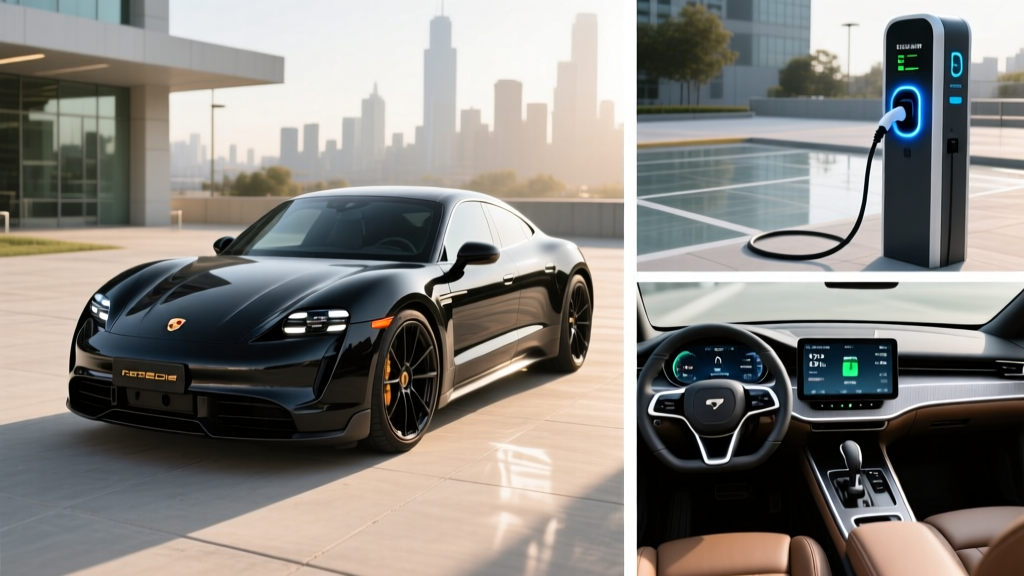
The Porsche Taycan Turbo GT with Weissach Package is the most powerful road car Porsche has ever built. Limited to 1,500 units globally, the Turbo GT Limited Edition (officially the Turbo GT with Weissach Package in Lava Orange) pairs a 1,019-horsepower dual-motor powertrain with aggressive weight reduction, a dedicated Attack Mode, and track-focused chassis tuning. But beyond the Nürburgring lap records and launch-control theatrics, buyers spending a quarter-million dollars on an electric performance sedan need to know the everyday realities: real-world range, charging logistics, ownership costs, and whether the Turbo GT makes sense as a daily driver or remains strictly a weekend weapon.
This review dissects the 2025 Porsche Taycan Turbo GT Limited Edition with exact figures — EPA range, battery chemistry, DC fast-charge curves, Level 2 home-charging speeds, cargo dimensions, and tax-credit eligibility — so you can evaluate it as an EV purchase, not just a headline generator.
Quick Verdict: Who Should Buy the Taycan Turbo GT?
Buy it if: You want the ultimate expression of Porsche's electric engineering, plan to use it primarily as a performance/track-day vehicle, have reliable home Level 2 charging, and understand that 220–250 miles of real-world range is the trade-off for 1,019 hp and a sub-2.2-second 0–60 time.
Pass if: You need a practical daily commuter with 300+ mile range, frequently road-trip beyond the 200-mile single-charge comfort zone, require rear-seat passenger space for adults, or expect the federal EV tax credit to meaningfully offset the $230,000+ price.
Range, Battery & Efficiency: The Real Numbers
| Spec | Value |
|---|---|
| EPA Range | 280 miles (Turbo GT) / 269 miles (Turbo GT w/ Weissach) |
| Battery (Usable) | 97.0 kWh (Performance Battery Plus) |
| Battery Chemistry | NMC (Nickel Manganese Cobalt) |
| Drivetrain | Dual-motor AWD |
| Horsepower (Launch Control) | 1,019 hp (Turbo GT) / 1,092 hp (w/ Weissach Attack Mode) |
| 0–60 mph | 2.1 sec (Turbo GT) / 2.2 sec (w/ Weissach, lighter) |
| Top Speed | 190 mph (Turbo GT) / 186 mph (w/ Weissach) |
| EPA Efficiency | 65 MPGe combined / 52 kWh/100 mi |
| Max DC Fast Charge | 320 kW (peak) |
| 10–80% DC Fast Charge | ~18 minutes (optimal conditions) |
| Level 2 Home Charge Rate | 19.2 kW (onboard charger) — ~60 mi/hr |
| Cargo (Trunk + Frunk) | 14.3 cu ft rear / 2.9 cu ft front (Weissach deletes rear seat) |
| Base MSRP | $230,000 (Turbo GT) / ~$240,000+ (w/ Weissach) |
| Battery Warranty | 8 years / 100,000 miles (70% capacity retention) |
Real-World Range Reality: The EPA rates the Taycan Turbo GT at 280 miles, but Porsche's performance-oriented tuning and the Turbo GT's wider 21-inch wheels with Michelin Pilot Sport Cup 2 tires reduce efficiency significantly under hard driving. In real-world highway testing at 70–75 mph, expect 220–250 miles in moderate temperatures. In cold weather (below 32°F), NMC chemistry loses roughly 15–25% range, dropping usable distance to 180–210 miles. City driving with regenerative braking can approach or slightly exceed the EPA figure. Porsche historically under-promises on EPA range — the Taycan often outperforms its sticker in mild conditions — but the Turbo GT's sticky tires and aggressive aero work against efficiency.
The 97.0 kWh (usable) Performance Battery Plus uses NMC chemistry, which offers higher energy density than LFP (lithium iron phosphate) but trades some cycle life and thermal stability. NMC cells are standard in performance EVs where weight and packaging matter more than the ultra-long cycle life LFP provides. The battery sits low in the chassis as a structural element, contributing to the Turbo GT's 0.95 g skidpad grip.
Efficiency is rated at 52 kWh per 100 miles (65 MPGe combined) per fueleconomy.gov. For context, a Tesla Model S Plaid achieves 120 MPGe combined — the Turbo GT sacrifices roughly half its efficiency to produce nearly double the peak horsepower and significantly more downforce.
Charging Speed: DC Fast Charge Curve & Home Setup
| Level | Power | Miles Added per Hour | Notes |
|---|---|---|---|
| Level 1 (120V) | ~1.4 kW | ~3 mi/hr | Emergency/trickle only — full charge in 60+ hours |
| Level 2 (240V, 48A) | 11.5 kW | ~36 mi/hr | Standard home wallbox; full charge ~9 hours |
| Level 2 (240V, 80A) | 19.2 kW | ~60 mi/hr | Porsche Mobile Charger Connect or ChargePoint Home Flex; full charge ~5.5 hours |
| DC Fast Charge | Up to 320 kW (peak) | N/A | 10–80% in ~18 min; requires 350 kW+ station & preconditioning |
The 2025 Taycan's updated 800-volt architecture supports a peak DC fast-charge rate of 320 kW — up from 270 kW on the pre-refresh models. On a 350 kW Electrify America or compatible CCS station with the battery preconditioned (navigating to the charger triggers automatic thermal prep), the Turbo GT can add roughly 155 miles of range in 10 minutes.
Charging curve reality: The 320 kW peak is not sustained. The Taycan holds peak power from roughly 10% to 35% State of Charge (SoC), then tapers progressively — dropping to ~200 kW by 50% SoC and ~120 kW by 70%. The 10–80% time of approximately 18 minutes assumes a 350 kW-capable station, a preconditioned battery at optimal temperature (68–86°F), and starting at 10% SoC. In cold weather or on 150 kW stations, expect 25–35 minutes for the same 10–80% session.
For home charging, the Taycan's 19.2 kW onboard AC charger is among the fastest in any production EV. Most homes with a NEMA 14-50 outlet on a 50-amp circuit will deliver 11.5 kW (48A continuous), adding ~36 miles of range per hour — enough to replenish a full day's driving overnight. Upgrading to a hardwired 100-amp circuit unlocks the full 19.2 kW, which a licensed electrician can assess based on your panel capacity. Expect $500–$2,000 for a standard Level 2 installation, or $2,000–$5,000+ if a panel upgrade to 200A service is needed.
Performance & Driving: 1,019 HP in Practice
The Taycan Turbo GT's headline number is 1,019 horsepower (1,092 hp in the Weissach Package's Attack Mode), delivered through a dual-motor all-wheel-drive system with a two-speed rear transmission — unique to the Taycan platform and critical for both brutal launches and efficient highway cruising. The 0–60 mph time of 2.1 seconds (2.2 with Weissach due to different launch tuning despite lower weight) places it among the quickest production cars ever built.
But the Turbo GT's engineering story extends beyond straight-line speed. The Weissach Package deletes the rear seats (saving ~150 lbs), adds a fixed carbon-fiber rear wing, installs carbon-ceramic brakes, and fits a roll cage. Porsche Active Ride — an electrohydraulic suspension system — keeps the body virtually flat through corners, eliminating the body roll that compromises most heavy EVs. The result is a 4,971-lb car that handles like a vehicle 1,000 lbs lighter.
Attack Mode, activated by pulling the right steering-wheel paddle, temporarily boosts output to 1,092 hp for 10 seconds — designed for track straights. This is a performance feature, not a daily-driving mode.
Pricing, Tax Credits & Total Cost of Ownership
| Item | Cost |
|---|---|
| Base MSRP (Turbo GT) | $230,000 |
| Base MSRP (Turbo GT w/ Weissach) | ~$240,000+ |
| Typical Options (paint, wheels, interior) | $10,000–$25,000 |
| Destination Charge | $1,650 |
| As-Tested Price (typical build) | $245,000–$265,000 |
| Federal §30D Tax Credit | $0 — MSRP exceeds $55,000 sedan cap |
Tax credit reality: The Taycan Turbo GT does not qualify for the IRS §30D federal EV tax credit. The credit's MSRP cap for sedans is $55,000 (and $80,000 for SUVs/vans/trucks), per IRS guidelines. At $230,000+, the Turbo GT exceeds this cap by a factor of four. Additionally, buyer income caps ($150,000 single / $300,000 joint MAGI) would disqualify many buyers regardless. State incentives (California's CVRP, for example) also have income and price caps that exclude this vehicle. Budget the full MSRP plus options, tax, and registration.
5-year ownership cost estimate: Beyond the purchase price, expect $8,000–$12,000/year in insurance (specialty performance EV rates), $1,500–$2,500/year in electricity (assuming 12,000 miles/year at $0.15/kWh), and $500–$1,000/year in maintenance (tire rotation, cabin air filter, brake fluid — carbon-ceramic brakes last 100,000+ miles). Tires are the major consumable: the Michelin Pilot Sport Cup 2 rear tires (285/35R21) cost ~$600 each and may need replacement every 8,000–12,000 miles under spirited driving. Total 5-year operating cost: approximately $55,000–$80,000 excluding depreciation.
Interior, Cargo & Technology
The Turbo GT's interior is driver-focused with a 16.8-inch curved digital instrument cluster, a 10.9-inch center touchscreen running Porsche Communication Management (PCM), and an optional 10.9-inch passenger display. The Weissach Package replaces the rear seats with a carbon-fiber shelf and roll cage, reducing the car to a strict two-seater — a critical practicality consideration.
Cargo space is limited: 14.3 cubic feet in the rear trunk and 2.9 cubic feet in the front trunk (frunk). The Weissach Package's deleted rear seats eliminate any possibility of carrying rear passengers, and the remaining trunk space suits a pair of carry-on bags or a track-day gear bag — not a week's groceries for a family.
Driver assistance: The Taycan includes Porsche InnoDrive with adaptive cruise control, lane-keeping assist, and traffic-sign recognition. This is an SAE Level 2 system — it assists with steering and speed but requires full driver attention and hands on or near the wheel at all times. It is not autonomous driving. Night Vision with pedestrian detection and Surround View cameras are available options.
Notable tech drawbacks: The PCM infotainment system, while improved, still lags behind Tesla's interface responsiveness and lacks native wireless Apple CarPlay/Android Auto in some configurations (wired connection required). The passenger display is a $1,100 option that adds glare in direct sunlight. Physical climate controls are absent — all HVAC adjustments route through the touchscreen, which requires eyes-off-road interaction.
Warranty & Long-Term Battery Outlook
Porsche covers the Taycan's battery pack for 8 years or 100,000 miles, whichever comes first, guaranteeing at least 70% of original capacity retention. The limited vehicle warranty is 4 years / 50,000 miles. Porsche also provides 4 years of complimentary scheduled maintenance and roadside assistance.
NMC battery degradation data from earlier Taycan model years (2020–2023) shows approximately 5–8% capacity loss over the first 60,000 miles under normal use, with the curve flattening thereafter. The Turbo GT's high-performance use case — frequent DC fast charging, high-discharge launches, track sessions — may accelerate degradation slightly. Porsche's thermal management system (liquid cooling with active heating and cooling) mitigates this, and the 70% warranty threshold provides a reasonable safety net.
Battery replacement cost, should it be needed out of warranty, is estimated at $25,000–$35,000 for the 97 kWh pack based on current Porsche service pricing — a figure to factor into long-term ownership planning for second or third owners.
Taycan Turbo GT vs. Key Competitors
| Model | EPA Range | 0–60 mph | HP | Max DC kW | Base MSRP |
|---|---|---|---|---|---|
| Porsche Taycan Turbo GT | 280 mi | 2.1 sec | 1,019 | 320 kW | $230,000 |
| Tesla Model S Plaid | 396 mi | 1.99 sec | 1,020 | 250 kW | $89,990 |
| Lucid Air Sapphire | 427 mi | 1.89 sec | 1,234 | 300 kW | $249,000 |
| BMW i7 M70 | 295 mi | 3.5 sec | 650 | 195 kW | $168,800 |
Choose the Taycan Turbo GT If:
- Chassis dynamics, steering feel, and track capability matter more than range or value
- You want Porsche build quality, dealer service, and brand heritage
- The 1,500-unit exclusivity and Weissach Package's race-car character appeal to you
- You'll primarily drive it on back roads or at track days, not cross-country
Choose a Competitor If:
- Model S Plaid: You want similar acceleration at 40% of the price with 40% more range
- Lucid Air Sapphire: Maximum range (427 mi) and horsepower (1,234) with a full rear seat
- BMW i7 M70: Luxury-grand-tourer comfort with respectable performance and rear-seat space for adults
Pros, Cons & Final Assessment
Pros
- Sub-2.2-second 0–60 with repeatable launch performance (no overheating after multiple runs)
- Class-leading chassis: Porsche Active Ride eliminates body roll; 0.95 g lateral grip
- 320 kW peak DC charging — among the fastest of any production EV
- 800V architecture enables sustained high-power charging and efficient highway cruising
- Weissach Package delivers genuine track-car character in a road-legal package
- Exclusivity: 1,500 units globally supports long-term collector value
Cons
- 220–250 mi real-world highway range is limiting for road trips
- $230,000+ MSRP with zero federal or state EV tax credit eligibility
- Weissach Package deletes rear seats — strictly a two-seater
- Tire costs are extreme: ~$2,400 per axle, 8K–12K mile lifespan under performance use
- PCM infotainment lags Tesla/Lucid in responsiveness and native wireless phone integration
- Insurance premiums $8,000–$12,000/year due to performance classification and repair costs
- Cold-weather range drops to 180–210 mi — problematic in northern climates
The Taycan Turbo GT Limited Edition is not a rational purchase. It is an emotional, engineering-driven statement that prioritizes driving dynamics above every practical metric. If you're cross-shopping it against a Model S Plaid on value, you've already missed the point — the Turbo GT exists for buyers who judge a car by its steering weight under braking at Turn 8, not by its cost-per-mile. But those buyers still need to charge it, insure it, and live with its range limitations. This review gives you the numbers to do that with eyes open.
Frequently Asked Questions
What is the real-world range of the Porsche Taycan Turbo GT?
The EPA rates it at 280 miles, but real-world highway driving at 70–75 mph yields approximately 220–250 miles in moderate temperatures. Cold weather (below 32°F) reduces this to 180–210 miles due to NMC battery chemistry losses and increased cabin heating demand. City driving with regenerative braking can approach or slightly exceed the 280-mile EPA figure.
How fast does the Taycan Turbo GT charge?
On a 350 kW DC fast charger with battery preconditioning, the Turbo GT peaks at 320 kW and charges from 10–80% in approximately 18 minutes. On a home Level 2 charger at 19.2 kW (80A circuit), it adds ~60 miles of range per hour, fully charging in about 5.5 hours. On a standard 48A Level 2 circuit (11.5 kW), expect ~36 miles per hour and a ~9-hour full charge.
Does the Taycan Turbo GT qualify for the federal EV tax credit?
No. The IRS §30D tax credit caps eligible sedans at an MSRP of $55,000. The Taycan Turbo GT starts at $230,000, making it ineligible regardless of buyer income or battery sourcing. State incentives similarly have price caps that exclude this vehicle. Consult a tax professional for your specific situation, but plan for the full purchase price.
Is the Taycan Turbo GT worth buying vs. the Tesla Model S Plaid or Lucid Air Sapphire?
On pure numbers, the Model S Plaid offers comparable acceleration (1.99 sec 0–60) with 40% more range (396 mi) at 40% of the price ($89,990). The Lucid Air Sapphire delivers more horsepower (1,234 hp) and more range (427 mi) at a similar price. The Turbo GT justifies its premium through chassis dynamics, steering feel, build quality, brand heritage, and the Weissach Package's track-focused engineering — qualities that don't appear on a spec sheet but are immediately apparent on a canyon road or race circuit.
What are the biggest ownership costs beyond the purchase price?
Insurance runs $8,000–$12,000/year. Tires (Michelin Pilot Sport Cup 2) cost ~$2,400 per axle and may last only 8,000–12,000 miles under performance driving. Electricity costs approximately $1,500–$2,500/year at 12,000 miles/year and $0.15/kWh. Out-of-warranty battery replacement is estimated at $25,000–$35,000 if needed beyond the 8-year/100,000-mile coverage.
Is the Weissach Package worth it?
If you plan to use the Turbo GT at track days and value exclusivity, yes — the Weissach Package saves ~150 lbs, adds the carbon-fiber wing, carbon-ceramic brakes, roll cage, and Attack Mode's 1,092 hp burst. If you ever need to carry a rear passenger, absolutely not — the package deletes the rear seats entirely. Most Turbo GT buyers choose Weissach for the collector value and track capability.