The 2025 Porsche Taycan: Range, Mileage, and Efficiency Decoded
The 2025 Porsche Taycan entered its second generation with a substantially upgraded battery, revised powertrain, and a new DC fast-charging architecture that fundamentally changes its road-trip profile. For buyers researching Porsche Taycan mileage — whether that means range per charge or energy efficiency — the numbers tell a story of meaningful improvement over the pre-2025 models, though physics and pricing still impose real-world trade-offs.
This review covers every current Taycan trim sold in the US: the base RWD, 4S, GTS, Turbo, and Turbo GT. We'll pair EPA sticker data with highway and cold-weather reality, dissect the 800-volt charging curve, and run the ownership math including federal tax credit eligibility.
Porsche Taycan Range: EPA vs. Real-World Mileage
The 2025 Taycan lineup uses a new lithium-ion NMC (nickel manganese cobalt) battery pack in a larger physical housing than the previous generation. Porsche offers a single usable capacity across most trims: 97.0 kWh usable (105.0 kWh gross) on the Performance Battery Plus. The base Taycan with the standard Performance Battery gets 79.2 kWh usable (89.0 kWh gross).
The EPA rates the 2025 Taycan 4S (with Performance Battery Plus) at 283 miles. In mixed real-world driving, expect 245–265 miles on the highway at 70–75 mph, and closer to 260–280 miles in city/suburban use where regenerative braking recovers energy. In sub-30°F winter conditions, plan for a 15–25% reduction, dropping effective range to roughly 200–230 miles depending on cabin heat usage and whether you precondition the battery.
| Trim | Battery (Usable kWh) | EPA Range (mi) | MPGe (Combined) | kWh/100 mi | Drivetrain |
|---|---|---|---|---|---|
| Taycan (RWD, Std Battery) | 79.2 | 225 | 84 | 40 | RWD |
| Taycan (RWD, Perf Batt Plus) | 97.0 | 283 | 88 | 38 | RWD |
| Taycan 4S | 97.0 | 283 | 86 | 39 | AWD |
| Taycan GTS | 97.0 | 268 | 82 | 41 | AWD |
| Taycan Turbo | 97.0 | 275 | 84 | 40 | AWD |
| Taycan Turbo GT (w/ Weissach) | 97.0 | 269 | 79 | 43 | AWD |
The efficiency figures — measured in kWh per 100 miles, the EV equivalent of fuel consumption — are strong for a 5,000+ lb performance sedan. The Taycan RWD with the larger battery achieves 38 kWh/100 mi, which is competitive with the Tesla Model S Long Range (~36 kWh/100 mi) and notably better than the Audi e-tron GT (~42 kWh/100 mi). Source: fueleconomy.gov.
What this means for daily mileage: If your round-trip commute is 50 miles, any Taycan trim handles it for 4–5 days between charges with the larger battery. For 300+ mile road trips, you'll need at least one DC fast-charge stop — but as we'll see, the Taycan makes that stop remarkably brief.
Charging Speed: DC Fast, Level 2, and the 800V Advantage
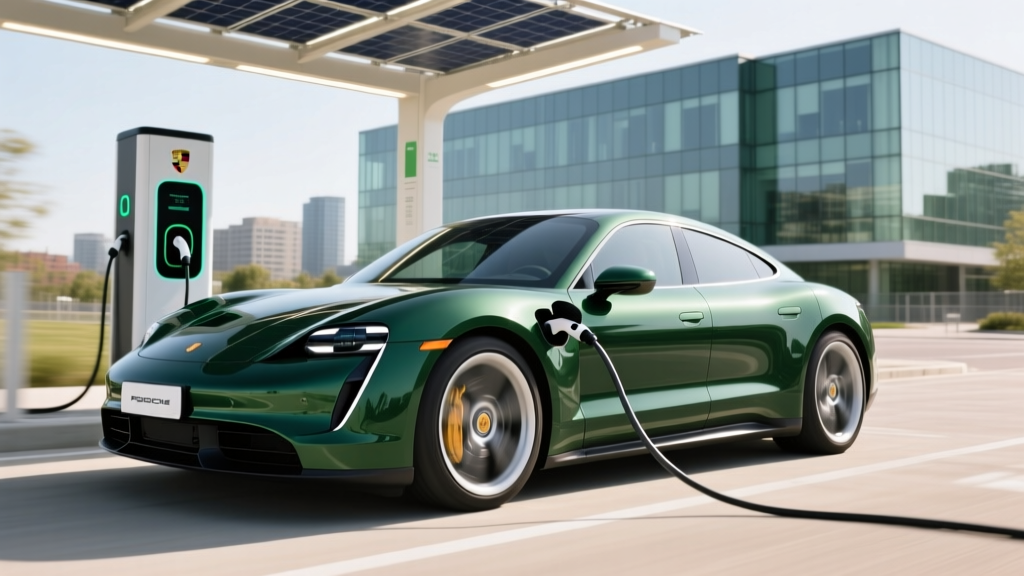
The 2025 Taycan retains its 800-volt electrical architecture, which remains one of the highest in any production EV and is the key to its class-leading charge speeds. Porsche upgraded the thermal management and charge curve for this generation, allowing higher sustained power through the middle of the state-of-charge window.
| Charge Level | Max Power | Speed | Notes |
|---|---|---|---|
| Level 1 (120V household) | 1.4 kW | ~3–4 mi/hr | Emergency/trickle only |
| Level 2 (240V, 48A) | 11.5 kW | ~30–33 mi/hr | Full charge in ~9.5 hrs (0–100%) |
| DC Fast Charge (CCS/NACS adapter) | 320 kW peak | 10–80% in ~18 min | Requires 350 kW+ station; preconditioning critical |
The headline number is 320 kW peak DC fast charging — up from 270 kW on the previous generation. On a 350 kW Electrify America or comparable station, with the battery preconditioned (the Taycan does this automatically when a charger is set as your navigation destination), you'll see peak rates above 300 kW between 10% and roughly 40% SoC. The curve tapers progressively after that: expect ~180 kW at 60%, ~120 kW at 75%, and ~60 kW by 90%.
Real-world charging insight: The 10–80% time of approximately 18 minutes is among the fastest of any production EV sold in the US. The Hyundai Ioniq 5 and Kia EV6 match it on paper (240 kW peak, ~18 min), but the Taycan's larger battery means it's adding more total miles in that window — roughly 185 miles of range in 18 minutes at highway efficiency.
For home Level 2 charging, the onboard 11.5 kW charger means a full overnight replenishment is realistic. If your home charger delivers the full 48 amps (11.5 kW), a depleted 97 kWh battery reaches full in about 9.5 hours. On a 40-amp circuit (9.6 kW), add about an hour. Most owners charging from 20–80% daily will see full replenishment in 5–6 hours.
Connector note: The 2025 Taycan ships with a CCS1 port in North America. Porsche includes a NACS adapter for Tesla Supercharger access, which significantly expands the usable fast-charging network. Tesla's V4 Supercharger stalls support CCS via the adapter at up to 250 kW.
Performance Specs: 0-60, Horsepower, and Drivetrain
The Taycan has always been a performance car first, and the 2025 update widens the gap between comfort and ferocity. A new rear-axle pulse inverter and revised motor on the rear axle improve both efficiency and power output.
| Trim | Horsepower | 0–60 mph (sec) | Top Speed (mph) | Drivetrain |
|---|---|---|---|---|
| Taycan (RWD) | 402 | 4.6 | 143 | Rear-wheel drive |
| Taycan 4S | 590 (Launch Control) | 3.5 | 155 | Dual-motor AWD |
| Taycan GTS | 690 (Launch Control) | 3.1 | 155 | Dual-motor AWD |
| Taycan Turbo | 870 (Launch Control) | 2.5 | 162 | Dual-motor AWD |
| Taycan Turbo GT (Weissach) | 1,019 (Launch Control) | 2.1 | 190 | Dual-motor AWD |
The Turbo GT with the Weissach Package is the current pinnacle: 1,019 horsepower in overboost with Launch Control, a 2.1-second 0–60 time, and a Nürburgring lap record for production EVs. But even the base RWD model at 402 hp and 4.6 seconds is quicker than most buyers will ever need.
All trims feature a two-speed transmission on the rear axle (first gear for launch, second for efficiency at speed), which contributes to both the blistering acceleration and the respectable highway efficiency. The front motor on AWD models uses a single-speed reduction gear and can fully decouple to reduce drag.
Pricing, Trims, and Federal Tax Credit Eligibility
The Taycan occupies the luxury performance tier, and pricing reflects that. Here's the 2025 MSRP breakdown by trim, followed by tax credit context.
| Trim | Base MSRP | As-Tested Typical | §30D Federal Credit Eligible? |
|---|---|---|---|
| Taycan (RWD) | $99,400 | $108,000–$115,000 | No — exceeds MSRP cap |
| Taycan 4S | $118,500 | $130,000–$145,000 | No — exceeds MSRP cap |
| Taycan GTS | $149,500 | $158,000–$170,000 | No — exceeds MSRP cap |
| Taycan Turbo | $175,200 | $190,000–$210,000 | No — exceeds MSRP cap |
| Taycan Turbo GT | $230,000 | $240,000+ | No — exceeds MSRP cap |
Federal tax credit reality: Under IRS §30D rules, new EVs must fall under MSRP caps to qualify for the up-to-$7,500 credit: $55,000 for sedans, $80,000 for SUVs/pickups/vans. The Taycan is classified as a sedan, so the cap is $55,000. Since even the base Taycan starts at $99,400, no new Taycan trim qualifies for the federal purchase credit.
Buyers should also be aware of income caps ($150,000 single / $300,000 joint MAGI) and critical mineral/battery component sourcing requirements — but in the Taycan's case, the MSRP cap is the disqualifying factor regardless.
Lease workaround: The commercial clean vehicle credit (§45W) allows lessors to claim a credit and potentially pass savings to the lessee. Some Porsche Financial Services leases have reflected this as a lease cash incentive, but availability and amounts vary by month and region. Consult your dealer and a tax professional for current lease structures.
Interior, Cargo, and Daily Practicality
The Taycan is a four-door sport sedan with a hatchback-style trunk lid (on the Sport Turismo wagon variant, cargo expands significantly). Here are the concrete dimensions:
- Trunk (sedan): 14.3 cu ft rear cargo; 2.9 cu ft front trunk (frunk)
- Sport Turismo wagon: 15.7 cu ft rear; 2.9 cu ft frunk; 42.8 cu ft with rear seats folded
- Rear legroom: 32.7 inches (adequate for adults under 6'0", tight for taller passengers)
- Front headroom: 39.3 inches
- Curb weight: 4,682–5,177 lbs depending on trim and battery
The sedan's 14.3 cu ft trunk is usable but shallow compared to a Model S (28 cu ft with hatch). The Sport Turismo (Cross Turismo in prior years) is the practicality pick — the wagon roofline adds meaningful cargo volume and a standard roof rail system.
Infotainment and tech: The 2025 Taycan features a 12.6-inch curved driver display, a 10.9-inch center touchscreen running Porsche Communication Management (PCM), and an available 10.9-inch front passenger display. Wireless Apple CarPlay and Android Auto are standard. A head-up display with augmented-reality navigation is available. The system is responsive but not class-leading — Tesla's interface remains more intuitive, and Hyundai/Kia's latest EV software is more customizable.
Driver assistance (SAE Level 2): Porsche InnoDrive with active lane guidance is the top ADAS package. It includes adaptive cruise control, lane centering, and predictive speed adjustment based on road curvature and traffic signs. It is a Level 2 system — the driver must maintain hands-on-wheel awareness and full supervisory responsibility. It is not self-driving. InnoDrive is competent on highways but less aggressive with lane changes than Ford BlueCruise or GM Super Cruise on compatible roads.
Battery Warranty, Degradation, and Long-Term Ownership
Porsche covers the Taycan's high-voltage battery with an 8-year / 100,000-mile warranty against defects and excessive capacity loss. Porsche defines "excessive" as falling below 70% of original usable capacity within the warranty period — this is the industry-standard threshold shared with BMW, Mercedes, and most others.
Real-world degradation data for the first-generation Taycan (2020–2024) has been encouraging. Fleet data from high-mileage owners and European lease returns suggest approximately 5–8% capacity loss at 60,000 miles under normal use patterns, well within the warranty buffer. The 2025 model's revised thermal management — including a more powerful coolant circuit and optimized charge preconditioning — should yield similar or better longevity.
Battery replacement cost: Out of warranty, a full Taycan battery replacement runs approximately $20,000–$28,000 including labor, based on current Porsche parts pricing. Module-level repair (replacing individual cell groups) is possible and significantly cheaper, but requires a Porsche-certified high-voltage technician.
Maintenance advantages: The Taycan requires no oil changes, no transmission fluid service (the two-speed rear unit is sealed), and brake pad life is extended significantly by regenerative braking — many owners report 60,000+ miles on original pads. Porsche recommends a cabin air filter replacement every ~20,000 miles and a brake fluid flush every 2 years. Annual maintenance cost averages $400–$700, far below a comparable Panamera.
Taycan vs. the Competition: Is It Worth It?
- Class-leading 320 kW DC fast charging — 10–80% in ~18 min
- Driving dynamics and steering feel unmatched in the EV sedan segment
- 800V architecture enables sustained high-speed charging, not just peak
- Strong real-world efficiency (38 kWh/100 mi) for a 5,000 lb performance car
- Build quality, materials, and NVH isolation are best-in-class
- NACS adapter included for Tesla Supercharger access
- No federal tax credit eligibility (MSRP exceeds $55K sedan cap)
- EPA range tops out at 283 mi — behind Model S (402 mi) and Lucid Air (420+ mi)
- Rear seat space is tight for adults over 6'0"
- Sedan trunk is small (14.3 cu ft) vs hatchback competitors
- Options packages push pricing well above base MSRP
- Infotainment is good but not segment-leading
Choose the Tesla Model S if: Maximum range (402 mi EPA) and Supercharger convenience are your top priorities, and you're willing to accept less precise steering feel and simpler interior materials.
Choose the Lucid Air if: Range (420+ mi EPA on Pure RWD) and rear-seat space are critical, and you don't mind a smaller service network.
Choose the Audi e-tron GT if: You want 800V architecture and similar styling at a slightly lower entry price, but can accept slower charging (~270 kW peak) and less range (249 mi EPA).
Frequently Asked Questions
What is the real-world range of the Porsche Taycan?
The EPA rates the best-case 2025 Taycan (RWD with Performance Battery Plus) at 283 miles. In real-world highway driving at 70–75 mph, expect 245–265 miles. In city driving with regenerative braking, 260–280 miles is achievable. In cold weather (below 30°F), range drops 15–25% to roughly 200–230 miles depending on conditions and preconditioning habits.
How fast does the Taycan charge at home and on the road?
On DC fast chargers, the 2025 Taycan peaks at 320 kW and charges from 10–80% in approximately 18 minutes on a 350 kW station. At home on a Level 2 (240V, 48A) charger, it adds about 30–33 miles of range per hour, fully replenishing the 97 kWh battery in roughly 9.5 hours.
Does the Porsche Taycan qualify for the federal EV tax credit?
No. Under current IRS §30D rules, new sedans must have an MSRP under $55,000 to qualify. The base Taycan starts at $99,400, so no trim is eligible for the $7,500 federal purchase credit. Some lease structures may pass through a commercial credit benefit, but this varies. Consult IRS guidance and a tax professional.
How does Taycan mileage compare to the Tesla Model S?
The Model S Long Range achieves 402 miles EPA and 36 kWh/100 mi — more range and slightly better efficiency. However, the Taycan charges faster (320 kW vs ~250 kW peak for Model S) and delivers substantially sharper handling. The trade-off is range vs. driving engagement and charge speed.
What's the biggest drawback of owning a Taycan?
Beyond the purchase price, the most commonly cited ownership friction is the combination of moderate EPA range (283 mi max) with a relatively small sedan trunk. Road trippers find the 18-minute charge stops acceptable, but the 250-mile practical highway range means stops come more frequently than in a Lucid Air or Model S. The Sport Turismo wagon variant partially solves the cargo issue.
Is the Taycan's battery chemistry LFP or NMC?
The 2025 Taycan uses NMC (nickel manganese cobalt) chemistry in its high-voltage battery. NMC offers higher energy density than LFP, which is critical for packaging a large battery in a low-slung sports sedan. The trade-off is that NMC batteries benefit more from avoiding sustained 100% SoC — Porsche recommends setting daily charge limits to 85% for battery longevity.
Sources: EPA Fuel Economy, IRS §30D Clean Vehicle Credits, Porsche USA official specifications.