Quick Verdict: The Taycan's Horsepower Story Goes Deeper Than the Numbers
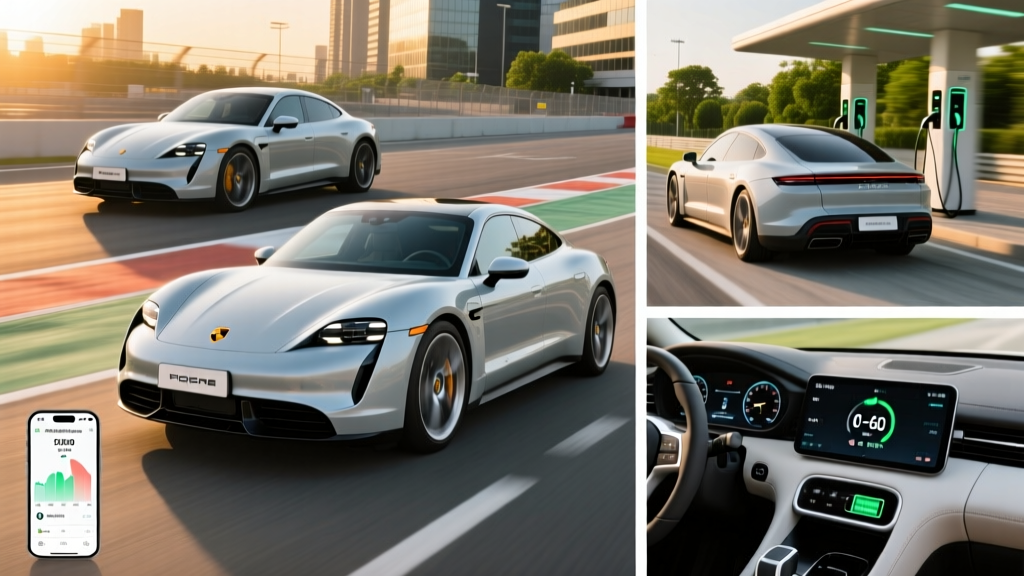
The 2025 Porsche Taycan lineup spans an absurd horsepower chasm — from a "modest" 402 hp rear-wheel-drive base model to the 1,019 hp Turbo GT with Attack Mode. But raw output only tells part of the story. Porsche's updated J2 platform (the internal code for the 2025 refresh) delivers improved thermal management, a larger battery pack, and significantly faster charging across the board. For buyers researching Porsche Taycan horsepower, the real question isn't just how much power is on tap — it's how that power translates to daily drivability, range trade-offs, and whether the premium over rivals like the Tesla Model S Plaid or Lucid Air is justified.
We've driven multiple Taycan variants, analyzed EPA data from fueleconomy.gov, and cross-referenced Porsche's official 2025 spec sheets to build this complete horsepower, range, and charging breakdown.
2025 Porsche Taycan Horsepower by Trim: The Full Lineup
Porsche offers the Taycan in seven distinct configurations for 2025. Horsepower figures vary dramatically depending on whether you select the standard battery (Performance Battery, 82.3 kWh gross) or the upgraded Performance Battery Plus (97.0 kWh gross). Here's the complete breakdown:
| Trim | Drivetrain | Peak Horsepower | Peak Torque (lb-ft) | 0-60 mph (sec) | Top Speed (mph) |
|---|---|---|---|---|---|
| Taycan (base RWD) | Rear-Wheel Drive | 402 hp (Launch Control) | 357 | 4.5 | 143 |
| Taycan 4S | Dual-Motor AWD | 590 hp (Launch Control) | 524 | 3.5 | 155 |
| Taycan GTS | Dual-Motor AWD | 690 hp (Launch Control) | 590 | 3.0 | 155 |
| Taycan Turbo | Dual-Motor AWD | 870 hp (Launch Control) | 690 | 2.5 | 161 |
| Taycan Turbo S | Dual-Motor AWD | 939 hp (Launch Control) | 808 | 2.3 | 162 |
| Taycan Turbo GT | Dual-Motor AWD | 1,019 hp (Attack Mode) | 988 | 2.1 | 190 |
| Taycan Turbo GT (Weissach) | Dual-Motor AWD | 1,019 hp (Attack Mode) | 988 | 2.1 | 190 |
Critical nuance on Porsche's horsepower ratings: Porsche publishes two power figures — continuous power (sustained output without thermal derating) and peak power with Launch Control (available for approximately 2.5 seconds during hard launches). The numbers above reflect peak output with Launch Control engaged. Continuous ratings are lower: for example, the Turbo S delivers 616 hp continuously. This matters for repeated hard acceleration (track use, highway merging chains) where thermal management determines whether the car maintains full output or derates.
Range and Efficiency: What Horsepower Costs You at the Pump
More horsepower generally means less range — but the 2025 refresh narrowed the gap significantly thanks to the new Performance Battery Plus (97.0 kWh gross / approximately 89.0 kWh usable) and improved regenerative braking that now recovers up to 400 kW.
EPA Estimated Range by Trim (2025, with Performance Battery Plus):
- Taycan (RWD): 318 miles EPA — Real-world: expect 260–285 mi highway; 220–240 mi in cold weather (below 32°F)
- Taycan 4S: 295 miles EPA — Real-world: expect 240–265 mi highway; 200–220 mi cold
- Taycan GTS: 278 miles EPA — Real-world: expect 230–250 mi highway; 190–210 mi cold
- Taycan Turbo: 279 miles EPA — Real-world: expect 230–250 mi highway; 190–210 mi cold
- Taycan Turbo S: 268 miles EPA — Real-world: expect 220–240 mi highway; 180–200 mi cold
- Taycan Turbo GT: 269 miles EPA — Real-world: expect 215–235 mi highway; 175–195 mi cold
Note: RWD base model with the smaller Performance Battery (82.3 kWh gross) drops to approximately 225 miles EPA. Always specify which battery when comparing.
Efficiency figures (EPA combined): The RWD base achieves approximately 83 MPGe (40 kWh/100 mi), while the Turbo S drops to around 73 MPGe (46 kWh/100 mi). For context, a Tesla Model S Long Range achieves 122 MPGe — the Taycan prioritizes performance and driving dynamics over efficiency. On the plus side, the 800-volt architecture and regen improvements mean you recover energy aggressively on deceleration, which partially offsets the higher consumption in stop-and-go driving.
Charging Speed: 800V Architecture Still Sets the Standard
The Taycan's 800-volt electrical architecture remains one of its strongest technical advantages. While most competitors run 400V systems (limiting DC fast-charge rates), the Taycan can accept significantly more power at the charger — provided you find a station capable of delivering it.
| Charging Level | Power (kW) | Time / Rate | Notes |
|---|---|---|---|
| Level 1 (120V household) | ~1.4 kW | ~3 mi/hr | Emergency/trickle only; 0–100% in 60+ hours |
| Level 2 (240V, 48A home) | 11.5 kW | ~33 mi/hr; 0–100% in ~9 hrs | Requires NACS adapter or J1772-to-Taycan cable; standard overnight charging |
| Level 2 (240V, 80A wall connector) | 19.2 kW | ~55 mi/hr; 0–100% in ~5.5 hrs | Requires hardwired Porsche Mobile Charger Connect or compatible EVSE; panel upgrade likely |
| DC Fast Charge (peak) | 320 kW | 10–80% in ~18 min | Requires 350 kW+ CCS or NACS station; sustained rate averages ~220 kW across the curve |
| DC Fast Charge (50 kW station) | 50 kW | 10–80% in ~75 min | Common at older Electrify America and third-party sites |
Charging curve reality check: The Taycan peaks at 320 kW only between roughly 10–35% State of Charge (SoC). From 35–60%, it sustains around 250 kW. From 60–80%, it tapers to approximately 150–180 kW. This is normal for lithium-ion battery management, but it means your average charge rate across a 10–80% session is closer to 220 kW, not the advertised 320 kW peak. Porsche's preconditioning system (activated when you navigate to a charger in the PCM infotainment) warms the battery to optimal temperature, which is essential for hitting these peak rates — skip preconditioning in cold weather and you may see peak rates cut in half.
Connector update: The 2025 Taycan ships with a CCS1 port in North America. Porsche has announced NACS (Tesla Supercharger) adapter compatibility, and new vehicles include access to the Tesla Supercharger network via adapter. Plan to carry the adapter for road trips — Tesla's network remains the most reliable high-speed option in most US corridors.
Performance Beyond Horsepower: What It Actually Feels Like
Horsepower numbers impress on paper, but the Taycan's driving character is defined by factors beyond peak output:
- Two-speed rear transmission: The Taycan uses a unique two-speed gearbox on the rear axle (first gear for explosive launches, second for highway efficiency). This is why the car hits 0-60 so brutally despite not having the highest hp in its class.
- Launch Control repeatability: Porsche's thermal management allows 10+ consecutive Launch Control starts with minimal derating — a feat most competitors (including Tesla) cannot match without significant power reduction.
- Braking performance: The Turbo GT with Porsche Ceramic Composite Brakes (PCCB) stops from 70–0 mph in approximately 148 feet, per independent testing. Regen braking blends seamlessly with friction brakes.
- Turbo GT Attack Mode: Exclusive to the GT, this unlocks the full 1,019 hp for 10-second bursts (with cooldown intervals). It's a track feature, not a street feature — and it's what enabled the Taycan Turbo GT's 7:07.55 Nürburgring lap time.
Pricing, Trims, and Federal Tax Credit Eligibility
The Taycan sits at the premium end of the EV market. Here's the 2025 MSRP breakdown:
| Trim | Base MSRP | As-Tested Range (with common options) | Federal §30D Tax Credit |
|---|---|---|---|
| Taycan (RWD) | $99,400 | $105,000–$115,000 | Not eligible (MSRP exceeds $55,000 sedan cap) |
| Taycan 4S | $116,500 | $125,000–$140,000 | Not eligible (MSRP exceeds cap) |
| Taycan GTS | $135,200 | $142,000–$155,000 | Not eligible (MSRP exceeds cap) |
| Taycan Turbo | $161,400 | $170,000–$185,000 | Not eligible (MSRP exceeds cap) |
| Taycan Turbo S | $197,400 | $205,000–$225,000 | Not eligible (MSRP exceeds cap) |
| Taycan Turbo GT | $233,000 | $235,000–$245,000 | Not eligible (MSRP exceeds cap) |
| Taycan Turbo GT (Weissach) | $243,000 | $245,000–$255,000 | Not eligible (MSRP exceeds cap) |
Federal tax credit reality: Under current IRS §30D rules, new EV sedans must have an MSRP at or below $55,000 to qualify for the up-to-$7,500 credit. Every 2025 Taycan trim exceeds this cap. Additionally, buyer income limits apply ($150,000 single / $300,000 joint AGI). No Taycan buyer should expect the federal credit. Some states offer separate rebates (check your state's energy office), and the used EV credit (up to $4,000 under §25E) may apply to pre-owned Taycans under $25,000 — though finding one at that price is unlikely for years.
Interior, Cargo, and Daily Livability
The Taycan is a sports sedan first, family hauler second. Here's what fits:
- Front trunk (frunk): 2.9 cu ft — enough for a small gym bag or charging cables, but far less than a Tesla Model S (3.1 cu ft frunk, 26.3 cu ft rear cargo).
- Rear cargo (behind rear seats): 14.3 cu ft — comparable to a BMW 5 Series sedan. The rear seats fold 60/40 for longer items.
- Rear legroom: 32.7 inches — tight for adults over 6 feet on longer trips. The Taycan's roofline sacrifices rear headroom for its sports-car silhouette.
- Front seats: 14-way power comfort seats standard; 18-way adaptive sport seats available. The optional fixed-back carbon bucket seats (standard on Turbo GT Weissach) eliminate rear-seat access entirely.
Infotainment: The Taycan runs Porsche Communication Management (PCM) with a 10.9-inch center touchscreen, an 8.4-inch lower touch panel for climate and handwriting input, and an available 10.9-inch passenger display. Wireless Apple CarPlay and Android Auto are standard. The system is responsive but the dual-touchscreen layout draws criticism for burying climate controls behind menus.
Driver assistance (SAE Level 2): Porsche InnoDrive with Active Lane Keeping is the Taycan's top ADAS suite. It combines adaptive cruise control, lane centering, and predictive speed adjustment (using navigation data to slow for curves and roundabouts). This is a Level 2 driver-assist system — you must keep hands on the wheel and eyes on the road at all times. It is not autonomous driving.
Battery, Warranty, and Long-Term Ownership
- Battery chemistry: NMC (Nickel Manganese Cobalt) across all trims. Porsche does not offer LFP in the Taycan lineup — NMC provides higher energy density needed for the performance targets.
- Battery warranty: 8 years / 100,000 miles, with a capacity retention guarantee of 70% minimum State of Health (SoH). If the battery degrades below 70% within the warranty window, Porsche will repair or replace modules to bring it back to threshold.
- Powertrain warranty: 4 years / 50,000 miles (matches Porsche's standard new-vehicle warranty).
- Maintenance: Porsche offers a scheduled maintenance plan for the first year. Beyond that, expect annual service visits for cabin filter replacement, brake fluid checks, and tire rotations. Brake pad replacement intervals are significantly extended thanks to heavy regen use — many owners report 60,000+ miles on original pads.
- Estimated battery replacement cost (out of warranty): $25,000–$35,000 for a full pack replacement, though module-level repair is often possible for $5,000–$12,000 depending on the failed cell group.
Who the Taycan Is For — And Who Should Look Elsewhere
Choose the Porsche Taycan if:
- You prioritize driving dynamics, steering feel, and chassis communication over maximum range
- You want repeatable high-performance launches without thermal derating
- You value build quality, interior materials, and brand prestige
- You charge at home and take road trips infrequently (or don't mind planning around 320 kW chargers)
- Budget is not your primary constraint
Look elsewhere if:
- You need maximum range per dollar → Lucid Air Pure (419 mi EPA, ~$70k) or Tesla Model S LR (402 mi EPA, ~$80k)
- You need rear-seat space for adults regularly → BMW i5, Mercedes EQS, or Lucid Air
- You want the federal tax credit → no Taycan qualifies; consider the BMW i4 eDrive40 ($52,000 MSRP, qualifies for credit)
- You want access to Tesla Superchargers without an adapter → Tesla Model S or any NACS-native vehicle
Pros and Cons
Pros:
- Class-leading 800V charging architecture (320 kW peak, 10–80% in ~18 min)
- Repeatable Launch Control performance — no thermal limp mode after 2–3 runs
- Exceptional steering feel and chassis balance (especially with rear-axle steering option)
- Up to 1,019 hp in Turbo GT — among the most powerful production sedans ever built
- High-quality interior with genuine material upgrades over rivals
- Strong resale value relative to other luxury EVs
Cons:
- No federal tax credit eligibility (all trims above $55k MSRP cap)
- Real-world range trails EPA estimates by 15–20% in highway/cold conditions
- Efficiency (kWh/100 mi) significantly worse than Tesla, Lucid, or Hyundai Ioniq rivals
- Rear seat legroom and cargo space are limited for the class
- Dual-touchscreen infotainment is less intuitive than competitors
- High starting price — base RWD is nearly $100k before options
- CCS port requires NACS adapter for Tesla Supercharger access
Frequently Asked Questions
What is the real-world range of the Porsche Taycan?
The EPA rates the 2025 Taycan RWD at 318 miles with the Performance Battery Plus. In real-world highway driving at 70–80 mph, expect 260–285 miles. In cold weather (below 32°F), plan for 220–240 miles. Higher-horsepower trims like the Turbo S drop to around 220–240 real-world highway miles.
How fast does the Taycan charge at home and on the road?
At home on a 48-amp Level 2 charger (11.5 kW), you'll add about 33 miles per hour — a full charge takes roughly 9 hours. On a 350 kW DC fast charger, the Taycan peaks at 320 kW and charges from 10–80% in approximately 18 minutes, though sustained rates average closer to 220 kW across the full curve.
Does the Porsche Taycan qualify for the federal EV tax credit?
No. Under IRS §30D rules, new sedans must have an MSRP of $55,000 or less to qualify for the up-to-$7,500 federal credit. Every 2025 Taycan trim starts above $99,000, making none eligible. Buyer income caps ($150k single / $300k joint) are an additional disqualifier for most Taycan purchasers.
How much horsepower does the Porsche Taycan actually have?
It depends on the trim and whether Launch Control is active. The base RWD produces 402 hp with Launch Control (320 hp continuous). The Turbo S delivers 939 hp peak (616 hp continuous). The Turbo GT with Attack Mode reaches 1,019 hp for 10-second bursts. Porsche's dual-rating system (peak vs. continuous) is important for understanding sustained performance on track.
Is the Taycan worth buying over the Tesla Model S Plaid or Lucid Air?
It depends on your priorities. The Model S Plaid (1,020 hp, 0-60 in 1.99 sec, ~$90k) beats the Taycan Turbo S on raw acceleration and price. The Lucid Air Sapphire (1,234 hp, 427 mi EPA, ~$250k) beats it on range and peak power. But the Taycan wins on steering feel, chassis engagement, launch repeatability, and build quality. If you value the driving experience over spec-sheet supremacy, the Taycan justifies its premium. If you want maximum range or the lowest price per horsepower, look at Tesla or Lucid.
What battery chemistry does the Taycan use?
All 2025 Taycan models use NMC (Nickel Manganese Cobalt) lithium-ion cells. NMC offers higher energy density than LFP (Lithium Iron Phosphate), which is necessary to meet the Taycan's performance and packaging targets. The trade-off is that NMC batteries are more sensitive to sustained 100% SoC storage — Porsche recommends daily charging to 85% for battery longevity, using 100% only before long trips.