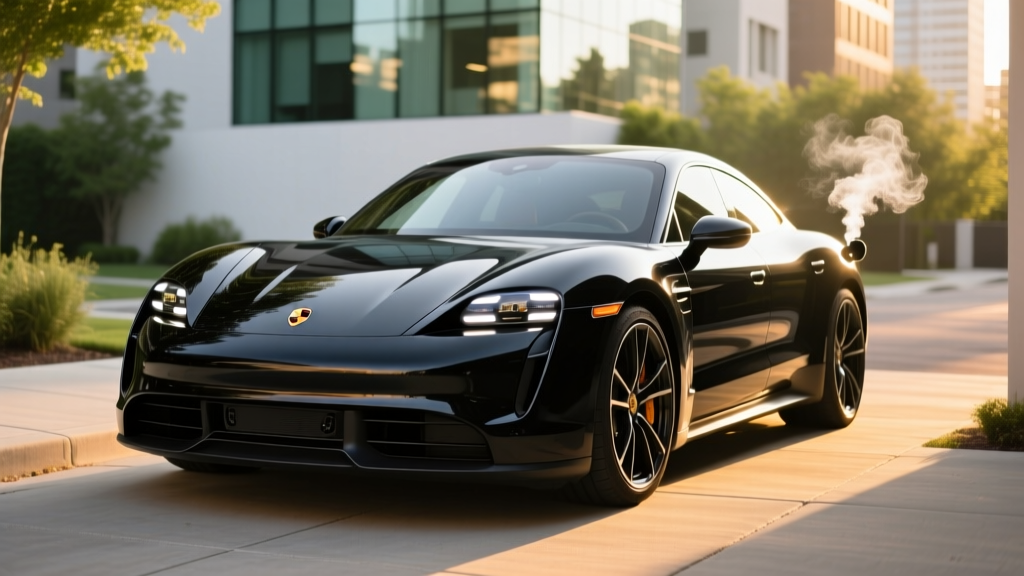
If you've been searching for an older model Porsche Taycan that uses gas, you're not alone — thousands of shoppers type that exact phrase into search engines every month. But here's the definitive answer up front: no Porsche Taycan has ever been sold with a gasoline engine, hybrid system, or any form of internal combustion. Every Taycan produced since its 2020 model-year launch is a fully battery-electric vehicle (BEV). There is no gas tank, no fuel filler door, and no engine oil to check.
So why the confusion? Porsche's own lineup includes the Panamera E-Hybrid and Cayenne E-Hybrid — plug-in hybrids that pair a turbocharged V6 with an electric motor and a small battery. Shoppers cross-shopping Porsche's electrified models sometimes assume the Taycan follows the same template. It doesn't. The Taycan was engineered from day one on Porsche's J1 electric platform, sharing its 800-volt architecture with the Audi e-tron GT.
This review covers the 2020–2024 Taycan (the "older" pre-refresh generation most buyers encounter on the used market), including real-world range, 800V charging performance, ownership costs, and how it stacks up against the Tesla Model S, Lucid Air, and BMW i5 in 2026.
Range and Efficiency: EPA vs. the Real World
The first-generation Taycan's EPA range varies sharply by trim and battery option. Base and 4S models equipped with the standard 79.2 kWh battery (gross; ~71 kWh usable) are rated between 200 and 227 miles. Opting for the larger Performance Battery Plus (93.4 kWh gross; ~83.7 kWh usable, NMC chemistry) pushes the Taycan 4S to an EPA-estimated 227 miles and the RWD Taycan to 242 miles (2022+ with rear-axle steering and heat pump).
EPA range assumes a mix of city and highway driving at moderate temperatures. In sustained 75 mph highway testing, expect roughly 185–210 miles from the Performance Battery Plus trims. In sub-30°F winter conditions without preconditioning, range can drop to 150–175 miles — a 20–30% reduction typical of NMC chemistry without an aggressive heat-pump strategy. The Taycan's heat pump (standard from 2022, optional on 2020–2021 models) mitigates this loss when activated.
| Trim | Battery (Gross/Usable kWh) | EPA Range | MPGe (City/Hwy/Combined) | kWh/100 mi |
|---|---|---|---|---|
| Taycan RWD (Std. Battery) | 79.2 / 71.0 | 200 mi | 94 / 84 / 89 | 34 |
| Taycan RWD (Perf. Battery Plus) | 93.4 / 83.7 | 242 mi | 99 / 87 / 93 | 32 |
| Taycan 4S (Perf. Battery Plus) | 93.4 / 83.7 | 227 mi | 92 / 81 / 87 | 35 |
| Taycan Turbo (Perf. Battery Plus) | 93.4 / 83.7 | 212 mi | 85 / 78 / 82 | 37 |
| Taycan Turbo S (Perf. Battery Plus) | 93.4 / 83.7 | 202 mi | 81 / 75 / 78 | 39 |
Source: fueleconomy.gov
Efficiency-wise, the Taycan RWD with the larger battery achieves a combined 93 MPGe — respectable for a 5,000+ lb performance sedan, though the Tesla Model S Long Range (124 MPGe combined, 405-mile EPA) and Lucid Air Pure (137 MPGe, 419-mile EPA) leave it behind in efficiency per kWh.
800V Charging Architecture: DC Fast and Home Level 2
The Taycan's 800-volt electrical architecture is one of its defining engineering achievements and the reason it remains a benchmark for DC fast charging even years after launch. On a compatible 350 kW DC fast charger (such as Electrify America's latest stalls), the Taycan with Performance Battery Plus peaks at 270 kW and sustains over 200 kW through a wide state-of-charge window.
| Charging Level | Power (kW) | Speed | Notes |
|---|---|---|---|
| Level 1 (120V household) | ~1.4 kW | ~3 mi/hr | Emergency trickle only; 60+ hours for full charge |
| Level 2 (240V, 48A) | 11.5 kW | ~30 mi/hr | 0–100% in ~8.5 hours; standard home setup |
| Level 2 (240V, 80A optional) | 19.2 kW | ~50 mi/hr | Requires Porsche Mobile Charger Connect + 100A circuit |
| DC Fast (CCS, 350 kW station) | Peak 270 kW | 10–80% in ~22 min | Requires battery preconditioning via nav-routed charging |
| DC Fast (CCS, 150 kW station) | Peak 150 kW | 10–80% in ~33 min | More common station type; still fast |
Charging-curve reality check: The Taycan's 270 kW peak is not sustained to 80%. The curve tapers to approximately 150 kW around 60% SoC and drops below 100 kW past 75%. That 22-minute 10–80% claim assumes preconditioning is active (triggered automatically when you navigate to a charger using the car's built-in routing). Without preconditioning — for example, at a charger you find without routing — the battery may be too cold to accept peak rates, extending the session by 5–10 minutes.
For home charging, a 48-amp Level 2 wall connector on a 60-amp circuit is the practical standard. Plan for $800–$1,500 in electrician labor if your panel has capacity, or $2,000–$4,000+ if a panel upgrade to 200A is needed. The Taycan's NACS adapter situation in 2026: Porsche offers a CCS-to-NACS adapter for Tesla Supercharger access, and the 2025+ refresh models ship with a native NACS port. For 2020–2024 models, you'll use CCS1 at non-Tesla networks and the adapter at Superchargers.
Performance: The Numbers That Define the Taycan
The Taycan's performance credentials are unambiguous, even on the base trim. Every model uses a two-speed transmission on the rear axle (a rarity among EVs — most use single-speed reducers), which gives the Taycan explosive launch acceleration and relaxed highway cruising.
| Trim | Drivetrain | Horsepower (Launch Control) | 0–60 mph | Top Speed |
|---|---|---|---|---|
| Taycan RWD | Rear-wheel drive | 402 hp | 5.1 sec | 143 mph |
| Taycan 4S | Dual-motor AWD | 562 hp | 3.8 sec | 155 mph |
| Taycan Turbo | Dual-motor AWD | 670 hp | 3.0 sec | 161 mph |
| Taycan Turbo S | Dual-motor AWD | 750 hp | 2.6 sec | 162 mph |
The Turbo S's 2.6-second 0–60 time made it one of the quickest production cars in the world at launch. Even the "base" RWD model's 5.1-second run outpaces most gas-powered sports sedans. The two-speed rear transmission is the secret: first gear multiplies torque for launch, second gear optimizes efficiency above ~50 mph. You'll feel the shift as a subtle mechanical click under hard acceleration — it's one of the Taycan's most distinctive driving characteristics.
Regenerative braking is handled differently than most EVs. Porsche chose not to offer aggressive one-pedal driving; instead, the Taycan blends regen with the physical brakes seamlessly, and you'll use the brake pedal as you would in a gas car. Maximum regen capacity is approximately 265 kW, among the highest of any production EV, which means the Taycan recovers significant energy during deceleration without the lurching sensation some drivers dislike in one-pedal setups.
Interior, Cargo, and Technology
The Taycan's cabin follows Porsche's minimalist-luxury ethos. A curved 16.8-inch digital instrument cluster faces the driver, a 10.9-inch central touchscreen handles infotainment, and an optional 10.9-inch passenger display sits ahead of the front passenger. Haptic touch controls replaced most physical buttons on the center console (climate, seat functions), which draws mixed reviews — functional but fingerprint-prone and harder to adjust while driving.
Cargo space is a Taycan weakness relative to competitors:
- Rear trunk: 14.3 cu ft (sedan); 15.7 cu ft (Cross Turismo wagon)
- Front trunk (frunk): 2.9 cu ft — barely fits a charging cable and a small bag
- Rear legroom: 32.7 inches — tight for adults on longer trips
- Front headroom: 40.0 inches
The Cross Turismo body style (introduced for 2021) adds a wagon-like rear hatch with up to 44.6 cu ft of cargo space with rear seats folded — a meaningful upgrade for anyone hauling gear. The GTS variant (2022+) bridges the 4S and Turbo with sport-tuned suspension and unique interior trim.
Driver-assistance technology is Porsche's InnoDrive suite, including adaptive cruise control, lane-keeping assist, and traffic-sign recognition. This is a SAE Level 2 system — the driver must remain fully engaged with hands on the wheel and eyes on the road. It is not autonomous driving. InnoDrive is smooth and competent but less ambitious than Tesla's Autopilot or GM's Super Cruise in terms of hands-free highway capability (Super Cruise allows hands-off on mapped highways; InnoDrive does not).
Pricing, Tax Credits, and Used-Market Value
The Taycan's original MSRP placed it firmly in luxury territory. Here's what the 2024 model year looked like before the 2025 refresh:
| Trim | Base MSRP | As-Tested Typical | §30D Federal Credit Eligible? |
|---|---|---|---|
| Taycan RWD | $92,250 | $105,000–$115,000 | No — exceeds $55,000 sedan MSRP cap |
| Taycan 4S | $105,050 | $120,000–$135,000 | No — exceeds $55,000 sedan MSRP cap |
| Taycan Turbo | $152,250 | $165,000–$180,000 | No — exceeds $55,000 sedan MSRP cap |
| Taycan Turbo S | $190,550 | $200,000–$220,000 | No — exceeds $55,000 sedan MSRP cap |
| Taycan Cross Turismo 4S | $111,100 | $125,000–$140,000 | No — exceeds $80,000 SUV/van MSRP cap* |
*Note on Cross Turismo classification: The IRS classifies vehicles by body type for the §30D MSRP cap. The Cross Turismo's classification has varied; consult irs.gov or a tax professional for current-year guidance.
- Sedan MSRP cap: $55,000 (Taycan starts at $92,250+)
- SUV/Van/Pickup MSRP cap: $80,000
- Buyer income cap: $150K single / $300K married filing jointly
- Battery critical-mineral and component sourcing requirements
- Vehicle must be assembled in North America (Taycan is built in Leipzig, Germany)
Used Taycan tax credit: The §25E used clean vehicle credit offers up to $4,000 (30% of sale price, capped) for qualifying used EVs priced at $25,000 or less. As of 2026, most used Taycans sell well above $25,000 — typically $45,000–$85,000 depending on model year, mileage, and trim — making the used credit unavailable as well. If Taycan residual values continue to soften, a high-mileage 2020 base model could theoretically cross below the threshold, but this is unlikely before 2027–2028.
For the used market, 2020–2022 Taycan 4S models with Performance Battery Plus represent the strongest value proposition in 2026, typically listing between $52,000 and $68,000 with 25,000–45,000 miles. Porsche's Certified Pre-Owned (CPO) program adds a 2-year unlimited-mileage warranty on top of any remaining factory coverage — strongly recommended for a car this complex.
Battery Warranty and Long-Term Ownership
Porsche warranties the Taycan's high-voltage battery for 8 years or 100,000 miles (whichever comes first), guaranteeing a minimum of 70% state of health (SoH) over that period. The powertrain (electric motors, power electronics, two-speed transmission) carries the same 8-year/100,000-mile coverage. The basic vehicle warranty is 4 years / 50,000 miles.
Real-world battery degradation data from early Taycan owners (2020–2021 models now at 60,000–100,000+ miles) shows approximately 5–8% capacity loss — well within the 70% warranty threshold. The NMC chemistry in the Performance Battery Plus has proven durable, aided by the Taycan's sophisticated thermal management system (liquid cooling and heating) and a relatively conservative usable buffer (~10 kWh reserved above and below the usable window).
Out-of-warranty battery replacement cost, should it ever be necessary: approximately $25,000–$35,000 for the Performance Battery Plus pack including labor. This is a worst-case scenario and not a common expense for Taycan owners, but it's a figure worth knowing when buying used.
Pros, Cons, and the Verdict
- 800V architecture: 10–80% DC fast charge in ~22 minutes (among the fastest in production)
- Two-speed rear transmission delivers explosive launch and relaxed highway efficiency
- Build quality, fit-and-finish, and driving dynamics exceed Tesla and rival Lucid
- Regenerative braking blending is seamless — no lurching or artificial feel
- Cross Turismo variant adds practicality with 44.6 cu ft cargo and raised ride height
- Strong CPO program and 8-year/100,000-mile battery warranty
- EPA range of 200–242 miles trails Tesla Model S (405 mi), Lucid Air (419 mi), and BMW i5 (295 mi)
- Frunk is tiny (2.9 cu ft); rear legroom is tight (32.7 in)
- Haptic-touch climate controls are distracting while driving
- No federal tax credit eligibility — new or used — due to MSRP and German assembly
- Level 2 ADAS (InnoDrive) requires hands-on; no hands-free highway mode
- Used prices remain high ($52K–$85K); out-of-warranty battery replacement is $25K–$35K
Choose a competitor if: You need 300+ miles of range (Tesla Model S, Lucid Air), hands-free highway driving (GM Super Cruise, Ford BlueCruise), a lower purchase price (BMW i5 eDrive40 starts ~$67K), or federal tax credit eligibility (many US-built EVs qualify).
Frequently Asked Questions
Does any Porsche Taycan use gas?
No. Every Porsche Taycan ever produced (2020–present) is a fully battery-electric vehicle with no gasoline engine, hybrid system, or fuel tank. If you want a Porsche that uses both gas and electricity, look at the Panamera E-Hybrid (plug-in hybrid, ~30 miles electric-only range) or the Cayenne E-Hybrid.
What is the real-world range of the Porsche Taycan?
The EPA rates the Taycan between 200 and 242 miles depending on trim and battery. In real-world highway driving at 75 mph, expect 185–210 miles from Performance Battery Plus models. In cold weather (below 30°F), range can drop to 150–175 miles without battery preconditioning. The heat pump (standard 2022+, optional earlier) helps significantly.
How fast does the Taycan charge at home and on the road?
At home on a 240V Level 2 charger (48 amps), the Taycan adds roughly 30 miles of range per hour and charges from 0–100% in about 8.5 hours. On a 350 kW DC fast charger, it peaks at 270 kW and charges from 10–80% in approximately 22 minutes — one of the fastest charging speeds of any production EV, thanks to its 800-volt architecture.
Does the Porsche Taycan qualify for the federal EV tax credit?
No. The new-vehicle §30D credit has a $55,000 MSRP cap for sedans and requires North American assembly. The Taycan exceeds both limits (starts at $92,250+ and is built in Germany). The used-vehicle §25E credit requires a sale price of $25,000 or less, which no Taycan currently meets. Consult irs.gov for the latest rules.
Is the Taycan worth buying over the Tesla Model S or Lucid Air?
It depends on your priorities. The Model S offers double the range (405 mi EPA) and access to the Supercharger network natively. The Lucid Air delivers 419 miles of range and a more spacious interior. The Taycan wins on driving dynamics, build quality, charging speed (800V), and Porsche's dealer/CPO experience. If range is your top concern, the Taycan is not the best choice. If driving engagement and craftsmanship are, it's arguably the best electric sedan ever made.
How long will the Taycan's battery last?
Porsche warranties the battery for 8 years / 100,000 miles at a minimum 70% state of health. Early 2020–2021 models now exceeding 80,000 miles are showing 5–8% degradation — well within warranty limits. With proper care (avoiding frequent 100% charges, using preconditioning for DC fast charging), the NMC battery should comfortably exceed 150,000 miles before approaching the 70% threshold.
Why do people search for a "Porsche Taycan that uses gas"?
The confusion likely stems from Porsche's E-Hybrid lineup (Panamera and Cayenne plug-in hybrids), which combine turbocharged gas engines with electric motors. Some shoppers assume the Taycan follows the same formula. Others may conflate the Taycan with range-extended EVs (EREVs) like the BMW i3 REx, which had a small gas generator. The Taycan has never offered either — it is purely electric.