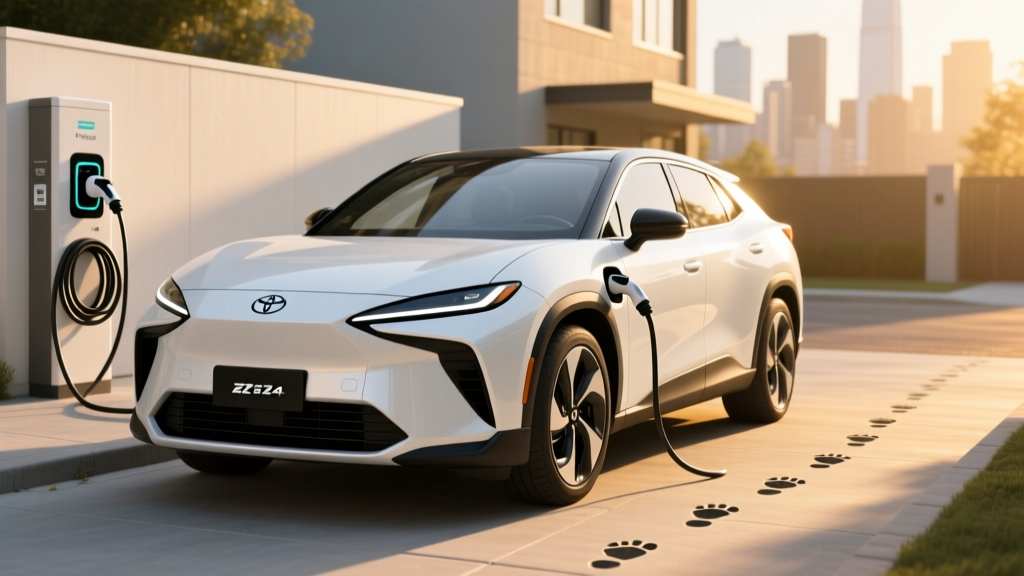
The 2024 Toyota bZ4X occupies a curious space in the electric-vehicle market. As Toyota's first dedicated battery-electric vehicle sold in the United States, it carries the weight of expectations from the world's largest automaker — yet it arrived with specs that landed squarely in the middle of an increasingly competitive compact EV SUV segment. For buyers researching a 2024 Toyota bZ4X lease, understanding the real-world numbers behind the EPA sticker is essential before signing any paperwork.
Now that we're well into 2026, the 2024 model year bZ4X is available on dealer lots as a certified pre-owned option or remaining new inventory, and lease deals on these units can be compelling — but only if the vehicle's actual capabilities match your daily driving needs. This review breaks down every spec that matters: true highway range, charging curve behavior, battery chemistry, ownership costs, and how the §30D federal tax credit applies whether you buy or lease.
Range and Efficiency: What the EPA Number Doesn't Tell You
The 2024 Toyota bZ4X comes in two drivetrain configurations, and the range difference between them is significant enough to affect your buying decision.
| Configuration | EPA Range | Combined MPGe | kWh/100 mi | Battery (Usable) |
|---|---|---|---|---|
| FWD (XLE) | 252 miles | 114 MPGe | 29 kWh | 64 kWh (71.4 kWh gross) |
| AWD (XLE) | 228 miles | 104 MPGe | 32 kWh | 64 kWh (71.4 kWh gross) |
| FWD (Limited) | 236 miles | 112 MPGe | 30 kWh | 64 kWh (71.4 kWh gross) |
| AWD (Limited) | 222 miles | 102 MPGe | 33 kWh | 64 kWh (71.4 kWh gross) |
The bZ4X's 71.4 kWh gross battery capacity (approximately 64 kWh usable) is modest compared to rivals like the Hyundai Ioniq 5 (77.4 kWh usable) or the Volkswagen ID.4 (77 kWh usable). Toyota reserves a relatively large buffer to protect long-term battery health, which is a sensible engineering choice but directly limits the miles available to the driver.
According to fueleconomy.gov, the FWD bZ4X achieves 131 MPGe city and 102 MPGe highway, revealing that this EV is notably more efficient in stop-and-go traffic where regenerative braking recaptures energy. Highway efficiency drops noticeably — a factor that road-trippers should weigh carefully.
Charging Speed: DC Fast Charging and Home Level 2
Charging performance is where the bZ4X draws the most criticism from EV enthusiasts, and the numbers explain why.
| Charging Level | Max Power | Time / Rate | Connector |
|---|---|---|---|
| Level 1 (120V household) | ~1.4 kW | ~3–4 miles per hour | J1772 |
| Level 2 (240V home/public) | 7.2 kW (onboard charger) | ~24 miles per hour; full charge in ~9.5 hrs | J1772 |
| DC Fast Charge (FWD) | 150 kW peak | 10–80% in ~30 minutes | CCS1 |
| DC Fast Charge (AWD) | 100 kW peak | 10–80% in ~38 minutes | CCS1 |
The critical detail here is the difference between FWD and AWD fast-charging speeds. The front-wheel-drive model peaks at 150 kW on a capable DC fast charger, while the all-wheel-drive model is capped at approximately 100 kW. This is a direct result of different battery thermal management tuning between the two configurations, and it means AWD owners will spend roughly 8 additional minutes at a fast charger during a 10–80% session.
Equally important is the charging curve taper. The bZ4X reaches its peak charge rate only at a low state of charge (roughly 10–20% SoC) and begins tapering significantly above 50–60%. If you arrive at a DC fast charger at 30% SoC, you may never see the full 150 kW peak — your session will average closer to 80–100 kW even in the FWD model. This is a common characteristic of many EVs but is more pronounced in the bZ4X than in competitors like the Ioniq 5, which sustains higher rates deeper into the charge curve thanks to its 800V architecture.
For home charging, the 7.2 kW onboard charger is adequate for overnight replenishment. Plugging in at 10 PM with a depleted battery will yield a full charge by roughly 7:30 AM — sufficient for virtually all daily commuting needs. Toyota includes a dual-voltage (120V/240V) portable charging cable with the vehicle, though installing a dedicated Level 2 home station (typically $500–$1,500 for equipment and electrician labor) is strongly recommended for any EV owner.
Performance, Drivetrain, and Daily Drivability
| Spec | FWD | AWD |
|---|---|---|
| Horsepower | 201 hp | 214 hp |
| Torque | 196 lb-ft | 248 lb-ft |
| 0–60 mph | ~7.1 seconds | ~5.8 seconds |
| Drivetrain | Single front motor | Dual motor (front + rear) |
| Towing Capacity | Not rated | Not rated |
The AWD bZ4X uses independent front and rear motors rather than a mechanical driveshaft, which is standard for dual-motor EV architectures. The 248 lb-ft of torque in the AWD model provides confident merging and passing power, and the 5.8-second 0–60 time is perfectly adequate for a family crossover — though it trails the Hyundai Ioniq 5 (5.2 seconds for the dual-motor) and the Ford Mustang Mach-E (5.1 seconds for the extended-range AWD).
One notable feature is Toyota's X-MODE AWD system, which includes dedicated settings for snow/dirt and deep snow/mud. It's not a hardcore off-roader, but the AWD system provides genuine all-weather confidence that many compact EV SUVs lack. The bZ4X also offers a Grip-Control function for low-traction situations.
Ride quality leans toward comfortable rather than sporty. The suspension absorbs road imperfections well, and cabin noise levels are low at highway speeds — a benefit of the absence of an internal combustion engine combined with Toyota's sound-deadening efforts.
Interior Space, Technology, and Standout Features
The bZ4X rides on Toyota's e-TNGA platform, which provides a flat floor and a wheelbase that maximizes interior volume. Here's how the space breaks down:
- Front headroom: 39.9 inches
- Front legroom: 42.1 inches
- Rear headroom: 38.1 inches
- Rear legroom: 35.6 inches
- Cargo volume (behind rear seats): 27.7 cubic feet
- Cargo volume (seats folded): 56.9 cubic feet
- Frunk: None — the bZ4X does not offer a front trunk
The rear legroom is competitive with the segment, though the cargo area is slightly smaller than the Volkswagen ID.4 (30.3 cu ft behind the rear seats). The absence of a frunk is a missed opportunity for additional storage that rivals like the Mach-E and Ioniq 5 provide.
Infotainment and tech highlights:
- 12.3-inch touchscreen with wireless Apple CarPlay and Android Auto
- 6-speaker audio system (9-speaker JBL premium on Limited)
- Wireless phone charging pad
- Wi-Fi Connect capability (subscription after trial)
- Toyota Safety Sense 3.0 (standard on all trims)
- Radiant heater on Limited trim — an energy-efficient cabin heating element that warms occupants directly, reducing battery drain compared to resistive cabin heating
The radiant heater deserves specific mention. Unlike a conventional HVAC system that heats all the cabin air (a significant battery drain in winter), the radiant heater warms the legs and feet of front-seat occupants using less energy. It's a practical feature for cold-climate drivers that partially offsets the bZ4X's range limitations in winter.
Toyota Safety Sense 3.0 and Driver Assistance
Toyota Safety Sense 3.0 is standard on every 2024 bZ4X and includes:
- Pre-Collision System with Pedestrian Detection
- Lane Departure Alert with Steering Assist
- Lane Tracing Assist
- Dynamic Radar Cruise Control (full-speed)
- Road Sign Assist
- Automatic High Beams
- Proactive Driving Assist (subtle braking and steering support in specific scenarios)
The system performs competently in highway cruising situations, maintaining lane centering and following distance reliably. However, it does not offer hands-free driving on mapped highways the way Ford's BlueCruise or GM's Super Cruise do. Toyota's approach is conservative — the car assists, but it always expects you to drive.
Pricing, Lease Considerations, and Federal Tax Credit
Understanding the financial picture is essential when evaluating a 2024 Toyota bZ4X lease or purchase, especially as remaining new and CPO inventory moves through dealerships in 2026.
| Trim | Drivetrain | Original MSRP (incl. destination) |
|---|---|---|
| XLE | FWD | $43,070 |
| XLE | AWD | $45,150 |
| Limited | FWD | $47,050 |
| Limited | AWD | $49,130 |
Federal Tax Credit Eligibility (§30D): The 2024 bZ4X qualifies for up to $7,500 in federal EV tax credits, but eligibility depends on multiple factors that buyers must verify. Under current IRS rules referenced at irs.gov, the key requirements include:
- MSRP cap: The bZ4X is classified as an SUV, so the MSRP cap is $80,000 — all trims fall well below this threshold.
- Buyer income cap: Adjusted gross income must not exceed $150,000 (single), $225,000 (head of household), or $300,000 (married filing jointly).
- Battery sourcing requirements: The bZ4X's battery components and critical minerals must meet phased-in domestic-content and FEOC (Foreign Entity of Concern) thresholds. For the 2024 model year, Toyota confirmed that the bZ4X meets the requirements for the full $7,500 credit ($3,750 for battery components + $3,750 for critical minerals). However, sourcing rules tighten annually — verify current-year compliance before purchase.
- Point-of-sale transfer: As of 2024, buyers can transfer the credit to the dealer at the point of sale, effectively reducing the purchase price by $7,500 at the time of transaction rather than waiting for a tax refund.
For buyers considering a certified pre-owned 2024 bZ4X in 2026, the used EV tax credit (§25E) offers up to $4,000 or 30% of the sale price (whichever is less), subject to income caps and a sale-price cap of $25,000. Given that CPO bZ4X pricing may hover near or above that threshold depending on trim and mileage, this credit may not apply to all transactions. Check the latest rules at irs.gov.
Battery Warranty, Longevity, and Ownership Costs
Toyota backs the 2024 bZ4X with one of the strongest EV warranties in the industry:
| Component | Coverage |
|---|---|
| EV Battery | 8 years / 100,000 miles (10 years / 150,000 miles in California and CARB-adopting states) |
| EV Powertrain (motor, inverter) | 8 years / 100,000 miles |
| Basic Vehicle | 3 years / 36,000 miles |
| Powertrain (non-EV) | 5 years / 60,000 miles |
| Corrosion Perforation | 5 years / unlimited miles |
| Roadside Assistance | 2 years / 25,000 miles |
The battery warranty guarantees that the pack will retain at least 70% of its original capacity during the coverage period. Toyota's engineering philosophy of using a large buffer between gross and usable capacity (roughly 7.4 kWh of buffer) suggests the company is prioritizing long-term battery health over maximizing advertised range — a trade-off that should reassure buyers planning to keep the vehicle for 8–10 years.
NMC chemistry batteries typically exhibit 10–15% capacity loss over 100,000 miles of normal use, though real-world degradation varies significantly based on charging habits, climate, and fast-charging frequency. Toyota's large buffer means that even with 15% gross degradation, the driver-accessible range may only decrease by 8–10% — because the buffer absorbs the initial losses.
How the bZ4X Compares to Key Rivals
| Spec | Toyota bZ4X (FWD) | Hyundai Ioniq 5 (RWD) | VW ID.4 (RWD) | Ford Mach-E (RWD ER) |
|---|---|---|---|---|
| EPA Range | 252 mi | 303 mi | 275 mi | 320 mi |
| Battery (usable) | 64 kWh | 77.4 kWh | 77 kWh | 91 kWh |
| Peak DC Charge | 150 kW | 240 kW | 170 kW | 150 kW |
| 10–80% DC Time | ~30 min | ~18 min | ~29 min | ~35 min |
| 0–60 mph | 7.1 sec | 7.4 sec | 7.7 sec | 6.3 sec |
| Cargo (rear seats up) | 27.7 cu ft | 27.2 cu ft | 30.3 cu ft | 29.7 cu ft |
| Base MSRP (2024) | $43,070 | $41,800 | $39,735 | $42,995 |
The bZ4X's 252-mile maximum range trails every competitor in this comparison. The Ioniq 5's 800V architecture gives it a decisive charging-speed advantage, while the ID.4 offers more cargo space at a lower starting price. Where the bZ4X competes effectively is in standard safety equipment (TSS 3.0 is comprehensive and included on every trim), Toyota's reputation for reliability, and the strong battery warranty.
Pros and Cons at a Glance
Pros
- Toyota Safety Sense 3.0 standard on all trims
- Strong 8-year/100,000-mile battery warranty (10/150k in CARB states)
- Comfortable ride quality and low cabin noise
- Radiant heater reduces winter energy consumption
- X-MODE AWD provides genuine all-weather capability
- Competitive pricing with full $7,500 tax credit eligibility (2024 MY)
- Wireless Apple CarPlay and Android Auto standard
Cons
- EPA range trails all key competitors (252 mi max)
- AWD model limited to 100 kW DC fast charging
- Significant charge-curve taper above 50% SoC
- No front trunk (frunk) for additional storage
- Not rated for towing
- Rear visibility is compromised by thick C-pillars
- No hands-free highway driving feature
Who Should Consider the 2024 Toyota bZ4X?
Best for: Daily commuters with reliable home charging who drive fewer than 150 miles round-trip, value Toyota's reliability reputation and warranty coverage, and want a comfortable, well-equipped compact EV SUV without paying a premium for range they won't use.
Not ideal for: Frequent road-trippers who need 300+ miles of range, apartment dwellers without home charging access (the modest range and charging speed make public-charging dependence frustrating), or buyers who need towing capability.
Lease specifically if: You want to drive an EV for 2–3 years while the charging infrastructure and battery technology mature, you can secure a lease deal that passes through the $7,500 credit as lease cash, and your daily driving stays well within the 200-mile real-world envelope.
Frequently Asked Questions
What is the real-world range of the 2024 Toyota bZ4X?
In mixed driving at moderate temperatures, expect 210–230 miles from the FWD model and 190–210 miles from the AWD. Highway driving at 70+ mph reduces these figures by 10–15%, and cold weather (below freezing) can cut range by an additional 20–30%. Plan for 155–180 miles of usable range in worst-case winter highway conditions.
How fast does the bZ4X charge at home and on the road?
At home on a Level 2 (240V) charger, the bZ4X charges at 7.2 kW, adding roughly 24 miles of range per hour and reaching a full charge in about 9.5 hours. On DC fast chargers, the FWD model peaks at 150 kW (10–80% in approximately 30 minutes), while the AWD model peaks at 100 kW (10–80% in approximately 38 minutes). Both models taper significantly above 50% state of charge.
Does the 2024 Toyota bZ4X qualify for the federal EV tax credit?
Yes — for the 2024 model year, the bZ4X qualifies for the full $7,500 §30D federal tax credit, provided the buyer meets income requirements ($150K single / $300K joint) and the vehicle's battery sourcing meets current-year thresholds. The credit can be transferred to the dealer at the point of sale. When leasing, the credit goes to the leasing company but is often passed through as lease cash. Always verify current eligibility at irs.gov and consult a tax professional.
Is it worth buying the bZ4X vs. the Hyundai Ioniq 5 or VW ID.4?
The bZ4X makes the most sense for buyers who prioritize Toyota's warranty and reliability track record over maximum range and charging speed. If you regularly drive more than 200 miles between charges or take frequent road trips, the Ioniq 5 (303 miles, 18-minute fast charge) or the ID.4 (275 miles, more cargo space, lower starting price) are stronger choices. For a commuter vehicle with home charging, the bZ4X's real-world capabilities are perfectly adequate, and lease deals on remaining inventory can make it financially attractive.
What battery chemistry does the bZ4X use?
The 2024 bZ4X uses an NMC (nickel manganese cobalt oxide) lithium-ion battery with a gross capacity of 71.4 kWh and approximately 64 kWh usable. NMC offers higher energy density than LFP (lithium iron phosphate) but is more sensitive to extreme temperatures and typically exhibits slightly faster long-term degradation. Toyota's large buffer strategy helps mitigate this.
Can I tow with the 2024 Toyota bZ4X?
No. Toyota does not rate the 2024 bZ4X for towing in the United States. If towing is a requirement, consider the Ford Mustang Mach-E (up to 1,500 lbs with the GT) or the Hyundai Ioniq 5 (up to 2,300 lbs when properly equipped), or look to larger EV SUVs like the Rivian R1S or Tesla Model X.