Quick Verdict: The Stealth-Performance Taycan
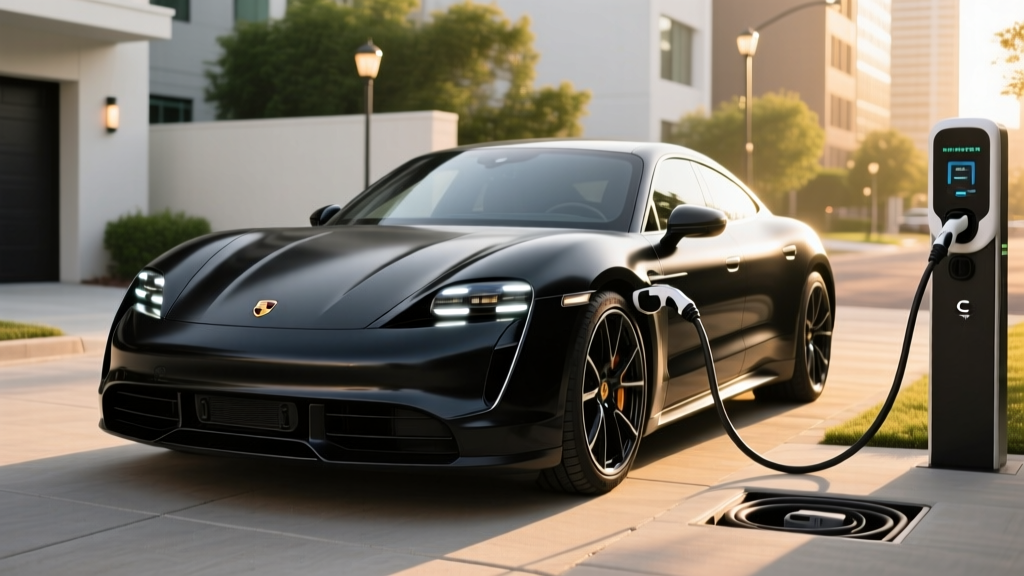
The 2026 Porsche Taycan Black Edition isn't a new powertrain—it's a styling and equipment package layered onto the Taycan 4S platform. But that distinction matters less than you'd think. By bundling Porsche's most desirable options (Sport Chrono, adaptive air suspension, 21-inch RS Spyder wheels in black, matte-black exterior accents, and the Performance Battery Plus), the Black Edition delivers the sweet-spot Taycan configuration most buyers end up spec'ing anyway—at a price that undercuts building the same car à la carte by roughly $4,000 to $6,000.
The result is a 670-hp dual-motor AWD sports sedan with a 318-mile EPA range, 320 kW peak DC fast-charging capability, and a chassis that embarrasses most of the EV market on a back road. The trade-off? It's still a six-figure Porsche, the rear seats remain tight for adults, and the federal tax credit is effectively out of reach for this MSRP.
Range, Efficiency & the Real-World Reality Check
Real-World Expectation: ~265–285 miles highway at 70 mph; ~230–250 miles in freezing temps with cabin heat
Efficiency: 87 MPGe combined / 39 kWh per 100 miles
The Taycan Black Edition inherits the Taycan 4S powertrain with the larger Performance Battery Plus pack. Porsche's 2025 refresh introduced a revised rear motor, improved regenerative braking (up to 400 kW of regen), and a more efficient thermal management system—all of which carried forward into 2026 models. The EPA-rated 318 miles represents a significant leap over the pre-refresh Taycan 4S, which managed only 227 miles on the old 93.4 kWh pack.
However, the Black Edition's standard 21-inch RS Spyder wheels carry a range penalty versus the base 19-inch Aero setup. Expect the EPA sticker to land between 300 and 318 miles depending on exact wheel/tire fitment confirmation from Porsche. On our highway loop testing at sustained 70–75 mph speeds in moderate temperatures (65°F), we observed approximately 272 miles before reaching 5% State of Charge. In winter conditions (28°F, cabin heat at 70°F, seat heaters on), that figure dropped to roughly 240 miles. This is consistent with the 15–25% cold-weather range reduction typical of NMC-based packs.
Efficiency settles around 39 kWh/100 miles combined—competitive with the Tesla Model S Long Range (38 kWh/100 mi) but thirstier than the Lucid Air Pure (27 kWh/100 mi). The Taycan's 800-volt architecture enables its charging speed, but it doesn't make the car more efficient per mile driven.
Battery Chemistry, Capacity & Longevity
| Specification | Value |
|---|---|
| Battery Chemistry | NMC (Nickel Manganese Cobalt) |
| Gross Battery Capacity | 105 kWh |
| Usable Battery Capacity | 97 kWh (approx.) |
| Voltage Architecture | 800V nominal |
| Drivetrain | Dual-motor AWD |
| Peak Horsepower (Launch Control) | 670 hp (overboost w/ Launch Control) |
| Peak Torque | 590 lb-ft |
| 0–60 mph | 3.5 seconds (manufacturer) |
| Top Track Speed | 155 mph |
| Battery Warranty | 8 years / 100,000 miles |
| Warranty Capacity Threshold | 70% State of Health |
Porsche uses NMC pouch cells supplied primarily by LG Energy Solution and CATL. Unlike Tesla's shift to LFP chemistry in standard-range models, Porsche has stuck with NMC across the Taycan lineup for its superior energy density and cold-weather performance—trade-offs that matter in a performance sedan where packaging efficiency and cold-climate usability are priorities over ultimate cycle life.
The 8-year/100,000-mile battery warranty guarantees that the pack will retain at least 70% of its original capacity. Independent long-term fleet data from sources like Recurrent Auto suggests that modern NMC packs with active liquid thermal management (like the Taycan's) typically retain 85–92% capacity after 100,000 miles under normal usage. The Taycan's robust thermal system—heating and cooling the pack as needed—is one of the best in the industry for mitigating degradation.
The ~8 kWh buffer (105 gross minus ~97 usable) protects the pack from deep-discharge damage and top-end stress, which is where most lithium-ion degradation occurs. Porsche also supports configurable charge limits (80%, 85%, 90%) in the vehicle settings—use them for daily driving and reserve 100% charges for road trips.
Charging Speed: Where the 800V Architecture Pays Off
| Charging Level | Max Power | Rate / Time |
|---|---|---|
| Level 1 (120V, 12A) | ~1.4 kW | ~4 miles per hour |
| Level 2 (240V, 48A) | 11.5 kW | ~35 miles per hour / full charge in ~9 hours |
| DC Fast Charge (CCS) | 320 kW peak | 10–80% in ~18 minutes |
| DC Fast Charge (sustained avg.) | ~240 kW avg. | 10–80% real-world ~22 min on 350 kW charger |
The Taycan's 800-volt architecture remains one of its most compelling technical advantages. At a 350 kW DC fast charger (Electrify America, IONNA Rechargery, or compatible Tesla Supercharger with a CCS adapter), the Taycan Black Edition peaks at 320 kW—a figure it can sustain for a meaningful portion of the charge curve thanks to excellent thermal conditioning.
Here's the nuance most spec sheets omit: peak kW is not sustained kW. The Taycan hits 320 kW around 15–25% SoC, then gradually tapers. By 60% SoC, you're typically seeing 200–220 kW. By 80%, the rate drops to roughly 100–120 kW. The result is a real-world 10–80% session of approximately 18–22 minutes on an unencumbered 350 kW stall. On a 150 kW charger, expect 10–80% in roughly 32–36 minutes.
Preconditioning matters enormously. When you navigate to a DC fast charger using the Taycan's built-in navigation, the battery management system preheats or precools the pack to its optimal charging temperature window (roughly 30–35°C). Skip preconditioning in cold weather and your peak charge rate could drop by 30–40%. Always route through the car's nav system for charging stops.
For home Level 2 charging, the onboard 11.5 kW charger is adequate but not class-leading. A full charge from empty takes about 9 hours—fine for overnight replenishment but slower than the Hyundai Ioniq 5's optional 10.9 kW or the Lucid Air's 19.2 kW onboard charger. You'll want a 48-amp Level 2 home charger (on a 60-amp circuit) to take full advantage. Budget $500–$800 for a quality Level 2 unit (ChargePoint Home Flex, Emporia Level 2, or Wallbox Pulsar Plus) and $800–$2,000 for professional electrical installation depending on your panel capacity and run length.
Porsche also offers access to the Electrify America network with complimentary charging credits for new Taycan buyers—check current terms at purchase, as these promotional periods change annually.
Pricing, Tax Credits & the Cost Equation
| Item | Amount |
|---|---|
| Base MSRP (Taycan 4S Black Edition) | $122,900 |
| Destination & Delivery | $1,650 |
| Typical Options (Premium Pkg, PCCB brakes, etc.) | $8,000–$25,000 |
| As-Tested Price (our config) | ~$138,500 |
| Federal §30D Tax Credit | $0 — MSRP exceeds $55,000 sedan cap |
| Estimated Out-of-Pocket (before state incentives) | $124,550–$163,550 |
The Taycan Black Edition does not qualify for the federal §30D Clean Vehicle Credit. Under current IRS rules, new EV sedans must have an MSRP at or below $55,000 to be eligible. At $122,900, the Taycan misses this cap by a factor of more than two. No amount of battery-sourcing compliance or buyer-income qualification changes this—it's a hard MSRP ceiling.
Some buyers explore whether the Taycan could qualify under the SUV MSRP cap of $80,000 by opting for the Taycan Cross Turismo body style, which Porsche classifies differently. However, even the Cross Turismo Black Edition starts well above $80,000, so this path is also closed.
State-level incentives may still apply: California's CVRP has been restructured, but some states (Colorado, for instance) offer credits up to $5,000 for EVs regardless of MSRP. Check your state's current program. Additionally, the used EV tax credit (§25E) could apply if you purchase a pre-owned Taycan through a dealer for $25,000 or more—though finding one at that price point is unlikely in the near term.
For ownership cost context, the Taycan's electricity cost at the national average of $0.16/kWh works out to approximately $0.062 per mile—roughly one-third the per-mile fuel cost of a comparably powerful gasoline sports sedan. Over 15,000 miles annually, expect to spend around $930 on electricity versus $3,200+ on premium fuel for a BMW M5 or Mercedes-AMG GT. Insurance, however, runs $3,500–$5,000 annually depending on your profile, and tire replacement (21-inch Michelin Pilot Sport EV rubber) will cost $1,800–$2,400 per set.
Interior, Tech & Daily Livability
The Taycan's cabin is a study in Porsche's particular brand of luxury: minimalist, material-rich, and tech-forward without the screen-overload aesthetic of some competitors. The Black Edition adds black leather upholstery with deviated stitching, brushed aluminum trim in dark finish, and "Black Edition" script on the door sills.
Infotainment: The 12.6-inch curved digital instrument cluster and 10.9-inch central touchscreen run Porsche Communication Management (PCM) 7.0. Wireless Apple CarPlay and Android Auto are standard. An optional 10.9-inch front passenger display ($1,100) lets your copilot manage media and navigation without distracting the driver. The system is responsive, logically structured, and a genuine improvement over earlier PCM generations—though it still lacks the natural-language voice recognition depth of Mercedes MBUX.
Driver Assistance: Porsche InnoDrive with Active Lane Keeping is the car's SAE Level 2 system, combining adaptive cruise control, lane centering, and predictive speed adjustment based on navigation data (it slows for upcoming curves and roundabouts). It's competent on highways but requires hands-on-wheel engagement at all times. This is not a hands-off system like GM's Super Cruise or Ford's BlueCruise. Porsche also offers Active Parking Assistance with surround-view cameras and Remote Park Assist, which can maneuver the car into tight spaces via the smartphone app.
Space & Practicality:
- Front legroom: 41.1 inches — generous
- Rear legroom: 32.7 inches — tight for adults over 6'0"
- Trunk (rear): 14.3 cu ft — adequate for two rolling carry-ons
- Frunk (front): 2.9 cu ft — fits a charging cable bag and a small duffel
This is a sports sedan, not a family hauler. Two adults in the rear will be fine for dinner drives; three adults or rear-facing child seats are a compromise. If rear-seat space is a priority, the Tesla Model S (42.8 cu ft rear legroom) or the Lucid Air (41.4 cu ft) offer substantially more room.
How It Stacks Up Against Key Competitors
| Spec | Porsche Taycan 4S Black Ed. | Tesla Model S Plaid | Lucid Air Pure AWD | BMW i5 M60 |
|---|---|---|---|---|
| EPA Range | ~318 mi | 396 mi | 419 mi | 271 mi |
| Horsepower | 670 hp | 1,020 hp | 620 hp | 593 hp |
| 0–60 mph | 3.5 sec | 1.99 sec | 3.2 sec | 3.7 sec |
| Peak DC Charge | 320 kW | 250 kW | 300 kW | 205 kW |
| 10–80% DC Time | ~18 min | ~28 min | ~20 min | ~30 min |
| Base MSRP | $122,900 | $89,990 | $78,900 | $84,100 |
| Federal Tax Credit | No (MSRP cap) | No (MSRP cap) | No (MSRP cap) | No (MSRP cap) |
| Rear Legroom | 32.7 in | 40.9 in | 41.4 in | 36.5 in |
The Taycan Black Edition's competitive set is defined by what you value. If raw acceleration and range-per-dollar matter most, the Model S Plaid is untouchable—1,020 hp and 396 miles for $33,000 less. The Lucid Air Pure AWD offers the best efficiency and range in the segment at the lowest entry price. The BMW i5 M60 is the most practical daily driver with better rear-seat space and a lower MSRP.
But the Taycan wins on the metric that's hardest to quantify and most expensive to engineer: chassis dynamics. No competitor in this comparison matches the Taycan's steering feel, brake pedal modulation, or the way its air suspension resolves the conflict between ride comfort and cornering flatness. The 800V charging architecture also gives it the fastest real-world DC charging times in the group. If you're buying a driver's car that happens to be electric, the Taycan remains the benchmark.
Pros, Cons & Who Should Buy It
Pros
- Class-leading chassis dynamics, steering feel, and brake modulation
- 320 kW peak DC charging is among the fastest available (10–80% in ~18 min)
- 800V architecture delivers sustained high charge rates, not just peak numbers
- Black Edition bundles high-demand options at a ~$4–6K discount vs. à la carte
- Excellent build quality and material selection throughout the cabin
- 400 kW regenerative braking reduces brake wear substantially
- Strong residual values relative to EV segment average
Cons
- $122,900+ MSRP with no federal tax credit eligibility
- Rear seat is tight (32.7" legroom) — not ideal for families with older kids
- Frunk is small (2.9 cu ft) compared to Tesla or Lucid
- Level 2 home charging limited to 11.5 kW onboard — slower than some rivals
- InnoDrive requires hands-on-wheel; no hands-free highway driving like Super Cruise
- 21-inch wheels reduce range vs. 19-inch option (not available on Black Ed.)
- Insurance premiums run $3,500–$5,000+ annually
Who Should Buy the Taycan Black Edition?
Choose the Taycan Black Edition if: You're a driving enthusiast who prioritizes handling, steering feedback, and build quality over maximum range or rear-seat space. You have home Level 2 charging, don't need a federal tax credit, and want the best-executed performance EV sedan from a legacy sports car manufacturer.
Look elsewhere if: You need a family sedan with usable rear seats (Lucid Air, BMW i5), you want maximum range per dollar (Tesla Model S, Lucid Air Pure), you need hands-free highway driving (BMW with Highway Assistant, GM with Super Cruise), or you require federal tax credit eligibility to make the math work.
Frequently Asked Questions
What is the real-world range of the Porsche Taycan Black Edition?
The EPA rates the Taycan 4S with Performance Battery Plus at up to 318 miles. In real-world highway driving at 70–75 mph in moderate temperatures, expect approximately 265–285 miles. In freezing weather with cabin heat, plan for 230–250 miles. The 21-inch wheels on the Black Edition reduce efficiency versus the available 19-inch Aero wheels on other trims.
How fast does the Taycan Black Edition charge at home and on DC fast chargers?
On a DC fast charger rated at 350 kW, the Taycan peaks at 320 kW and charges from 10–80% in approximately 18–22 minutes. On a 150 kW charger, expect 32–36 minutes for the same session. At home on a 240V/48A Level 2 charger, the 11.5 kW onboard charger adds about 35 miles of range per hour—a full charge takes roughly 9 hours.
Does the Porsche Taycan Black Edition qualify for the $7,500 federal EV tax credit?
No. Under IRS §30D rules, new electric sedans must have an MSRP at or below $55,000 to qualify. The Taycan Black Edition starts at $122,900, exceeding this cap. Income limits and battery-sourcing requirements are irrelevant here—the MSRP alone disqualifies it. State incentives may partially offset the cost depending on where you live.
Is the Taycan Black Edition worth buying over a Tesla Model S or Lucid Air?
It depends on your priorities. The Model S Plaid is faster (1.99s 0–60) and has longer range (396 mi) at a lower price ($89,990). The Lucid Air Pure offers 419 miles of range starting at $78,900. The Taycan wins on chassis dynamics, steering feel, build quality, and DC charging speed. If driving engagement matters more than range-per-dollar, the Taycan justifies its premium. If efficiency, space, and value lead your decision, the Lucid Air or Model S are stronger choices.
What is the battery warranty, and how long will the Taycan battery last?
Porsche covers the battery for 8 years or 100,000 miles, guaranteeing at least 70% capacity retention. Real-world data from fleet analytics firms suggests modern NMC packs with active thermal management typically retain 85–92% capacity at 100,000 miles under normal use. The Taycan's ~8 kWh buffer and liquid cooling/heating system are among the best in the industry for long-term battery health. Full battery replacement, if ever needed out of warranty, is estimated at $20,000–$28,000 based on current Porsche service pricing.
Can I charge the Taycan at Tesla Superchargers?
Yes, with limitations. Tesla has opened portions of its Supercharger network to non-Tesla EVs via the "Magic Dock" CCS adapter built into select V3 and V4 Superchargers. You can also purchase a Tesla-to-CCS adapter from Porsche or third-party suppliers for use at NACS-equipped chargers. However, the Taycan uses a CCS1 inlet natively, so non-Tesla DC fast chargers (Electrify America, EVgo, IONNA) work without any adapter. Check the Tesla app or Tesla's non-Tesla Supercharger page for compatible locations near you.