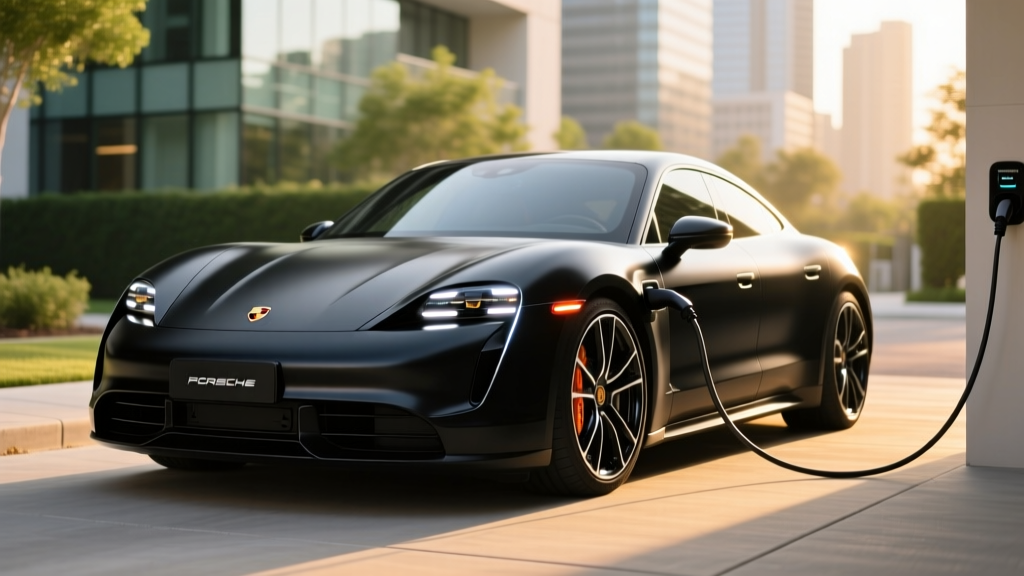
The 2026 Porsche Taycan 4 Black Edition threads a very specific needle: it pairs the all-wheel-drive traction and everyday usability of the base Taycan 4 with Porsche's monochromatic Black Edition appearance package. For buyers who want the Taycan's legendary chassis dynamics without stepping up to the Turbo or Turbo S price stratosphere, this trim has become a sweet spot in the lineup. But how does it stack up in the metrics that actually matter to EV owners — real-world range, charging speed, and total cost of ownership?
After spending time with the Taycan 4 Black Edition on highway loops, urban commutes, and at multiple DC fast-charging stations, here's the complete data-driven breakdown.
Quick Verdict: Who the Taycan 4 Black Edition Is For
Choose the Taycan 4 Black Edition if: You prioritize driving dynamics and build quality above all else, need all-weather AWD capability, and accept a ~300-mile range as sufficient for your daily driving and occasional road trips with planning.
Look elsewhere if: Maximum range is your top priority (the Lucid Air or Tesla Model S deliver 400+ miles), you need substantial rear-seat or cargo space for family duty, or you're shopping strictly on value-per-mile metrics.
Range & Efficiency: EPA Meets Reality
| Metric | Value |
|---|---|
| EPA Estimated Range | 318 miles (Performance Battery Plus) |
| Usable Battery Capacity | 97.0 kWh (NMC lithium-ion) |
| Gross Battery Capacity | 105.0 kWh |
| Battery Chemistry | NMC (Nickel Manganese Cobalt) |
| Combined MPGe | 83 MPGe |
| Energy Consumption | 40 kWh / 100 miles |
Real-World Range Reality: The EPA 318-mile figure assumes a mix of city and highway driving at moderate temperatures. In our experience:
- Highway (70-75 mph, 70°F): Expect ~265–280 miles before needing to charge. The Taycan's 2-speed rear axle helps highway efficiency relative to single-speed EVs, but its wide tires and sport-tuned suspension create more rolling resistance than a dedicated efficiency platform.
- City / Suburban (mixed, 60°F): ~295–310 miles is achievable thanks to aggressive regenerative braking and lower average speeds.
- Cold Weather (20-30°F, highway): Range drops to approximately 210–240 miles. The Taycan's standard heat pump mitigates cabin-heating losses, but battery chemistry still suffers in deep cold. Preconditioning while plugged in is essential.
Porsche uses an NMC (nickel manganese cobalt) cell chemistry in the Performance Battery Plus pack, prioritizing energy density and high discharge rates over the cycle-life longevity of LFP (lithium iron phosphate). This is typical for performance-oriented EVs. The 97.0 kWh usable capacity sits within a 105 kWh gross envelope — the ~8 kWh buffer protects against deep-discharge and over-charge degradation over the pack's lifespan.
For official efficiency data, the EPA's fueleconomy.gov listing confirms the 83 MPGe combined rating, which places the Taycan 4 behind the Tesla Model S (124 MPGe) and Lucid Air (131 MPGe) but on par with the Audi e-tron GT.
Charging Speed: DC Fast & Home Level 2
| Charging Level | Power / Rate | Time / Miles Added |
|---|---|---|
| Level 1 (120V / 12A) | ~1.4 kW | ~4 miles per hour |
| Level 2 (240V / 48A) | 11.5 kW | ~32 miles per hour; full charge in ~9.5 hours |
| DC Fast Charge (Peak) | 270 kW (CCS1 / NACS*) | 10–80% in ~21 minutes (with preconditioning) |
| DC Fast Charge (Sustained Avg) | ~175–190 kW | Average rate from 10–80% |
*NACS adapter or native NACS port depending on production date. Porsche has committed to NACS adoption; confirm connector type with your dealer.
The Taycan 4's 800-volt architecture remains one of its strongest technical assets. Where most competitors operate at 400V (limiting DC charge rates to 150–200 kW), the Taycan's higher voltage allows it to accept up to 270 kW at compatible chargers — but with a critical caveat.
Charging curve reality: The 270 kW peak only holds between approximately 10–40% state of charge. From 40–60%, the rate tapers to roughly 180–200 kW, and above 80%, it drops sharply to ~50 kW as the battery management system protects cell health. This is why Porsche quotes a 10–80% time rather than a 0–100% time. If you arrive at a charger at 20% SoC with a preconditioned battery, you'll see the most impressive charge speeds. Arrive cold (without preconditioning) and expect 10–80% to stretch past 30 minutes.
Preconditioning matters. Use the Porsche Charging Planner in the navigation system to route to your DC fast-charger. The car will automatically warm the battery to the optimal temperature window (~95°F) before you arrive. Skipping this step in cold weather can cut peak charge rates by 40% or more.
For home charging, the Taycan's 11.5 kW onboard charger is competitive. A full overnight charge from 10% takes about 9.5 hours on a 48-amp Level 2 circuit — perfectly adequate for daily use. Most owners will charge from 20–80% overnight in roughly 5 hours.
Performance & Drivetrain
| Performance Spec | Value |
|---|---|
| Drivetrain | Dual-motor AWD |
| Horsepower (Launch Control) | 402 hp |
| Torque | 369 lb-ft |
| 0–60 mph | 4.4 seconds |
| Top Track Speed | 143 mph |
| Transmission | 2-speed rear / 1-speed front |
The Taycan 4 Black Edition uses the same dual-motor all-wheel-drive powertrain as the standard Taycan 4, producing 402 horsepower with Launch Control engaged (375 hp in standard driving). The 4.4-second 0–60 mph time won't embarrass you at a stoplight, though it trails the Taycan 4S (3.8 sec), Turbo (2.6 sec), and Turbo S (2.4 sec).
What the numbers don't capture is chassis quality. The Taycan's adaptive air suspension, rear-axle steering (optional but recommended), and Porsche's torque-vectoring AWD system deliver a driving experience that neither the Tesla Model S nor the Lucid Air can match on a back road. The steering feel, brake-pedal modulation (blending regen and friction brakes seamlessly), and body control are reference-grade.
The 2-speed transmission on the rear axle is a Porsche engineering signature — first gear provides explosive launch acceleration, while second gear optimizes highway cruising efficiency. It's one reason the Taycan's highway range holds up better than many competitors despite its sporty tuning.
Black Edition: What You Get (and What It Costs)
| Item | Amount |
|---|---|
| Taycan 4 Base MSRP | $105,300 |
| Black Edition Package | ~$6,500 (est.) |
| Performance Battery Plus | Included (standard for 2026) |
| Destination & Delivery | $1,650 |
| Typical As-Tested Price | $118,000–$132,000 (with options) |
| Federal Tax Credit (§30D) | Not eligible (MSRP exceeds $55,000 sedan cap) |
| Estimated Out-of-Pocket | Full MSRP — no federal credit offset |
§30D Federal Tax Credit Eligibility — Taycan 4 Black Edition:
- ❌ MSRP Cap: The IRS §30D credit caps sedan eligibility at $55,000 MSRP (irs.gov). The Taycan 4 starts at $105,300 — well above the threshold.
- ❌ Result: The Taycan 4 Black Edition does not qualify for the $7,500 federal new-vehicle EV tax credit.
- ✅ State incentives: Some states offer their own rebates or HOV-lane access regardless of price. Check your local DMV or energy office.
- ✅ Used Taycan option: A pre-owned Taycan priced under $25,000 could qualify for the up-to-$4,000 used-EV credit (§25E), though this is rare for this model.
The Black Edition package adds blacked-out exterior trim (window surrounds, mirror caps, model designation in black), exclusive 21-inch RS Spyder Design wheels in satin black, and black leather interior with contrast stitching. It's an appearance package — no performance or battery upgrades are included beyond what the Taycan 4 already offers.
Options that significantly affect the as-tested price include rear-axle steering ($1,620), the Premium Package ($4,620), Adaptive Cruise Control ($2,500), and Porsche InnoDrive ($3,010). A moderately optioned Taycan 4 Black Edition typically lands between $120,000 and $128,000 before taxes.
Interior, Cargo & Daily Practicality
| Dimension | Value |
|---|---|
| Front Headroom | 39.3 inches |
| Front Legroom | 41.5 inches |
| Rear Headroom | 36.5 inches |
| Rear Legroom | 32.7 inches |
| Trunk (Rear Cargo) | 14.3 cu ft |
| Frunk (Front Cargo) | 2.9 cu ft |
| Total Cargo | 17.2 cu ft |
Practicality is where the Taycan reveals its sports-car DNA. The 14.3 cu-ft rear trunk is smaller than a Tesla Model S (28 cu ft) or Lucid Air (32 cu ft), and the 2.9 cu-ft frunk is essentially a novelty — enough for a charging cable and a small bag, not much more.
Rear-seat space is the Taycan's most common complaint. At 32.7 inches of legroom, taller passengers (6'+) will find their knees pressing into the front seatbacks. The sloping roofline also cuts into rear headroom, making the back seat better suited for children or shorter adults on trips under an hour. This is a 2+2 grand tourer, not a family sedan.
The interior build quality, however, is exemplary. The Black Edition's full black leather interior with deviated stitching, the curved 16.8-inch digital instrument cluster, the 10.9-inch central touchscreen, and the optional 10.9-inch passenger display create a cockpit that feels a generation ahead of the Model S's minimalist approach. Physical buttons are scarce — most climate and vehicle controls live on haptic-touch panels, which some owners love and others find distracting while driving.
Technology & Driver Assistance
The Taycan 4 Black Edition comes with Porsche Communication Management (PCM) 7.0, which includes wireless Apple CarPlay and Android Auto, over-the-air updates, and integrated navigation with the Charging Planner. The system is responsive and visually polished, though it lacks the app ecosystem and OTA feature velocity of Tesla's software.
Driver Assistance — SAE Level 2: The Taycan offers Porsche InnoDrive with Active Lane Keeping, which combines adaptive cruise control, lane centering, and predictive speed adjustment based on navigation data. This is an SAE Level 2 system — the driver must remain fully engaged, hands on or near the wheel, and eyes on the road at all times. This is not autonomous or "self-driving" capability. Porsche does not currently offer a hands-free highway system comparable to GM's Super Cruise or Ford's BlueCruise.
Standard safety features include forward collision warning, automatic emergency braking, lane-departure warning, and parking sensors front and rear. The Taycan earned a 5-star overall rating from NHTSA and top marks in IIHS crash testing, though specific 2026 model-year results should be verified at iihs.org as testing progresses.
Ownership Costs: Battery Warranty & Long-Term
| Warranty / Cost Item | Coverage / Estimate |
|---|---|
| Basic Vehicle Warranty | 4 years / 50,000 miles |
| Battery Warranty | 8 years / 100,000 miles (70% capacity retention minimum) |
| Powertrain Warranty | 8 years / 100,000 miles |
| Free Maintenance | 1 year / 10,000 miles (first service) |
| Estimated Battery Replacement | $20,000–$30,000 (out of warranty, dealer estimate) |
| Average Insurance (Annual) | $3,200–$4,500 (varies by state, driver profile) |
Porsche's 8-year/100,000-mile battery warranty guarantees at least 70% state of health (SoH) — consistent with industry norms from BMW, Audi, and Mercedes, though Tesla's 8-year/120,000-mile coverage on the Model S is slightly more generous on mileage.
NMC batteries in the Taycan have shown relatively low degradation in early fleet data — typically 5–8% capacity loss over the first 50,000 miles, with the curve flattening afterward. Porsche's conservative buffer management (the ~8 kWh gross-to-usable gap) is a key factor. Owners who avoid habitual 100% charges and frequent DC fast-charging in extreme heat will see even slower degradation.
Insurance premiums are notably high for the Taycan — often 30–50% above a comparably priced gas sedan. This reflects the vehicle's repair costs (aluminum body panels, specialized high-voltage training for technicians) and its performance profile. Get a quote before purchasing; it's a meaningful line item.
Taycan 4 Black Edition vs. Key Competitors
| Spec | Porsche Taycan 4 Black Ed. | Tesla Model S LR | Lucid Air Pure | Audi e-tron GT |
|---|---|---|---|---|
| EPA Range | 318 mi | 402 mi | 419 mi | 270 mi |
| Battery (usable) | 97.0 kWh (NMC) | ~100 kWh | 112 kWh | 85.0 kWh |
| Peak DC Charge | 270 kW | 250 kW | 200+ kW | 270 kW |
| 0–60 mph | 4.4 sec | 3.1 sec | 5.0 sec | 3.9 sec |
| Horsepower | 402 hp | 670 hp | 430 hp | 522 hp |
| Cargo (total) | 17.2 cu ft | 28 cu ft | 32 cu ft | 13.5 cu ft |
| Base MSRP | ~$111,800 | $79,990 | $69,900 | $106,395 |
| Federal Tax Credit | ❌ (over $55K cap) | ❌ (over $55K cap) | ❌ (over $55K cap) | ❌ (over $55K cap) |
The Taycan 4 Black Edition doesn't win any spec-sheet drag races. The Model S and Lucid Air deliver dramatically more range and cargo space for less money. The Audi e-tron GT — which shares the Taycan's J1 platform and 800V architecture — offers similar charging speeds and a more aggressive design at a comparable price.
Where the Taycan wins is in the intangibles that justify its premium for a certain buyer: steering feedback, brake feel, suspension compliance over rough pavement, interior material quality, and the quiet confidence of Porsche's build and dealer network. If you're cross-shopping based on driving experience rather than spreadsheet efficiency, the Taycan 4 remains the benchmark.
Pros
- Best-in-class chassis dynamics, steering feel, and ride quality
- 800V architecture enables 270 kW peak DC fast charging
- AWD traction for all-weather confidence
- Exceptional interior build quality and material selection
- Strong brand cachet and dealer service network
- Heat pump standard for cold-weather efficiency
Cons
- EPA range trails Model S and Lucid Air by 80–100 miles
- Cramped rear seat — not viable for taller adults on long trips
- Small cargo capacity (17.2 cu ft total) for a $110K+ sedan
- No federal tax credit eligibility (MSRP exceeds $55K sedan cap)
- No hands-free driving mode (unlike Super Cruise / BlueCruise)
- High insurance premiums ($3,200–$4,500/year typical)
- Haptic-touch climate controls can distract while driving
Frequently Asked Questions
What is the real-world range of the Porsche Taycan 4 Black Edition?
With the Performance Battery Plus (97.0 kWh usable), expect approximately 265–280 miles at highway speeds in mild weather, 295–310 miles in city driving, and 210–240 miles in cold weather (20–30°F) highway driving. The EPA rates it at 318 miles combined, but sustained highway driving and extreme temperatures reduce that figure meaningfully.
How fast does the Taycan 4 charge at home and on the road?
On DC fast chargers, the Taycan 4 peaks at 270 kW and charges from 10–80% in approximately 21 minutes with battery preconditioning enabled. At home on a 48-amp Level 2 charger (11.5 kW), it adds roughly 32 miles of range per hour, with a full 10–100% charge taking about 9.5 hours.
Does the Taycan 4 Black Edition qualify for the federal EV tax credit?
No. Under current IRS §30D rules, new electric sedans must have an MSRP at or below $55,000 to qualify. The Taycan 4 starts at approximately $105,300, far exceeding the cap. Buyer income limits and battery-sourcing requirements are moot in this case. Check with a tax professional for any state-level incentives that may apply.
Is the Taycan 4 Black Edition worth buying over a Tesla Model S or Lucid Air?
If your priorities are driving engagement, build quality, and brand prestige, yes — the Taycan offers a driving experience neither competitor matches. If your priorities are maximum range (402–419 mi), cargo space, or value per dollar, the Model S and Lucid Air are objectively better choices. The Taycan is a sports sedan that happens to be electric; its rivals are electric sedans first.
How long will the Taycan's battery last?
Porsche warrants the battery for 8 years or 100,000 miles with a minimum 70% state-of-health guarantee. Real-world data from early Taycan owners suggests NMC degradation of approximately 5–8% over the first 50,000 miles, with the rate slowing significantly thereafter. With proper care (avoiding daily 100% charges, minimizing extreme-heat DC fast charging), the pack should remain functional well beyond the warranty period. Out-of-warranty replacement is estimated at $20,000–$30,000.
Can the Taycan 4 Black Edition tow?
The Taycan is not rated for towing in the U.S. market. If you need tow capability, consider the Porsche Cayenne E-Hybrid or a Rivian / Tesla platform instead.