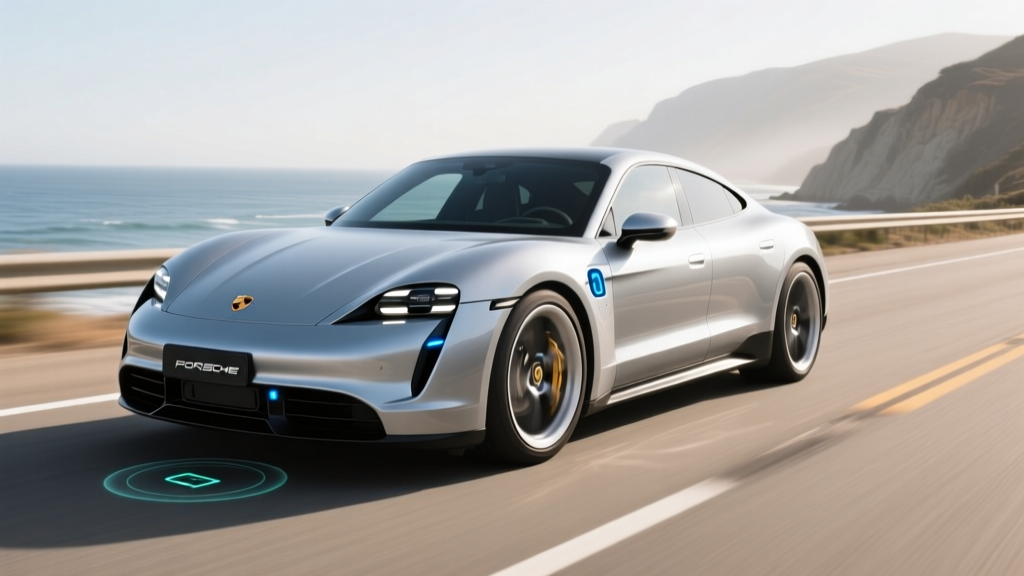
The Porsche Taycan has always been the answer to a specific question: can a battery-electric car deliver the soul of a 911 while functioning as a daily driver? For 2026, Porsche has sharpened that answer considerably. The updated Taycan lineup brings faster charging, revised battery chemistry, and 0-60 mph times that border on the absurd — but it also demands a price that puts it firmly in luxury-sports territory. This review breaks down every trim's acceleration, real-world range, charging behavior, and whether the federal EV tax credit applies.
2026 Porsche Taycan: Trim-by-Trim 0-60 and Performance Specs
The keyword here is porsche taycan 060, so let's lead with the numbers that matter. Porsche offers the 2026 Taycan in six core configurations, each with distinct power outputs and acceleration profiles. All figures below reflect factory-claimed 0-60 mph times with Launch Control engaged.
| Trim | Drivetrain | Peak HP (Launch Control) | 0-60 mph (seconds) | Top Speed (mph) | Base MSRP |
|---|---|---|---|---|---|
| Taycan (Base RWD) | Rear-Wheel Drive | 402 hp | 4.6s | 143 | $92,950 |
| Taycan 4S | Dual-Motor AWD | 590 hp | 3.5s | 155 | $109,650 |
| Taycan GTS | Dual-Motor AWD | 690 hp | 3.0s | 155 | $132,650 |
| Taycan Turbo | Dual-Motor AWD | 870 hp | 2.5s | 161 | $161,050 |
| Taycan Turbo S | Dual-Motor AWD | 944 hp | 2.2s | 161 | $197,450 |
| Taycan Turbo GT | Dual-Motor AWD | 1,019 hp | 2.1s | 180 | $234,350 |
For context, the base Taycan's 4.6-second 0-60 time matches a well-optioned BMW M340i, while the Turbo GT's 2.1-second sprint puts it in hypercar territory — roughly a half-second quicker than a Bugatti Veyron. The dual-motor AWD trims (4S and above) use Porsche's two-speed rear axle, which gives the Taycan a unique edge: first gear multiplies torque off the line, while second gear optimizes high-speed efficiency. This is why the Taycan's 0-60 times hold up even against lighter competitors.
Battery, Chemistry, and Real-World Range
The 2026 Taycan offers two battery packs across the lineup. The base RWD model uses a 79.2 kWh (gross) lithium-ion NMC (nickel manganese cobalt) pack, while the 4S, GTS, Turbo, Turbo S, and Turbo GT use the larger 97.0 kWh (gross) Performance Battery Plus. Porsche does not currently offer LFP chemistry in the Taycan — the energy density and discharge-rate requirements of a performance sedan favor NMC.
The Turbo GT, despite its massive 97.0 kWh pack, sacrifices range for performance — its EPA rating sits at just 269 miles, and aggressive track-style driving can halve that figure. Conversely, the Taycan 4S with the Performance Battery Plus and efficiency-oriented driving can approach its EPA number on mixed suburban routes thanks to strong regenerative braking (up to 290 kW of regen recovery, among the highest in the industry).
| Trim | Battery (kWh gross) | EPA Range (mi) | Combined MPGe | kWh/100 mi |
|---|---|---|---|---|
| Taycan (Base RWD) | 79.2 | 252 | 88 | 38 |
| Taycan 4S | 97.0 | 283 | 84 | 40 |
| Taycan GTS | 97.0 | 272 | 80 | 42 |
| Taycan Turbo | 97.0 | 278 | 79 | 43 |
| Taycan Turbo S | 97.0 | 270 | 77 | 44 |
| Taycan Turbo GT | 97.0 | 269 | 75 | 45 |
Source: EPA Fuel Economy — verify trim-specific values as equipment changes yearly.
Charging Speed: 320 kW DC and the 10-80% Reality
Porsche upgraded the Taycan's DC fast-charging architecture for 2026. The Performance Battery Plus (97.0 kWh) now peaks at 320 kW on compatible CCS1 chargers, up from 270 kW on the prior generation. The base 79.2 kWh pack peaks at 235 kW. Both use an 800-volt architecture, which is what enables these high charge rates without excessive cable heating.
| Charging Method | Base (79.2 kWh) | Performance Battery Plus (97.0 kWh) |
|---|---|---|
| Level 1 (120V, 12A) | ~1.4 kW / ~4 mi/hr | ~1.4 kW / ~4 mi/hr |
| Level 2 (240V, 48A) | 11.5 kW / ~31 mi/hr | 11.5 kW / ~31 mi/hr |
| Level 2 (240V, 80A — optional) | 19.2 kW / ~52 mi/hr | 19.2 kW / ~52 mi/hr |
| DC Fast Charge (peak) | 235 kW | 320 kW |
| DC 10-80% time | ~24 minutes | ~18 minutes |
A critical note on charge curves: the Taycan does not sustain 320 kW for the entire 10-80% session. Peak rate is achieved between roughly 10-40% state of charge (SoC), after which the rate tapers progressively. From 80-100%, charging slows dramatically to protect battery longevity — expect a full 80-100% top-off to take an additional 20+ minutes. For road trips, plan to charge from 10-80% and drive on; that's where the Taycan's charging speed is most impressive.
For home Level 2 charging, the standard 11.5 kW onboard charger replenishes the 97.0 kWh pack from empty in roughly 9.5 hours. The optional 19.2 kW charger cuts that to about 6 hours but requires a 100-amp dedicated circuit — a significant electrical panel consideration. Most owners will find the 11.5 kW setup sufficient for overnight replenishment. Always consult a licensed electrician for home charger installation specs.
Pricing, Tax Credits, and Ownership Costs
The 2026 Taycan lineup starts at $92,950 for the base RWD sedan and climbs to $234,350 for the Turbo GT with Weissach Package. Cross Sport Turismo (wagon) body styles add approximately $3,000–$5,000 to equivalent sedan pricing. Destination charges add $1,650.
- MSRP Cap: §30D limits eligible sedars to an MSRP of $55,000 or less. Every Taycan trim exceeds this threshold.
- Battery Sourcing: Even if a lower-priced trim existed, the Taycan's battery cell sourcing does not meet the critical-minerals and battery-component requirements phased in through 2025-2026.
Some states offer separate EV rebates or tax incentives — check your state's energy office or the IRS §30D page for current rules. Consult a tax professional before making purchase decisions based on incentives.
| Trim | Base MSRP | As-Tested (typical options) | Federal §30D Credit |
|---|---|---|---|
| Taycan (Base RWD) | $92,950 | $101,000–$108,000 | Not eligible |
| Taycan 4S | $109,650 | $118,000–$128,000 | Not eligible |
| Taycan GTS | $132,650 | $142,000–$152,000 | Not eligible |
| Taycan Turbo | $161,050 | $172,000–$185,000 | Not eligible |
| Taycan Turbo S | $197,450 | $210,000–$225,000 | Not eligible |
| Taycan Turbo GT | $234,350 | $245,000+ | Not eligible |
Insurance costs are commensurate with the price. Expect annual premiums of $3,500–$5,500 depending on trim, driving record, and location. The Taycan's high repair costs (especially carbon-fiber and aluminum body panels) drive these figures. Porsche's warranty covers the vehicle for 4 years/50,000 miles, with the battery and powertrain warranted for 8 years/100,000 miles, guaranteed to retain at least 70% of original capacity during that period.
Interior, Cargo, and Daily Practicality
The Taycan's cabin reflects Porsche's current design language: a curved 16.8-inch digital instrument cluster, a 10.9-inch central touchscreen running Porsche Communication Management (PCM), and an optional 10.9-inch passenger display. Build quality is exceptional — every surface is either leather, Alcantara, aluminum, or carbon fiber, depending on trim and options.
Practicality is the Taycan's weakest suit compared to rivals:
- Front trunk (frunk): 2.9 cu ft — enough for a small bag or charging cables
- Rear trunk: 14.3 cu ft (sedan), expandable with 60/40 split-folding rear seats
- Rear legroom: 32.7 inches — tight for adults over 6 feet on longer trips
- Front headroom: 38.0 inches (sedan); the Sport Turismo wagon adds 0.8 inches
The Taycan Cross Turismo (wagon variant) improves cargo capacity to approximately 15.7 cu ft behind the rear seats and offers a slightly raised ride height for light gravel or snow. It's the more practical choice for anyone who regularly carries gear or rear-seat passengers.
Driver-Assistance Tech and Smart Features
Porsche's tech suite includes:
- InnoDrive: Predictive cruise control that reads GPS and road-sign data to adjust speed for curves, intersections, and speed limits up to 90 mph. Works well on highways but requires driver supervision.
- Active Lane Keeping: Gentle steering corrections; less aggressive than Tesla Autopilot but also less capable in construction zones.
- Park Assist with Surround View: Excellent 360-degree camera system; self-parking available but slow compared to competitors.
- Night Vision Assist: Thermal camera (optional, ~$2,600) highlights pedestrians and animals — genuinely useful for rural night driving.
The infotainment system supports wireless Apple CarPlay and Android Auto, over-the-air updates, and Porsche Connect services (remote preconditioning, charge monitoring, vehicle tracking). Preconditioning the battery for DC fast charging is available via the navigation system — enter a fast charger as your destination and the Taycan will warm the battery to optimal temperature, improving charge speeds by 15-25% in cold weather.
Taycan vs. the Competition: Is It Worth It?
The Taycan's competitive set includes the Tesla Model S Plaid, Audi e-tron GT, Lucid Air, and BMW i7. Here's how they stack up on the metrics buyers actually compare:
| Metric | Porsche Taycan Turbo S | Tesla Model S Plaid | Lucid Air Sapphire | Audi e-tron GT RS |
|---|---|---|---|---|
| 0-60 mph | 2.2s | 1.99s | 1.89s | 2.5s |
| EPA Range | 270 mi | 396 mi | 427 mi | 232 mi |
| Peak DC Charge | 320 kW | 250 kW | 300 kW | 270 kW |
| Starting MSRP | $197,450 | $89,990 | $249,000 | $164,900 |
The Taycan wins on build quality, driving dynamics, and charging speed. Its steering feel, brake modulation, and chassis balance remain class-leading — no EV sedan communicates road surface as clearly. The 320 kW peak charge rate is the fastest in this group.
It loses on range and value. The Model S Plaid offers nearly 50% more EPA range at less than half the price. The Lucid Air Sapphire is quicker and goes farther. If straight-line speed and range are your only metrics, the Taycan is hard to justify.
But if you prioritize the experience of driving — steering weight, suspension composure, interior material quality, the way the two-speed rear axle delivers relentless acceleration — the Taycan has no equal. It's the EV that drives most like a Porsche, which is precisely what its buyers want.
Pros, Cons, and Who Should Buy
Pros
- Class-leading driving dynamics and steering feel
- 320 kW DC fast charging (10-80% in ~18 min)
- 290 kW regenerative braking recovery
- Exceptional build quality and materials
- Two-speed rear axle for sustained performance
- Strong brand cachet and resale value
Cons
- EPA range trails Tesla Model S and Lucid Air significantly
- No federal tax credit eligibility
- Tight rear legroom (32.7 inches)
- Small frunk (2.9 cu ft)
- High insurance and repair costs
- Infotainment learning curve; no physical knobs
Decision Framework: Who Is the Taycan For?
Choose the Taycan if: You prioritize driving engagement over maximum range, want the fastest DC charging available, value Porsche build quality, and don't need rear-seat space for adults on long trips. The 4S trim offers the best balance of performance, range, and price.
Look elsewhere if: You need 350+ miles of range (Lucid Air, Tesla Model S), require regular rear-seat adult passengers (BMW i7, Mercedes EQS), or want federal tax credit eligibility (consider the BMW i4 or Hyundai Ioniq 6).
Frequently Asked Questions
What is the real-world range of the 2026 Porsche Taycan?
The EPA rates the Taycan 4S at 283 miles combined. Real-world highway driving at 75 mph typically yields 235–250 miles. In cold weather (below 30°F), expect 195–210 miles. The base RWD model delivers roughly 210–225 highway miles in moderate conditions.
How fast does the Taycan charge at home and on the road?
At home on a 240V/48A Level 2 charger, the Taycan adds approximately 31 miles of range per hour (11.5 kW). On a DC fast charger, the Performance Battery Plus peaks at 320 kW and charges from 10-80% in approximately 18 minutes, though the charge rate tapers significantly above 80% SoC.
Does the Porsche Taycan qualify for the federal EV tax credit?
No. The Taycan exceeds the §30D MSRP cap of $55,000 for sedans, and its battery sourcing does not meet current critical-minerals requirements. No trim qualifies for the $7,500 federal credit. Check IRS guidelines for the latest rules, as they are subject to legislative change.
What is the fastest Porsche Taycan 0-60 time?
The 2026 Taycan Turbo GT achieves 0-60 mph in 2.1 seconds with Launch Control, producing 1,019 hp. The Turbo S follows at 2.2 seconds (944 hp). Both figures are with the 97.0 kWh Performance Battery Plus and AWD.
Is the Taycan worth buying over the Tesla Model S?
It depends on priorities. The Model S offers more range (396 vs. 283 mi EPA), a lower starting price ($89,990 vs. $109,650 for the 4S), and access to the Supercharger network. The Taycan offers superior build quality, better steering feel, faster DC charging (320 vs. 250 kW), and a more engaging driving experience. If driving dynamics matter most, the Taycan wins. If range and value matter most, the Model S wins.
What is the Taycan's battery warranty?
Porsche warrants the Taycan's high-voltage battery for 8 years or 100,000 miles, whichever comes first, guaranteeing it will retain at least 70% of its original capacity. The general vehicle warranty is 4 years/50,000 miles.