Quick Answer: What Happened With the Macan EV?
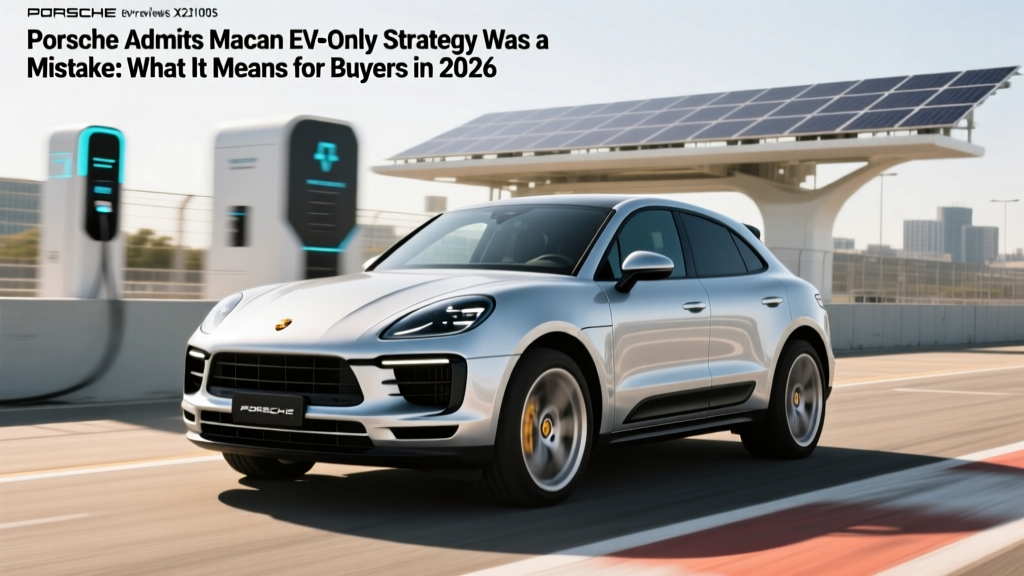
In 2025, Porsche acknowledged that phasing out the internal-combustion Macan entirely in favor of the all-electric Macan EV alienated a significant portion of its buyer base — particularly in markets where charging infrastructure remains inconsistent and where the EV's starting price pushed past $80,000. The company confirmed it would explore reintroducing a combustion or plug-in hybrid variant alongside the EV for future model years. For buyers right now, the all-electric Macan (sold as the Macan 4 Electric and Macan Turbo Electric) remains the only new Macan available in the U.S. through 2026, and it's a genuinely capable luxury EV SUV — but the controversy raises valid questions about whether it's the right vehicle for your specific driving situation.
Why Porsche Walked Back Its EV-Only Macan Plan
Porsche's original roadmap called for the combustion Macan — one of the brand's best-selling models globally — to be fully replaced by the electric Macan by 2025. The automaker invested heavily in the Premium Platform Electric (PPE) architecture co-developed with Audi, betting that the luxury compact SUV segment was ready for a full battery-electric transition.
The reality proved more complicated. Several factors converged:
- Price creep: The electric Macan starts at approximately $81,300 for the Macan 4 Electric and climbs to $106,700 for the Macan Turbo Electric — a significant premium over the outgoing gas Macan, which started around $62,000 in its final model year.
- Infrastructure gaps: In key Porsche markets — including rural areas of the U.S. South and Mountain West — DC fast-charging networks remain sparse, making an EV-only proposition a harder sell.
- Regulatory shifts: Evolving EPA emissions standards and shifting political attitudes toward EV mandates in the U.S. created uncertainty about the timeline for full electrification.
- Buyer pushback: Dealers reported losing customers who wanted the Macan form factor but weren't ready to commit to a fully electric vehicle, particularly those without reliable home charging access.
The result: Porsche signaled it would evaluate adding a plug-in hybrid or updated combustion option for future Macan generations, effectively conceding that a single-powertrain strategy was premature for this segment and price point.
2026 Macan EV: The Numbers That Matter
If you're considering the electric Macan as it exists today, here's what the spec sheet looks like across the two available trims.
| Specification | Macan 4 Electric | Macan Turbo Electric |
|---|---|---|
| Base MSRP | $81,300 | $106,700 |
| Battery (usable) | 95 kWh (NMC) | 95 kWh (NMC) |
| EPA Range | 307 miles | 288 miles |
| Real-World Range (highway, 70 mph) | ~255–275 miles | ~240–260 miles |
| Cold-Weather Range (20°F) | ~220–245 miles | ~205–230 miles |
| Horsepower | 402 hp | 630 hp |
| 0–60 mph | 4.9 seconds | 3.1 seconds |
| Peak DC Fast Charge | 270 kW | 270 kW |
| 10–80% DC Charge Time | ~21 minutes | ~21 minutes |
| Level 2 Charge Rate | 11 kW (AC) | 11 kW (AC) |
| MPGe (combined) | 88 MPGe | 83 MPGe |
| Battery Warranty | 8 years / 100,000 miles | 8 years / 100,000 miles |
Real-World Range Reality Check: The EPA-rated 307 miles on the Macan 4 Electric is respectable, but expect 255–275 miles on sustained highway driving at 70+ mph, and potentially as low as 220 miles in sub-freezing temperatures. Porsche's thermal management system and standard heat pump help mitigate cold-weather losses, but physics still applies. The Macan Turbo's heavier equipment and more aggressive power delivery reduce range further. On road trips, plan charging stops around 200-mile intervals to stay comfortable and avoid the steep charge-curve taper above 80% SoC.
Macan EV vs. Gas Macan vs. PHEV Competitors: Cost and Capability
The core question Porsche's strategy reversal raises is whether going fully electric makes financial and practical sense in this segment. Let's compare the electric Macan against the outgoing gas Macan and a key plug-in hybrid competitor.
| Metric | 2026 Macan 4 Electric | 2024 Gas Macan (Final Year) | 2026 BMW X5 xDrive50e (PHEV) |
|---|---|---|---|
| Base MSRP | $81,300 | $62,000 (discontinued) | $74,100 |
| Powertrain | Dual-motor BEV | 2.0L Turbo I4 | 3.0L I6 Turbo + Electric Motor |
| EPA Range / MPG | 307 mi / 88 MPGe | 21 MPG combined | 38 mi electric / 50 MPGe combined |
| 0–60 mph | 4.9 sec | 5.9 sec | 4.6 sec |
| Fuel/Energy Cost (5 yr, 15k mi/yr) | ~$4,800 (electricity) | ~$12,500 (premium gas) | ~$7,200 (mixed) |
| Estimated Maintenance (5 yr) | ~$2,100 | ~$5,800 | ~$4,500 |
| Federal Tax Credit (§30D) | $0 (exceeds MSRP cap) | N/A | $0 (exceeds MSRP cap) |
| Cargo Volume | 18.4 cu ft (rear seats up) | 17.6 cu ft | 33.9 cu ft |
Several takeaways emerge from this comparison:
- The EV costs more upfront but saves on running costs. Over five years and 75,000 miles, the Macan 4 Electric saves roughly $7,700 in energy and $3,700 in maintenance compared to the gas Macan — a combined $11,400. That still doesn't close the ~$19,300 purchase-price gap.
- No federal tax credit applies. The §30D credit caps SUV MSRP eligibility at $80,000, and the Macan 4 Electric starts just above that threshold at $81,300. Even if you option a competing PHEV below the cap, the credit requires North American battery assembly and critical-mineral sourcing compliance per IRS §30D rules — verify eligibility with a tax professional before purchase.
- PHEVs offer a middle path. The BMW X5 xDrive50e provides 38 miles of electric-only range — enough for most daily commutes — with a gas engine for road trips, eliminating charging-infrastructure dependency.
Real Ownership Costs: 5-Year Breakdown
Beyond the sticker price, here's what owning a Macan 4 Electric actually costs over five years, assuming 15,000 miles per year and national-average electricity and insurance rates.
| Cost Category | Macan 4 Electric (5 yr) | Gas Equivalent SUV (5 yr) |
|---|---|---|
| Purchase Price (base) | $81,300 | $65,000 |
| Energy / Fuel | $4,800 | $12,500 |
| Maintenance | $2,100 | $5,800 |
| Insurance (avg) | $14,500 | $11,200 |
| Depreciation (est. 55%) | $44,715 | $35,750 |
| Home Charger Install (Level 2) | $1,200–$2,500 | $0 |
| Total Estimated 5-Yr Cost | ~$148,615–$150,115 | ~$130,250 |
Key insight: EV insurance premiums run 20–30% higher than comparable gas vehicles due to battery replacement costs and specialized repair requirements. The Macan EV's depreciation is also steeper in absolute dollars because of its higher starting price, even if the percentage holds similarly. When you add home charger installation ($1,200–$2,500 for a 48-amp Level 2 unit, more if your electrical panel needs a 200-amp upgrade), the total-cost-of-ownership advantage of the EV doesn't fully materialize at this price point within five years.
Decision Framework: Should You Buy the Macan EV or Wait?
Buy the Macan 4 Electric now if:
- You have reliable Level 2 home charging (a 240V / 48-amp circuit adds ~25–30 miles per hour of charging, fully replenishing overnight).
- Your daily driving is under 200 miles round-trip, with occasional road trips where you're comfortable planning 20-minute DC fast-charge stops.
- You value the driving dynamics — 402 hp, a low center of gravity, and Porsche's chassis tuning deliver a genuinely sporty experience that no gas Macan matched.
- You live in a region with robust public charging (Tesla Supercharger access via NACS adapter, Electrify America, or similar).
- The $81,300+ price fits your budget without relying on federal tax incentives.
Consider a PHEV alternative (or wait for a combustion Macan return) if:
- You lack home charging access — apartment dwellers and street parkers will find the Macan EV's 95 kWh battery impractical to recharge on public Level 2 infrastructure alone.
- You regularly drive in extreme cold (below 10°F) where range drops to 200 miles or less and charging speeds slow significantly without preconditioning.
- You frequently tow — the Macan EV's 4,409-lb towing capacity is adequate for light trailers, but towing slashes range by 30–40%.
- You want the Macan badge but need a lower entry price — a reintroduced combustion or PHEV variant would likely start $15,000–$20,000 below the EV.
- You take long road trips through charging-desert regions (parts of Montana, the Dakotas, West Virginia, rural Texas).
Common Misconceptions About the Macan EV Controversy
| Myth | Fact |
|---|---|
| "Porsche is discontinuing the electric Macan." | False. The Macan EV remains on sale and in production. Porsche is evaluating adding a combustion or PHEV variant alongside it for future model years — not replacing the EV. |
| "The Macan EV has bad range." | 307 miles EPA on the Macan 4 Electric is competitive with the BMW iX xDrive50 (309 mi) and better than the Mercedes EQB 350 (251 mi). It's not class-leading, but it's adequate for most use cases. |
| "EVs don't work in cold climates." | The Macan EV's heat pump and battery preconditioning reduce cold-weather losses. Expect ~220–245 miles in 20°F weather — diminished but manageable. Norway, where EVs dominate market share, has far harsher winters than most of the U.S. |
| "Charging takes too long for road trips." | At 270 kW peak DC rate, the Macan EV charges 10–80% in ~21 minutes. That's a rest-stop bathroom break and a coffee. Sustained charging above 80% slows dramatically, so plan stops around 80% for efficiency. |
| "Battery replacement will cost $30,000+." | Porsche's 8-year/100,000-mile battery warranty covers defects and capacity loss below 70%. Full battery replacement outside warranty is expensive (~$20,000–$25,000 estimated), but NMC degradation data shows most packs retain 85–90% capacity at 100,000 miles with normal use. |
Charging the Macan EV: What You Actually Need to Know
The Macan EV uses the NACS (Tesla) connector as standard for 2026, giving it native access to Tesla's Supercharger network — over 25,000 stalls in North America. This is a significant practical advantage over CCS-equipped competitors that require adapters for Supercharger access.
| Charging Level | Power | Miles Added per Hour | Use Case |
|---|---|---|---|
| Level 1 (120V household) | ~1.4 kW | ~4–5 miles | Emergency only; not viable for daily use with a 95 kWh battery |
| Level 2 (240V / 48A home) | 11.5 kW | ~30–35 miles | Primary daily charging; full charge in ~9 hours |
| DC Fast Charge (peak) | 270 kW | N/A (~21 min 10–80%) | Road trips; charge curve tapers significantly above 80% |
Home charging is essential. A 95 kWh battery charged on a standard 120V outlet would take roughly 65+ hours for a full charge — effectively unusable. Budget $1,200–$2,500 for a professional Level 2 installation (48-amp hardwired charger on a dedicated 60-amp circuit). If your home has a 100-amp electrical panel, you'll likely need a 200-amp panel upgrade ($2,000–$4,000 additional) to support the charger alongside existing household loads. Always get a quote from a licensed electrician before committing to the vehicle.
For road trips, the 270 kW peak rate is impressive, but understand the charge curve: the Macan EV sustains near-peak speeds from roughly 10–50% SoC, then gradually tapers. Charging from 80–100% on DC fast charge can take as long as the 10–80% session. The practical move is to charge to 80% and drive — don't wait for a full charge at a public station.
What First-Time EV Buyers Should Know Before Committing
Porsche's strategy reversal is actually an instructive case study for any first-time EV buyer. The lesson isn't that EVs are flawed — the Macan EV is a technically excellent vehicle. The lesson is that EV ownership success depends on matching the vehicle to your specific infrastructure and driving patterns, not on the vehicle's specs alone.
Before purchasing any EV at this price point, work through this checklist:
- Confirm home charging feasibility. Can you install a Level 2 charger? Get an electrician's quote before buying.
- Map your actual driving patterns. Track your daily mileage for two weeks. If 95% of your driving is under 200 miles, an EV works. If you regularly exceed 300 miles in a day, a PHEV or gas vehicle may be more practical.
- Research public charging in your area. Use apps like PlugShare or A Better Routeplanner to see what's available within 5 miles of your home and along your most common road-trip routes.
- Calculate your real total cost. Use the cost-comparison framework above with your local electricity rates (check your utility's EV time-of-use plans — off-peak charging can cut energy costs by 40–60%).
- Test-drive in conditions you actually experience. If you live in Minnesota, test-drive in January, not July.
- Verify tax credit eligibility independently. Per IRS §30D guidelines, the Macan EV exceeds the $80,000 SUV MSRP cap, so the $7,500 federal credit does not apply regardless of your income. State incentives may still be available — check AFDC's state incentive database.
The Bottom Line for 2026 Buyers
Porsche's admission that an EV-only Macan strategy was premature doesn't make the electric Macan a bad vehicle — it makes it a vehicle that isn't right for every buyer in every situation. The Macan 4 Electric delivers genuine Porsche performance, competitive range, best-in-class Supercharger access, and lower running costs. But at $81,300+ with no federal tax credit, higher insurance premiums, and a hard dependency on home charging infrastructure, it demands a buyer whose lifestyle aligns with EV ownership realities.
If Porsche does reintroduce a combustion or plug-in hybrid Macan for 2027 or 2028, expect it to undercut the EV on price by $15,000–$20,000 while sacrificing the instant torque, lower running costs, and Supercharger access that define the electric experience. For now, the choice is EV or wait — and that's a decision only your charging access, driving patterns, and budget can answer.
Is the Porsche Macan EV still available to buy in 2026?
Yes. The Macan 4 Electric ($81,300) and Macan Turbo Electric ($106,700) remain on sale. Porsche's strategy reversal concerns future model years, where a combustion or PHEV variant may be added alongside the EV.
Does the Macan EV qualify for the $7,500 federal tax credit?
No. Under IRS §30D rules, SUVs must have an MSRP at or below $80,000 to qualify. The Macan 4 Electric starts at $81,300, exceeding the cap. Buyer income limits and battery-sourcing requirements are additional barriers even if the MSRP cap were met.
How much does it cost to charge a Macan EV at home?
At the national average residential electricity rate of ~$0.16/kWh, a full 95 kWh charge costs approximately $15.20 and provides roughly 280–300 real-world miles. That works out to about $0.05–$0.06 per mile — compared to $0.15–$0.18 per mile for premium gasoline in a comparable SUV. Off-peak utility rates can reduce home charging costs further.
Will Porsche bring back a gas Macan?
Porsche has not confirmed a specific timeline or powertrain, but the company has acknowledged it is evaluating options including a plug-in hybrid or updated combustion variant for future Macan generations. No model is currently announced or available for order.
Is the Macan EV reliable?
Long-term reliability data is still accumulating — the electric Macan launched for the 2025 model year. Porsche's 8-year/100,000-mile battery and powertrain warranty provides coverage for major components. The PPE platform is shared with the Audi Q6 e-tron, which has shown solid early reliability in European markets. Check NHTSA ratings and IIHS results as they become available for the latest safety data.