Quick Verdict: Is the 2025 Porsche Macan EV Worth It?
The 2025 Porsche Macan EV delivers 288–308 miles of EPA range, class-leading 270 kW DC fast charging (10–80% in ~21 minutes), and 0–60 mph as quick as 3.3 seconds (Turbo). Starting at $78,800 (Macan 4) and $96,900 (Macan Turbo), it is a premium electric SUV that outperforms its gas predecessor in every measurable metric — but it costs significantly more upfront and does not qualify for the federal §30D tax credit due to its MSRP and German battery sourcing. It is the right choice if you have reliable home Level 2 charging, value driving dynamics, and can absorb the premium. It is the wrong choice if you are budget-sensitive, rely exclusively on public charging, or need maximum cargo utility.
2025 Porsche Macan EV Specs at a Glance
| Specification | Macan 4 EV | Macan Turbo EV |
|---|---|---|
| Base MSRP | $78,800 | $96,900 |
| EPA Range | 308 mi | 288 mi |
| Battery (usable) | 95 kWh (NMC) | 95 kWh (NMC) |
| Horsepower | 402 hp | 630 hp (Launch Control) |
| 0–60 mph | 4.9 sec | 3.3 sec |
| Top Speed | 136 mph | 161 mph |
| Max DC Fast Charge | 270 kW | 270 kW |
| 10–80% DCFC Time | ~21 min | ~21 min |
| Level 2 Charge (11 kW) | ~10 hr (0–100%) | ~10 hr (0–100%) |
| Connector | NACS (native) | NACS (native) |
| MPGe (combined) | 84 MPGe | 79 MPGe |
| Drivetrain | Dual-motor AWD | Dual-motor AWD |
| Battery Warranty | 8 yr / 100,000 mi | 8 yr / 100,000 mi |
| Federal §30D Credit | Not eligible | Not eligible |
Sources: Porsche USA, fueleconomy.gov. Specs reflect 2025 model year as published.
Real-World Range: What to Actually Expect
The EPA sticker says 308 miles for the Macan 4 and 288 for the Turbo. But EPA testing uses a mixed city/highway cycle with climate control at moderate settings. Here is what real-world conditions do to those numbers:
- Highway driving (75+ mph, sustained): Expect 250–270 miles in the Macan 4, 235–255 in the Turbo. Aerodynamic drag scales with the square of speed, and the Macan's SUV profile works against it at velocity.
- Cold weather (below 32°F / 0°C): Lithium-ion batteries lose 15–30% of effective capacity in freezing temperatures. The Macan EV includes a heat pump (standard), which mitigates cabin-heating energy draw, but cold still increases internal battery resistance. Plan for 220–260 miles in winter for the Macan 4.
- Mixed suburban/commute (ideal conditions): You will approach or slightly exceed EPA estimates in stop-and-go driving where regenerative braking recaptures energy. The Macan's regen system offers multiple levels, including a near-one-pedal mode.
Charging Speed: The Macan EV's Strongest Card
The Macan EV rides on Porsche's 800-volt Premium Platform Electric (PPE), co-developed with Audi. This architecture enables a peak DC fast-charge rate of 270 kW — among the highest of any production SUV. At a compatible 350 kW charger (Electrify America, EVgo, or Tesla Supercharger V4 with NACS), the battery can go from 10% to 80% in approximately 21 minutes.
But peak kW is not sustained kW. Here is how the charging curve actually behaves:
- 10–40% SoC: Near-peak 270 kW. This is where the bulk of energy transfers fastest.
- 40–80% SoC: Rate tapers progressively, averaging roughly 170–200 kW.
- 80–100% SoC: Sharp taper to protect battery longevity. Charging above 80% adds significant time — roughly another 25–30 minutes for the final 20%.
For road trips, the strategy is clear: charge to 80%, then go. Charging past 80% at a DC fast charger is almost never worth the time unless you absolutely need the range to reach your destination.
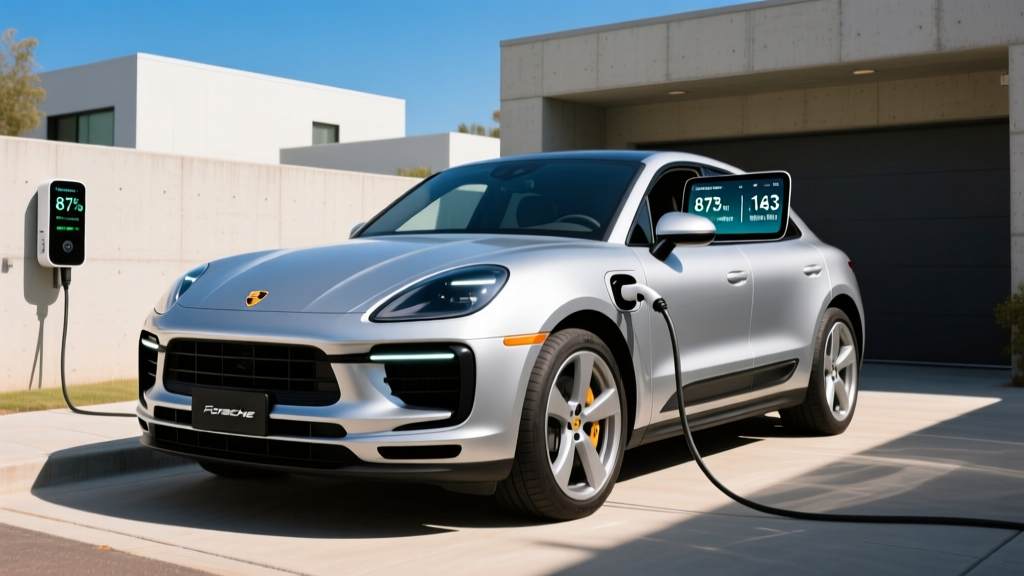
At home, the Macan EV accepts up to 11 kW on Level 2 (48-amp circuit required for full speed). A full 0–100% charge takes roughly 10 hours. With a typical daily commute of 30–50 miles, you will replenish what you use in 2–4 hours overnight. Most owners will rarely see a full 0–100% cycle — daily charging between 20% and 80% extends battery life and is easily managed with the vehicle's scheduled charging settings.
Macan EV vs. Gas Macan: Cost and Performance Compared
The 2025 Macan EV replaces the gasoline Macan in Porsche's lineup for most markets (a gas Macan continues for the US through the current generation). Here is how the two stack up on paper and in your wallet:
| Metric | Macan 4 EV (2025) | Gas Macan (2024, final US model) |
|---|---|---|
| Base MSRP | $78,800 | $62,900 |
| 0–60 mph | 4.9 sec | 6.0 sec (base) / 4.6 sec (GTS) |
| Energy/Fuel Cost per Mile | ~$0.04–0.06 (home L2) | ~$0.16–0.20 (premium gas, 21 MPG combined) |
| Annual Fuel/Energy (12,000 mi) | ~$480–$720 | ~$1,920–$2,400 |
| Annual Maintenance | ~$200–$400 | ~$800–$1,200 |
| Federal Tax Credit | $0 (MSRP + sourcing) | N/A |
| Estimated Insurance (annual) | $2,800–$3,500 | $2,200–$2,800 |
The EV saves roughly $1,500–$2,200 per year in fuel and maintenance. Over a 5-year ownership cycle, that is $7,500–$11,000 in operational savings. But the Macan 4 EV costs $15,900 more upfront than the final gas Macan base — meaning the fuel/maintenance savings alone do not close the gap. You are paying for performance, technology, and the EV driving experience, not pure economics.
5-Year Total Cost of Ownership Breakdown
| Cost Category | Macan 4 EV | Gas Macan (2024) |
|---|---|---|
| Purchase Price (base, before tax) | $78,800 | $62,900 |
| Federal Tax Credit | $0 | $0 |
| 5-Year Fuel/Energy | $3,000 | $10,800 |
| 5-Year Maintenance | $1,500 | $5,000 |
| 5-Year Insurance (est.) | $16,000 | $12,500 |
| Estimated 5-Year Depreciation | $31,500 (40%) | $28,300 (45%) |
| 5-Year Total Cost | $67,800 | $62,900 |
Depreciation estimates based on historical Porsche retention data and current EV market trends. Insurance varies significantly by state, driving record, and coverage level. Get quotes before purchasing.
The 5-year TCO gap narrows to roughly $4,900 when operational savings are factored in — but the EV still costs more overall. The Macan EV is a luxury purchase justified by performance and technology, not a cost-saving play.
Common Misconceptions About the Macan EV
| Myth | Fact |
|---|---|
| "It qualifies for the $7,500 federal tax credit." | It does not. The Macan EV exceeds the §30D MSRP cap for SUVs ($80,000 — the Macan 4 base is $78,800 but options push it over, and German battery sourcing fails the critical-minerals requirement). Always verify current IRS §30D rules. |
| "The battery will need expensive replacement in 5 years." | Porsche warranties the battery for 8 years / 100,000 miles with a 70% capacity retention guarantee. NMC batteries in 800V architectures with active thermal management typically degrade 1–2% per year under normal use. |
| "It can use Tesla Superchargers." | The 2025 Macan EV ships with a native NACS charge port, granting access to Tesla Supercharger stations that have been opened to non-Tesla vehicles. Verify station compatibility via the Porsche or Tesla app before relying on a specific location. |
| "EVs are cheaper to insure." | EV insurance premiums are typically 15–25% higher than gas equivalents due to higher repair costs, specialized parts, and battery replacement risk. The Macan EV is no exception. |
| "Charging takes too long for road trips." | At 270 kW peak, a 10–80% charge takes ~21 minutes — roughly the time for a rest stop. On a 500-mile trip, plan one charging stop and you are covered. |
First-Time EV Buyer: What You Need to Know Before Ordering
If the Macan EV is your first electric vehicle, here are the practical realities that brochures do not emphasize:
Home Charging Is Nearly Mandatory
Public DC fast charging costs $0.30–$0.50 per kWh at most networks — making it roughly as expensive as gas on a per-mile basis. The economic and convenience case for EV ownership rests on home Level 2 charging at residential electricity rates ($0.10–$0.20/kWh in most states). If you cannot install a Level 2 charger at home (apartment, street parking, HOA restrictions), the Macan EV becomes significantly more expensive and less convenient to own.
A 48-amp Level 2 home charger installation typically costs $800–$2,500 depending on electrical panel capacity, distance from the panel to the garage, and local permit requirements. If your home has a 200-amp panel with spare capacity, expect the lower end. A panel upgrade to 200A or 400A adds $2,000–$5,000.
Preconditioning Matters for Fast Charging
The Macan EV can precondition its battery when you navigate to a DC fast charger. This warms the battery to the optimal temperature for accepting maximum charge rate. In cold weather, skipping preconditioning can cut your peak charge rate by 30–50%. Always use the built-in navigation for charging stops — it triggers preconditioning automatically.
Cargo Space Is Reduced
The Macan EV offers 22.5 cubic feet of rear cargo space (seats up) and a small front trunk (frunk). This is competitive with the gas Macan but less than some rivals like the Tesla Model Y (30.2 cu ft). If cargo capacity is a priority, cross-shop accordingly.
Decision Framework: Should You Buy the 2025 Macan EV?
Buy the Macan EV if:
- You have access to Level 2 home charging (garage or dedicated parking with a 240V outlet)
- Your daily driving is under 100 miles round-trip, with occasional road trips under 400 miles
- You prioritize driving dynamics, build quality, and brand cachet over maximum range-per-dollar
- You can absorb the $78,800+ price without relying on federal tax credits
- You live in a region with moderate winters or have garage parking (cold-weather range loss is manageable with preconditioning and a heat pump)
Skip the Macan EV (for now) if:
- You rely exclusively on street parking or apartment living without charging access
- You regularly drive 300+ miles in a single day in cold weather
- You need the lowest possible total cost of ownership — a Tesla Model Y or Hyundai Ioniq 5 delivers better value
- You were counting on the $7,500 federal tax credit to make the math work
- Cargo space is a top priority — consider the Model Y, Rivian R2, or BMW iX instead
Frequently Asked Questions
Does the 2025 Porsche Macan EV qualify for any federal tax credit?
No. Under current IRS §30D rules, the Macan EV fails on two fronts: its battery components and critical minerals do not meet the North American sourcing thresholds, and many configured examples exceed the $80,000 MSRP cap for SUVs. Some states offer separate EV incentives (California, Colorado, New York, and others), but amounts and eligibility vary. Check your state's energy office or a tax professional for specifics.
How long does it take to charge the Macan EV at home?
On a Level 2 home charger delivering 11 kW, a full 0–100% charge takes roughly 10 hours. In practice, most owners charge from 20–80% overnight, which takes about 5–6 hours. A standard 120V Level 1 outlet adds only about 3–4 miles of range per hour — adequate for emergency top-ups but not practical for daily use with a 95 kWh battery.
What happens to the Macan EV battery after the warranty expires?
Porsche's 8-year/100,000-mile battery warranty guarantees at least 70% of original capacity. Industry data from similar NMC packs suggests 10–15% total degradation over 10 years / 150,000 miles with normal use. Full battery replacement on a 95 kWh pack is estimated at $15,000–$25,000 out of warranty, but most owners will never need a full replacement — individual module repair is increasingly available.
Is the Macan EV all-wheel drive?
Yes. Both the Macan 4 and Macan Turbo use a dual-motor all-wheel-drive configuration. The system can vary torque between front and rear axles in milliseconds, providing confident traction in rain and light snow. The Macan Turbo can also simulate a rear-bias feel in Sport modes.
How does the Macan EV compare to the Tesla Model Y Performance?
The Model Y Performance starts at roughly $52,990, delivers 277 miles of EPA range, charges at up to 250 kW, and hits 0–60 in 3.5 seconds. The Macan Turbo is quicker (3.3 sec), charges faster (270 kW), and offers superior interior materials and ride quality — but costs nearly double. The Model Y wins on value and cargo space; the Macan wins on luxury, brand, and driving refinement. They serve different buyers.
Can I tow with the Macan EV?
Yes. The Macan EV is rated to tow up to 4,409 pounds (braked trailer). However, towing reduces range significantly — expect a 30–50% reduction depending on trailer weight and aerodynamics. If you tow frequently, plan charging stops accordingly.