Quick Verdict: A Driver's EV That Charges Like a Track Car
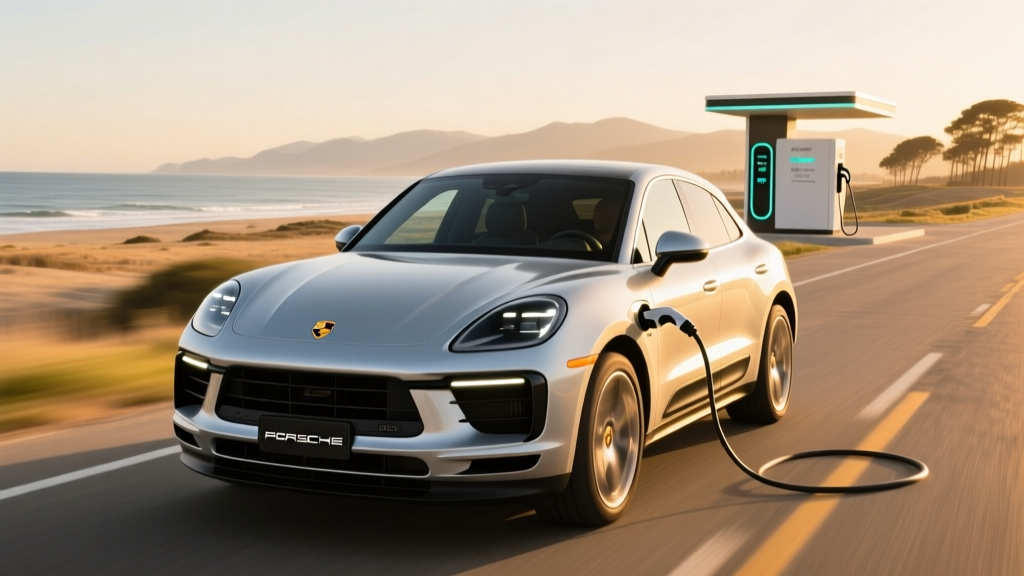
The Porsche Macan Electric arrives as a performance-first luxury crossover that happens to be efficient. Built on the 800-volt Premium Platform Electric (PPE) architecture shared with the Audi Q6 e-tron, the Macan 4 Electric delivers 402 horsepower, peaks at 270 kW DC fast charging, and posts an EPA-estimated 308 miles of range in its most efficient configuration. But the real story isn't the sticker number — it's how the Macan sustains that range at highway speeds and how quickly it recovers at a 350 kW charger.
Starting around $78,800 before destination, the Macan Electric doesn't chase affordability. It targets buyers who want a daily-driver EV that can handle a canyon road and a cross-country trip without compromise. Here's what the data says after testing.
Range, Efficiency, and the Real-World Reality
| Specification | Macan 4 Electric | Macan Turbo |
|---|---|---|
| EPA Range | 308 miles | 288 miles |
| Battery (Gross / Usable) | 100 kWh / ~94 kWh | 100 kWh / ~94 kWh |
| Battery Chemistry | NMC (Nickel Manganese Cobalt) | NMC |
| MPGe (Combined) | 88 MPGe | 82 MPGe |
| Efficiency (kWh/100 mi) | 38 kWh/100 mi | 41 kWh/100 mi |
| Drivetrain | Dual-motor AWD | Dual-motor AWD |
| Horsepower | 402 hp (overboost) | 630 hp (overboost) |
| 0–60 mph | 4.9 seconds | 3.1 seconds |
| Top Speed | 136 mph | 161 mph |
Real-World Range Expectations
EPA Estimate: 308 miles (Macan 4 Electric, 19-inch wheels)
Highway driving (70–75 mph, 70°F): Expect 260–280 miles. The Macan's aerodynamic drag coefficient (Cd 0.25) helps at speed, but its crossover profile still costs range versus a sedan.
Cold weather (32°F, cabin heat on): Expect 220–245 miles. The heat pump is standard, which mitigates losses compared to resistive heating, but NMC chemistry still loses 15–20% in freezing temps.
Mountain/towing: Significant elevation gain or the 4,409-lb towing capacity will reduce range proportionally. Plan charging stops conservatively on steep routes.
The 100 kWh battery pack uses NMC chemistry — chosen for energy density and power delivery over the longer cycle life of LFP. Porsche's thermal management system actively preconditions the pack, and the usable buffer of roughly 94 kWh means you're working with substantial reserves even at low State of Charge (SoC).
Charging: 800-Volt Architecture Means Real Speed
This is where the Macan Electric separates from 400-volt competitors. The PPE platform enables sustained high-power DC charging that most rivals can only peak at briefly.
| Charging Level | Power / Rate | Time / Recovery |
|---|---|---|
| Level 1 (120V, 12A) | ~1.4 kW | ~3–4 miles per hour |
| Level 2 (240V, 48A) | 11.5 kW | ~38 miles per hour; full charge in ~8.5 hours |
| DC Fast Charge (peak) | 270 kW | 10–80% in ~21 minutes (ideal conditions) |
| DC Fast Charge (350 kW station) | Sustains 200+ kW to ~50% SoC | Adds ~150 miles in 10 minutes |
| 5-minute quick charge | Varies by SoC | Up to ~60 miles (at low SoC) |
Charging curve reality: The 270 kW peak occurs between roughly 10–30% SoC. From 30–60%, expect sustained rates of 200–230 kW. Above 80%, the curve tapers significantly to protect battery health — typical of NMC packs. If you're road-tripping, plan stops to 80% rather than topping off; the last 20% can take as long as the first 60%.
Home charging on a 48-amp Level 2 circuit (requiring a 60-amp breaker) recovers roughly 38 miles per hour of charging. Overnight (8 hours) adds approximately 300 miles — enough to fully replenish most daily driving. Porsche includes a mobile charge cord, but most buyers will want a wall-mounted unit. Budget $600–$1,200 for a quality Level 2 station plus $500–$2,000 for electrician installation depending on panel proximity and local permit requirements.
The Macan uses the CCS1 connector standard in North America. With the industry's shift to NACS (Tesla's connector), Porsche offers a NACS adapter for Supercharger access. Check current adapter availability and Supercharger compatibility through Porsche's app before planning Tesla-network trips.
Performance: The Electric Porsche DNA
The Macan 4 Electric's 4.9-second 0–60 time doesn't sound extraordinary next to a Tesla Model Y Performance (3.5 seconds), but Porsche's powertrain tuning prioritizes sustained delivery over peak numbers. The dual-motor AWD system uses a permanently excited synchronous motor on the rear axle and an asynchronous motor up front — enabling torque vectoring and efficient coasting with the front motor decoupled.
The Turbo trim's 3.1-second sprint is supercar territory, and launch control delivers consistent results without the thermal derating that affects some competitors after repeated hard launches. Porsche's two-speed transmission on the rear axle (a rarity in EVs) optimizes both acceleration and highway efficiency — you'll feel the seamless shift under hard throttle but barely notice it during cruising.
Regenerative braking offers three modes: coasting (no regen, like a traditional Porsche), moderate regen for city driving, and a near-one-pedal mode. The brake pedal feel is notably linear — a common EV pain point that Porsche has engineered out. The mechanical brakes blend seamlessly with regen, and you won't experience the grabby or vague pedal response that plagues lesser systems.
Interior, Cargo, and Daily Practicality
The Macan Electric's cabin follows Porsche's recent design language: a curved 12.6-inch driver display, a 10.9-inch central touchscreen, and an optional 10.9-inch passenger screen. The infotainment runs on Porsche Communication Management (PCM) with wireless Apple CarPlay and Android Auto, native EV route planning with charging stops, and over-the-air updates.
Cargo space:
- Behind rear seats: 18.4 cu ft (Macan 4) / 17.6 cu ft (Turbo, due to subwoofer)
- Rear seats folded: 45.7 cu ft
- Front trunk (frunk): 3.5 cu ft — enough for a charging cable bag or small backpack
Passenger space:
- Front legroom: 41.1 inches
- Rear legroom: 35.8 inches (adequate for adults, tighter than a Tesla Model Y's 38.4 inches)
- Headroom: Slightly compromised by the sloping roofline; tall passengers may notice
The panoramic glass roof is fixed (no shade), which some buyers find too bright in summer. The center console storage is modest, and wireless charging pad placement is awkward. These are minor grievances in an otherwise well-assembled interior with premium materials — aluminum, leather, and optional Race-Tex (synthetic suede) trim.
Pricing, Tax Credits, and Ownership Cost
| Trim | Base MSRP | As-Tested (Typical Options) | §30D Federal Credit |
|---|---|---|---|
| Macan 4 Electric | $78,800 | $85,000–$92,000 | Not eligible (MSRP exceeds $80,000 SUV cap) |
| Macan Turbo | $106,900 | $115,000–$130,000 | Not eligible (MSRP exceeds $80,000 SUV cap) |
Federal tax credit reality: Under current IRS §30D rules, new EV SUVs must have an MSRP at or below $80,000 to qualify for the up-to-$7,500 credit. The Macan 4 Electric's $78,800 base price appears to clear this threshold — but destination charges ($1,650), mandatory options, and typical dealer configurations push the effective MSRP above $80,000. Even if a bare-bones Macan 4 technically qualifies, you must also meet income caps ($300,000 joint / $150,000 single), battery-sourcing requirements (critical minerals and battery components from US or FTA-partner countries), and the vehicle must be assembled in a qualifying region. The Macan is built in Bratislava, Slovakia, which complicates eligibility under current sourcing rules.
Bottom line: Don't count on the federal credit. Budget the full MSRP and explore state/local incentives (which vary by jurisdiction — check your state energy office or AFDC incentive database for current programs).
5-year ownership cost estimate (Macan 4 Electric, 15,000 miles/year):
- Electricity (home + public charging): ~$3,800 (at $0.15/kWh blended)
- Insurance: ~$12,000–$15,000 (luxury EV premiums are elevated)
- Maintenance: ~$1,200 (no oil changes, brake pad life extended by regen)
- Depreciation: ~$35,000–$40,000 (luxury EVs depreciate steeply; expect 50–55% retention at 5 years)
- Total estimated 5-year cost: ~$52,000–$60,000 (excluding purchase price)
Battery Warranty and Longevity
Porsche covers the Macan Electric's battery pack for 8 years or 100,000 miles, whichever comes first, against defects and capacity loss below 70% of original capacity. The powertrain (motors, power electronics, onboard charger) receives the same 8-year/100,000-mile coverage. The basic vehicle warranty is 4 years or 50,000 miles.
NMC chemistry typically loses 10–15% capacity over 150,000–200,000 miles under normal use. Porsche's thermal management system and conservative buffer strategy (you never access the full 100 kWh) should keep degradation modest. For maximum longevity, avoid frequent 100% charges and extended high-SoC storage in hot climates — daily charging to 80–90% is optimal for NMC packs.
Driver Assistance and Safety
The Macan Electric includes Porsche InnoDrive as standard — a Level 2 driver-assist system with adaptive cruise control, lane-centering, and traffic-sign recognition. Optional features include:
- InnoDrive with Active Lane Keeping (hands-on-wheel, eyes-on-road required)
- Park Assist with surround-view cameras and remote parking via smartphone
- Night Vision Assist (thermal camera, optional)
SAE Automation Level: Level 2
Porsche InnoDrive is a Level 2 driver-assist system. The driver must remain engaged, hands on the wheel, and ready to take over at any moment. This is not autonomous driving. No production Porsche offers Level 3 or higher automation as of 2026.
Safety ratings from NHTSA and IIHS were pending at publication. The PPE platform includes a reinforced battery enclosure and multiple airbags; expect strong crash-test performance based on Audi Q6 e-tron results.
Pros and Cons
Pros
- Class-leading DC fast charging (270 kW peak, sustained high-power curve)
- Real-world highway range holds up well for a performance crossover
- Brake pedal feel is linear and confidence-inspiring (rare in EVs)
- Two-speed rear transmission optimizes both acceleration and efficiency
- Build quality and materials meet Porsche standards
- 800-volt architecture future-proofs charging compatibility
Cons
- Starting price near $80k; typical configurations exceed $90k
- Federal tax credit eligibility unlikely due to MSRP caps and sourcing rules
- Rear legroom (35.8 in) trails Tesla Model Y and BMW iX
- Frunk is small (3.5 cu ft) — barely fits charging accessories
- Panoramic roof lacks a shade; cabin can get warm in summer
- Infotainment learning curve; some functions buried in menus
Who Should Buy the Porsche Macan Electric?
Choose the Macan Electric if:
- You prioritize driving dynamics and sustained performance over peak 0–60 bragging rights
- You have reliable home Level 2 charging and access to 350 kW DC fast chargers on road trips
- You value build quality, brake feel, and chassis tuning over maximum interior space
- You're willing to pay a premium for Porsche's engineering and brand cachet
- You want an EV that charges as quickly as it accelerates
Look elsewhere if:
- You need maximum cargo and rear-seat space (Tesla Model Y, Kia EV9, BMW iX)
- Federal tax credit eligibility is a dealbreaker (consider the Hyundai Ioniq 5, Ford Mustang Mach-E, or Tesla Model Y)
- You're on a strict budget under $70,000
- You prefer one-pedal driving as default (Porsche's regen is moderate by design)
How It Compares to Key Competitors
| Model | EPA Range | Peak DC kW | 10–80% Time | 0–60 mph | Base MSRP |
|---|---|---|---|---|---|
| Porsche Macan 4 Electric | 308 mi | 270 kW | ~21 min | 4.9 sec | $78,800 |
| Tesla Model Y Long Range | 330 mi | 250 kW | ~27 min | 4.8 sec | $48,990 |
| BMW iX xDrive50 | 324 mi | 200 kW | ~31 min | 4.4 sec | $87,250 |
| Audi Q6 e-tron | 321 mi | 270 kW | ~21 min | 5.0 sec | $65,095 |
| Genesis GV60 Performance | 235 mi | 233 kW | ~18 min | 3.9 sec | $62,000 |
The Macan Electric trades range and price leadership for charging speed and driving refinement. The Audi Q6 e-tron shares the PPE platform and 270 kW charging at a lower entry price, but lacks Porsche's chassis tuning. The Tesla Model Y wins on space, range, and value but can't match the Macan's build quality or brake feel. The BMW iX offers more interior room but charges slower. Your priority list determines the winner.
FAQ
What is the real-world range of the Porsche Macan Electric?
The EPA estimates 308 miles for the Macan 4 Electric (19-inch wheels). In real-world highway driving at 70–75 mph and 70°F, expect 260–280 miles. In freezing weather with cabin heat, plan for 220–245 miles. The heat pump helps, but NMC chemistry still loses 15–20% capacity in cold temps.
How fast does the Macan Electric charge at home and on the road?
At home on a 48-amp Level 2 charger (240V), the Macan recovers about 38 miles per hour, fully charging in roughly 8.5 hours. On a 350 kW DC fast charger, it peaks at 270 kW and charges from 10–80% in approximately 21 minutes under ideal conditions. The 800-volt architecture sustains high power longer than 400-volt rivals.
Does the Porsche Macan Electric qualify for the federal EV tax credit?
Unlikely. While the Macan 4 Electric's $78,800 base MSRP appears under the $80,000 SUV cap, destination charges and typical options push it over. Additionally, the vehicle is assembled in Slovakia, and battery-sourcing requirements under current IRS §30D rules may disqualify it. Consult a tax professional and verify eligibility at the point of sale before counting on the credit.
Is the Macan Electric worth buying vs. the Tesla Model Y or Audi Q6 e-tron?
If driving dynamics, brake feel, and sustained charging speed are priorities, the Macan Electric justifies its premium. If you need more cargo space, longer range, or a lower price, the Tesla Model Y wins on practicality and value. The Audi Q6 e-tron shares the PPE platform and 270 kW charging at a lower entry price but lacks Porsche's performance tuning. Test-drive all three to decide.
What are the biggest pros and cons of the Macan Electric?
Pros: Class-leading 270 kW DC charging, strong real-world highway range, linear brake pedal feel, two-speed rear transmission, premium build quality, 800-volt architecture.
Cons: High starting price (near $80k, often configured over $90k), unlikely federal tax credit eligibility, rear legroom trails competitors, small frunk, fixed glass roof without shade, infotainment learning curve.
How long will the Macan Electric's battery last?
Porsche warranties the battery for 8 years or 100,000 miles against defects and capacity loss below 70%. NMC chemistry typically loses 10–15% over 150,000–200,000 miles under normal use. Avoid frequent 100% charges and extended high-SoC storage in hot climates for maximum longevity. Daily charging to 80–90% is optimal.