Quick Verdict: Is the Macan 4S Electric Worth It?
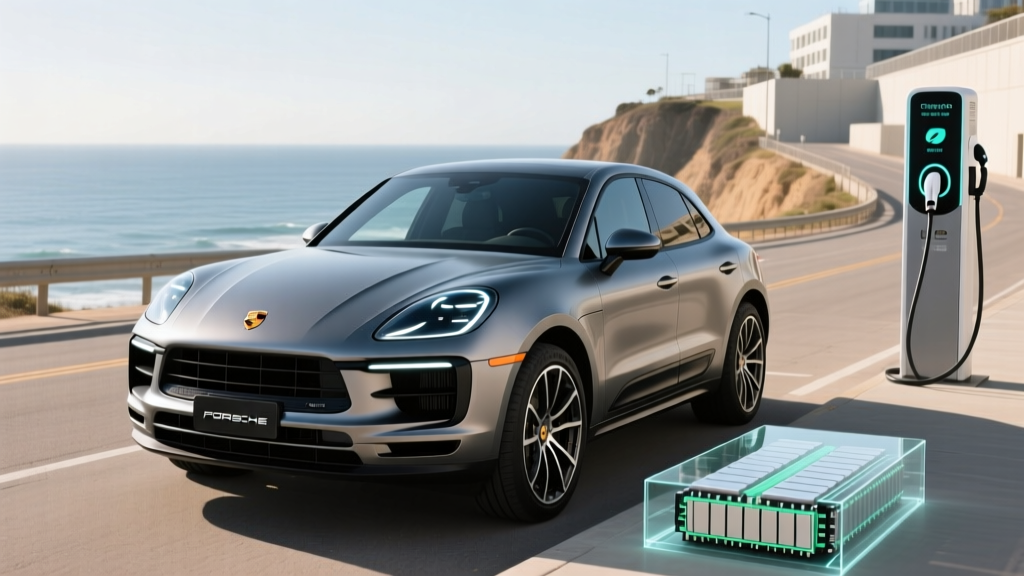
The 2026 Porsche Macan 4S Electric delivers 509 hp, a 308-mile EPA range, and 10–80% DC fast charging in about 21 minutes via its 800-volt architecture. Starting at roughly $87,400 before destination, it undercuts the Turbo trim while retaining the dual-motor AWD setup and 100 kWh (96.2 kWh usable) NMC battery. It qualifies for no federal §30D tax credit due to its MSRP exceeding the $80,000 SUV cap and its German battery sourcing. If you want a performance luxury electric crossover with genuine sports-sedan dynamics and can charge at home, the 4S is the sweet spot in the electric Macan lineup. If you need federal incentives or tow frequently, look at alternatives.
Range, Battery, and Real-World Efficiency
The Macan 4S Electric pairs a front and rear permanent-magnet synchronous motor for a combined 509 hp and 612 lb-ft of torque (with launch control). Energy is stored in a 100 kWh gross (96.2 kWh net usable) lithium-ion NMC pack mounted low in the skateboard platform.
| Spec | 2026 Macan 4S Electric |
|---|---|
| Battery (gross / usable) | 100 kWh / 96.2 kWh (NMC) |
| EPA Range | 308 miles |
| MPGe (city / hwy / combined) | 95 / 87 / 91 MPGe |
| Efficiency | ~37 kWh/100 mi |
| Drivetrain | Dual-motor AWD |
| 0–60 mph | 4.9 seconds |
| Top Speed | 143 mph |
| Horsepower / Torque | 509 hp / 612 lb-ft |
| Towing Capacity | 4,409 lbs |
| Base MSRP | ~$87,400 + destination |
Real-World Range Expectations
The EPA 308-mile figure assumes mixed driving at moderate temperatures. On a sustained 75-mph highway run in 70°F weather, expect roughly 260–275 miles before needing a charger. In freezing conditions (20–30°F), range can drop 15–25%, landing you around 230–260 miles depending on cabin heat usage. The Macan's standard heat pump mitigates some of this loss compared to resistive heating, but physics wins in deep cold. Plan road trips around 220-mile legs for a comfortable buffer.
For context, the base rear-wheel-drive Macan Electric achieves up to 308 miles EPA on a slightly different tuning, while the range-topping Macan Turbo Electric drops to around 280 miles due to its 630 hp output and more aggressive calibration. The 4S splits the difference in power while maintaining strong efficiency.
Charging Speed: 800-Volt Architecture in Practice
Porsche's 800-volt Premium Platform Electric (PPE), co-developed with Audi, is the Macan Electric's strongest ownership differentiator. The 4S can accept up to 270 kW at a DC fast charger under ideal conditions.
| Charging Level | Power / Connector | Speed (approx.) | Use Case |
|---|---|---|---|
| Level 1 | 1.4 kW (120V / 12A) | ~4–5 mi/hr | Emergency / trickle only |
| Level 2 | 11.5 kW (240V / 48A) | ~33–36 mi/hr; full in ~8.5 hrs | Home overnight / workplace |
| DC Fast Charge | Up to 270 kW (CCS/NACS*) | 10–80% in ~21 min | Road trips |
*Porsche has committed to adopting the Tesla NACS connector for North American models. Check your delivery configuration; early 2025–2026 units may ship with CCS1 and include a NACS adapter for Supercharger access. Porsche has confirmed Supercharger network compatibility via adapter.
The charge curve matters more than the peak number. The Macan 4S sustains above 200 kW from roughly 10% to 45% SoC, then gradually tapers. From 80% to 100%, charging slows dramatically to protect the NMC cells — a full top-off can add another 30+ minutes. For battery longevity, Porsche's battery management system includes a configurable charge limit (set to 80% or 90% for daily use) and preconditioning that warms the pack when a DC charger is set as your navigation destination.
For home charging, the onboard 11.5 kW AC charger means a full charge from empty takes roughly 8.5 hours on a 48-amp Level 2 circuit (hardwired, 60-amp breaker). A standard 240V/40A home charger delivers about 9.6 kW, adding roughly 28 miles of range per hour — enough to replenish a daily commute overnight.
Cost Breakdown: Macan 4S Electric vs. Gas Macan 4S
The most common buyer question: does the electric Macan save money versus the gasoline Macan 4S? The answer depends heavily on your electricity rates, annual mileage, and how long you keep the vehicle.
| Cost Factor | Macan 4S Electric | Macan 4S (Gas, 2.9L V6) |
|---|---|---|
| Base MSRP | ~$87,400 | ~$74,500 |
| Federal Tax Credit (§30D) | $0 (MSRP > $80k cap; foreign battery sourcing) | $0 |
| Est. Annual Fuel/Energy (12,000 mi/yr) | ~$610 (at $0.14/kWh, home charging) | ~$2,280 (at $3.80/gal, 20 MPG combined) |
| Annual Maintenance | ~$300 (no oil, fewer brake replacements w/ regen) | ~$800 (oil, filters, brakes, spark plugs) |
| Est. Annual Insurance | ~$2,800–$3,400 | ~$2,200–$2,700 |
| 5-Year Fuel + Maintenance Total | ~$4,550 | ~$15,400 |
| 5-Year Total Cost Delta (vs. gas) | Electric saves ~$10,850 in running costs, but starts ~$12,900 higher | |
The math is clear: the Macan 4S Electric's higher purchase price is not fully offset by five years of fuel and maintenance savings alone. The breakeven point arrives around year 6–7 of ownership, assuming stable energy prices and no major battery service. However, the EV's performance, refinement, and driving dynamics offer intangible value that spec sheets don't capture — and depreciation curves for both models remain to be fully established in the used market.
According to fueleconomy.gov, the Macan 4S Electric's combined 91 MPGe translates to an estimated annual electricity cost of roughly $600–$700 for 15,000 miles of driving at the national average rate. Gas Macan owners at the same mileage spend closer to $2,800–$3,200 annually.
What First-Time EV Buyers Should Know
If the Macan 4S Electric is your first EV, several ownership realities differ from the gas-car experience:
Home charging is nearly essential. Relying solely on public DC fast charging is expensive ($0.40–$0.60/kWh at networks like Electrify America) and adds wear from repeated high-rate charging. Budget $800–$2,200 for a professional Level 2 home charger installation (equipment + licensed electrician + permit). If your home electrical panel is older or already near capacity, a panel upgrade can add $1,500–$3,500.
Preconditioning is not optional for fast charging. Navigating to a DC fast charger triggers the Macan's thermal management system to warm the battery to optimal temperature. Without preconditioning, a cold battery may accept only 50–80 kW instead of the 270 kW peak, doubling your charge stop time.
Regenerative braking changes how you drive. The Macan 4S offers adjustable regen intensity and a one-pedal-like mode that recovers up to 290 kW of energy under deceleration. This reduces brake pad wear substantially — many EV owners report original brake pads lasting 80,000+ miles.
Battery warranty provides peace of mind. Porsche covers the high-voltage battery for 8 years or 100,000 miles, whichever comes first, guaranteeing a minimum of 70% capacity retention. If the pack drops below that threshold under normal use, Porsche will repair or replace it. Independent data from similar 800V NMC platforms suggests typical degradation of 8–12% over the first 100,000 miles.
Common Misconceptions — Myth vs. Fact
| Myth | Fact |
|---|---|
| "The Macan Electric qualifies for the $7,500 federal tax credit." | It does not. The §30D credit caps SUVs at $80,000 MSRP, and the Macan 4S Electric starts at ~$87,400. Additionally, its battery cells are manufactured outside the U.S., failing the critical-minerals and battery-component sourcing requirements. Always verify current rules at irs.gov. |
| "Electric cars can't handle cold weather." | Cold reduces range 15–25%, but the Macan's heat pump and preconditioning system mitigate this. With a heated garage and planned charging, winter ownership is entirely practical — just budget shorter legs on road trips. |
| "I'll need to replace the battery for $20,000 in a few years." | Modern NMC packs in 800V systems are engineered for 200,000+ miles with gradual, predictable degradation. An out-of-warranty replacement would be costly (estimates $15,000–$25,000), but most owners will trade the vehicle before this becomes relevant. |
| "Charging takes too long for road trips." | At 270 kW peak, the Macan 4S adds roughly 170 miles of range in 15 minutes. Combined with preconditioning and route-planned charging (built into the Porsche Communication Management system), road trip stops align with normal rest breaks. |
| "It doesn't drive like a real Porsche." | The 4S Electric's low center of gravity, rear-biased torque distribution, and available rear-axle steering produce handling dynamics that rival or exceed the gas Macan 4S in most metrics, while the instant torque delivery makes it feel quicker than its 4.9-second 0–60 suggests. |
Decision Framework: Is the Macan 4S Electric Right for You?
Choose the Macan 4S Electric If:
- You have reliable home Level 2 charging (garage or driveway with 240V access)
- Your daily driving is under 250 miles and most trips are under 300 miles
- You value instant torque, silent acceleration, and a low center of gravity
- You plan to keep the vehicle 5+ years to recoup the price premium through fuel savings
- You want Porsche build quality, warranty support, and the 800V charging advantage
Consider an Alternative If:
- You lack home charging and rely on street parking or apartment living
- You regularly tow more than 4,000 lbs or take 400+ mile road trips in winter
- Federal or state tax credits are essential to your purchase math
- You prefer the lighter, more traditional feel of a gas powertrain (the gas Macan 4S weighs ~4,500 lbs vs. the 4S Electric's ~5,300 lbs)
- Budget is firm below $80,000 — consider the base Macan Electric (RWD, ~$78,800) or competitors like the BMW iX xDrive50 or Genesis Electrified GV70
Ownership Considerations: Insurance, Depreciation, and Daily Life
Luxury EV insurance premiums run 15–30% higher than equivalent gas models, driven by higher repair costs for battery-adjacent damage and specialized technician requirements. Expect quotes in the $2,800–$3,400/year range depending on your profile and state. Shop multiple carriers — some insurers now offer EV-specific policies with battery coverage riders.
Depreciation is the wildcard. Early Porsche Taycan depreciation was steep (some models losing 40%+ in year one), but the Macan nameplate carries stronger mainstream demand. Industry analysts project the electric Macan will hold value better than the Taycan, though not as well as the gas Macan initially. Plan for 35–45% depreciation over three years/36,000 miles, with the caveat that the used EV market is still maturing.
Daily ownership is where the Macan 4S Electric shines. Wake up to a full "tank" every morning, precondition the cabin from your phone while still plugged in, and enjoy near-silent operation with zero tailpipe emissions. The frunk (front trunk) adds 2.9 cu ft of storage on top of the 18.4 cu ft rear cargo area (50.2 cu ft with seats folded). Over-the-air updates continue to refine powertrain mapping, infotainment, and ADAS features post-purchase.
Frequently Asked Questions
Does the 2026 Macan 4S Electric qualify for any federal or state incentives?
Not the federal §30D credit — it exceeds the $80,000 SUV MSRP cap and its battery sourcing doesn't meet domestic-content requirements. Some states offer separate rebates or HOV lane access for EVs regardless of price; check your state's energy office or the Alternative Fuels Data Center for specifics.
How does the Macan 4S Electric compare to the Tesla Model Y Performance?
They target different buyers. The Model Y Performance starts around $52,000, offers 303 miles EPA, and qualifies for the $7,500 federal credit (subject to buyer income limits). It's more efficient and tech-forward. The Macan 4S Electric costs ~$35,000 more but delivers superior interior materials, chassis dynamics, steering feel, and brand cachet. If driving engagement matters, the Porsche wins. If value and software ecosystem matter, Tesla wins.
Can I use Tesla Superchargers with the Macan 4S Electric?
Yes, via the NACS adapter (included or available depending on production date). Porsche has confirmed Supercharger network access for its North American EVs. The Macan's 800V system is compatible, though charging at a V3 Supercharger (250 kW max) won't reach the Macan's full 270 kW capability — you'd need a CCS-equipped 350 kW station like Electrify America for peak speed.
What happens if I need to charge in a rural area with no DC fast chargers?
The Macan's navigation system routes you through available chargers and provides range predictions based on terrain, temperature, and driving style. In true charging deserts, the 308-mile EPA range provides substantial buffer. For remote cabins or vacation homes, even a standard 120V outlet adds ~4–5 miles per hour — enough for 50+ miles overnight.
Is the Macan 4S Electric's battery repairable or only replaceable?
Porsche's 800V battery pack is modular — individual cell modules can be diagnosed and replaced by certified technicians rather than swapping the entire pack. This reduces out-of-warranty repair costs significantly compared to older monolithic pack designs. Still, any high-voltage service must be performed at a Porsche dealer or authorized EV specialist.