Quick Verdict: Is the Macan 4 Electric Worth It?
The Porsche Macan 4 Electric is a luxury performance SUV that trades the gas Macan's inline-four for a 100 kWh (95.9 kWh usable) NMC battery delivering 402 hp, an EPA-estimated 308 miles of range, and DC fast charging that peaks at 270 kW (10–80% in ~21 minutes). Starting at $78,800, it qualifies for no federal §30D tax credit due to its MSRP exceeding the $80,000 SUV cap when optioned, and its German-built battery sourcing. It's the right choice if you want Porsche driving dynamics in an EV and have reliable home Level 2 charging. It's the wrong choice if you're budget-conscious, lack home charging, or frequently tow in cold climates.
Range and Efficiency: EPA vs the Real World
Porsche rates the Macan 4 Electric at 308 miles EPA combined with its standard 100 kWh gross battery pack (95.9 kWh net usable). That's among the best in the luxury electric SUV segment, but EPA numbers tell only part of the story.
Real-World Range Expectations
EPA Sticker: 308 miles (combined)
Highway (70–80 mph, 72°F): ~255–275 miles
Cold Weather (20°F, cabin heat): ~215–245 miles
Mixed driving, moderate climate: ~270–290 miles
The Macan 4 Electric uses a heat pump as standard equipment, which helps preserve range in cold weather compared to resistive heating. However, like all EVs, you'll see roughly 15–25% range reduction in sub-freezing temperatures. At sustained highway speeds above 75 mph, aerodynamic drag pushes consumption higher — expect around 3.0–3.3 miles per kWh rather than the EPA-rated 3.6 mi/kWh (roughly 94 MPGe combined per fueleconomy.gov).
Efficiency is a strong point. The Macan 4's 800-volt architecture and silicon-carbide inverters contribute to competitive energy consumption for a 5,200-lb SUV. For context, the BMW iX xDrive50 achieves a similar 3.0–3.3 mi/kWh real-world, while the Tesla Model X is slightly more efficient at ~3.4 mi/kWh thanks to lower weight and drag.
Charging Speed: 800V Architecture Pays Off
This is where the Macan 4 Electric genuinely excels. Its 800-volt platform enables DC fast charging at up to 270 kW — among the fastest of any production EV currently on sale.
| Charging Level | Power (kW) | Miles Added per Hour | Notes |
|---|---|---|---|
| Level 1 (120V) | 1.4 kW | ~4 mi/hr | Emergency/trickle only; ~68 hours for full charge |
| Level 2 (240V, 48A) | 11.5 kW | ~35 mi/hr | Home overnight; ~9 hours 10–100% |
| DC Fast (peak) | 270 kW | ~580 mi/hr (peak) | 10–80% in ~21 min; tapers significantly above 80% |
| DC Fast (typical 150 kW station) | 150 kW | ~320 mi/hr | 10–80% in ~32 min; more common infrastructure |
The charge curve matters more than the peak number. The Macan 4 sustains above 200 kW from roughly 10% to 45% SoC, then gradually tapers. You'll still reach 80% in about 21 minutes at a capable 350 kW charger (like Electrify America's newest stalls), but the final 20% takes considerably longer — plan to charge to 80% on road trips and move on.
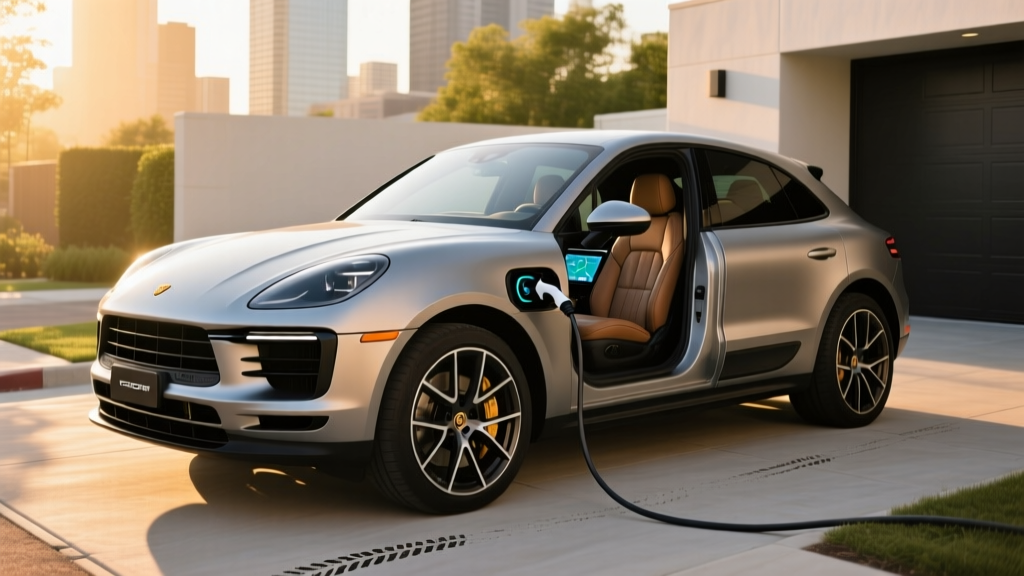
The Macan 4 comes with a NACS (Tesla-style) charge port for the US market, giving native access to Tesla's Supercharger network. CCS adapters are not needed, and Porsche includes access agreements with Electrify America. For home charging, Porsche offers the Mobile Charger Connect (up to 9.6 kW on a NEMA 14-50 outlet) and the Porsche Home Energy Manager for optimized Level 2 charging at up to 11.5 kW with a hardwired wall unit.
Common Macan 4 Electric Misconceptions
| Myth | Fact |
|---|---|
| "It qualifies for the $7,500 federal tax credit" | Most buyers won't qualify. The Macan 4's MSRP often exceeds the §30D $80,000 SUV cap once options are added, and its battery components and critical minerals are largely sourced outside North America. Always verify current-year IRS rules at irs.gov. |
| "270 kW means a full charge in 20 minutes" | 270 kW is peak rate, not sustained. 10–80% takes ~21 min; 10–100% takes ~45+ min due to taper above 80%. |
| "I'll get 308 miles no matter how I drive" | EPA is a combined-cycle estimate. Real-world highway and cold-weather driving reduce this by 15–30%. |
| "The battery will need replacing in 5 years" | Porsche warranties the battery for 8 years/100,000 miles with a minimum 70% capacity retention threshold. NMC batteries typically retain 85–90% at 100k miles based on industry data. |
Macan 4 Electric vs Gas Macan: Cost and Performance Comparison
The gas-powered Porsche Macan (which continues in some markets but is being phased out in favor of the EV) offers a useful baseline. Here's how they stack up on paper and in projected 5-year costs.
| Attribute | Macan 4 Electric (2025/2026) | Gas Macan (Base 2.0T, last available) |
|---|---|---|
| Base MSRP | $78,800 | $62,300 |
| Powertrain | Dual-motor AWD, 402 hp / 406 lb-ft | Turbo 2.0L I-4, 261 hp / 295 lb-ft |
| 0–60 mph | 4.9 seconds | 6.2 seconds |
| EPA Efficiency | 94 MPGe (3.6 mi/kWh) | 21 MPG combined |
| EPA Range / Tank | 308 miles | ~375 miles (18.7 gal tank) |
| Fuel/Energy Cost per Year* | ~$720 (electricity at $0.16/kWh) | ~$2,450 (gas at $3.60/gal) |
| Estimated 5-Year Maintenance | ~$1,800 | ~$4,200 |
| Federal Tax Credit | Unlikely (MSRP/sourcing limits) | N/A |
*Based on 12,000 miles/year, national average electricity and fuel prices. Your costs will vary by local utility rates and gas prices.
The gas Macan starts ~$16,500 lower, but the EV's annual energy savings (~$1,730/year) and reduced maintenance (no oil changes, less brake wear from regen, no transmission fluid) close the gap over time. Over 5 years, the EV saves roughly $8,650 in fuel and $2,400 in maintenance — approximately $11,050 total. That still leaves the EV about $5,500 more expensive before accounting for insurance, which typically runs 15–25% higher on the Macan Electric due to repair costs and vehicle value.
Total Cost of Ownership: 5-Year Breakdown
| Cost Category | Macan 4 Electric | Gas Macan (Base) |
|---|---|---|
| Purchase Price (base) | $78,800 | $62,300 |
| Estimated Options (typical buyer) | +$8,000 | +$5,000 |
| Federal Tax Credit | $0 (likely ineligible) | $0 |
| 5-Year Fuel/Energy | $3,600 | $12,250 |
| 5-Year Maintenance | $1,800 | $4,200 |
| 5-Year Insurance (est.) | $14,500 | $11,800 |
| Home Charger Install (one-time) | $1,200–$2,500 | $0 |
| Estimated 5-Year Depreciation | ~$38,000 (48%) | ~$30,000 (45%) |
| 5-Year Total Cost | ~$107,900–$109,200 | ~$95,550 |
| Cost per Mile | ~$1.80 | ~$1.59 |
The Macan 4 Electric costs roughly $13,000–$14,000 more to own over 5 years. The fuel and maintenance savings are real but insufficient to overcome the higher purchase price, elevated insurance premiums, steeper depreciation (EVs in the luxury segment have shown 45–55% five-year depreciation per industry data), and the home charger installation cost.
This is a vehicle you buy for performance, refinement, and the EV driving experience — not for pure economics. If cost-per-mile is your primary concern, a Tesla Model Y or Hyundai Ioniq 5 will dramatically undercut both Macans.
Home Charging and Real-World Ownership Logistics
Home charging access is the single most important factor in EV ownership satisfaction, and it's where many first-time EV buyers underestimate the complexity.
What you'll need: A Level 2 (240V) home charger is practically mandatory for the Macan 4 Electric. The onboard charger accepts up to 11.5 kW, meaning a 48-amp hardwired Wallbox or ChargePoint unit will replenish the 95.9 kWh usable battery in roughly 9 hours — perfectly suited for overnight charging.
Installation reality: If your electrical panel has capacity (typically 200A service with spare breaker slots), expect to pay $800–$1,500 for a licensed electrician to run a 60A circuit and install a hardwired Level 2 unit. If you need a panel upgrade from 100A to 200A, that adds $1,500–$3,500. Always get a quote from a licensed electrician before committing to an EV purchase — this is a cost many buyers overlook.
Apartment and condo dwellers: If you lack dedicated parking with electrical access, the Macan 4 Electric becomes significantly harder to live with. Relying solely on public DC fast charging is feasible but adds time cost (2–3 sessions per week at 25–35 minutes each), and repeated DC fast charging at high rates can accelerate battery degradation slightly over many years. Check your workplace charging options and local public infrastructure on PlugShare before purchasing.
Climate considerations: The Macan 4's standard heat pump is a genuine advantage in cold climates. In testing, vehicles with heat pumps show 10–15% less range loss in sub-freezing weather versus those using resistive PTC heaters. If you live in the upper Midwest or Northeast, preconditioning the battery while plugged in (using the Porsche app's scheduled departure feature) will preserve range and improve regenerative braking performance on cold mornings.
Performance, Tech, and What You Actually Get
The Macan 4 Electric produces 402 horsepower and 406 lb-ft of torque from its dual-motor all-wheel-drive setup. The 0–60 mph time of 4.9 seconds is brisk but not supercar territory — the Macan 4S Electric (509 hp, 4.1 sec) and Turbo (630 hp, 3.3 sec) fill that role. The base Macan 4 is the efficiency-optimized variant, trading some performance for its 308-mile range advantage.
Driving dynamics are where Porsche earns its premium. The Macan 4 Electric uses an adaptive air suspension with Porsche Active Suspension Management (PASM), rear-axle steering (optional), and a low center of gravity from the floor-mounted battery. The result is a 5,200-lb SUV that corners with composure rivaling lighter sports sedans. Regenerative braking offers up to 290 kW of recuperation, enabling effective one-pedal driving in most conditions — though Porsche deliberately tunes the regen to be progressive rather than aggressive, which some EV veterans may find too mild.
The interior features a 12.6-inch curved driver display, a 10.9-inch central touchscreen running Porsche Communication Management (PCM), and an optional 10.9-inch passenger screen. The software supports over-the-air updates, wireless Apple CarPlay and Android Auto, and Porsche's InnoDrive adaptive cruise with lane-centering — a Level 2 SAE driver-assist system that requires continuous driver supervision.
Driver Assist ≠ Self-Driving
Porsche InnoDrive with Active Lane Keeping is an SAE Level 2 system. You must keep your hands on the wheel and eyes on the road at all times. It handles highway lane-centering and adaptive cruise competently but does not navigate intersections, handle construction zones autonomously, or replace driver attention. This is fundamentally different from Level 4 robotaxi services like Waymo, which operate without any human driver in geofenced areas.
Pricing, Trims, and Tax Credit Reality
The Macan 4 Electric starts at $78,800 (including destination). Key trims and pricing:
- Macan 4 Electric: $78,800 — 402 hp, 308 mi range
- Macan 4S Electric: $89,600 — 509 hp, 288 mi range
- Macan Turbo Electric: $106,700 — 630 hp, 275 mi range
Most buyers add $5,000–$12,000 in options (Premium Package, adaptive cruise, rear-axle steering, upgraded wheels), pushing the Macan 4 well above $84,000 and the 4S past $95,000.
Federal §30D Tax Credit: Why the Macan 4 Electric Likely Won't Qualify
- MSRP Cap: SUVs must be under $80,000 MSRP. The base Macan 4 at $78,800 technically fits, but any factory options push it over. The 4S and Turbo are well above the cap.
- Buyer Income Cap: AGI must not exceed $150,000 (single), $225,000 (head of household), or $300,000 (joint). Many Porsche buyers exceed these thresholds.
- Battery Sourcing: Critical minerals and battery components must meet escalating North American sourcing thresholds. The Macan Electric's battery is manufactured in Europe with minerals sourced globally, failing the critical-minerals requirement for most model years.
- Assembly: Final assembly must occur in North America. The Macan Electric is assembled in Bratislava, Slovakia — disqualifying it independently.
- Point-of-Sale Transfer: Even if eligible, the credit can be transferred to the dealer at purchase for an immediate price reduction, but all criteria must be met simultaneously.
Verify current eligibility at irs.gov or consult a tax professional. Rules change annually.
Battery Warranty, Degradation, and Longevity
Porsche covers the Macan 4 Electric's high-voltage battery for 8 years or 100,000 miles (whichever comes first) with a capacity retention threshold of 70%. If the battery falls below 70% State of Health within that period, Porsche will repair or replace it to restore capacity above the threshold.
The 100 kWh gross (95.9 kWh usable) NMC battery includes a ~4% top and bottom buffer to protect against overcharge and deep-discharge degradation. Real-world data from similar NMC packs in the Hyundai Ioniq 5 and Kia EV6 (which share supply-chain chemistry) shows typical degradation of 8–12% over the first 100,000 miles, with the curve flattening significantly afterward. Expecting 85–90% capacity at 100k miles is realistic.
Out-of-warranty battery replacement costs remain high — estimated at $18,000–$28,000 for a pack of this size, including labor. However, full replacements are rare; most warranty claims involve replacing individual modules rather than the entire pack.
The powertrain (motors, power electronics) is covered for 8 years/100,000 miles, and the basic vehicle warranty is 4 years/50,000 miles. Porsche also includes 4 years of scheduled maintenance and roadside assistance.
Decision Framework: Should You Buy the Macan 4 Electric?
Choose the Macan 4 Electric If:
- You have access to Level 2 home charging (garage or dedicated parking with 240V circuit)
- You value driving dynamics and want a luxury EV that handles like a Porsche
- Your daily driving is under 200 miles and you take road trips 3–5 times per year
- You're upgrading from a gas luxury SUV and want to electrify without sacrificing performance
- You live in a region with reliable DC fast charging infrastructure (Electrify America, Tesla Superchargers)
- The $80,000–$95,000 total cost (with options) fits your budget without relying on tax credits
Look Elsewhere If:
- You lack home or workplace Level 2 charging access
- You need a $7,500 tax credit to justify the purchase — the Macan 4 almost certainly won't qualify
- You frequently tow (the Macan 4 is rated at 4,409 lbs, but towing cuts range by 40–50%)
- You want the lowest cost-per-mile — a Tesla Model Y, Hyundai Ioniq 5, or Chevrolet Equinox EV costs dramatically less
- You need third-row seating or maximum cargo space (the Macan's 18.4 cu ft rear cargo is modest; the frunk adds 3.0 cu ft)
- You live in an extreme cold climate and regularly drive 250+ miles between charges in winter
Consider Instead:
- BMW iX xDrive50 ($87,250): Similar luxury, 324 mi range, slightly more interior space
- Tesla Model X ($79,990): Access to Supercharger network natively, falcon-wing doors, optional 6-seat config
- Genesis GV60 ($53,350): 800V architecture, 248 mi range, significantly lower price
- Porsche Macan 4S Electric ($89,600): If performance matters more than range, the 4S's 509 hp and 4.1-sec 0–60 justify the trade-off
First-Time EV Buyer Checklist
If the Macan 4 Electric is your first EV, work through these items before signing:
- Get an electrical panel assessment. A licensed electrician should confirm your panel can support a 60A circuit for Level 2 charging. Budget $1,200–$4,000 for installation depending on panel condition and run length.
- Check your utility's EV rate plan. Many utilities offer time-of-use (TOU) rates that make overnight charging 30–50% cheaper than daytime rates. This directly affects your cost-per-mile.
- Download PlugShare or A Better Routeplanner. Map your most common road trips and confirm DC fast charger availability along those routes.
- Test-drive with regen in mind. One-pedal driving takes 1–2 weeks to internalize. Porsche's regen is progressive, not aggressive — you'll still use the friction brake pedal at low speeds and for emergency stops.
- Understand your insurance costs. Get a quote before purchasing. Luxury EV insurance can be 15–30% higher than equivalent gas vehicles due to repair complexity and parts costs.
- Plan for cold weather. If you live where temperatures regularly drop below freezing, precondition the battery while plugged in using the Porsche app's scheduled departure timer. This warms the pack using grid power rather than battery power, preserving range.
Does the Macan 4 Electric have a frunk?
Yes, but it's small — 3.0 cubic feet, enough for a charging cable and a small bag. The rear cargo area offers 18.4 cu ft (seats up) and 46.9 cu ft (seats folded). Total storage is less than a Tesla Model Y.
Can I use Tesla Superchargers with the Macan 4 Electric?
Yes. The US-market Macan Electric comes with a native NACS (Tesla-style) charge port, giving direct access to Tesla's Supercharger network without an adapter. You'll use the Tesla app or in-car navigation to initiate sessions at non-Tesla chargers on the network.
How does the Macan 4 Electric handle in snow?
Well. The dual-motor AWD system provides excellent traction, and the low center of gravity from the floor-mounted battery improves stability. Winter tires are still recommended for temperatures consistently below 45°F, as the all-season tires prioritize efficiency over cold-weather grip. Expect 20–25% range reduction in sustained sub-freezing driving.
What's the towing capacity?
The Macan 4 Electric is rated to tow 4,409 lbs (2,000 kg) with the optional tow package. However, towing significantly impacts range — expect a 40–50% reduction at highway speeds with a loaded trailer. A 308-mile range becomes roughly 160–185 miles when towing.
How long does the battery actually last?
Porsche warranties it for 8 years/100,000 miles at 70% minimum capacity. Industry data on comparable NMC packs suggests 85–92% retention at 100k miles is typical, with gradual degradation continuing to 200,000+ miles before reaching the 70% threshold. Full pack replacement is rare and typically costs $18,000–$28,000 out of warranty.
Is the Macan Electric the same size as the gas Macan?
Similar but slightly larger. The electric Macan rides on VW Group's PPE (Premium Platform Electric) architecture co-developed with Audi. Wheelbase is 115.3 inches (vs. 110.9 for the gas Macan), and overall length is 188.5 inches. Interior passenger space is comparable, but the EV's cargo area is slightly smaller due to the rear motor packaging.