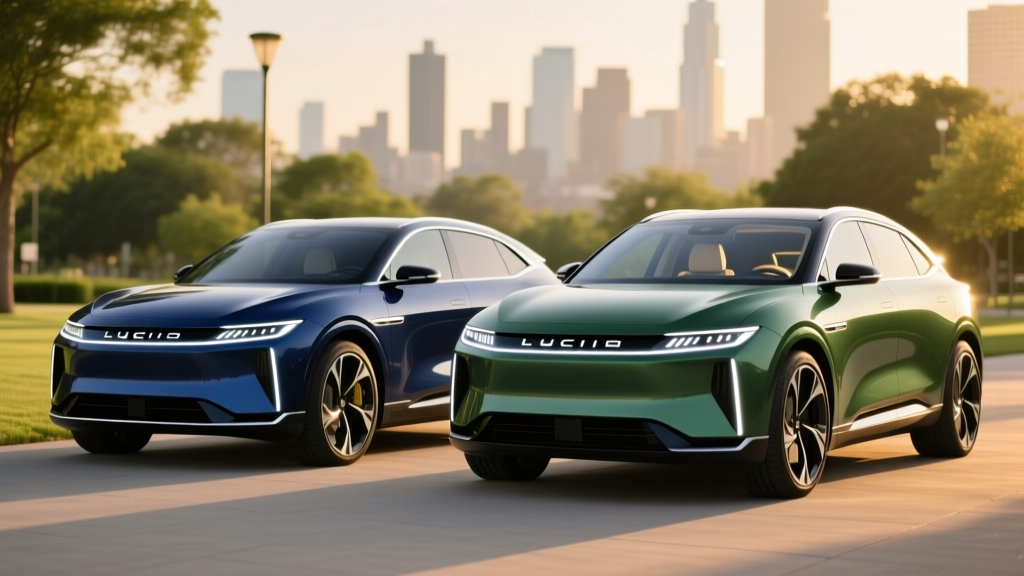
Luxury EV maker Lucid Group has officially confirmed the naming convention for its upcoming mid-size electric SUV lineup: the vehicles will be called Earth and Cosmos. The announcement, made during a corporate update, signals Lucid's push into the high-volume premium SUV segment currently dominated by the Tesla Model Y, BMW iX, and Mercedes-Benz EQE SUV. While these models remain in the pre-production phase with final specifications yet to be certified by the EPA, Lucid has shared enough engineering detail to build a credible preview of what buyers can expect when production begins.
As with any announced-but-unreleased vehicle, every specification below carries a preliminary tag. Lucid's track record with the Air sedan — which exceeded EPA range targets in several trims — gives these early numbers some credibility, but final figures will depend on production battery sourcing, software calibration, and EPA certification testing.
What Lucid's Earth and Cosmos Names Signal About the Lineup
Lucid's naming strategy follows the brand's established theme — the Air sedan uses Grand Touring, Touring, and Pure designations, while the Gravity large SUV uses similar trim logic. The Earth and Cosmos names suggest a two-model approach for the mid-size platform:
- Lucid Earth: Positioned as the volume-oriented, accessible variant. Expect a single-motor RWD or dual-motor AWD configuration, a slightly smaller battery pack, and a price target that undercuts the Gravity significantly.
- Lucid Cosmos: The performance and range flagship of the mid-size platform. Likely dual-motor AWD standard, a larger battery pack, and premium feature content aimed at the BMW iX M60 and Mercedes-AMG EQE SUV buyer.
This mirrors how Lucid structured the Air lineup — a Pure model starting below $70,000 and a Sapphire halo exceeding $249,000 — giving the brand reach across a wide price band on a shared architecture.
Expected Range, Battery, and Efficiency
Lucid's competitive advantage has always been powertrain efficiency. The Air Grand Touring achieves an EPA-estimated 516 miles from a 112 kWh usable battery — roughly 4.6 miles per kWh, the best in the luxury sedan class. The mid-size SUV platform is expected to use a next-generation version of Lucid's compact drive units, which the company claims are 30% smaller and lighter than the Air's already-compact motors.
| Spec | Lucid Earth (Est.) | Lucid Cosmos (Est.) |
|---|---|---|
| Battery Capacity (usable) | ~88 kWh | ~112 kWh |
| Battery Chemistry | NMC (nickel manganese cobalt) | NMC (next-gen high-silicon anode) |
| EPA Est. Range | ~330–350 mi | ~400–420 mi |
| Efficiency | ~28–30 kWh/100 mi | ~27–29 kWh/100 mi |
| Drivetrain | RWD / AWD optional | Dual-motor AWD |
| Horsepower | ~400–480 hp | ~600–700+ hp |
| 0–60 mph | ~4.5–5.5 sec | ~3.0–3.5 sec |
| Platform Voltage | 900V architecture | 900V architecture |
The 900V architecture is key to both range and charging performance. Higher voltage allows thinner, lighter wiring harnesses (reducing vehicle weight) and enables faster DC charging without excessive current that would require heavier cables and generate more heat. Lucid was an early adopter of 900V in the Air; Porsche's Taycan and Hyundai's E-GMP vehicles (Ioniq 5, Ioniq 6, EV6) also use 800V-class systems, but most competitors still rely on 400V platforms.
Charging Performance: DC Fast and Home Level 2
Lucid has confirmed that the mid-size platform will support DC fast charging at up to 300+ kW on compatible chargers, leveraging the 900V architecture. The Air Grand Touring currently peaks at approximately 220 kW and sustains above 150 kW through much of the charge curve, achieving a 10–80% charge in roughly 28 minutes. The mid-size SUV's next-generation battery pack is expected to improve upon this.
| Charging Level | Rate / Speed | Details |
|---|---|---|
| Level 1 (120V) | ~1.4 kW / ~4 mi/hr | Emergency/trickle only; full charge takes 3+ days |
| Level 2 (240V, 48A) | ~11.5 kW / ~35–40 mi/hr | Home charging; full charge overnight in ~8–10 hours |
| DC Fast Charge (peak) | ~300+ kW peak | 10–80% est. ~20 min; requires 350 kW CCS/NACS station |
Important context on kW vs. kWh: The battery capacity is measured in kWh (kilowatt-hours — the energy "tank size"), while charging speed is measured in kW (kilowatts — the rate of energy flow). A 300 kW peak charge rate on a ~100 kWh battery means that, at peak, the battery is filling at roughly 3x its capacity per hour. However, no EV sustains peak rate for the entire session — the charge curve tapers significantly above 80% State of Charge (SoC) to protect battery health. Expect the 80–100% portion to add another 15–25 minutes.
Lucid has not yet confirmed whether the mid-size SUVs will ship with a NACS (Tesla-style) or CCS1 charge port. Given that Lucid has announced adoption of the NACS standard for future vehicles and that the Gravity is expected to include NACS compatibility, it is highly likely the Earth and Cosmos will feature NACS ports natively, granting access to Tesla's Supercharger network — currently the largest and most reliable DC fast-charging network in the U.S.
Performance and Driving Dynamics
Lucid's compact drive units are among the smallest and lightest in the industry — each weighs roughly 70 kg including the motor, inverter, and gearbox. This packaging advantage frees up space for both a front trunk (frunk) and a flat floor, while reducing unsprung weight for better ride quality.
For the Earth, expect a single rear motor producing approximately 400–480 horsepower in RWD form, with an optional dual-motor AWD configuration pushing output toward 600 hp. The Cosmos is expected to feature a performance-tuned dual-motor AWD setup producing 600–700+ horsepower, with a 0–60 mph time in the low 3-second range — competitive with the BMW iX M60 (4.4 sec) and significantly quicker than the base Tesla Model Y Long Range (5.0 sec).
Lucid vehicles have consistently impressed reviewers with ride quality and steering precision. The Air uses a multi-link front and rear suspension with available air springs, and the mid-size platform is expected to share this hardware. Given the SUV form factor's higher center of gravity, Lucid's engineers will need to manage body roll carefully — the Air's low-slung battery pack gives it sedan-like dynamics that won't fully translate to an SUV, but the 900V architecture's weight savings help.
Interior Space, Cargo, and Technology
The mid-size platform is designed to compete in the segment occupied by the BMW iX, Genesis Electrified GV70, and Tesla Model Y. Expect exterior dimensions similar to the BMW iX — roughly 195 inches long, 77 inches wide — with interior space optimized by Lucid's space-efficient powertrain packaging.
Projected interior dimensions:
- Front legroom: ~42 inches
- Rear legroom: ~39–41 inches
- Cargo volume (rear seats up): ~30–35 cu ft
- Cargo volume (rear seats folded): ~65–72 cu ft
- Frunk: ~5–8 cu ft (Lucid's compact drive units make this possible)
The Lucid Gravity, which seats up to seven, uses a 34-inch curved glass cockpit display that spans the driver's field of view. The Earth and Cosmos are expected to use a similar — possibly slightly scaled-down — version of this display, running Lucid's proprietary infotainment OS. Features expected to carry over include:
- Lucid DreamDrive Pro: Lucid's Level 2 driver-assistance system using 32 sensors including LiDAR. Note: this is an SAE Level 2 system — the driver must remain attentive and hands on or near the wheel at all times. It is not "self-driving."
- Over-the-air updates: Lucid has consistently delivered feature improvements via OTA software, including range optimizations and new DreamDrive capabilities.
- V2L (Vehicle-to-Load): Likely available, allowing the SUV to power external devices — useful for camping, job sites, or emergency backup.
- Panoramic glass roof: A Lucid design signature, expected on the Cosmos and available on higher Earth trims.
Pricing, Trims, and Federal Tax Credit Eligibility
Lucid CEO Marc Winterhoff has indicated that the mid-size platform will target a starting price significantly below the Gravity's ~$80,000 base. Industry analysts expect the Earth to start in the $50,000–$60,000 range, with the Cosmos positioned between $70,000 and $85,000 depending on trim.
| Model / Trim | Est. Base MSRP | §30D Credit Eligibility | Est. Net Price |
|---|---|---|---|
| Earth RWD | ~$52,000–$55,000 | Up to $7,500 (if sourcing rules met) | ~$44,500–$47,500 |
| Earth AWD | ~$58,000–$62,000 | Up to $7,500 (if sourcing rules met) | ~$50,500–$54,500 |
| Cosmos AWD | ~$72,000–$80,000 | Eligible (under $80K SUV cap) | ~$64,500–$72,500 |
| Cosmos Performance | ~$82,000–$88,000 | At risk if MSRP exceeds $80K cap | ~$74,500–$88,000 |
Federal tax credit rules under IRS §30D (current as of 2026): The up-to-$7,500 clean vehicle credit is subject to several constraints that buyers must verify before counting on the savings:
- MSRP cap: SUVs must have a base MSRP at or below $80,000. Sedans are capped at $55,000. The Earth should clear this easily; the Cosmos Performance may exceed it depending on final pricing.
- Buyer income limits: Modified adjusted gross income (MAGI) must not exceed $300,000 (joint filers), $225,000 (head of household), or $150,000 (single filers).
- Battery sourcing requirements: The credit is split into two halves — $3,750 for critical minerals and $3,750 for battery component manufacturing. Each has escalating domestic-content thresholds that tighten annually. Lucid must certify compliance for each model year.
- Point-of-sale transfer: Buyers can transfer the credit to the dealer at purchase, reducing the sale price directly rather than waiting for a tax refund. This is available regardless of tax liability.
Always verify current eligibility on IRS.gov before making a purchase decision, as battery sourcing requirements and eligible vehicle lists are updated regularly.
Warranty and Ownership Considerations
Lucid currently provides the following coverage on the Air and is expected to offer similar terms on the mid-size platform:
- Vehicle limited warranty: 4 years / 50,000 miles
- Battery and powertrain warranty: 8 years / 100,000 miles (with a capacity retention threshold, typically 70% of original capacity)
- Roadside assistance: 4 years / 50,000 miles
The 8-year/100,000-mile battery warranty is industry standard and aligns with what Tesla, BMW, and Mercedes-Benz offer. Lucid's NMC battery chemistry provides high energy density but is more sensitive to frequent DC fast charging and sustained 100% SoC storage than LFP (lithium iron phosphate) chemistry. Lucid's battery management system includes a buffer — the usable kWh is less than the total cell capacity — to protect long-term health. Expect typical degradation of 8–12% over the first 100,000 miles based on industry data for NMC packs with active thermal management.
Insurance costs for Lucid vehicles have been higher than segment average due to the brand's low production volume and specialized repair requirements. As the mid-size platform ramps production, insurance rates should moderate, but buyers should obtain quotes before purchasing.
How the Earth and Cosmos Compare to Key Competitors
The mid-size luxury electric SUV segment is crowded and growing. Here's how Lucid's expected specs stack up against confirmed competitors:
| Vehicle | EPA Range | Peak DC Charge | 0–60 mph | Base MSRP |
|---|---|---|---|---|
| Lucid Earth (est.) | ~330–350 mi | ~300 kW | ~4.5–5.5 sec | ~$52,000 |
| Lucid Cosmos (est.) | ~400–420 mi | ~300 kW | ~3.0–3.5 sec | ~$72,000 |
| Tesla Model Y LR AWD | 320 mi | ~250 kW | 5.0 sec | ~$47,000 |
| BMW iX xDrive50 | 324 mi | ~200 kW | 4.4 sec | ~$87,000 |
| Mercedes EQE 350+ SUV | 305 mi | ~170 kW | 6.2 sec | ~$78,000 |
| Genesis Electrified GV70 | 236 mi | ~240 kW | 4.5 sec | ~$67,000 |
The key differentiator for Lucid remains efficiency. If the Earth achieves 350 miles from an ~88 kWh pack, that's roughly 4.0 miles/kWh in an SUV — a figure no current competitor matches. The BMW iX, for example, achieves 324 miles from a 111.5 kWh pack (~2.9 mi/kWh). That efficiency gap means lighter weight, faster charging per mile added, and lower electricity costs per mile driven.
Pros, Cons, and Who Should Wait for the Earth and Cosmos
✅ Projected Pros
- Class-leading efficiency and range per kWh
- 900V architecture enables 300+ kW DC charging
- Compact drive units maximize interior and cargo space
- Earth pricing potentially under $55K before incentives
- Luxury build quality with Lucid's proven powertrain tech
- NACS compatibility for Tesla Supercharger access
⚠️ Projected Cons
- Not yet available — production timeline uncertain
- Lucid's limited service center network vs. Tesla/BMW
- Higher insurance costs likely at launch
- Brand-new platform means first-year production risk
- Cosmos Performance may exceed $80K MSRP tax credit cap
- Final EPA and tax credit eligibility unconfirmed
Decision Framework: Who Should Consider the Earth and Cosmos?
Wait for the Earth if: You want a premium mid-size EV SUV with 330+ miles of range, sub-$55K pricing, and can defer your purchase 12–18 months. The Earth could be the most efficient vehicle in its class.
Wait for the Cosmos if: You want BMW iX / Model X performance with significantly better range and efficiency, and you're comfortable paying $70K+ for a Lucid.
Buy now instead if: You need a vehicle within 3–6 months. The Tesla Model Y, BMW iX, and Genesis Electrified GV70 are available today with confirmed specs and tax credit eligibility. See our EPA EV database for current certified figures.
Frequently Asked Questions
When will the Lucid Earth and Cosmos be available to buy?
Lucid has indicated that the mid-size platform will enter production following the Gravity's ramp-up. The most realistic timeline places first deliveries in late 2026 or early 2027, though automotive production timelines frequently shift. Reservations may open before production begins.
What is the real-world range of the Lucid Earth and Cosmos?
Based on preliminary estimates, the Earth should deliver approximately 280–315 real-world highway miles (from an EPA est. of 330–350), while the Cosmos should manage 340–380 highway miles (from an EPA est. of 400–420). Cold weather will reduce these figures by an additional 15–25%. Lucid's efficiency advantage means real-world range should be closer to EPA stickers than most competitors.
How fast do the Earth and Cosmos charge?
Lucid targets 300+ kW peak DC fast charging on the 900V platform, with an estimated 10–80% time of approximately 20 minutes on a 350 kW charger. Home Level 2 charging at 11.5 kW should add roughly 35–40 miles per hour of charging, meaning a full overnight charge is feasible for most daily driving needs.
Will the Lucid Earth qualify for the $7,500 federal tax credit?
The Earth's expected MSRP of $52,000–$62,000 is well under the $80,000 SUV cap. Eligibility will depend on battery sourcing compliance (critical minerals and component manufacturing requirements under §30D) and the buyer's income falling within IRS limits ($150K single / $300K joint). The Cosmos at $72,000–$80,000 should also qualify, but a Cosmos Performance variant above $80,000 would not. Always check IRS.gov for the latest eligible vehicle list.
Is the Lucid Earth worth waiting for vs. buying a Tesla Model Y or BMW iX today?
If you can wait 12–18 months and value range efficiency above all else, the Earth could be worth the wait — it's projected to offer 10–15% more range than the Model Y at a comparable price point. If you need a vehicle now, the Model Y remains the sales-volume leader with the most reliable Supercharger network, while the BMW iX offers established luxury dealer support. The Earth's key risk is Lucid's production ramp history and service network limitations.
What battery chemistry will the Earth and Cosmos use?
Both models are expected to use NMC (nickel manganese cobalt) chemistry, which prioritizes energy density over the longer cycle life of LFP (lithium iron phosphate). Lucid has not announced plans for an LFP variant, though one could follow as a lower-cost Earth trim to hit an even more aggressive price point. NMC batteries benefit from not being routinely charged to 100% — daily charging to 80–90% SoC is recommended for longevity.
Will the Earth and Cosmos have a frunk (front trunk)?
Yes, a frunk is expected on both models. Lucid's drive units are significantly smaller than competitors' — roughly the size of a carry-on suitcase — which leaves room for front cargo storage. Expect 5–8 cubic feet of frunk space, useful for charging cables, groceries, or a carry-on bag.
This article will be updated as Lucid releases confirmed EPA data, final pricing, and production timelines. Last updated based on Lucid's corporate naming confirmation.