The Quick Answer on Porsche EVs
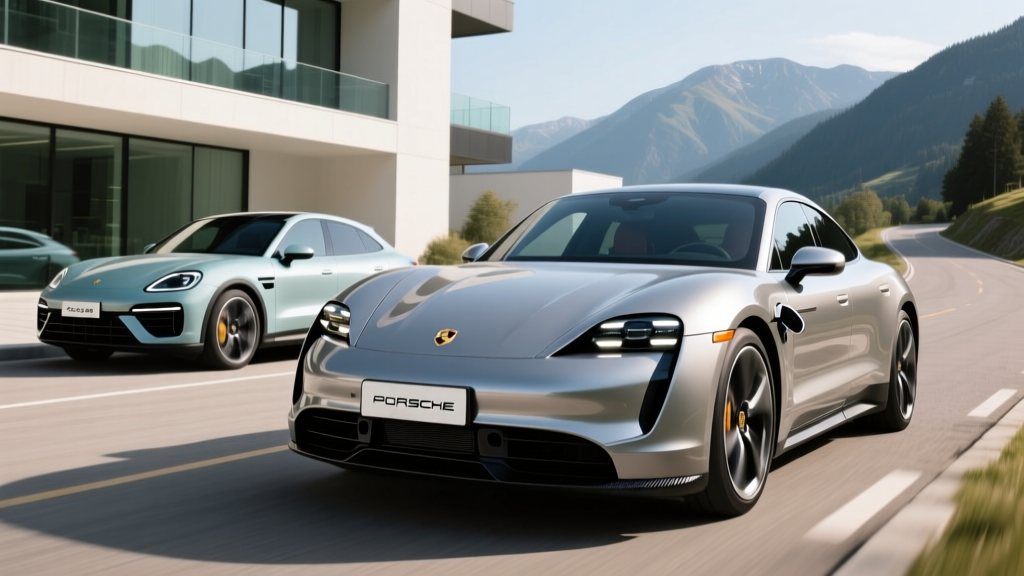
Porsche's 2026 EV lineup includes the Taycan (sedan/wagon, 89–100.4 kWh battery, EPA 225–318 miles, $99,400–$240,000+), the Macan Electric (compact SUV, 100 kWh battery, EPA 288–308 miles, $78,800–$118,000), and the newly arriving Cayenne Electric (mid-size SUV, expected late 2026, ~$90,000+). All use 800-volt architectures enabling DC fast charging up to 270–320 kW, reaching 10–80% in roughly 18–21 minutes at compatible stations. None qualify for the federal §30D tax credit due to MSRP caps and battery-sourcing rules. Porsche EVs deliver benchmark performance and charging speed, but ownership costs run 30–50% higher than comparable luxury EVs from BMW or Mercedes-Benz when factoring insurance, maintenance, and depreciation.
Porsche's 2026 EV Lineup at a Glance
| Spec | Taycan (2026) | Macan Electric (2026) | Cayenne EV (2026) |
|---|---|---|---|
| Body Style | Sedan / Sport Turismo / Cross Turismo | Compact SUV | Mid-size SUV (announced) |
| Battery (usable) | 89 kWh (base) / 100.4 kWh (Performance Battery Plus) | 100 kWh (NMC) | ~100–115 kWh (NMC, estimated) |
| EPA Range | 225–318 mi (varies by trim/wheels) | 288–308 mi | ~280–310 mi (estimated) |
| Architecture | 800V (J1 platform) | 800V (PPE platform) | 800V (PPE platform) |
| Peak DC Fast Charge | 320 kW (Performance Battery Plus) | 270 kW | ~270–300 kW (estimated) |
| 10–80% DC Charge Time | ~18 min (at 350 kW station) | ~21 min | ~20–22 min (estimated) |
| Level 2 AC Rate | 19.2 kW (optional) / 11 kW (standard) | 11 kW | 11–19.2 kW (estimated) |
| 0–60 mph | 3.0s (4S) / 2.4s (Turbo GT) | 3.3s (Macan 4) / 5.5s (base) | TBA |
| Horsepower | 402 (base) / 1,019 (Turbo GT w/ Launch Control) | 335 (base) / 509 (Turbo) | TBA |
| Starting MSRP | $99,400 | $78,800 | ~$90,000+ (estimated) |
| Federal Tax Credit (§30D) | Not eligible | Not eligible | Not eligible (expected) |
| Battery Warranty | 8 yr / 100,000 mi (70% capacity retention) | 8 yr / 100,000 mi | 8 yr / 100,000 mi (expected) |
Sources: fueleconomy.gov, Porsche USA. Cayenne EV specs are preliminary estimates for a model announced but not yet on sale.
Real-World Range vs. EPA Sticker
Porsche's EPA estimates are measured conservatively, but real-world results depend heavily on your driving profile:
- Highway cruising at 75 mph: Expect 10–15% below EPA. A Taycan 4S rated at 283 miles EPA typically delivers 240–255 miles on a flat interstate run at 70–75 mph.
- Cold weather (below 32°F): Lithium-ion batteries lose 20–30% range in freezing temps. The Macan Electric's 308-mile EPA figure can drop to 215–245 miles in sub-freezing conditions without preconditioning.
- Mountain driving: Regenerative braking recovers energy on descents, partially offsetting uphill consumption — but net range still drops 5–10% in hilly terrain.
- Preconditioning matters: Using Porsche's navigation-routed battery preconditioning before arriving at a DC fast charger can reduce 10–80% charge time by 3–5 minutes in cold weather by warming the pack to optimal temperature.
Porsche EVs vs. Gas Cayenne and Macan: The Cost Comparison
The most common question from Porsche shoppers: does going electric actually save money? Here's a five-year ownership comparison using the Macan Electric vs. the gas Macan S as a representative pair.
| Cost Factor (5 Years / 75,000 mi) | Macan Electric (Base) | Gas Macan S (2026) |
|---|---|---|
| Purchase Price (MSRP) | $78,800 | $68,800 |
| Federal Tax Credit | $0 (MSRP/income/sourcing ineligible) | $0 |
| Fuel / Electricity | $4,500 (home L2 at $0.14/kWh avg) | $11,250 (19 MPG combined, $3.80/gal) |
| Maintenance | $1,800 (no oil, fewer brake replacements due to regen) | $4,500 (oil, filters, brake pads, spark plugs) |
| Insurance (avg) | $14,400 ($240/mo avg for luxury EV) | $10,800 ($180/mo) |
| Estimated Depreciation | $31,520 (40% over 5 yr) | $27,520 (40% over 5 yr) |
| Total 5-Year Cost | $131,020 | $122,870 |
| Cost Per Mile | $1.75 | $1.64 |
Electricity costs assume 80% home Level 2 charging at national average residential rate. Public DC fast charging at $0.40–$0.60/kWh would raise the EV fuel cost to $6,000–$8,500 over 5 years. Gas price based on EIA weekly averages. Depreciation estimates from industry data. Your actual costs will vary by state, driving pattern, and electricity rate.
The takeaway: The Macan Electric saves roughly $6,750 in fuel and maintenance over five years, but that's more than offset by a $10,000 higher purchase price and ~$3,600 more in insurance. The EV wins on driving experience and daily convenience (home charging, no gas station stops), not on pure economics. If your electricity rate is below $0.10/kWh or you have access to free workplace charging, the math shifts meaningfully in the EV's favor.
Charging Reality: What Porsche EV Owners Actually Experience
Porsche's 800-volt architecture is the brand's genuine EV advantage. Here's what that means in practice across charging levels:
| Charging Level | Power (kW) | Miles Added Per Hour | Typical Use Case |
|---|---|---|---|
| Level 1 (120V household) | 1.4 kW | ~4–5 mi/hr | Emergency / overnight trickle (not practical for daily use) |
| Level 2 (240V home, 48A) | 11 kW | ~35–40 mi/hr | Overnight home charging — full charge in 9–10 hours |
| Level 2 (Porsche Mobile Charger Connect, 80A) | 19.2 kW | ~60–70 mi/hr | Faster home charging — full charge in ~5.5 hours (requires 100A circuit) |
| DC Fast (350 kW station) | Up to 320 kW (Taycan) | ~180 mi in 10 min | Road trips — 10–80% in ~18 min |
| DC Fast (150 kW station) | ~140 kW sustained | ~50–55 mi per 10 min | Common public chargers — 10–80% in ~30 min |
The Charge Curve Reality
Porsche advertises "up to 320 kW" peak charging on the Taycan with Performance Battery Plus. That peak is real but brief. Here's the actual charging curve behavior:
- 10–40% SoC: The Taycan sustains 270–320 kW, adding range extremely quickly.
- 40–60% SoC: Power tapers to roughly 200–240 kW as battery temperature and cell voltage rise.
- 60–80% SoC: Further taper to 120–160 kW. This is why the 10–80% metric matters more than peak kW.
- Above 80%: Charging drops sharply to protect battery health — expect 50 kW or less. Avoid DC fast charging past 80% on road trips unless necessary.
For context, a Tesla Model S on a V3 Supercharger (250 kW peak) adds 10–80% in roughly 25–30 minutes. The Taycan's 800V system genuinely charges faster at compatible Electrify America or Porsche-branded 350 kW stations — but only if you can find them. Roughly 40% of U.S. DC fast chargers max out at 150 kW, where the Porsche's advantage narrows.
Home Charging Installation
Most Porsche EV owners install a Level 2 home charger. Budget accordingly:
| Item | Cost Range |
|---|---|
| Level 2 charger hardware (Porsche Mobile Charger or ChargePoint Home Flex) | $500–$1,200 |
| Electrician labor (240V/60A circuit run, 20–50 ft from panel) | $800–$2,500 |
| Permit and inspection | $100–$400 |
| Electrical panel upgrade (if needed — 200A service) | $1,500–$4,000 |
| Total typical install | $1,400–$4,100 |
| Total with panel upgrade | $2,900–$8,100 |
Always get a quote from a licensed electrician before committing to an EV purchase. Older homes with 100A panels frequently need an upgrade to support a 48A or higher Level 2 circuit alongside existing household loads.
Common Misconceptions About Porsche EVs
| Myth | Fact |
|---|---|
| "Porsche EVs qualify for the $7,500 federal tax credit." | False. Under current IRS §30D rules, the Taycan and Macan Electric exceed the MSRP cap ($55,000 for sedans, $80,000 for SUVs/vans/pickups), and Porsche's battery supply chain does not meet the critical-minerals and battery-component sourcing requirements. No Porsche EV qualifies. Verify current rules at irs.gov. |
| "The Taycan's range is too low for road trips." | Partially true, but misleading. A Taycan 4S with EPA 283 miles can realistically cover 240–255 highway miles. But its 18-minute 10–80% charge time at 350 kW stations means a 600-mile trip requires only two ~20-minute stops — comparable to gas-car rest stops. Range matters less when charging is this fast. |
| "Porsche EVs depreciate faster than gas Porsches." | Currently true. The luxury EV market is volatile. Taycan depreciation has averaged 40–50% over three years, compared to 25–35% for the gas 911. However, 911s are an outlier in holding value. Compared to a gas Panamera or Cayenne, Taycan depreciation is similar or slightly worse. |
| "I can't charge a Porsche EV at Tesla Superchargers." | Changing. Porsche has not adopted NACS (Tesla's connector) for its current models. Taycan and Macan Electric use CCS1 in North America. You can use a CCS-to-NACS adapter at some open Tesla Superchargers, but Porsche does not officially support this. Future Porsche models may adopt NACS natively. |
| "EV maintenance is basically zero." | Overstated. Porsche EVs skip oil changes, spark plugs, and transmission fluid. But they still need tire rotations (EVs wear tires faster due to instant torque and heavier weight), cabin air filters, brake fluid checks, coolant system service, and wiper/12V battery maintenance. Budget $300–$500/year, not zero. |
Who Should Buy a Porsche EV — and Who Shouldn't
Choose a Porsche EV If:
- You prioritize driving dynamics above all else. The Taycan remains the benchmark for how an EV should feel — precise steering, adaptive air suspension, and a two-speed rear transmission (on most trims) that gives it a sports-car character no Tesla or Lucid matches in corner-carving feel.
- You have reliable home Level 2 charging. Porsche EVs shine when you wake up every morning with a full "tank." Without home charging, you'll rely on public DC fast charging, which costs $0.40–$0.60/kWh and adds 15–20 minutes to your routine several times a week.
- You take road trips on routes with Electrify America or 350 kW chargers. Porsche's 800V charging advantage only materializes at high-power stations. If your typical routes rely on 50–150 kW chargers, a BMW iX or Mercedes EQE SUV will charge at similar real-world speeds for less money.
- You want a luxury EV that doesn't look or feel like a tech pod. Porsche interiors are driver-focused with physical controls, premium materials, and understated design — the opposite of Tesla's minimalist approach.
Look Elsewhere If:
- You need maximum range per dollar. A Lucid Air Pure ($69,900, EPA 419 miles) or Tesla Model S ($74,990, EPA 402 miles) delivers far more range for less money. The Taycan's efficiency is around 2.8–3.2 kWh/mile, while the Lucid Air achieves ~4.0+ miles/kWh.
- Federal tax credit eligibility matters to your budget. The Hyundai Ioniq 5, BMW iX (some trims), and several other luxury EVs may qualify for partial or full §30D credits depending on sourcing and income. No Porsche EV does.
- You primarily drive in extreme cold. Porsche EVs use liquid thermal management and heat pumps (standard on Macan Electric, optional on some Taycan trims), but all EVs lose 20–30% range below freezing. If you live in Minnesota or Maine and need 250+ real winter miles, consider a PHEV like the Cayenne E-Hybrid instead.
- Total cost of ownership is your primary decision factor. A BMW iX xDrive50 ($87,250, EPA 307 miles) offers comparable luxury, more cargo space, and lower insurance costs. A Tesla Model X ($79,990, EPA 320 miles) provides more range and Supercharger network access.
First-Time Porsche EV Buyer Checklist
If you're transitioning from a gas Porsche (or any gas car) to a Porsche EV, here's what to prepare for:
- Get a home electrical assessment before buying. A licensed electrician can tell you if your panel supports a 60A or 100A circuit for Level 2 charging. This is the single biggest ownership enabler.
- Download the Porsche Connect app and your charging-network apps. You'll need Electrify America, ChargePoint, and EVgo apps for public charging. Porsche's built-in navigation routes you to compatible chargers and can precondition the battery en route.
- Understand kW vs. kWh. kW (kilowatts) measures power — how fast energy flows into the car. kWh (kilowatt-hours) measures energy — how much the battery holds. A 100 kWh battery charged at 200 kW doesn't fill in 30 minutes because the charge rate tapers as the battery fills.
- Plan for tire costs. Porsche EVs are heavy (Taycan: 4,700–5,300 lbs) with instant torque. Expect tire replacement every 20,000–30,000 miles at $300–$500 per tire for performance rubber.
- Get insurance quotes before signing. Luxury EV insurance averages 15–30% higher than equivalent gas models. Shop multiple carriers — some specialize in EV coverage.
- Test the regen braking feel. Porsche's regenerative braking is less aggressive than Tesla's one-pedal driving. You'll still use the brake pedal regularly, which some drivers prefer for a natural feel.
Frequently Asked Questions
Does any Porsche EV qualify for the federal tax credit in 2026?
No. Under current IRS §30D rules, Porsche EVs fail multiple eligibility criteria: the Taycan sedan exceeds the $55,000 MSRP cap, the Macan Electric and Cayenne exceed the $80,000 SUV cap, and Porsche's battery supply chain does not meet the critical-minerals and battery-component sourcing requirements. Always verify current eligibility at irs.gov, as rules can change.
How long does a Porsche EV battery last?
Porsche warrants its high-voltage batteries for 8 years or 100,000 miles, guaranteeing at least 70% capacity retention. Real-world data from 2020–2022 Taycan models suggests NMC batteries in Porsche's thermal management system degrade roughly 1–2% per year under normal use. At that rate, a Taycan with 318 miles EPA new would retain roughly 285–295 miles after 5 years and 75,000 miles. Full battery replacement, if ever needed outside warranty, currently costs $20,000–$30,000+ depending on the pack.
Can I charge a Porsche Taycan or Macan Electric at a Tesla Supercharger?
Not natively. Porsche uses the CCS1 connector in North America. Some Tesla Superchargers are opening to non-Tesla EVs via the Magic Dock adapter, but coverage is limited. A third-party CCS-to-NACS adapter (such as those from Lectron or A2Z) can work at open Superchargers, but Porsche does not officially endorse this. Porsche has signaled future models may adopt NACS, but current-production Taycan and Macan Electric vehicles ship with CCS1.
Is the Porsche Cayenne EV available to buy now?
No. As of early 2026, the Cayenne Electric has been announced and shown in prototype form but is not yet available for purchase or delivery in the U.S. Expected availability is late 2026 or early 2027. All specs listed for the Cayenne EV in this guide are preliminary estimates based on the PPE platform shared with the Macan Electric and Audi Q6 e-tron.
How does the Macan Electric compare to the Audi Q6 e-tron?
Both ride on the same VW Group PPE 800V platform with a 100 kWh battery. The Macan Electric starts at $78,800 with EPA 288–308 miles and a sportier suspension tune. The Q6 e-tron starts at $63,800 with EPA 308–321 miles and a more comfort-oriented setup. The Audi offers better value and slightly more range; the Porsche delivers sharper handling and brand cachet. Both charge at up to 270 kW DC.
What's the real-world MPGe of a Porsche Taycan?
The EPA rates the 2026 Taycan 4S at roughly 75–83 MPGe combined depending on wheel size. In real-world mixed driving, owners typically see 2.8–3.2 kWh per mile, which translates to about 70–80 MPGe equivalent. Highway driving at 75+ mph drops efficiency to roughly 65–72 MPGe. For reference, a gas Porsche Panamera 4S achieves 21 MPG combined — the Taycan uses roughly one-third the "fuel" cost per mile when charging at home.