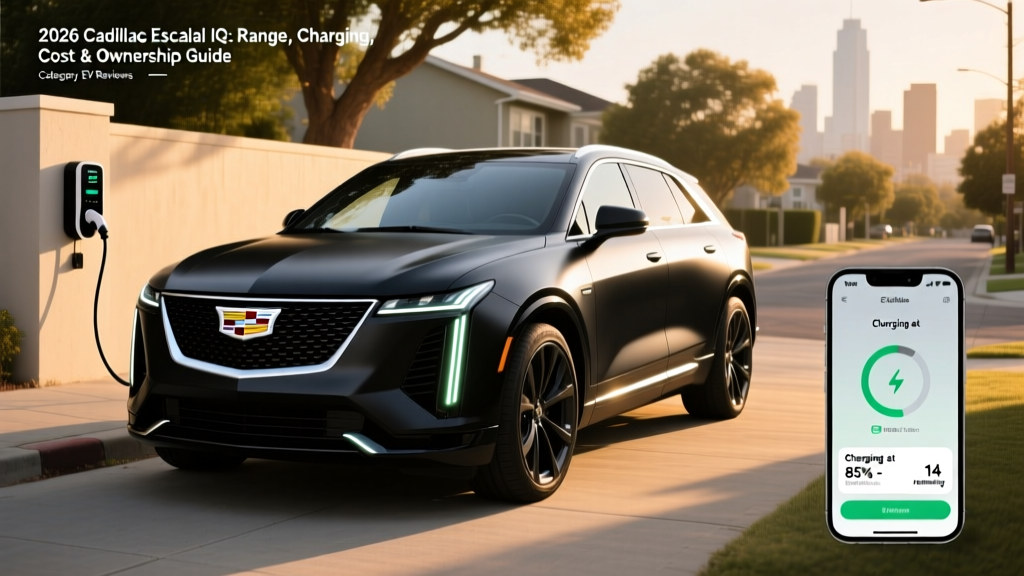
Quick Answer: Is the 2026 Cadillac Escalade IQ Worth It?
The 2026 Cadillac Escalade IQ (Cadillac's all-electric Escalade) delivers an EPA-estimated 460 miles of range from a massive 200+ kWh Ultium battery, charges at up to 350 kW DC (adding ~100 miles in 10 minutes), and starts around $130,000. It's a compelling choice if you have reliable Level 2 home charging, drive a luxury three-row SUV today, and want to eliminate $4,000+ in annual fuel costs. However, its size makes public charging awkward, the MSRP exceeds the federal §30D tax credit cap, and real-world highway range will land closer to 370–400 miles. If you frequently tow, live in an apartment without charging access, or regularly drive in sub-20°F climates, the gas Escalade or a plug-in hybrid alternative may serve you better.
2026 Escalade IQ: The Numbers That Matter
Cadillac built the Escalade IQ on GM's BT1 electric platform — the same architecture underpinning the GMC Hummer EV and Chevrolet Silverado EV. That means enormous battery capacity, 800-volt electrical architecture for ultra-fast DC charging, and available four-wheel steer. Here are the core specifications buyers need to evaluate:
| Specification | 2026 Escalade IQ Luxury | 2026 Escalade IQ Sport |
|---|---|---|
| EPA Range (est.) | 460 miles | 440 miles |
| Battery Capacity (usable) | ~200 kWh (NMC Ultium) | ~200 kWh (NMC Ultium) |
| Peak DC Fast Charge Rate | 350 kW | 350 kW |
| 10–80% DC Charge Time | ~24 minutes (at 350 kW stall) | ~24 minutes |
| Level 2 AC Charge Rate | 19.2 kW | 19.2 kW |
| Horsepower | 680 hp (dual motor AWD) | 750 hp (dual motor AWD) |
| 0–60 mph | ~4.0 sec | ~3.5 sec |
| MPGe (combined, est.) | ~88 MPGe | ~85 MPGe |
| Starting MSRP | $129,990 | $149,990 |
| Battery Warranty | 8 yr / 100,000 mi | 8 yr / 100,000 mi |
Real-World Range Reality Check
The 460-mile EPA figure is impressive on paper, but large, heavy SUVs with boxy aerodynamics lose efficiency quickly at highway speeds. Expect 370–400 miles on a 75-mph highway trip in mild weather. In cold conditions (below 30°F), plan for 300–340 miles of usable range before needing to charge. The Escalade IQ's heat pump helps mitigate winter losses, but a 200+ kWh battery still takes significant energy to warm. Always precondition the battery while plugged in before a cold-weather departure — this draws grid power instead of battery power for cabin and pack heating.
Charging the Escalade IQ at Home and on the Road
A battery this large demands serious charging infrastructure. Here's what each charging level looks like in practice:
| Charging Level | Power (kW) | Miles Added per Hour | Full 0–100% Time | Best Use Case |
|---|---|---|---|---|
| Level 1 (120V outlet) | 1.4 kW | ~3 mi/hr | ~65+ hours | Emergency / trickle only |
| Level 2 (240V, 48A) | 11.5 kW | ~25 mi/hr | ~18 hours | Daily overnight top-up |
| Level 2 (240V, 80A) | 19.2 kW | ~42 mi/hr | ~11 hours | Recommended home setup |
| DC Fast (350 kW stall) | 350 kW peak | ~600+ mi/hr (peak) | 10–80% in ~24 min | Road trips |
Home charging is non-negotiable for this vehicle. With a 200+ kWh battery, Level 1 charging is effectively useless — you'd add only 30 miles overnight. A Level 2 home charger is essential. The Escalade IQ supports up to 19.2 kW AC charging, which requires a 100-amp dedicated circuit and a hardwired wall connector. Most homes will need a 200-amp electrical panel upgrade to support this, adding $2,000–$5,000 to your installation budget on top of $500–$1,200 for the charger unit and $800–$2,500 for electrician labor and permits.
On the road, the 800-volt architecture allows the Escalade IQ to accept up to 350 kW at compatible DC fast chargers. At that rate, a 10–80% session takes roughly 24 minutes. However, sustained peak charging is rare — the charge curve tapers significantly above 60% state of charge (SoC) to protect battery health. Real-world 10–80% times at a typical 150–250 kW Electrify America or EVgo station will stretch to 30–40 minutes. The Escalade IQ uses the NACS (Tesla-style) connector for both AC and DC charging in the 2026 model year, granting access to Tesla Superchargers via GM's adapter agreement.
Escalade IQ vs. Gas Escalade: The True Cost of Ownership
The gas-powered 2026 Cadillac Escalade starts around $83,000 and returns roughly 16 MPG combined with its 6.2L V8. Let's compare five-year ownership costs head to head, assuming 15,000 miles per year, $3.50/gallon regular unleaded, and $0.16/kWh home electricity (national average):
| Cost Category (5 Years) | Escalade IQ (EV) | Gas Escalade (V8) |
|---|---|---|
| Purchase Price (base MSRP) | $129,990 | $83,000 |
| Federal Tax Credit (§30D) | $0 (MSRP exceeds $80K cap) | $0 |
| Fuel / Energy (75,000 mi) | $4,800 (home charging) | $16,400 (gas) |
| Maintenance | $1,500 (tire rotations, cabin filter, fluid top-offs) | $4,200 (oil changes, brakes, spark plugs, transmission) |
| Insurance (avg. annual × 5) | $18,500 | $14,000 |
| Estimated Depreciation | $52,000 (40%) | $33,200 (40%) |
| Total 5-Year Cost | $206,790 | $150,800 |
The Escalade IQ saves roughly $11,600 in fuel and $2,700 in maintenance over five years compared to the gas model. But the $47,000 higher purchase price, steeper insurance premiums (typical for luxury EVs), and greater absolute depreciation dollars mean the gas Escalade remains cheaper to own over five years at current pricing. The IQ wins on driving experience, technology, and daily convenience — not on pure economics. If fuel prices spike above $5/gallon or you drive 20,000+ miles annually, the math shifts in the EV's favor.
For a more efficiency-focused comparison, the Cadillac Lyriq (starting ~$58,000, EPA 314 miles, eligible for partial §30D credit) offers similar luxury with far lower running costs if three rows aren't mandatory.
Federal Tax Credit and Incentive Reality
Here's where buyers often get confused. Under current IRS §30D rules, the federal clean vehicle credit offers up to $7,500 — but it comes with strict limitations that disqualify the Escalade IQ:
- MSRP Cap: SUVs must have an MSRP at or below $80,000. The Escalade IQ starts at $129,990 — well over the limit.
- Buyer Income Cap: AGI must not exceed $300,000 (joint) / $225,000 (head of household) / $150,000 (individual).
- Battery Sourcing: Critical minerals and battery components must meet phased-in domestic/free-trade-partner sourcing requirements.
- Point-of-Sale Transfer: Eligible buyers can transfer the credit to the dealer for an immediate price reduction — but only if the vehicle itself qualifies.
Bottom line: The 2026 Escalade IQ does not qualify for the federal §30D credit due to its MSRP. Some states offer additional incentives that aren't MSRP-capped (check your state energy office or AFDC incentive database), and commercial fleet buyers may explore the §45W commercial clean vehicle credit, which has different caps. Consult a tax professional for your specific situation.
First-Time EV Buyer: What to Know Before You Commit
| Common Misconception | Fact |
|---|---|
| "I'll never need to visit a gas station, so charging is free." | Home charging costs $0.12–$0.25/kWh depending on your utility. A full Escalade IQ charge costs $24–$50 at home and $60–$100+ at public DC fast chargers. |
| "The battery will need replacing in 5 years." | GM's Ultium NMC batteries carry an 8-year/100,000-mile warranty against degradation below 60% capacity. Real-world data from GM's Ultium fleet suggests 10–15% degradation over 150,000+ miles with proper care. |
| "I can charge on any public charger." | The Escalade IQ uses NACS. Most Electrify America and third-party stations use CCS1. GM provides a NACS-to-CCS adapter, but adapter charging may cap at lower kW rates. Tesla Superchargers are native NACS. |
| "EVs don't work in cold weather." | EVs work in cold — but range drops 15–30% below freezing. The Escalade IQ's heat pump and battery preconditioning minimize this. Plan shorter segments and charge more often in winter. |
| "I can tow just as far on a charge." | Towing a 5,000-lb trailer can cut EV range by 40–50%. Expect ~200–230 miles while towing — plan charging stops accordingly. |
Home charging access is the single biggest ownership variable. If you have a garage or dedicated parking spot with 240V access, daily EV ownership is effortless — plug in at night, wake up "full." If you rely exclusively on street parking or apartment living with no charging infrastructure, owning a 200+ kWh luxury EV becomes a logistical burden. Public DC fast charging works, but 30–40 minute sessions two to three times per week adds up quickly, and public charger reliability remains inconsistent outside major metro areas.
Before purchasing, verify these items:
- Your electrical panel capacity (schedule a licensed electrician consultation — typically $150–$300 for a site assessment).
- Your utility's time-of-use rates (charging overnight at off-peak rates can cut energy costs by 40–60%).
- DC fast charger availability along your most common road-trip routes using apps like PlugShare or A Better Routeplanner.
- Your HOA or landlord's EV charging policies if you don't own your parking space.
Decision Framework: Should You Buy the Escalade IQ?
Choose the 2026 Escalade IQ If:
- You have a garage with 240V access (or can install it) and a 200-amp electrical panel.
- You want three-row luxury with the smoothest, quietest powertrain available — electric torque delivery in a 7,500-lb SUV is remarkable.
- You drive 12,000–18,000 miles per year, mostly within 300 miles of home, with occasional road trips.
- You value the latest tech (55-inch pillar-to-pillar display, Super Cruise hands-free driving on compatible highways, available four-wheel steering for tighter urban maneuvers).
- Fuel savings, zero tailpipe emissions, and reduced maintenance visits matter to you even if total cost of ownership isn't cheaper than gas.
Stick with the Gas Escalade (or Consider Alternatives) If:
- You lack reliable home charging access and can't install a Level 2 charger.
- You frequently tow heavy trailers over long distances (range drops dramatically).
- You regularly drive in remote areas with limited DC fast charging infrastructure.
- Your budget is under $100,000 and you need three rows — the gas Escalade, or a luxury PHEV like the Volvo XC90 Recharge, offers lower entry pricing.
- You plan to keep the vehicle 10+ years and are concerned about out-of-warranty battery replacement costs (estimated $25,000–$35,000 for a pack this size).
Ownership Costs: Charging, Insurance, and Maintenance in Detail
Charging costs vary enormously by location and method. At the national average residential rate of $0.16/kWh, a full 200 kWh charge costs about $32 — delivering roughly 400 real-world miles. That's approximately $0.08 per mile on home electricity. Compare that to the gas Escalade at 16 MPG and $3.50/gallon: $0.22 per mile. For a driver covering 15,000 miles annually, that's $3,360 in gas vs. $1,200 in home electricity — a $2,160 annual savings.
However, public DC fast charging is significantly more expensive. Networks like Electrify America and EVgo charge $0.40–$0.60/kWh in many markets. At $0.50/kWh, your cost per mile jumps to $0.25 — actually more expensive than gasoline. If more than 50% of your charging will happen at public stations, the fuel-cost advantage evaporates.
Insurance for the Escalade IQ runs 25–35% higher than the gas Escalade, driven by higher repair costs for EV-specific components, elevated MSRP, and limited collision-repair data on the BT1 platform. Expect annual premiums of $3,200–$4,500 depending on your driving record, state, and coverage levels. Get quotes from multiple insurers before purchase — some carriers offer EV-specific discounts.
Maintenance is where EVs shine. The Escalade IQ has no engine oil, no transmission fluid, no spark plugs, no timing chain, and no exhaust system. Brake pads last far longer thanks to regenerative braking handling most deceleration. Budget for tire rotations every 7,500 miles, cabin air filter replacement annually, windshield washer fluid, and wiper blades. GM's Cadillac Premium Care covers the first scheduled maintenance visit.
Super Cruise and Driver Assistance: What It Actually Does
SAE Automation Level: Level 2. Super Cruise is a hands-free driver-assistance system — not self-driving. You must remain alert, keep your eyes on the road (monitored by a driver-attention camera), and be prepared to take over immediately. It operates only on pre-mapped divided highways (~400,000+ miles of compatible roads in the US and Canada). It does not handle city streets, construction zones, or unmapped roads. The driver is legally responsible at all times.
The Escalade IQ comes with Super Cruise standard, which enables hands-free driving on compatible highways and includes automatic lane changes when you activate the turn signal. For the 2026 model year, GM has expanded Super Cruise coverage and refined the system's merging and curve-speed behavior. It's one of the most polished Level 2 systems available, alongside Ford's BlueCruise, but it remains a driver-assist feature — not a robotaxi.
Frequently Asked Questions
How long does it take to fully charge the 2026 Escalade IQ at home?
With a 19.2 kW Level 2 hardwired charger (requiring a 100-amp circuit), a full 0–100% charge takes approximately 11 hours. Most owners will never charge from 0% — a typical 20–80% daily top-up takes about 6–7 hours, easily completed overnight. On a standard 48-amp Level 2 charger (11.5 kW), plan for roughly 18 hours for a full charge.
Does the Escalade IQ qualify for any federal tax credits?
No. The Escalade IQ's MSRP of $129,990+ far exceeds the IRS §30D $80,000 SUV cap. Some state-level incentives may apply — check your state's energy office or the Alternative Fuels Data Center for local programs. Commercial buyers may explore the §45W credit with their tax advisor.
What happens if the battery degrades significantly?
GM warrants the Ultium battery for 8 years or 100,000 miles against capacity loss below 60% of original. Real-world degradation data from GM's Ultium vehicles suggests most packs retain 85–90% capacity after 100,000 miles. To maximize longevity, avoid routinely charging to 100% for daily use (set a 80–90% daily limit), use preconditioning before DC fast charging, and minimize repeated back-to-back Level 3 charges in extreme heat.
Can I tow with the Escalade IQ?
Yes — Cadillac rates the Escalade IQ for up to 8,000 lbs of towing capacity. However, towing drastically reduces range. Expect a 40–50% range reduction when pulling a heavy trailer, dropping real-world range to roughly 200–230 miles. Plan charging stops carefully and verify DC fast charger availability along your towing route.
Is the Escalade IQ bigger or smaller than the gas Escalade?
The Escalade IQ rides on a slightly longer wheelbase than the gas Escalade ESV and offers comparable interior volume across all three rows. The flat floor (no transmission tunnel) actually improves second-row footroom. Cargo space is similar, with a small front trunk (frunk) adding roughly 10–12 cubic feet of bonus storage.
What's the best home charger for the Escalade IQ?
Because the IQ supports 19.2 kW AC charging, you'll want a hardwired Level 2 station capable of 80 amps — such as the ChargePoint Home Flex (configured for 80A), FLO Home X8, or a GM-approved Ultium Home charger. Ensure your electrician installs a dedicated 100-amp circuit. The NACS connector is native, so no adapter is needed for home charging.