Quick Answer: Is a Porsche EV Worth It in 2026?
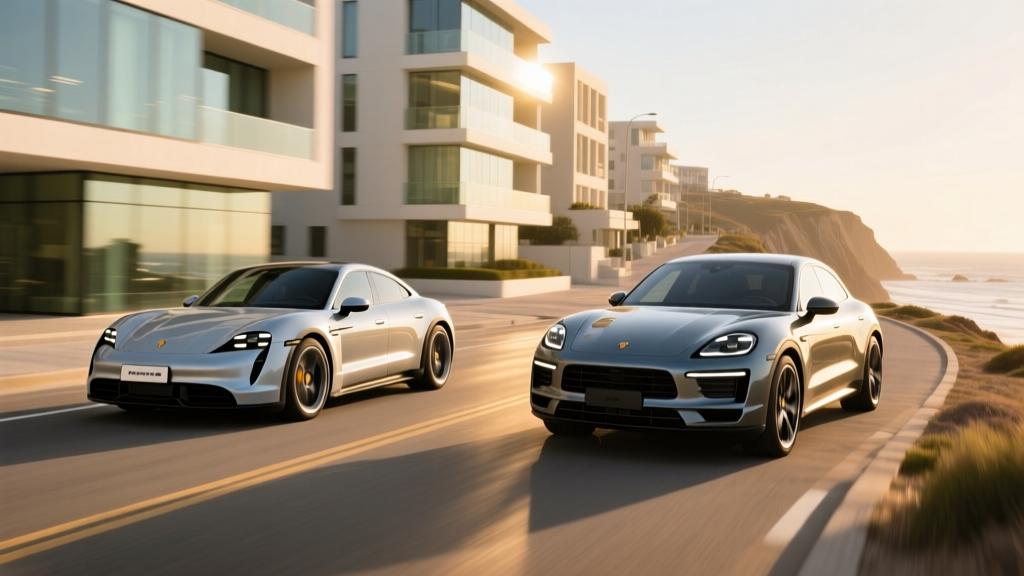
Porsche currently sells two fully electric models in the US: the Taycan sedan/cross-turismo (EPA range up to 318 miles on the 105 kWh Performance Battery Plus) and the Macan EV SUV (EPA range up to 308 miles). Base pricing starts around $99,400 for the Taycan and $78,800 for the Macan EV — both above the IRS §30D federal tax credit MSRP caps ($55,000 sedans, $80,000 SUVs), meaning neither qualifies for the $7,500 new EV credit. However, Porsche's 800-volt architecture delivers class-leading DC fast charging (10–80% in roughly 18 minutes at up to 320 kW), making road-trip downtime shorter than nearly any competitor. The real buying decision comes down to whether you value peak driving dynamics and ultra-fast charging enough to absorb premium purchase costs, higher insurance, and no federal incentive.
The 2026 Porsche EV Lineup: What's Actually for Sale
Porsche's electric portfolio has matured significantly. Here is the current US lineup with the specs that matter most for daily ownership:
| Model | Trim | Battery (kWh usable) | EPA Range | Peak DC kW | 10–80% Time | 0–60 mph | Base MSRP |
|---|---|---|---|---|---|---|---|
| Taycan | Base (RWD) | 84 kWh (LFP option) / 97 kWh NMC | 225–318 mi | 320 kW | ~18 min | 4.5s | $99,400 |
| Taycan | 4S | 97 kWh NMC | 283–318 mi | 320 kW | ~18 min | 3.5s | $118,900 |
| Taycan | Turbo GT | 97 kWh NMC | 269 mi | 320 kW | ~18 min | 2.1s | $230,000 |
| Macan EV | Base (RWD) | 95 kWh NMC | 308 mi | 270 kW | ~21 min | 5.0s | $78,800 |
| Macan EV | 4 | 95 kWh NMC | 288 mi | 270 kW | ~21 min | 4.4s | $86,800 |
| Macan EV | Turbo | 95 kWh NMC | 270 mi | 270 kW | ~21 min | 3.1s | $106,000 |
Chemistry note: Porsche uses NMC (nickel manganese cobalt) chemistry across most trims for its higher energy density. An LFP (lithium iron phosphate) option is available on the base Taycan — it sacrifices roughly 40 miles of range but offers longer cycle life and can be charged to 100% daily without degradation concerns. If you commute short distances and charge at home nightly, LFP is the smarter longevity play.
Porsche EV vs. Gas Equivalent: Real Cost Data
The natural cross-shops are the Taycan against the Panamera, and the Macan EV against the gas Macan or Cayenne. Let's run five-year numbers on the most common comparison: Taycan 4S vs. Panamera 4.
| Cost Factor (5 Years / 75,000 mi) | Taycan 4S ($118,900) | Panamera 4 ($105,000) |
|---|---|---|
| Purchase price (after incentives) | $118,900 (no §30D credit) | $105,000 |
| Fuel / electricity | $4,875 (home L2 @ $0.14/kWh avg) | $11,250 (premium gas @ $4.50/gal, 22 MPG) |
| Maintenance | $2,100 (cabin filter, fluid checks, tires) | $5,400 (oil, brakes, spark plugs, tires) |
| Insurance (avg) | $18,500 ($3,700/yr) | $14,500 ($2,900/yr) |
| Estimated depreciation | $52,000 (~44%) | $42,000 (~40%) |
| Total 5-Year Cost | $196,375 | $178,150 |
| Cost per mile | $2.62 | $2.38 |
The Taycan costs roughly $18,225 more over five years in this comparison. The fuel and maintenance savings (~$9,675 combined) offset a portion of the higher purchase price, insurance premiums, and steeper depreciation, but do not close the gap. You buy a Porsche EV for the driving experience and charging speed, not to save money versus a gas Panamera.
However, the equation shifts if you compare the Macan EV Base ($78,800) against a loaded gas Macan S (~$68,000). The smaller price gap, combined with the Macan EV's superior MPGe (84 combined per fueleconomy.gov), narrows the 5-year delta to under $8,000 — a much easier premium to justify for daily drivers.
Charging Reality: 800V Architecture Explained
Porsche's 800-volt electrical architecture is the Taycan and Macan EV's most significant technical differentiator. Most competitors run 400V systems. Higher voltage allows more power (kW) to flow at lower current, reducing heat and enabling sustained fast charging.
Real-World Range vs. EPA Sticker
Taycan 4S (EPA 318 mi): Expect 255–275 miles in mixed highway driving at 70–75 mph. In cold weather (below 35°F), plan for 210–235 miles. Porsche's thermal management system and standard heat pump minimize cold-weather losses compared to older EVs, but physics still applies.
Macan EV (EPA 308 mi): Expect 250–270 miles highway, and 200–225 miles in freezing conditions. The SUV's larger frontal area and weight work against efficiency at speed.
| Charging Level | Power (kW) | Speed (miles/hour) | Typical Use Case |
|---|---|---|---|
| Level 1 (120V household) | 1.4 kW | ~4 mi/hr | Emergency / trickle only |
| Level 2 (240V home) | 9.6–19.2 kW | 28–58 mi/hr | Daily overnight charging |
| DC Fast ( Electrify America 350 kW) | Up to 320 kW | ~750 mi/hr (peak) | Road trips; 10–80% in ~18 min |
Charging curve honesty: The "320 kW peak" only holds between roughly 10–40% state of charge. From 40–80%, the Taycan tapers to 150–200 kW. That's still excellent — the 10–80% time of ~18 minutes is among the fastest of any production EV — but don't expect 320 kW sustained across the entire session. Above 80%, charging slows dramatically to protect the NMC cells. Preconditioning the battery (via the car's navigation to a DC fast charger) is essential to hit peak rates.
Connector note: The Taycan uses CCS1 in North America. The Macan EV launched with NACS compatibility via adapter, with native NACS on 2026+ models, granting access to Tesla Superchargers (now the largest reliable fast-charging network). If you're cross-shopping, this is a meaningful advantage for the Macan EV on road trips.
Federal Tax Credit: Why Porsche EVs Don't Qualify
This is the most common misconception among Porsche EV shoppers. Under current IRS §30D rules, the federal EV tax credit has hard MSRP caps:
- Sedans (Taycan): MSRP must be $55,000 or less
- SUVs (Macan EV): MSRP must be $80,000 or less
- Buyer income caps: $150K single / $300K joint (modified AGI)
- Battery sourcing: Critical minerals and battery components must meet phased-in domestic/free-trade requirements
The cheapest Taycan is $99,400. The cheapest Macan EV is $78,800 — technically under the $80,000 SUV cap, but once destination charges and any dealer-installed options push it above $80,000 (which happens on nearly every unit), it loses eligibility. Even a base Macan EV that stays under cap must clear the battery-sourcing requirements, which are increasingly restrictive in 2026.
Bottom line: Budget the full MSRP. Do not factor $7,500 into your purchase math. Some states offer separate rebates (California's CVRP, for example, has its own income and price rules) — check your local energy utility and DMV for regional incentives.
Common Porsche EV Misconceptions — Corrected
| Myth | Fact |
|---|---|
| "Porsche EVs have poor range." | The 2026 Taycan with the Performance Battery Plus achieves 318 EPA miles — competitive with the Tesla Model S and Lucid Air Pure. Earlier 2020–2023 models had 200–227 EPA miles; the refresh closed the gap. |
| "You can't road-trip a Taycan." | At 320 kW peak, a Taycan adds ~180 miles of range in 15 minutes on a capable 350 kW Electrify America station. That's faster than a Tesla Model S on V3 Superchargers. |
| "EV maintenance is free." | No oil changes, but tire wear is 20–30% faster due to instant torque and heavy curb weight (~5,100 lbs for the Taycan 4S). Budget $1,800–$2,400 for a set of Porsche-rated tires every 25,000–30,000 miles. |
| "The battery will need replacing." | Porsche warranties the battery for 8 years/100,000 miles against defects and capacity loss below 70%. Real-world NMC degradation data from early Taycans shows ~5–7% loss at 60,000 miles — well within warranty thresholds. |
| "Home charging is too expensive to install." | A basic 240V/48A Level 2 home charger install averages $1,200–$2,500 if your panel has capacity. A 200-amp panel upgrade adds $1,500–$3,000. Over 5 years of home charging, you'll save $5,000–$7,000 vs. gas — the install pays for itself. |
Real-World Ownership: Who Should (and Shouldn't) Buy
After tracking ownership costs, charging behavior, and driver satisfaction across Porsche EV forums and fleet data, the buyer profile is clear:
Choose a Porsche EV If:
- You have home Level 2 charging (or can install it) — public-only charging at $0.40–$0.60/kWh erases the fuel-cost advantage entirely
- You value driving dynamics over maximum range — Porsche's chassis tuning, steering feel, and regen calibration are best-in-class for enthusiasts
- You take regular road trips and want the shortest DC fast-charge stops available (10–80% in ~18 min is genuinely transformative on interstates)
- Your household income exceeds the §30D caps anyway, so the tax credit is irrelevant to your finances
- You want an EV that doesn't look or feel like a tech appliance — Porsche interiors prioritize analog-feeling controls alongside digital screens
Look Elsewhere If:
- Your primary goal is cost savings — a Tesla Model Y, Hyundai Ioniq 5, or Chevrolet Equinox EV will save you $30,000–$60,000 on purchase price and still qualify for the federal credit
- You live in an apartment without charging access and your area has sparse public DC fast-charging infrastructure
- You need maximum cargo space — the Taycan's trunk (14.3 cu ft) and frunk (2.9 cu ft) are modest; the Macan EV is better (28 cu ft behind rear seats) but trails the Tesla Model X
- You drive in extreme cold regularly (below 10°F for weeks) — range loss of 25–35% is real, and a PHEV like the Cayenne E-Hybrid may be more practical
Insurance, Depreciation, and the Hidden Costs
Porsche EVs carry insurance premiums 20–35% higher than their gas counterparts, driven by higher repair costs (specialized aluminum body panels, high-voltage safety protocols) and elevated theft/collision claim severity. Expect annual premiums of $3,200–$4,500 depending on your state, driving record, and coverage level. Get quotes before ordering — this is the ownership cost most buyers underestimate.
Depreciation on the Taycan was brutal in 2022–2024 (some examples lost 45–50% in two years as Tesla price cuts rippled through the luxury EV segment). The 2025 refresh with improved range and 320 kW charging has stabilized values, but plan on 40–45% depreciation over 5 years — slightly worse than a gas Panamera (~38%) and significantly worse than a 911 (~25%).
Frequently Asked Questions
Does the Porsche Taycan qualify for any tax incentives?
Not the federal §30D credit — the Taycan exceeds the $55,000 sedan MSRP cap. Some states (California, Colorado, Massachusetts) offer separate EV rebates with higher price caps, and certain utility companies provide $500–$1,500 for home charger installation. Check your state's energy office for current programs.
How long does a Porsche EV battery last?
Porsche warrants the high-voltage battery for 8 years or 100,000 miles, guaranteeing at least 70% capacity retention. Based on data from 2020–2023 Taycans now exceeding 80,000 miles, real-world NMC degradation averages 5–8% at 60,000 miles with normal charging habits (avoiding daily 100% charges and frequent DC fast charging). Full battery replacement outside warranty would cost an estimated $22,000–$28,000, but this is extremely rare.
Can I charge a Porsche EV at Tesla Superchargers?
The 2026 Macan EV with native NACS can charge at Tesla Superchargers directly. The Taycan (CCS1) requires the Porsche-approved NACS adapter (~$250) for Supercharger access. Tesla's network remains the most reliable DC fast-charging option in the US, with over 6,000 stalls nationwide.
Is the Macan EV better than the Taycan for daily use?
For most buyers, yes — the Macan EV offers easier ingress/egress, more cargo space (28 vs. 14.3 cu ft), a lower starting price ($78,800 vs. $99,400), and NACS compatibility. The Taycan wins on driving engagement, rear-seat headroom (surprisingly), and marginally faster peak charging. If you don't need SUV ride height, the Taycan is the better driver's car; if you want practicality, the Macan EV is the smarter buy.
What's the real-world highway range at 75 mph?
Independent testing shows the Taycan 4S with the 97 kWh battery delivers approximately 260–275 miles at a steady 75 mph in 65–75°F weather. The Macan EV 4 returns roughly 245–260 miles under the same conditions. Drop temperatures below 35°F and subtract 15–25%. These figures are better than pre-2025 Taycans but still trail the Lucid Air Pure (~350 highway miles) and Tesla Model S Long Range (~320 highway miles).