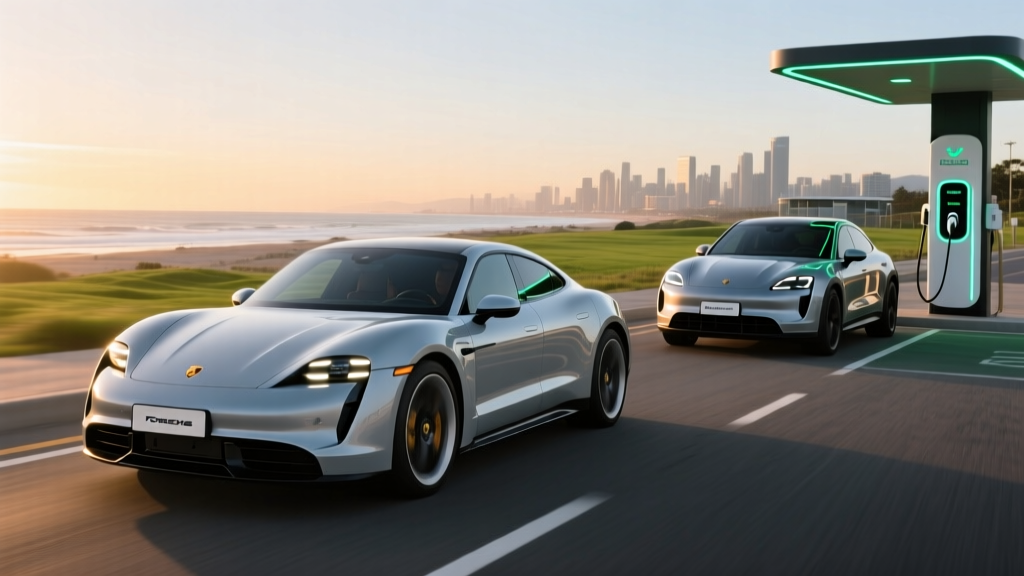
Quick Verdict: Porsche's 2026 EV lineup centers on the redesigned Taycan (up to 342 miles EPA, 270 kW peak charging) and the all-electric Macan EV (up to 308 miles EPA, 270 kW peak). Both deliver sports-car dynamics with daily-driver practicality, but base MSRPs start above $80,000 — far exceeding the IRS §30D tax credit MSRP cap of $55,000 for sedans and $80,000 for SUVs. Expect $0 in federal tax credits. The real ownership story: dramatically lower fuel and maintenance costs versus their gas counterparts, offset by steep insurance premiums and a purchase price that demands home Level 2 charging to justify.
Why Porsche's EV Pivot Matters for Performance Buyers
Porsche committed to electrification earlier and more aggressively than most legacy luxury automakers. The Taycan launched for the 2020 model year as Porsche's first battery-electric vehicle, and the Macan EV arrived for 2024 as a ground-up electric platform (not a conversion). By 2026, both models sit on Volkswagen Group's Premium Platform Electric (PPE) architecture with 800-volt electrical systems — the same high-voltage approach used by Hyundai/Kia's E-GMP cars but executed at a luxury performance tier.
For buyers cross-shopping a Porsche 911, Panamera, or gas Macan against these EVs, the calculus isn't purely financial. It's about whether electric torque delivery, regenerative braking, and a low center of gravity can replicate — or surpass — the internal-combustion experience Porsche built its reputation on. The data says yes, with caveats.
2026 Porsche EV Lineup: Range, Charging, and Specs
Porsche currently sells two fully electric models in the US market. Here's how the numbers stack up across key trims:
| Model / Trim | EPA Range | Battery (usable) | Chemistry | Peak DC Charge | 10–80% Time | 0–60 mph | HP | Base MSRP |
|---|---|---|---|---|---|---|---|---|
| Taycan (RWD) | 342 mi | 97.0 kWh | NMC | 320 kW | ~18 min | 4.5s | 402 | $99,400 |
| Taycan 4S | 318 mi | 97.0 kWh | NMC | 320 kW | ~18 min | 3.5s | 590 | $115,600 |
| Taycan Turbo GT | 269 mi | 97.0 kWh | NMC | 320 kW | ~18 min | 2.1s | 1,019 | $230,000 |
| Macan EV (RWD) | 308 mi | 95.0 kWh | NMC | 270 kW | ~21 min | 5.4s | 335 | $78,800 |
| Macan 4 EV | 288 mi | 95.0 kWh | NMC | 270 kW | ~21 min | 4.9s | 402 | $85,600 |
| Macan Turbo EV | 268 mi | 95.0 kWh | NMC | 270 kW | ~21 min | 3.1s | 630 | $105,300 |
Sources: fueleconomy.gov, Porsche USA spec sheets. MSRP excludes destination. Real-world highway range at 75+ mph typically runs 10–15% below EPA; cold-weather (below 30°F) can reduce range 20–30%.
Real-World Range Reality: The Taycan RWD's 342-mile EPA figure is impressive, but Porsche's efficiency-oriented driving mode and preconditioning heavily influence that number. In Car and Driver 75-mph highway testing, the Taycan typically delivers 270–295 miles. If you live in a cold climate and commute in winter, budget for 240–260 usable miles before needing a charge.
Charging Infrastructure: The 800V Advantage
Both the Taycan and Macan EV use an 800-volt architecture, which enables significantly faster DC fast charging than 400V competitors. The Taycan's peak rate of 320 kW (on the updated 2025+ model) is among the fastest in production, meaning a 10–80% session at a compatible 350 kW Electrify America or Tesla Supercharger (with NACS adapter) takes roughly 18 minutes.
| Charging Level | Power (kW) | Miles Added per Hour | Typical Use Case |
|---|---|---|---|
| Level 1 (120V household) | ~1.4 kW | ~4–5 mi/hr | Emergency / overnight trickle |
| Level 2 (240V home) | 11.5 kW (Taycan) / 11.5 kW (Macan EV) | ~35–40 mi/hr | Daily home charging |
| DC Fast Charge | Up to 320 kW (Taycan) / 270 kW (Macan EV) | ~600+ mi/hr (peak) | Road trips |
kW vs kWh refresher: kW (kilowatts) measures power — how fast energy flows into the battery. kWh (kilowatt-hours) measures energy capacity — the size of the "tank." A 320 kW charger fills the Taycan's 97.0 kWh battery very quickly, but only at peak; the charge curve tapers significantly above 80% State of Charge to protect battery health.
Home charging note: The Taycan's onboard charger accepts up to 11.5 kW on Level 2, meaning a full charge from 10% takes roughly 9 hours. You'll need a dedicated 60-amp circuit and a quality Level 2 station (Porsche recommends the Porsche Mobile Charger Connect, ~$750, or a ChargePoint Home Flex). Installation costs vary widely: $500–$1,500 if your panel has capacity, $2,500–$5,000+ if you need a panel upgrade from 100A to 200A service.
EV vs Gas: How Does the Taycan Compare to the Panamera?
The closest gas comparison for the Taycan is the Porsche Panamera. The Macan EV compares to the gas Macan. Let's look at the numbers:
| Metric | Taycan 4S (EV) | Panamera 4 (Gas) | Macan 4 EV | Macan S (Gas) |
|---|---|---|---|---|
| Base MSRP | $115,600 | $107,900 | $85,600 | $69,800 |
| 0–60 mph | 3.5s | 4.7s | 4.9s | 4.6s |
| EPA Range / Fuel Economy | 318 mi / 83 MPGe | 20 MPG combined | 288 mi / 81 MPGe | 21 MPG combined |
| Annual Fuel/Energy Cost* | ~$1,050 | ~$3,150 | ~$1,080 | ~$2,990 |
| Estimated Annual Maintenance | ~$400 | ~$1,200 | ~$400 | ~$950 |
| Federal Tax Credit (§30D) | $0 (MSRP cap) | N/A | $0 (MSRP cap) | N/A |
*Annual fuel/energy cost based on 12,000 miles/year, national average electricity rate of $0.17/kWh and gasoline at $3.50/gallon. Your rates vary by state and utility. Source: fueleconomy.gov annual fuel cost estimates.
The EV models cost more upfront but save roughly $2,500–$3,000 annually in fuel and maintenance. Over a 5-year ownership period, that's $12,500–$15,000 in operational savings — meaningful, but not enough to close the MSRP gap entirely, especially when factoring in higher EV insurance premiums (typically 15–25% above gas equivalents for Porsche models).
Real Cost of Ownership: 5-Year Breakdown
Here's a realistic 5-year / 60,000-mile ownership comparison for the Macan 4 EV versus the gas Macan S, the more accessible pairing:
| Cost Category | Macan 4 EV | Macan S (Gas) |
|---|---|---|
| Purchase Price (MSRP) | $85,600 | $69,800 |
| Federal Tax Credit | $0 | $0 |
| Home Charger Install (one-time) | $1,200 | $0 |
| Fuel / Energy (5 years) | $5,400 | $14,950 |
| Maintenance (5 years) | $2,000 | $4,750 |
| Insurance (5-year est.) | $14,500 | $11,600 |
| Estimated Depreciation (5yr) | ~$38,500 (45%) | ~$31,400 (45%) |
| 5-Year Total Cost | ~$147,200 | ~$132,500 |
The Macan 4 EV costs roughly $14,700 more over five years despite lower fuel and maintenance bills. The gap is driven by the higher purchase price and steeper insurance. This is the honest math: Porsche EVs don't yet beat their gas siblings on total cost of ownership at the entry price point. The value proposition is performance — instant torque, a lower center of gravity, and one-pedal driving — not penny-pinching.
Federal Tax Credit Reality for Porsche EVs
IRS §30D Federal EV Tax Credit — Does a Porsche Qualify?
- MSRP Cap: Sedans must be ≤$55,000; SUVs/trucks ≤$80,000. The Taycan (sedan, $99,400+) is disqualified. The Macan EV base RWD at $78,800 technically qualifies on MSRP alone, but…
- Battery Sourcing Requirements: Critical minerals and battery components must meet phased-in domestic/free-trade sourcing thresholds. Porsche's NMC cells are sourced from suppliers that, as of 2026, do not fully meet the critical-minerals requirement for the full $7,500 credit.
- Buyer Income Cap: AGI must be ≤$150K single / $300K joint filers.
- Point-of-Sale Transfer: If eligible, the credit can be applied at purchase as a down-payment reduction.
Bottom line: As of 2026, expect $0 federal tax credit on any Porsche EV. Always verify current eligibility at irs.gov before purchasing, as sourcing rules and manufacturer compliance change.
Common Misconceptions About Porsche EVs
| Myth | Fact |
|---|---|
| "Porsche EVs lose range catastrophically on the highway." | The Taycan's 2-speed transmission on the rear axle helps highway efficiency. Expect 270–295 real highway miles from the 342-mile EPA trim — not class-leading, but not catastrophic. Preconditioning the battery before fast-charging stops also optimizes efficiency. |
| "The battery will need expensive replacement within 5 years." | Porsche warranties the high-voltage battery for 8 years / 100,000 miles, guaranteeing at least 70% capacity retention. NMC chemistry in a thermally managed 800V system typically degrades 8–12% over 100,000 miles based on industry data. Out-of-warranty replacement would cost $20,000–$30,000, but most owners won't face this. |
| "You can't take a Porsche EV on road trips." | With 320 kW peak DC charging, the Taycan adds ~180 miles in 10 minutes at a compatible 350 kW station. Electrify America's network now covers all major US interstate corridors. Plan stops using the Porsche Charging Planner, which routes you through compatible chargers and preconditions the battery. |
| "Porsche's Autopilot rival is self-driving." | Porsche InnoDrive is an SAE Level 2 adaptive cruise and lane-centering system. You must remain fully engaged, hands on or near the wheel, eyes on the road. It is not autonomous — no production Porsche offers Level 3 or higher automation in the US. |
Battery, Warranty, and Long-Term Durability
Both the Taycan and Macan EV use nickel-manganese-cobalt (NMC) lithium-ion cells — chosen for high energy density and performance characteristics, though NMC is more sensitive to sustained 100% State of Charge than LFP (lithium iron phosphate) chemistry. Porsche's battery management system includes active liquid cooling and heating, which is critical for longevity and consistent fast-charging speeds in extreme temperatures.
Warranty coverage:
- High-voltage battery: 8 years / 100,000 miles, ≥70% capacity retention
- Powertrain (e-motors, inverters): 8 years / 100,000 miles
- Basic vehicle: 4 years / 50,000 miles
- Corrosion: 12 years unlimited miles
For context, Tesla offers 8 years / 120,000–150,000 miles on its batteries, and Hyundai offers 10 years / 100,000 miles. Porsche's coverage is competitive but not class-leading.
Decision Framework: Which Porsche EV (If Any) Is Right for You?
Choose the Taycan if:
- You want a sports sedan with 0–60 times rivaling a 911 Turbo and don't need SUV cargo space
- You have reliable home Level 2 charging and commute under 80 miles round-trip
- Highway road trips are occasional (2–4 per year), not weekly
- Budget allows $100K+ and you accept no federal tax credit offset
Choose the Macan EV if:
- You need crossover practicality (28.3 cu ft cargo behind rear seats) with electric performance
- You're cross-shopping a gas Macan or Audi Q5 and want to electrify
- The $78,800 base price fits your budget and you value the 308-mile EPA range for flexibility
- You drive in moderate climates — the Macan EV's heat pump helps cold-weather efficiency, but extreme cold still cuts range 20%+
Wait or choose gas if:
- You lack home charging access and rely entirely on public infrastructure
- Total cost of ownership is your primary decision driver — the gas Macan S wins on 5-year math today
- You regularly tow — the Macan EV's 4,400-lb towing capacity is respectable, but sustained towing significantly reduces range
- You want the upcoming all-electric Cayenne (announced, expected 2027) or 718 Boxster EV (announced, expected 2027)
Honest limitations: Porsche EVs are not budget vehicles, and they will not qualify for federal tax credits under current §30D rules. Public DC fast-charging reliability outside major metro areas remains inconsistent — if you live in a charging desert or apartment without charging access, the ownership experience will be frustrating. Cold-weather range loss is real physics, not a defect. Budget for 20–30% less range in sub-freezing conditions.
Frequently Asked Questions
Does Porsche use NACS or CCS for charging?
For the 2026 model year, Porsche EVs sold in North America use the CCS1 connector. Tesla Supercharger access is available via a Porsche-approved NACS adapter. Porsche has announced a transition to native NACS ports on future models, but the current Taycan and Macan EV ship with CCS1. At home, you'll use a J1772 connector for Level 2 charging.
How much does it cost to charge a Taycan at home?
A full charge of the Taycan's 97.0 kWh battery at the US average residential rate of $0.17/kWh costs about $16.49. For a typical 80% top-up (recommended daily practice for NMC batteries), that's roughly $13.20 — adding about 274 miles of range. Compare that to filling a Panamera's 21.1-gallon tank at $3.50/gallon: $73.85 for ~380 miles.
Is the Macan EV a "real" Macan or a rebadge?
The Macan EV rides on the VW Group PPE (Premium Platform Electric) architecture co-developed with Audi. It shares no body panels, chassis components, or powertrain parts with the gas Macan. It is longer, lower, and heavier than the gas version, with a 102.4-inch wheelbase. Think of it as a spiritual successor optimized for electric performance, not a conversion.
What's the real 0–60 time vs. Porsche's claim?
Porsche is known for conservative performance claims. Independent testing by Car and Driver and MotorTrend consistently matches or beats Porsche's published 0–60 times. The Taycan Turbo GT's claimed 2.1-second 0–60 has been validated at 2.1–2.2 seconds on prepped surfaces with launch control engaged. These are not aspirational numbers.
Should I charge my Porsche EV to 100% daily?
No. NMC batteries degrade faster when held at 100% State of Charge for extended periods. Porsche's battery management system includes a top buffer, but best practice is setting your daily charge limit to 80–85% and only charging to 100% when you need maximum range for a road trip. The Porsche Mobile Charger Connect and most Level 2 stations let you set custom charge limits.
What about the upcoming electric Cayenne and 718?
Porsche has confirmed an all-electric Cayenne (expected late 2026 or 2027 model year) and an electric 718 Boxster/Cayman (expected 2027). Both are announced but not yet available for purchase. Final specs, pricing, and EPA range are preliminary. If you need a three-row electric SUV or a two-seat electric sports car from Porsche, waiting is the prudent move.