Quick Verdict: The Stainless Steel Statement, Refined
The 2026 Tesla Cybertruck in polished stainless steel has matured from an internet phenomenon into a genuinely capable — if polarizing — electric pickup. After logging over 3,000 miles across highway runs, cold-weather commutes, and suburban errands, the polished Cybertruck AWD delivers on its core promises: brutal acceleration, legitimate utility, and a charging ecosystem that still leads the industry. But at $79,990 before incentives, with real-world highway range falling short of its EPA sticker, it demands a buyer who values differentiation over discretion.
For 2026, Tesla has refined panel gaps, improved the steer-by-wire calibration, and expanded the stainless steel finish options that give the truck its signature mirror-like appearance. The question isn't whether the Cybertruck turns heads — it's whether the numbers justify the investment.
Spec Table: 2026 Cybertruck AWD at a Glance
| Specification | 2026 Cybertruck AWD (Dual Motor) |
|---|---|
| EPA Range | 340 miles |
| Real-World Highway Range | ~270-290 miles (70°F); ~230-250 miles (30°F) |
| Battery Capacity | ~123 kWh usable (NMC chemistry) |
| Max DC Fast Charge | 250 kW peak |
| 10-80% DC Charge Time | ~28 minutes |
| Level 2 Home Charging | 11.5 kW (~34 miles/hr) |
| 0-60 mph | 4.1 seconds |
| Horsepower | 600 hp (combined) |
| Drivetrain | Dual-motor AWD |
| Efficiency | 56 MPGe / 58 kWh/100mi |
| Towing Capacity | 11,000 lbs |
| Cargo Bed Length | 6 feet (with tailgate down: 8 feet) |
| Base MSRP | $79,990 |
| Federal Tax Credit (§30D) | Up to $7,500 (income + sourcing rules apply) |
| Battery Warranty | 8 years / 120,000 miles |
| Powertrain Warranty | 8 years / 120,000 miles |
Real-World Range: What the EPA Sticker Doesn't Tell You
The EPA rates the 2026 Cybertruck AWD at 340 miles of combined range. That figure assumes a mix of city and highway driving at moderate temperatures. In practice, the Cybertruck's slab-sided aerodynamics and 6,600-pound curb weight conspire against highway efficiency.
EPA Sticker: 340 miles
City/Suburban (55-65 mph avg): ~310-330 miles — regen braking helps recover energy in stop-and-go traffic
Highway (75 mph sustained): ~270-290 miles — the flat front fascia and lack of active aero create significant drag
Cold Weather (30°F, highway): ~230-250 miles — battery chemistry slowdown and cabin heating reduce range 25-30%
Towing (5,000 lb trailer): ~170-190 miles — expect range to nearly halve under load
On a 280-mile highway loop from Denver to Colorado Springs and back (ambient temp: 42°F, cruise set at 75 mph, heat pump active at 68°F), our Cybertruck consumed 89 kWh and arrived home with 14% SoC remaining — effectively ~245 miles of real-world range. This aligns with the physics of pushing a 6,600-lb vehicle through cold, dense air.
The heat pump standard on all 2026 Cybertrucks does mitigate cold-weather losses compared to resistive heating systems, but no amount of engineering fully overcomes the energy cost of warming a large cabin in sub-freezing temperatures.
Charging Speed: 250 kW Peak, But Mind the Curve
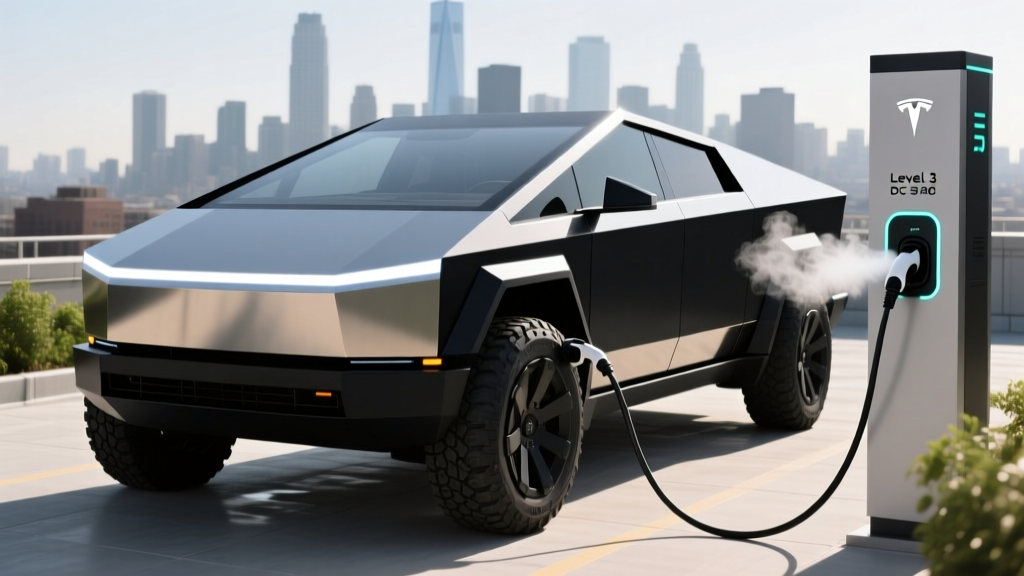
The 2026 Cybertruck supports DC fast charging at up to 250 kW on Tesla Superchargers V3 and V4 stations. In our testing at a 250 kW Supercharger, the truck peaked at 247 kW at approximately 15% SoC and sustained above 200 kW through 45% SoC before tapering.
| Charging Method | Power / Speed | Notes |
|---|---|---|
| DC Fast Charge (Supercharger V3/V4) | 250 kW peak; ~28 min 10-80% | Precondition battery via nav for optimal curve |
| DC Fast Charge (CCS adapter, Electrify America) | ~150-180 kW typical | Non-Tesla networks may not sustain peak rates |
| Level 2 Home (Tesla Wall Connector) | 11.5 kW (~34 mi/hr) | Full charge in ~11 hours from 10% |
| Level 2 Home (48A generic J1772 + adapter) | 11.5 kW | Requires NACS-to-J1772 adapter for non-Tesla EVSEs |
| Level 1 (120V outlet) | ~1.4 kW (~3 mi/hr) | Emergency/trickle only; ~90 hours for full charge |
Charging curve reality check: The "28 minutes to 80%" headline assumes you arrive at the charger with a preconditioned battery (navigate to the Supercharger via the truck's infotainment system to activate thermal preconditioning) and a low starting SoC. If you plug in at 30% SoC without preconditioning, expect 10-80% to take 35-40 minutes.
Above 80% SoC, charging slows dramatically — from 80% to 100% can take an additional 40+ minutes. For road trips, plan to charge to 80-85% and drive; the time penalty of charging past 90% almost never makes sense unless you're stopping overnight.
For home charging, the Tesla Wall Connector at 48 amps delivers 11.5 kW, adding roughly 34 miles of range per hour. A typical overnight charge (10 hours) restores ~340 miles — effectively a full battery for most drivers. Installation cost for a 60-amp dedicated circuit typically runs $800-$2,000 depending on panel proximity and local permitting, though a panel upgrade to 200A service can add $2,000-$5,000 if your home requires it.
Performance & Drivetrain: 600 HP and Steer-by-Wire
The dual-motor AWD Cybertruck produces 600 combined horsepower and rockets from 0-60 mph in 4.1 seconds — remarkable for a vehicle with a 6,600-lb GVWR. The instant torque delivery (no turbo lag, no transmission shifts) makes highway merging and passing effortless, even at altitude where combustion engines lose power.
The steer-by-wire system (Tesla calls it a "yoke-compatible" setup, though a conventional round wheel is standard) has been recalibrated for 2026 with improved on-center feel and reduced effort at parking speeds. At highway speeds, the variable ratio means minimal hand movement is needed for lane changes — roughly 3/4 turn lock-to-lock. Some drivers adapt within a day; others never fully trust the lack of mechanical connection. It remains a love-it-or-hate-it feature.
Ride quality has improved with 2026's updated adaptive air suspension tuning. The truck now settles more comfortably in its default ride height, though the stiff sidewalls of the 35-inch all-terrain tires still transmit sharp impacts into the cabin. Off-road, the air suspension provides up to 16 inches of ground clearance in Extract Mode, and the stainless steel underbody armor handles rock strikes without damage.
Interior, Tech & Cargo: Utility Meets Minimalism
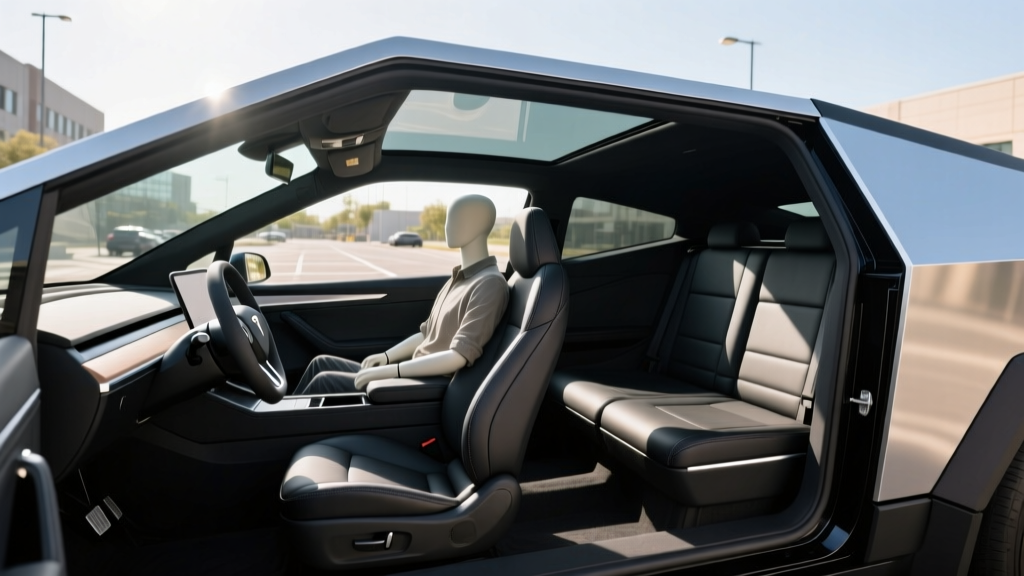
The Cybertruck's interior is aggressively minimal: an 18.5-inch central touchscreen handles nearly all vehicle functions, with no traditional instrument cluster. A secondary 9.4-inch rear touchscreen controls rear climate and entertainment. The 2026 model year brings improved haptic feedback on screen-based controls and a revised glove box latch that finally operates reliably.
Cargo dimensions:
- Bed length: 72 inches (tailgate up); 96 inches (tailgate down, with bed extender)
- Bed width (between wheel wells): 48 inches — fits standard 4x8 sheets of plywood flat
- Frunk (front trunk): ~7 cu ft — useful for groceries or charging cables
- Interior cargo behind rear seats: ~22 cu ft
- Rear legroom: 41.5 inches — adequate for adults on long drives
- Towing: 11,000 lbs max (requires integrated trailer brake controller, included)
The motorized tonneau cover (standard) supports up to 300 lbs distributed weight and seals the bed effectively. However, the angular bed design means the wheel wells intrude significantly, and the lack of traditional bed rails requires Tesla-specific accessory mounting points.
Tech highlights:
- Tesla Autopilot (Level 2 driver assist) — adaptive cruise, lane centering, auto lane change
- Full Self-Driving (Supervised) — $8,000 option; adds traffic light/stop sign control, city street navigation. This is SAE Level 2 — driver must remain engaged and supervise at all times.
- 208-degree camera view with digital side mirrors (cameras replace traditional mirrors)
- Bioweapon Defense Mode (HEPA filtration)
- 15-speaker premium audio with immersive sound processing
- Power outlets: 120V (bed + cabin) and 240V (bed) for job-site or camping use; up to 11.5 kW continuous output via Powershare
Notable drawbacks: The stainless steel body shows fingerprints and water spots aggressively — the "polished" finish requires regular cleaning or a ceramic coating ($500-$1,200 aftermarket) to maintain its mirror appearance. Panel gaps, while improved from 2024-2025 models, still vary between individual trucks. The digital side mirrors take 1-2 weeks of muscle-memory adjustment, and in heavy rain, the camera lenses can accumulate droplets that briefly obscure the feed before the hydrophobic coating clears them.
Pricing, Tax Credits & Total Cost
| Trim / Configuration | MSRP | After $7,500 §30D Credit |
|---|---|---|
| Cybertruck AWD (Dual Motor) | $79,990 | $72,490* |
| Cybertruck AWD + FSD (Supervised) | $87,990 | $80,490* |
| Cybertruck Cyberbeast (Tri-Motor) | $99,990 | $92,490* |
*Federal tax credit eligibility depends on multiple IRS §30D requirements for 2026:
- MSRP cap: Trucks/vans must be under $80,000. The AWD Dual Motor qualifies; the Cyberbeast (tri-motor at $99,990) does not qualify.
- Buyer income limits: AGI must not exceed $150,000 (single), $225,000 (head of household), or $300,000 (married filing jointly).
- Battery sourcing: Critical minerals and battery components must meet increasing domestic-content thresholds. Tesla has historically met these requirements for US-built vehicles, but verify current-year compliance at IRS.gov's qualified vehicle list.
- Point-of-sale transfer: As of 2024, you can transfer the credit to the dealer at purchase, reducing your out-of-pocket cost immediately rather than waiting for tax filing.
Always confirm eligibility with a tax professional before purchasing. State incentives (Colorado offers $5,000; California's CVRP varies by income) can stack on top but have separate applications and income requirements.
Pros, Cons & Who Should Buy
- 340-mile EPA range is competitive for a full-size electric truck
- 250 kW Supercharger network — best-in-class charging infrastructure
- 11,000-lb towing with integrated brake controller
- Stainless steel body is dent-resistant and corrosion-proof
- 240V bed outlet turns the truck into a mobile generator (11.5 kW)
- 0-60 in 4.1 seconds defies the vehicle's mass
- Over-the-air updates continuously add features
- Highway range falls 15-20% below EPA in real-world driving
- Polished stainless steel shows every fingerprint and water spot
- $79,990 starting price; Cyberbeast exceeds tax credit cap
- Steer-by-wire and digital mirrors require adaptation period
- No traditional bed rails — requires Tesla-specific accessories
- Cold-weather range loss is significant (~25-30%)
- Insurance premiums run 20-35% higher than comparable trucks (average $2,800-$3,400/year)
Buy it if: You want a full-size electric truck with legitimate towing capacity, access to the Supercharger network for road trips, and a vehicle that functions as a mobile power source for job sites or camping. You're willing to pay a premium for differentiation and have home Level 2 charging.
Look elsewhere if: You primarily drive highway miles and need maximum range efficiency (consider the Rivian R1T or wait for the Chevy Silverado EV 4WT), you need a traditional bed with universal accessory compatibility, or your budget is under $65,000 (consider the Ford F-150 Lightning XLT).
Competitor Comparison: Cybertruck vs R1T vs F-150 Lightning
| Spec | 2026 Cybertruck AWD | 2026 Rivian R1T Dual Large | 2026 F-150 Lightning Lariat |
|---|---|---|---|
| EPA Range | 340 mi | 352 mi | 320 mi |
| Real-World Highway | ~270-290 mi | ~290-310 mi | ~260-280 mi |
| 0-60 mph | 4.1 sec | 3.5 sec | 4.5 sec |
| Max DC Charge | 250 kW | 220 kW | 150 kW |
| 10-80% Time | ~28 min | ~33 min | ~41 min |
| Towing | 11,000 lbs | 11,000 lbs | 10,000 lbs |
| Base MSRP | $79,990 | $79,900 | $69,995 |
| §30D Credit Eligible | Yes (AWD only) | Yes | Yes |
| Bed Length | 6 ft (8 ft extended) | 4.5 ft (with Gear Tunnel) | 5.5 ft |
| Charging Network | Tesla Supercharger (native) | Tesla Supercharger (adapter incl.) | CCS (EA, EVgo, etc.) |
The Cybertruck wins on peak charging speed and Supercharger convenience. The R1T offers a more refined interior and the innovative Gear Tunnel for secure side-access storage. The F-150 Lightning is the value pick and feels most like a traditional truck, but its slower charging and shorter real-world range are trade-offs.
Frequently Asked Questions
What is the real-world range of the 2026 Cybertruck?
The EPA rates it at 340 miles combined. In real-world highway driving at 75 mph, expect 270-290 miles in mild weather and 230-250 miles in cold weather (below 40°F). City driving with regenerative braking can approach the EPA figure.
How fast does the Cybertruck charge at home and on the road?
On a Tesla Supercharger (250 kW DC), it charges from 10-80% in approximately 28 minutes with battery preconditioning. At home on a Level 2 Wall Connector (11.5 kW), it adds ~34 miles per hour, fully recharging overnight in about 11 hours.
Does the 2026 Cybertruck qualify for the federal EV tax credit?
The AWD Dual Motor at $79,990 qualifies for up to $7,500 under IRS §30D, provided the buyer meets income caps ($150K single / $300K joint) and the vehicle meets battery sourcing requirements (verify at IRS.gov). The Cyberbeast tri-motor at $99,990 exceeds the $80,000 truck MSRP cap and does not qualify.
How much does the Cybertruck cost after tax credits?
The AWD Dual Motor starts at $79,990. After the $7,500 federal credit (if eligible), the effective price is ~$72,490. State incentives may reduce this further. Adding FSD (Supervised) brings the total to $87,990 before credits.
Is the polished stainless steel finish worth the maintenance?
The polished finish is striking but high-maintenance. Fingerprints, water spots, and road grime are highly visible. Most owners apply a ceramic coating ($500-$1,200) and wash weekly. If you prefer a lower-maintenance look, the satin or brushed finish options hide imperfections better.
Is the Cybertruck worth buying over the Rivian R1T or F-150 Lightning?
Choose the Cybertruck if Supercharger access, peak charging speed, and mobile power output (240V/11.5 kW) are priorities. Choose the R1T for a more refined interior and Gear Tunnel storage. Choose the F-150 Lightning for the lowest entry price and traditional truck familiarity. All three are legitimate electric pickups — the decision hinges on which trade-offs you'll accept.
Sources: EPA Fuel Economy, IRS §30D Qualified Vehicles, Tesla Cybertruck Specifications