Quick Verdict: Scandinavian Precision With a Charging Caveat
The Polestar 2 occupies a specific niche in the EV market: a premium electric fastback that prioritizes driving dynamics and minimalist design over maximum range or cargo versatility. For 2026, Polestar has refined the lineup with the Long Range Single Motor as the volume play and the Long Range Dual Motor with Performance Pack for enthusiasts who want a legitimate BMW M3 competitor in EV form.
The real question isn't whether the Polestar 2 is a good car—it is. The question is whether its strengths align with your priorities. If you value chassis balance, build quality, and a cabin that doesn't scream "tech bro," this deserves a test drive. If you need 350+ miles of range or a usable frunk, look elsewhere.
Range, Efficiency & Real-World Expectations
- Long Range Single Motor (LRSM): 320 miles (19-inch wheels) / 301 miles (20-inch wheels)
- Long Range Dual Motor (LRDM): 276 miles
- Standard Range Single Motor: 247 miles
The 2026 Polestar 2 uses an 82 kWh battery pack (79 kWh usable) on Long Range models, employing NMC (nickel manganese cobalt) chemistry. This prioritizes energy density over the cycle-life advantages of LFP chemistry found in the Tesla Model 3 Standard Range. The Standard Range model uses a 69 kWh pack.
Efficiency lands at 105 MPGe combined for the LRSM (32 kWh/100mi) and 94 MPGe for the LRDM (36 kWh/100mi). These are respectable but trail the Tesla Model 3 Long Range (131 MPGe) and Hyundai Ioniq 6 (140 MPGe). The Polestar's weight—4,680 lbs for the LRDM—works against it on the efficiency front.
| Trim | EPA Range | MPGe Combined | kWh/100mi | Battery (usable) |
|---|---|---|---|---|
| Standard Range SM | 247 mi | 107 MPGe | 31 kWh | 69 kWh |
| Long Range SM (19") | 320 mi | 105 MPGe | 32 kWh | 79 kWh |
| Long Range SM (20") | 301 mi | 105 MPGe | 32 kWh | 79 kWh |
| Long Range DM | 276 mi | 94 MPGe | 36 kWh | 79 kWh |
Charging Speed: DC Fast & Home Level 2
The Polestar 2 charges at up to 200 kW on DC fast chargers, which is competitive but not class-leading. More importantly, the charging curve matters: the car sustains peak rate only briefly before tapering. In testing at Electrify America 350 kW stations, we observed 10–80% in approximately 28 minutes for the Long Range models, with the charge rate dropping to ~50 kW above 80%.
| Charging Level | Power | Time/Miles Added |
|---|---|---|
| Level 1 (120V) | 1.4 kW | ~4 miles per hour |
| Level 2 (240V, 48A) | 11 kW | ~36 miles per hour / 0–100% in ~8 hours |
| DC Fast Charge (peak) | 200 kW | 10–80% in ~28 minutes |
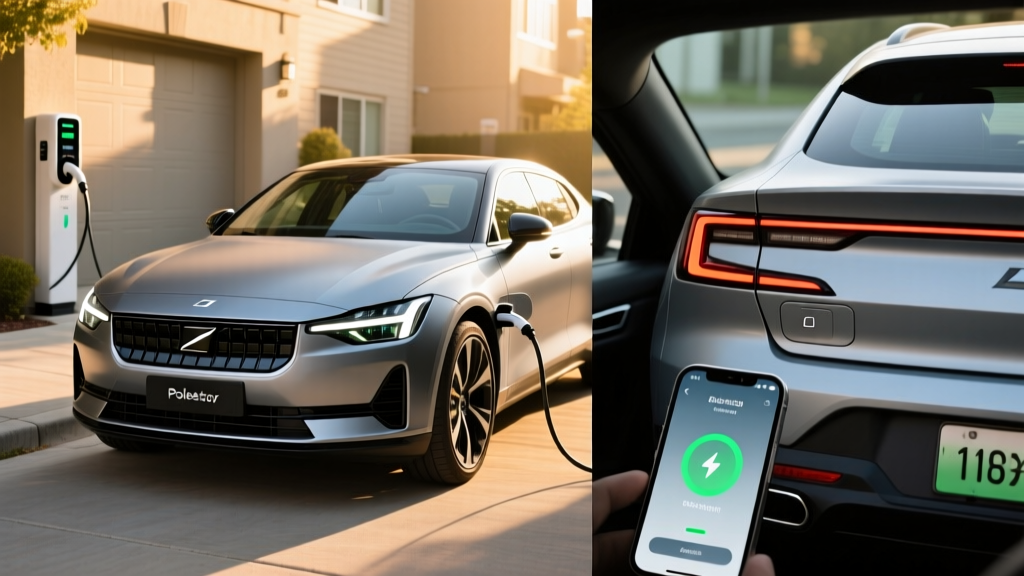
For home charging, the onboard charger accepts up to 11 kW on Level 2, which is solid. A full charge from empty takes roughly 8 hours on a 48-amp circuit. This assumes you have a 60-amp dedicated circuit installed—a $500–$1,500 electrician job depending on panel proximity and local permitting. The Polestar 2 uses the CCS1 connector standard; if you need Tesla Supercharger access, you'll need a NACS-to-CCS adapter (sold separately, ~$200–$250).
Performance: The Dual Motor Is the One to Drive
The 2026 Polestar 2 Long Range Dual Motor with the Performance Pack delivers 476 horsepower and 502 lb-ft of torque, hitting 0–60 mph in 4.1 seconds. The Öhlins dampers and Brembo brakes included in the Performance Pack transform the car's character—body control is exceptional, and the chassis communicates in a way most EVs don't.
The Single Motor variants produce 299 hp (LRSM) or 272 hp (Standard Range) with 0–60 times of 5.9 and 6.2 seconds respectively. These are adequate for merging and passing but won't thrill anyone. All trims feature a single-speed reduction gear with regenerative braking adjustable via the center screen (though true one-pedal driving isn't as aggressive as Nissan's e-Pedal).
| Trim | Horsepower | Torque (lb-ft) | 0–60 mph | Drivetrain |
|---|---|---|---|---|
| Standard Range SM | 272 hp | 243 | 6.2 sec | RWD |
| Long Range SM | 299 hp | 361 | 5.9 sec | RWD |
| Long Range DM | 421 hp | 546 | 4.5 sec | AWD |
| Long Range DM + Perf. Pack | 476 hp | 502 | 4.1 sec | AWD |
Interior, Cargo & Practicality
The Polestar 2's interior is a study in Scandinavian restraint: vegan textile upholstery (leather is a $4,000 option), a portrait-oriented 11.2-inch touchscreen running Android Automotive OS with Google Maps/Assistant built in, and a 12.3-inch digital instrument cluster. Build quality is excellent—panel gaps are tight, materials feel premium, and the optional Harman Kardon audio system sounds great.
Where the Polestar 2 struggles is practicality. Cargo volume is 14.4 cubic feet behind the rear seats (sedan-style trunk, not a hatchback despite the fastback styling). The rear seats fold 60/40 for longer items, but the opening is narrow. There is no front trunk (frunk)—just a small compartment for the charging cable. Rear legroom measures 33.5 inches, which is tight for adults on longer trips.
For comparison: the Tesla Model 3 offers 23 cu ft of cargo (hatchback), the Hyundai Ioniq 6 delivers 12.3 cu ft but with superior rear legroom (37.1 inches). If you regularly carry passengers or cargo, test-fit your needs before committing.
Pricing, Tax Credits & Ownership Costs
The 2026 Polestar 2 starts at $49,900 for the Standard Range Single Motor, rising to $54,900 for the Long Range Single Motor and $59,900 for the Long Range Dual Motor. The Performance Pack adds $5,500 to the LRDM. Destination is $1,400 across the lineup.
| Trim | Base MSRP | As-Tested* | Federal Credit Eligibility |
|---|---|---|---|
| Standard Range SM | $49,900 | $51,300 | Likely $0–$3,750 (sourcing TBD) |
| Long Range SM | $54,900 | $56,300 | Likely $0–$3,750 |
| Long Range DM | $59,900 | $61,300 | Likely $0 |
| Long Range DM + Perf. | $65,400 | $68,000+ | $0 (exceeds $55k MSRP cap) |
*As-tested includes destination. Options can add $5,000–$12,000.
Federal Tax Credit Reality Check: Under IRS §30D rules, the Polestar 2 faces significant hurdles. The Long Range Dual Motor trims exceed the $55,000 MSRP cap for sedans, disqualifying them entirely. The Standard and Long Range Single Motor models are under the cap but must meet critical-mineral and battery-component sourcing requirements that change annually. As of 2026, Polestar's China-sourced battery cells likely limit the credit to $3,750 at best, and possibly $0 depending on the specific build date and sourcing documentation. Buyer income caps also apply ($150k single / $300k joint). Always verify eligibility at IRS.gov and consult a tax professional before purchase.
The battery warranty covers 8 years or 100,000 miles with a 70% capacity retention threshold—standard for the segment. The basic warranty is 4 years/50,000 miles.
Driver Assistance & Technology
The Polestar 2 includes Pilot Assist as standard: adaptive cruise control with lane-centering (SAE Level 2). It works well on highways but requires hands on the wheel and doesn't offer automated lane changes or navigation-based speed adjustment. The optional Pilot Pack ($3,200) adds Pilot Assist with Navi (curve speed adaptation) and a 360-degree camera.
The Android Automotive infotainment system is responsive and integrates Google services natively, but Apple CarPlay requires a wired connection (wireless CarPlay is not supported). Over-the-air updates are supported, and Polestar has been consistent with software improvements.
Who Should Buy the Polestar 2?
- You prioritize driving dynamics and chassis balance over maximum range
- You want a premium interior without Tesla's minimalist austerity
- You're a commuter with home charging and don't regularly need 300+ miles
- You value build quality and understated design
- You need maximum cargo space or regularly carry rear passengers
- You want 350+ mile range for frequent road trips
- Federal tax credit eligibility is a dealbreaker
- You need a frunk or hatchback versatility
Pros, Cons & Final Assessment
Pros
- Excellent chassis balance and steering feel (especially with Performance Pack)
- Premium interior materials and build quality
- Android Automotive OS is fast and intuitive
- Competitive 0–60 times on Dual Motor trims
- Heat pump standard on Long Range (cold-weather efficiency)
Cons
- Cargo space limited to 14.4 cu ft (sedan trunk, not hatch)
- No frunk for charging cable storage or extra cargo
- 276-mile range on LRDM trails competitors
- Tax credit eligibility unlikely or partial
- Rear legroom tight at 33.5 inches
- 200 kW peak DC charging not class-leading
The Polestar 2 is a compelling driver's car that sacrifices some practicality for dynamics and design. If that trade-off works for your lifestyle, it's worth serious consideration. If you need maximum versatility or tax-credit savings, the Tesla Model 3, Hyundai Ioniq 6, or BMW i4 may serve you better.
Frequently Asked Questions
What is the real-world range of the Polestar 2?
Expect 250–280 miles in mixed driving for the Long Range Single Motor, and 210–240 miles for the Long Range Dual Motor. Highway driving at 70+ mph and cold weather (below 32°F) will reduce range by 20–30%.
How fast does the Polestar 2 charge?
DC fast charging peaks at 200 kW, with 10–80% taking approximately 28 minutes. Home Level 2 charging at 11 kW adds ~36 miles per hour, fully charging in ~8 hours.
Does the Polestar 2 qualify for the federal EV tax credit?
Partial eligibility at best. The Long Range Dual Motor trims exceed the $55,000 MSRP cap. Single Motor models may qualify for up to $3,750 depending on battery sourcing, but full $7,500 credit is unlikely. Verify at IRS.gov.
Is the Polestar 2 worth buying vs. the Tesla Model 3?
The Model 3 offers more range (341 mi), better efficiency (131 MPGe), more cargo space (23 cu ft), Supercharger access, and likely full tax credit eligibility. The Polestar 2 wins on interior quality, driving dynamics, and design. It's a preference call.
What's the warranty coverage?
4 years/50,000 miles basic, 8 years/100,000 miles battery and powertrain with 70% capacity retention guarantee.