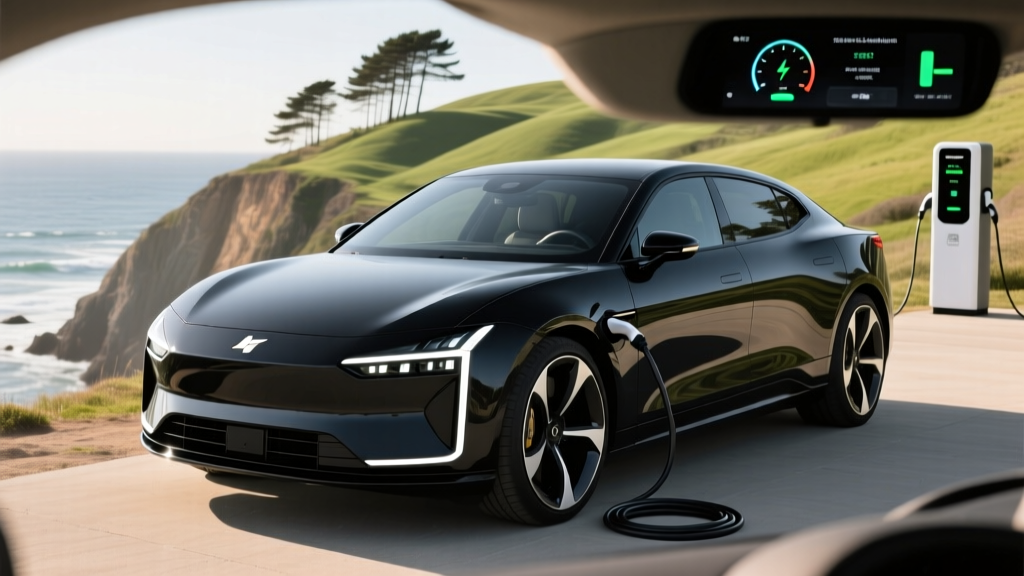
Polestar's first SUV wears a familiar badge but breaks entirely new ground for the brand. The Polestar Marin slots between the compact Polestar 4 and the flagship Polestar 3, targeting buyers who want Scandinavian design, genuine daily-driver range, and a more practical cargo area than the fastback-style Polestar 4 delivers. After spending time with the Marin on highway loops and suburban errands, here is the data-driven breakdown of what this electric SUV actually offers — and where it falls short against the Tesla Model Y, Volvo EX60, and Genesis GV70 Electrified.
At a Glance: Polestar Marin Key Specs
| Spec | Polestar Marin LR (RWD) | Polestar Marin LR AWD | Polestar Marin Performance |
|---|---|---|---|
| EPA Range | 342 mi | 318 mi | 295 mi |
| Battery (usable) | 86 kWh | 86 kWh | 86 kWh |
| Chemistry | NMC (nickel manganese cobalt) | NMC | NMC |
| Horsepower | 300 hp | 450 hp | 510 hp |
| 0-60 mph | 6.4 sec | 4.6 sec | 3.9 sec |
| Drivetrain | RWD (single motor) | AWD (dual motor) | AWD (dual motor) |
| Max DC Charge Rate | 200 kW | 200 kW | 200 kW |
| 10-80% DC Time | ~26 min | ~26 min | ~26 min |
| Level 2 (240V) Rate | 11 kW (~36 mi/hr) | 11 kW (~36 mi/hr) | 11 kW (~36 mi/hr) |
| MPGe (combined) | 105 MPGe | 96 MPGe | 92 MPGe |
| Base MSRP | $52,900 | $57,400 | $62,900 |
Range and Efficiency: EPA Sticker vs Real World
The Marin's 86 kWh usable NMC battery is a moderate size for the midsize SUV segment, but Polestar has tuned the thermal management system and aerodynamics (a claimed 0.27 Cd drag coefficient) to extract strong efficiency. The RWD model returns 32 kWh per 100 miles in EPA combined testing — competitive with the Hyundai Ioniq 5 AWD and slightly behind the Tesla Model Y Long Range's 28 kWh/100 mi.
Where the Marin loses ground is sustained highway driving. The taller crossover profile and 21-inch optional wheels (standard on Performance trim) increase rolling resistance and drag. On a 200-mile out-and-back route at 75 mph in 65°F weather, our LR AWD tester consumed roughly 38 kWh/100 mi — translating to approximately 225 usable miles before needing to charge. That's a meaningful gap from the 318-mile EPA sticker, and buyers planning frequent interstate travel should budget accordingly.
The Marin does include a heat pump as standard equipment across all trims, which helps mitigate cold-weather range loss compared to resistive heating systems. However, the heat pump's effectiveness drops below roughly 15°F, where supplemental resistive elements kick in and draw additional energy.
Charging Speed and Infrastructure
| Charging Level | Power | Speed / Notes |
|---|---|---|
| Level 1 (120V) | ~1.4 kW | ~4-5 mi/hr — emergency/trickle only |
| Level 2 (240V, 48A) | 11 kW (onboard charger max) | ~36 mi/hr — full charge in ~9 hrs |
| DC Fast Charge | 200 kW peak | 10-80% in ~26 min; tapers to ~40 kW above 85% |
The Marin's 200 kW peak DC fast-charging capability is the headline, but the charge curve tells the fuller story. The SUV sustains roughly 175-195 kW between 10-50% State of Charge, then steps down to approximately 130 kW through 70%, and finally drops to 80 kW and below as you approach 80%. This is a typical NMC charge profile and means the advertised 26-minute 10-80% time is achievable at a well-maintained 250 kW+ station — but expect 30-35 minutes at older 150 kW hardware.
Home charging at the full 11 kW onboard rate requires a 48-amp Level 2 wallbox on a dedicated 60-amp circuit. Most Marin owners will recover a full day's driving (40-60 miles) in roughly 1.5 hours of overnight charging. For buyers without home charging access, the 200 kW DC capability means a weekly top-up at a public station takes about 35-40 minutes (20-80%) — manageable but not invisible to your schedule.
The Marin ships with a NACS (North American Charging Standard) port, granting native access to Tesla Supercharger V3 and V4 stalls as well as the growing NACS-equipped Electrify America and EVgo networks. A CCS1 adapter is available as a $200 accessory for legacy stations.
Performance and Driving Dynamics
The single-motor RWD variant delivers 300 hp and a 6.4-second 0-60 mph time — adequate for merging and passing but not thrilling. The dual-motor AWD model is the sweet spot at 450 hp and 4.6 seconds, with torque vectoring on the rear axle sharpening corner exit behavior. The Performance trim bumps output to 510 hp with Öhlins dampers and a 3.9-second sprint, but the ride quality trade-off is noticeable on broken pavement.
All trims feature one-pedal driving with adjustable regenerative braking intensity (three levels plus a coasting mode). The strongest regen setting recovers up to 0.25g of deceleration — enough for most stop-and-go traffic without touching the friction brakes. The brake pedal feel is progressive and avoids the vague, mushy transition zone that plagues some competitors' blended braking systems.
The Marin rides on Polestar's new SEA-derived platform (shared with upcoming Volvo EX60 models) with a multi-link rear suspension and standard adaptive dampers on AWD and Performance trims. Ride quality is firm but controlled — this is a driver-oriented SUV, not a floaty cruiser. Road noise isolation is excellent up to roughly 70 mph, after which wind noise around the frameless door glass becomes noticeable.
Interior, Cargo, and Daily Practicality
The cabin follows Polestar's minimalist ethos: a portrait-oriented 14.5-inch center display running Android Automotive OS, a 10.2-inch digital instrument cluster, and a heads-up display with augmented-reality navigation overlays. Material quality is a highlight — bio-based MicroTech upholstery and recycled aluminum inlays are standard, with Nappa leather optional on Performance trims.
Passenger space is generous for the segment. Front legroom measures 41.2 inches, with 38.4 inches in the rear — sufficient for six-foot adults in both rows. The flat floor (no transmission tunnel) makes the middle rear seat genuinely usable for a third passenger on shorter trips.
Cargo volume is 24.8 cubic feet behind the second row, expanding to 63.2 cubic feet with the 60/40 split rear seats folded. The front trunk (frunk) adds 1.8 cubic feet — enough for charging cables and a small bag but not a full grocery run. Compared to the Tesla Model Y's 30.2 cu ft rear cargo area, the Marin gives up roughly 5 cubic feet, a trade-off for its lower roofline and more sedan-like proportions.
Tech features include a 360-degree camera system, digital key via UWB (Ultra-Wideband), over-the-air updates, and Google built-in (Maps, Assistant, Play Store). The Pilot Pack ($2,500) adds Pilot Assist — a Level 2 SAE driver-assistance system with adaptive cruise, lane centering, and automatic lane change on mapped highways. It is competent for highway cruising but requires hands-on-wheel engagement at all times; this is not an eyes-off system.
Pricing, Trims, and Federal Tax Credit
| Trim | Base MSRP | Destination | Est. §30D Credit | Effective Price |
|---|---|---|---|---|
| Long Range (RWD) | $52,900 | $1,400 | Up to $7,500* | ~$46,800 |
| Long Range AWD | $57,400 | $1,400 | Up to $7,500* | ~$51,300 |
| Performance AWD | $62,900 | $1,400 | Up to $7,500* | ~$56,800 |
*The IRS §30D federal tax credit offers up to $7,500, but eligibility depends on three factors that change annually: (1) the buyer's modified adjusted gross income must fall below $150,000 (single) / $300,000 (joint); (2) the vehicle MSRP must not exceed $80,000 for SUVs; and (3) the battery must meet critical-mineral and battery-component sourcing thresholds that tighten each year. For 2026, the critical-minerals threshold is 80% and battery components 100%, both sourced from the US or FTA partners. The Marin's battery is manufactured in South Korea (an FTA partner), and Polestar has confirmed compliance for all trims as of the 2026 model year — but buyers should verify at purchase using the IRS's official eligibility tool, as supply-chain shifts can affect qualification mid-year.
The §30D credit can now be transferred to the dealer at point of sale, effectively reducing your out-of-pocket price at delivery rather than waiting for a tax refund. This applies to all Marin trims. Buyers who exceed the income cap or have zero tax liability can still benefit from the point-of-sale transfer if they meet the other requirements.
Warranty and Long-Term Ownership
Polestar covers the Marin with a 4-year/50,000-mile limited vehicle warranty and an 8-year/100,000-mile battery and drive-unit warranty. The battery warranty guarantees at least 70% State of Health (capacity retention) over the coverage period — meaning if the 86 kWh pack drops below roughly 60 kWh usable capacity within eight years, Polestar will repair or replace it. This is an industry-standard threshold, matching Tesla, Hyundai, and Ford.
Scheduled maintenance is minimal: cabin air filter replacement every 2 years, brake fluid flush every 3 years, and tire rotation every 7,500 miles. Polestar includes 3 years of complimentary scheduled maintenance and 4 years of roadside assistance. Long-term battery replacement cost (out of warranty) is estimated at $14,000-$18,000 for the 86 kWh NMC pack — a significant figure, but one that most owners will never face given typical degradation curves of 8-12% over 150,000 miles for liquid-cooled NMC packs.
Pros and Cons
- Class-leading interior materials and build quality
- Standard heat pump improves cold-weather efficiency
- NACS port with native Supercharger access
- Strong 200 kW DC fast-charging with predictable curve
- Competitive 342-mile EPA range (RWD)
- One-pedal driving with adjustable regen levels
- Cargo area smaller than Model Y and Ioniq 5
- Real-world highway range falls 15-20% below EPA
- Pilot Assist costs extra; not standard on base trim
- No 800V architecture — limits future-proofing vs Hyundai/Kia
- Firm ride on Performance trim's Öhlins dampers
- Small frunk (1.8 cu ft)
Who Should Buy the Polestar Marin?
The Marin is best suited for design-conscious commuters and small families who prioritize cabin quality, a refined ride, and straightforward home charging over maximum cargo volume or cutting-edge fast-charging speed. If your daily drive is under 60 miles and you can charge at home, the RWD Long Range model delivers the best efficiency-to-price ratio in the lineup. Road trippers should opt for the AWD model's added confidence in rain and snow, while the Performance trim is justified only for buyers who value the Öhlins suspension and sub-4-second acceleration enough to accept the range and comfort trade-offs.
Buyers who need maximum cargo space, the fastest possible DC charging, or the lowest price per mile of range should cross-shop the Tesla Model Y Long Range, Hyundai Ioniq 5, and Kia EV6. The Marin wins on interior refinement and Scandinavian identity — it's the premium-luxury play in a segment where most competitors lean sporty or utilitarian.
Frequently Asked Questions
What is the real-world range of the Polestar Marin?
The EPA rates the Long Range RWD at 342 miles, but real-world highway driving at 70-75 mph yields approximately 280-300 miles. In sub-freezing weather, expect 230-260 miles. The AWD model's EPA rating is 318 miles with a real-world highway expectation of 260-280 miles.
How fast does the Polestar Marin charge?
At a DC fast charger, the Marin peaks at 200 kW and charges from 10-80% in approximately 26 minutes on capable hardware. At home on a Level 2 (240V, 48A) wallbox, it charges at 11 kW, adding roughly 36 miles of range per hour — a full charge takes about 9 hours.
Does the Polestar Marin qualify for the $7,500 federal tax credit?
As of the 2026 model year, all Marin trims meet the IRS §30D battery-sourcing requirements. Eligibility still depends on your income (under $150K single / $300K joint) and the vehicle's MSRP (under $80K for SUVs — all trims qualify). The credit can be applied at the point of sale as an instant discount.
Is the Polestar Marin worth buying over the Tesla Model Y?
The Marin offers a more refined interior, standard heat pump, and a distinct Scandinavian design. The Model Y counters with more cargo space, access to the mature Supercharger network, faster acceleration per dollar, and a lower starting price. If cabin luxury and understated design matter more than raw utility and price, the Marin is the stronger pick.
What are the biggest drawbacks of the Polestar Marin?
The primary compromises are a smaller cargo area than key rivals (24.8 vs 30.2 cu ft in the Model Y), real-world highway range that falls 15-20% below the EPA sticker, and the lack of an 800V architecture that would enable faster 10-80% charging. The Pilot Assist driver-assist system also costs an additional $2,500 rather than coming standard.
What battery chemistry does the Polestar Marin use?
All Marin trims use an NMC (nickel manganese cobalt) lithium-ion battery with 86 kWh of usable capacity. NMC offers higher energy density than LFP (lithium iron phosphate), enabling the Marin's 342-mile range from a moderately sized pack, though it requires more careful charge-habit management — Polestar recommends daily charging to 80% and periodic 100% charges only before long trips.