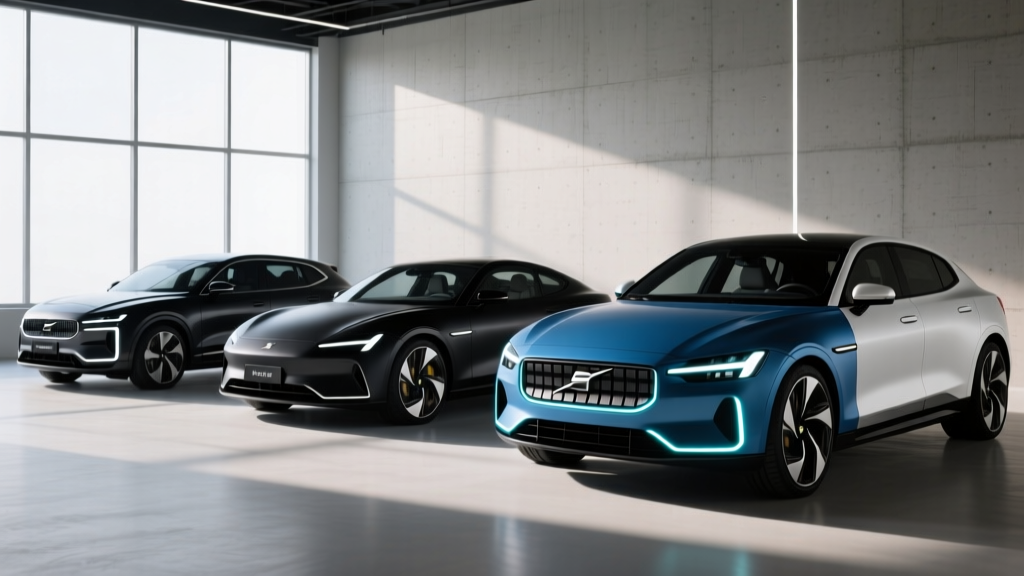
If you've searched for a Polestar definition, you've likely found conflicting descriptions: a Volvo spinoff, a Tesla rival, a design-first EV startup, a performance brand. The truth is all of the above — and none of it fully captures what buying a Polestar actually means in 2026. Rather than a dictionary entry, the real Polestar definition comes from driving, charging, and living with its vehicles. This review breaks down the current US lineup — the Polestar 2, Polestar 3, and Polestar 4 — with exact EPA figures, real-world range expectations, charging speeds, and ownership economics so you can decide if the brand matches your needs.
What Is Polestar? The Brand in 2026
Polestar launched as a performance sub-brand of Volvo in 2017, spun into a standalone EV-only automaker backed by Zhejiang Geely Holding (which also owns Volvo, Lotus, and Zeekr). By 2026, the company has moved past its single-model startup phase and fields three distinct vehicles in the US market, with the Polestar 5 grand tourer announced for late 2026/early 2027. Manufacturing happens in China (Polestar 2, 4) and South Korea at the Renault Korea Busan plant (Polestar 3), which matters directly for IRS §30D tax-credit battery-sourcing rules.
The brand's through-line: Scandinavian-minimalist design, Android Automotive OS infotainment (Google Maps, Google Assistant, Play Store built in), and a performance bias that prioritizes handling precision over straight-line drag-race numbers. Polestar doesn't chase Tesla on price or Supercharger exclusivity; it competes on build quality, chassis tuning, and a less ubiquitous design language.
2026 Polestar Lineup: Spec Table at a Glance
| Spec | Polestar 2 (LRDM) | Polestar 3 (LRDM) | Polestar 4 (LRDM) |
|---|---|---|---|
| Body Style | Liftback sedan | Mid-size SUV | Coupe SUV |
| Drivetrain | Dual-motor AWD | Dual-motor AWD | Dual-motor AWD |
| Horsepower | 421 hp | 489 hp | 544 hp |
| 0-60 mph | 4.5 sec | 5.0 sec | 3.8 sec |
| Battery (usable) | 79 kWh NMC | 107 kWh NMC | 100 kWh NMC |
| EPA Range | 276 mi | 315 mi (est.) | 288 mi (est.) |
| MPGe (combined) | 98 MPGe | ~89 MPGe | ~95 MPGe |
| Max DC Charge | 205 kW | 250 kW | 200 kW |
| 10-80% DC Time | ~27 min | ~30 min | ~29 min |
| Level 2 Home Rate | 11 kW (~37 mi/hr) | 11 kW (~32 mi/hr) | 11 kW (~34 mi/hr) |
| Base MSRP | $51,900 | $67,900 | $59,900 |
| Cargo (behind 2nd row) | 14.4 cu ft | 17.1 cu ft | 18.3 cu ft |
| Battery Warranty | 8 yr / 100,000 mi | 8 yr / 100,000 mi | 8 yr / 100,000 mi |
Notes: All figures reflect Long-Range Dual-Motor trims where applicable. Single-motor RWD variants of the Polestar 2 exist at lower price points with higher range. Polestar 3 and 4 figures are based on latest available US-spec data; verify at fueleconomy.gov for finalized EPA numbers.
Range: EPA Sticker vs. Real-World Expectations
Polestar 2 LRDM: EPA 276 mi. Expect ~240-255 mi on mixed highway driving (70-75 mph); ~210-230 mi in sub-freezing winter conditions. City/regen-heavy driving can push toward 285 mi.
Polestar 3 LRDM: EPA ~315 mi. Expect ~270-290 mi highway; ~240-260 mi in cold weather. The larger 107 kWh pack gives a meaningful buffer.
Polestar 4 LRDM: EPA ~288 mi. Expect ~250-265 mi highway. The coupe-SUV shape is slightly less aero-efficient than a sedan at high speed.
Polestar's EPA numbers tend to be conservative compared to some competitors (Hyundai/Kia often beat their stickers), but highway efficiency suffers in all three models because of their weight and performance-oriented tuning. The Polestar 2's ~3.3 mi/kWh highway figure is middling against the Tesla Model 3 Long Range's ~4.0 mi/kWh. If you regularly drive 300+ miles between charges in cold climates, none of these cars will do it without a stop — plan accordingly.
Charging Speeds: Home, Public, and the Curve Taper
Charging is where Polestar shows its Geely/Volvo engineering roots: competent but not class-leading. The 800-volt architecture in the Polestar 3 and 4 enables stronger peak rates than the older 400V Polestar 2, but sustained charging curves taper noticeably above 80% State of Charge (SoC) to protect the NMC cells.
| Level | Polestar 2 | Polestar 3 | Polestar 4 |
|---|---|---|---|
| Level 1 (120V) | ~1.4 kW / 4 mi/hr | ~1.4 kW / 3.5 mi/hr | ~1.4 kW / 3.5 mi/hr |
| Level 2 (240V home) | 11 kW / ~37 mi/hr | 11 kW / ~32 mi/hr | 11 kW / ~34 mi/hr |
| DC Fast (peak) | 205 kW | 250 kW | 200 kW |
| 10-80% DCFC | ~27 min | ~30 min | ~29 min |
| Connector | CCS1 (NACS adapter avail.) | CCS1 (NACS adapter avail.) | CCS1 (NACS adapter avail.) |
Charging-curve insight: The Polestar 3's 250 kW peak only holds between roughly 10-35% SoC, then steps down to ~175 kW through 60%, and ~100 kW by 80%. A 10-80% session on a 350 kW Electrify America stall takes about 30 minutes — competitive with the BMW iX but slower than the Hyundai Ioniq 5's 18-minute sprint. For road trips, the practical cadence is 25-30 minutes every 220-250 miles.
At home on an 11 kW Level 2 charger (requires a 48-amp dedicated circuit, ~$800-$1,500 installed), a full Polestar 3 charge takes about 10 hours overnight. Polestar does not currently support V2L (vehicle-to-load) or V2H (vehicle-to-home) in the US market.
Performance, Handling, and Daily Drivability
All three models use dual-motor AWD with torque-vectoring rear axles (disconnectable on the Polestar 3 and 4 for efficiency). The Polestar 4's 3.8-second 0-60 time makes it the quickest — quicker than a Porsche Macan Electric base model. The Polestar 2, despite being the oldest platform, remains the most engaging to drive on back roads thanks to its lower weight (~4,680 lbs vs ~5,700 for the Polestar 3) and optional Öhlins dampers on the Performance Pack.
Regenerative braking is one-pedal-capable but less aggressive than Tesla or Nissan Leaf. The brake pedal feel is firm and predictable — a Polestar hallmark — and the Brembo brakes on Performance trims resist fade well. Ride quality leans firm across the lineup; if you prioritize plushness, the Genesis Electrified GV70 or BMW iX will feel more compliant over broken pavement.
Interior, Tech, and the Google Automotive Question
Polestar's interior design is its strongest differentiator. The Polestar 2's vegan "WeaveTech" upholstery, floating center console, and frameless mirror are distinctive. The Polestar 3 and 4 elevate this with available wool-blend textiles, Nappa leather, and a panoramic glass roof (fixed, with electrochromic dimming on higher trims).
Infotainment: All three run Android Automotive OS natively — meaning Google Maps is the navigation engine, Google Assistant handles voice, and the Play Store offers native apps (Spotify, Tidal, EasyPark). Apple CarPlay is wireless on the Polestar 3 and 4, wired on the Polestar 2. The 14.5-inch center screen in the Polestar 3/4 is crisp, but the portrait-oriented 11.2-inch screen in the Polestar 2 feels dated by 2026 standards.
Driver assistance: Polestar's Pilot Pack bundles adaptive cruise, lane-centering, and blind-spot intervention at SAE Level 2. The driver must remain engaged — hands on the wheel (or torque-sensing), eyes on the road. This is not self-driving; it's comparable to Volvo's Pilot Assist, not Tesla FSD or GM Super Cruise. The Polestar 3 and 4 add LiDAR (Luminar) hardware on equipped trims, but as of 2026, its functionality is limited to enhanced perception for future over-the-air updates — no hands-free highway driving is currently enabled.
Notable drawbacks: Rear visibility in the Polestar 4 is compromised by the coupe roofline (a digital rear-view mirror mitigates this). The Polestar 2's rear seat is tight for adults over 6'0" (35.2" legroom vs 41.7" in the Polestar 3). Touch-sensitive climate controls on the Polestar 3/4 frustrate some owners who prefer physical knobs.
Pricing, Trims, and Federal Tax Credit Eligibility
| Model / Trim | Base MSRP | As-Tested Typical | §30D Credit Eligible? |
|---|---|---|---|
| Polestar 2 Standard Range SM | $46,900 | $49,500 | Check sourcing — varies by build |
| Polestar 2 Long Range DM | $51,900 | $58,500 | Check sourcing — varies by build |
| Polestar 3 Long Range DM | $67,900 | $78,000 | Likely eligible (SK assembly) |
| Polestar 4 Long Range DM | $59,900 | $68,000 | Check sourcing — China-built |
Tax credit reality check: Under IRS §30D rules, the full $7,500 federal credit requires meeting both critical-mineral and battery-component sourcing thresholds, plus MSRP caps ($55,000 for sedans, $80,000 for SUVs/trucks) and buyer income caps ($150k single / $300k joint). The Polestar 3's South Korean assembly gives it the strongest credit eligibility of the lineup. The China-built Polestar 2 and 4 face battery-component restrictions that can reduce or eliminate the credit depending on the build date and battery pack sourcing. Always verify current eligibility on the IRS qualified-vehicles list before purchase, and consider the point-of-sale transfer option if you want the credit applied at the dealer rather than waiting for your tax return.
Who Should Buy a Polestar — and Who Shouldn't
- Distinctive Scandinavian design that avoids the "Tesla everywhere" problem
- Excellent chassis tuning and steering feel, especially Polestar 2
- Android Automotive OS is best-in-class for Google ecosystem users
- Strong build quality and materials relative to price
- 8-year/100,000-mile battery warranty with 70% capacity retention threshold
- Range and efficiency trail Tesla, Hyundai/Kia benchmarks
- DC fast charging is adequate, not class-leading
- Tax-credit eligibility is inconsistent across the lineup
- Rear-seat and cargo space lag key rivals (Polestar 2 especially)
- Resale values historically softer than Tesla/Porsche
- You want a design-forward EV that isn't a Tesla and value chassis dynamics
- You're a Google ecosystem user who wants native Maps/Assistant integration
- You're a two-adult household (Polestar 2) or small family (Polestar 3/4)
- You commute under 60 miles daily and road-trip 2-3 times per year
- Maximum range and efficiency are your top priorities (Tesla Model 3/Y, Hyundai Ioniq 6)
- You need three-row seating or serious cargo volume (Kia EV9, Rivian R1S)
- You depend on the full $7,500 tax credit and can't verify eligibility for your build
- You want hands-free highway driving (GM Super Cruise, Ford BlueCruise)
Frequently Asked Questions
What is the real-world range of the Polestar 2?
The EPA rates the 2026 Polestar 2 Long Range Dual Motor at 276 miles. In real-world mixed-highway driving at 70-75 mph, expect 240-255 miles. In freezing temperatures, plan for 210-230 miles due to cabin heating and increased battery resistance. The single-motor variant achieves up to 320 miles EPA but sacrifices the AWD traction many buyers want.
How fast does a Polestar charge at home and on the road?
At home on an 11 kW Level 2 charger (48A circuit), all three Polestars add roughly 32-37 miles of range per hour — a full overnight charge in 8-10 hours. On DC fast chargers, the Polestar 3 peaks at 250 kW (10-80% in ~30 minutes), while the Polestar 2 peaks at 205 kW (~27 minutes). Expect tapering above 80% SoC — don't plan road-trip stops beyond 80%.
Does Polestar qualify for the $7,500 federal EV tax credit?
Eligibility varies by model and build. The Polestar 3, assembled in South Korea, has the strongest §30D eligibility. The China-built Polestar 2 and 4 may face battery-component sourcing restrictions that reduce or eliminate the credit. All are subject to MSRP caps ($55k sedans / $80k SUVs) and buyer income limits. Always check the IRS qualified vehicles list for your specific VIN before purchasing.
Is Polestar worth buying vs. Tesla, BMW, or Hyundai?
Polestar wins on design differentiation, build quality, and driving dynamics relative to its price. It loses on efficiency, charging speed, and software ecosystem breadth vs. Tesla. Against the BMW iX, Polestar is less plush but more affordable. Against the Hyundai Ioniq 5, Polestar feels more premium but charges slower and costs more. If "not a Tesla" and "drives well" are top criteria, Polestar earns its spot on the shortlist.
What is Polestar's battery warranty and degradation expectation?
Polestar covers the high-voltage battery for 8 years or 100,000 miles (whichever comes first), guaranteeing at least 70% capacity retention. NMC chemistry in these vehicles typically degrades 8-12% over the first 100,000 miles based on industry data. To maximize longevity, Polestar recommends daily charging to 80-90% and avoiding prolonged storage at 100% SoC or below 10%.
Can I use Tesla Superchargers with a Polestar?
Yes, with a NACS adapter. Polestar provides or sells CCS-to-NACS adapters for all current US models, enabling access to Tesla's Supercharger network. Native NACS ports are expected on future model-year refreshes. Charging speed on Superchargers will be limited by the vehicle's peak kW acceptance, not the stall's capacity.