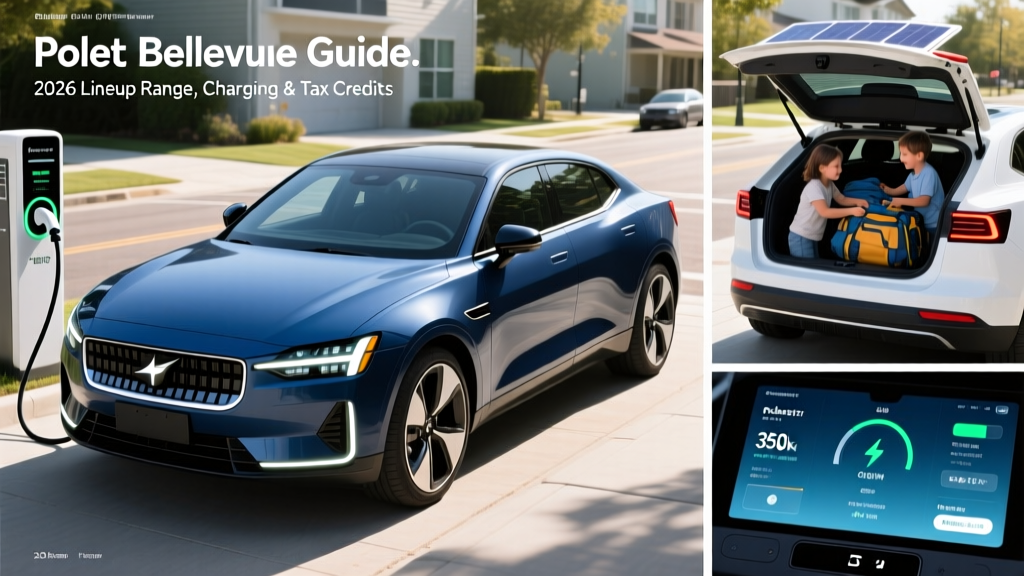
Walking into Polestar Bellevue on 116th Ave NE, you are stepping into one of the most focused EV showrooms in the Pacific Northwest. Unlike multi-brand dealers that split attention across gas, hybrid, and electric models, this Bellevue, WA Space is dedicated entirely to Polestar's growing battery-electric lineup. For 2026, that means evaluating three very different vehicles: the refreshed Polestar 2 sedan/fastback, the flagship Polestar 3 luxury SUV, and the coupe-SUV Polestar 4.
This guide gives you the exact numbers — EPA range, battery kWh, peak DC charge rates, 10-80% charging minutes, and post-credit pricing — that matter when you are comparing trims on the Bellevue showroom floor or configuring online for Washington State delivery.
2026 Polestar Lineup at a Glance
| Spec | Polestar 2 (LRDM) | Polestar 3 (LRDM) | Polestar 4 (LRDM) |
|---|---|---|---|
| EPA Range | 320 mi | 315 mi (est.) | 300 mi (est.) |
| Battery (usable) | 79 kWh, NMC | 107 kWh, NMC | 100 kWh, NMC |
| Drivetrain | Dual-Motor AWD | Dual-Motor AWD | Dual-Motor AWD |
| Horsepower | 421 hp | 489 hp | 544 hp |
| 0-60 mph | 4.3 sec | 4.7 sec | 3.7 sec |
| Peak DC Charge | 200 kW | 250 kW | 200 kW |
| 10-80% DC Time | ~27 min | ~30 min | ~28 min |
| Level 2 Rate | 11 kW (~37 mi/hr) | 11 kW (~33 mi/hr) | 11 kW (~34 mi/hr) |
| MPGe (combined) | 107 MPGe | 89 MPGe (est.) | 95 MPGe (est.) |
| Cargo Volume | 14.4 cu ft + frunk 1.4 | 26.7 cu ft + frunk 2.1 | 19.1 cu ft (no frunk) |
| Base MSRP | $51,300 | $79,900 | $62,900 |
Sources: EPA / fueleconomy.gov, Polestar US Specifications. Polestar 3 and 4 figures reflect 2026 model-year estimates and may shift with final EPA certification.
Real-World Range: What the EPA Sticker Doesn't Tell You
The Polestar 2 Long Range Dual Motor carries an EPA estimate of 320 miles. In real-world Pacific Northwest driving — think I-90 at 70 mph with rain, 45°F ambient, and heat pump running — expect 265-285 miles before you are hunting for a charger. Summer city driving with regen-heavy stop-and-go can push closer to 310. Highway efficiency is the limiting factor for all three models, and the heavier Polestar 3 will lose proportionally more range in cold, wet conditions. If your Bellevue-to-Spokane road trip is 280 miles each way, plan one DC stop either way.
Cold-weather range loss is a physics reality, not a marketing footnote. NMC lithium-ion cells experience higher internal resistance below 40°F, and cabin heating draws heavily even with a heat pump. Polestar's battery preconditioning — activated when you navigate to a DC fast charger — partially mitigates this by warming the pack before you plug in. Use it every time; skipping preconditioning can shave 15-20% off your peak charge rate in winter.
Charging Speed and Infrastructure in Bellevue
| Charging Level | Power (kW) | Miles Added per Hour | Best For |
|---|---|---|---|
| Level 1 (120V household) | ~1.4 kW | ~4-5 mi/hr | Overnight trickle, PHEV topping |
| Level 2 (240V home, 48A) | 11 kW | ~33-37 mi/hr | Daily home charging, full overnight |
| DC Fast Charge | 200-250 kW peak | ~600-800 mi/hr (peak) | Road trips, rapid top-ups |
All three 2026 Polestars use the NACS (Tesla-style) charge port natively, a shift Polestar adopted for the North American market beginning with 2025 model-year production. This means direct access to Tesla Supercharger V3 and V4 stalls across Bellevue, Redmond, and the broader I-5 corridor without an adapter — a significant practical advantage over older CCS-equipped EVs.
The charging curve matters more than peak kW. The Polestar 2's 200 kW peak is only sustained between roughly 10-40% State of Charge (SoC). Above 60%, the rate tapers progressively, dropping to ~50 kW near 80%. That is why the 10-80% time of ~27 minutes is the honest metric to compare, not the headline peak number. The Polestar 3's larger 107 kWh battery can absorb more energy at peak rate, but its bigger pack also means more total minutes to reach 80%.
Bellevue-area public charging is strong: Tesla Superchargers at Bellevue Square and Factoria, plus Electrify America and ChargePoint DC stations along I-90 and SR-520. For home Level 2 charging, a NEMA 14-50 outlet on a 50A circuit delivers ~9.6 kW (32 mi/hr for the Polestar 2), while a hardwired 60A circuit unlocks the full 11 kW onboard charger. Expect $800-$2,500 for a licensed electrician to install a Level 2 circuit in a Bellevue home, depending on panel capacity and conduit run length.
Performance and Driving Impressions
The Polestar 2 Long Range Dual Motor delivers 421 hp and 443 lb-ft of torque through its AWD system, reaching 60 mph in 4.3 seconds. With the optional Performance Pack ($5,500), Öhlins dampers and Brembo brakes sharpen the chassis further — a meaningful upgrade for Cascade foothill roads but overkill for Bellevue school runs. The steering is precise and weighted, and the one-pedal driving mode offers strong regen that can bring the car to a full stop without touching the brake.
The Polestar 4 is the performance outlier: 544 hp and a 3.7-second 0-60 time make it the quickest vehicle in the showroom. Its coupe-SUV profile sacrifices rear headroom and eliminates the rear window entirely (a camera-based digital rearview mirror replaces it). The Polestar 3 sits between them — a genuine luxury cruiser with adaptive air suspension, but its 5,000+ lb curb weight shows in cornering dynamics compared to the lighter Polestar 2.
Pricing, Trims, and Federal Tax Credit Eligibility
| Model / Trim | Base MSRP | As-Tested (Typical) | §30D Credit Eligible? | Effective Price (if eligible) |
|---|---|---|---|---|
| Polestar 2 LRSM (Single Motor) | $48,100 | $52,000 | Yes (if sourcing rules met) | ~$40,600 |
| Polestar 2 LRDM (Dual Motor) | $51,300 | $58,500 | Yes (if sourcing rules met) | ~$43,800 |
| Polestar 4 LRDM | $62,900 | $71,000 | Likely (under $80K SUV cap) | ~$55,400 |
| Polestar 3 LRDM | $79,900 | $89,500 | Unlikely (exceeds $80K SUV cap) | $79,900+ |
The IRS §30D Clean Vehicle Credit offers up to $7,500, but eligibility for 2026 depends on three moving targets:
- MSRP caps: Vans, SUVs, and pickups must be under $80,000; sedans and other body styles under $55,000. The Polestar 2 (classified as a sedan) clears the $55K cap at base, but adding options can push it over — configure carefully.
- Buyer income limits: Modified AGI must not exceed $150,000 (single), $225,000 (head of household), or $300,000 (joint filing).
- Battery sourcing requirements: The critical minerals and battery component percentages must meet escalating annual thresholds set by the Inflation Reduction Act. Polestar's supply chain has been evolving; confirm with your Bellevue sales advisor which VINs qualify at point of sale.
The point-of-sale transfer option lets you apply the credit directly to your down payment at Polestar Bellevue rather than waiting for a tax refund. Always verify your specific VIN on the IRS portal before signing.
Interior, Tech, and Driver Assistance
Polestar's Google-built infotainment system (Android Automotive OS) is the strongest in the segment for native Google Maps navigation, Google Assistant voice control, and over-the-air updates. The 11.2-inch portrait touchscreen in the Polestar 2 is responsive, though the Polestar 3 and 4 upgrade to a larger 14.5-inch landscape display with a separate 9-inch lower screen for climate controls.
Driver assistance is branded Pilot Assist and operates at SAE Level 2 — meaning you must keep hands on the wheel and eyes on the road at all times. It handles lane centering, adaptive cruise, and stop-and-go traffic competently on I-405, but it does not automate lane changes or navigate interchanges autonomously. The Polestar 3 and 4 offer an available LiDAR-equipped Pilot Pack (from Luminar) that enables enhanced highway assist features, but these remain Level 2 supervised systems, not Level 4 driverless capability.
Notable drawbacks across the lineup: the Polestar 2's rear seat is tight for adults over 6 feet (35.7 inches of legroom vs. 42.3 in the Model Y), and its 14.4 cu-ft trunk trails most compact SUVs. The Polestar 4's camera-based rearview mirror takes adjustment — some drivers find the digital feed disorienting in heavy rain or direct sun glare.
- Native NACS charge port — no adapter needed at Superchargers
- Google Automotive infotainment is best-in-class for navigation
- Minimalist Scandinavian design with premium materials
- Strong 8-year/100,000-mile battery and powertrain warranty
- Competitive DC charging speeds for road-trip practicality
- Polestar 2 cargo and rear-seat space trails key rivals
- Polestar 3 pricing exceeds §30D MSRP cap for most buyers
- Polestar 4's missing rear window takes getting used to
- Service network thinner than Tesla or legacy brands in WA
- Pilot Assist is capable but unremarkable vs. BlueCruise or Super Cruise
Warranty and Ownership Costs
Polestar covers all three models with a 4-year/50,000-mile limited warranty and an 8-year/100,000-mile battery and drive unit warranty that guarantees at least 70% capacity retention. This is competitive with Volvo (Polestar's parent company) and matches Tesla's battery coverage, though Tesla's 8-year/120,000-mile powertrain warranty extends further on miles.
Insurance costs in the Bellevue/King County area tend to run 15-25% higher for Polestar models compared to equivalent Tesla or Hyundai EVs, driven by lower parts availability and specialized repair requirements. Get a quote before committing — it can shift your 5-year total cost of ownership by $2,000-$4,000.
Maintenance is minimal: cabin air filter, brake fluid check, wiper fluid, and tire rotation. Regenerative braking significantly extends brake pad life. Polestar offers a service plan that can be bundled at purchase, but third-party EV-aware shops in the Seattle metro area are increasingly capable for out-of-warranty work.
Who Should Buy from Polestar Bellevue?
Choose the Polestar 4 if: You need SUV practicality with sports-sedan acceleration, can accept the digital rearview mirror trade-off, and want a vehicle that stands apart from the sea of Model Ys in Bellevue parking lots.
Choose the Polestar 3 if: Budget is flexible, you want a true luxury electric SUV with air suspension and available LiDAR, and you are less dependent on the federal tax credit. Cross-shop with the BMW iX and Audi Q8 e-tron.
Look elsewhere if: You need three-row seating (consider the Kia EV9), maximum cargo volume (Tesla Model Y or Rivian R1S), or the lowest possible cost-per-mile (Chevrolet Equinox EV or Hyundai Ioniq 5).
Frequently Asked Questions
What is the real-world range of Polestar models sold in Bellevue?
The Polestar 2 LRDM achieves an EPA-estimated 320 miles, but expect 265-285 miles in mixed highway and cold-weather driving common to the Pacific Northwest. The Polestar 3 and 4 are rated lower (300-315 mi EPA) due to greater weight and less aerodynamic profiles, with real-world results of 250-280 miles depending on conditions.
How fast do Polestars charge at home and on the road?
At home on a 240V Level 2 circuit, all three models charge at up to 11 kW, adding roughly 33-37 miles of range per hour — enough for a full overnight charge. On DC fast chargers, the Polestar 2 peaks at 200 kW (10-80% in ~27 min), the Polestar 3 at 250 kW (~30 min), and the Polestar 4 at 200 kW (~28 min). All use the NACS connector natively.
Does Polestar qualify for the $7,500 federal EV tax credit?
Eligibility varies by model, trim, and buyer income. The Polestar 2 base trims fall under the $55,000 sedan MSRP cap and may qualify if battery sourcing rules are met. The Polestar 4 (under $80K as an SUV) is likely eligible. The Polestar 3's $79,900 base MSRP sits right at the SUV cap — adding options pushes it over, disqualifying it. Always check the IRS portal and confirm with your Bellevue advisor.
Is Polestar worth buying over Tesla or Hyundai?
Polestar wins on build quality, interior materials, and design differentiation. Tesla wins on charging network breadth (though the gap is narrowing with NACS adoption), software ecosystem, and rear-seat/cargo space in the Model Y. Hyundai/Kia win on value and warranty. Your priorities determine the winner — test-drive all three at Bellevue-area dealers before deciding.
Where do I service a Polestar in the Bellevue area?
Polestar operates a service hub in the Seattle metro area, and select Volvo dealers (which share platform components) can handle warranty and routine work. Mobile service for minor issues is available in some zip codes. The service network is growing but remains thinner than Tesla's or legacy brands — factor this into your ownership decision if you live outside the I-405 corridor.
Do Polestars come with NACS or CCS charging ports?
2026 model-year Polestars sold in North America come with the NACS (Tesla-style) charge port as standard, giving direct access to Tesla Supercharger V3/V4 stalls and other NACS-equipped networks. If you encounter a used 2024 or earlier Polestar 2, it will have CCS1 and require an adapter for Supercharger access.