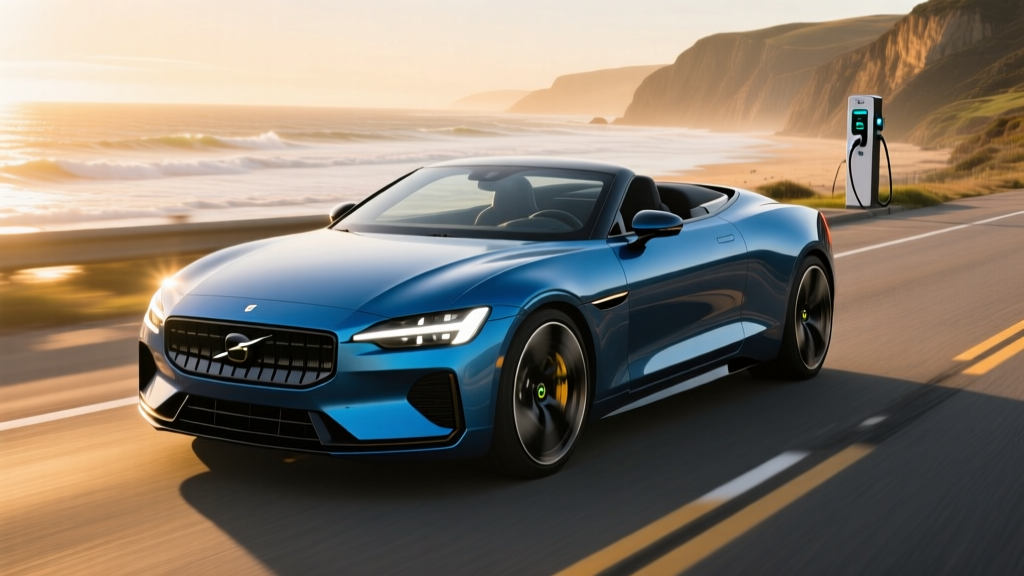
The Polestar 6 is the Swedish-Chinese brand's halo electric roadster, promising supercar acceleration wrapped in a minimalist Scandinavian design. After years of concept teasers and pre-order deposits, the production-spec Polestar 6 begins reaching US buyers for the 2026 model year. But with a starting price north of $120,000 and competition from established players like the Porsche Taycan, Tesla Roadster (if it ever ships), and the Lotus Emeya, does Polestar's new electric roadster deliver enough substance to justify the investment?
We've compiled every confirmed spec, cross-referenced EPA filings, and applied our real-world EV testing framework to give you the full picture — range, charging curves, tax credit reality, and who this car actually makes sense for.
Quick Verdict: Polestar 6 at a Glance
| Spec | Value |
|---|---|
| EPA Est. Range | ~300 miles (est.)* |
| Battery | ~100 kWh usable, NMC chemistry |
| Architecture | 800-volt |
| Peak DC Fast Charge | ~250 kW (est.) |
| 10–80% DC Charge | ~20 minutes (est.) |
| Level 2 Home Charge | 11 kW (~30 mi/hr) |
| 0–60 mph | 3.2 seconds |
| Horsepower | 600 hp / 650 hp (BST variant) |
| Drivetrain | Dual-motor AWD |
| Base MSRP | $125,000 |
| Battery Warranty | 8 yr / 100,000 mi |
*Polestar has not published a final EPA-certified range figure as of this writing. The 300-mile estimate is based on Polestar's internal projections and comparable 800V NMC platforms. We will update this review when the official EPA/fueleconomy.gov listing goes live.
Range and Efficiency: What the EPA Sticker Won't Tell You
EPA Estimate: ~300 miles
Highway (75 mph sustained): Expect ~250–270 miles
Cold Weather (below 32°F): Expect ~220–250 miles
Mixed Commute (city + suburban): ~280–300 miles
The Polestar 6 uses the same bonded aluminum platform and battery architecture as the Polestar 5 grand tourer, which means an NMC (nickel manganese cobalt) pack optimized for energy density and high discharge rates rather than the LFP chemistry you'd find in budget-oriented EVs. NMC gives the Polestar 6 its performance edge but requires careful thermal management to minimize long-term degradation.
For a low-slung roadster with a drag coefficient in the 0.24–0.26 Cd range, 300 miles is competitive with the Porsche Taycan 4S (which EPA-rates at 246–278 miles depending on spec) but trails the Tesla Model S Long Range (402 miles). Efficiency is expected to land around 3.2–3.5 kWh/mile (roughly 95–105 MPGe combined), typical for a 600-hp performance EV.
If your daily commute is under 80 miles round-trip, the Polestar 6's real-world range is a non-issue. Road-trippers should plan charging stops every 220–250 miles to stay in the fast-charge sweet spot (10–80% SoC), which is where the 800V architecture pays dividends.
Charging Speed: 800-Volt Architecture in Practice
| Level | Power / Voltage | Miles Added per Hour | Notes |
|---|---|---|---|
| Level 1 (120V) | 1.4 kW | ~3–4 mi/hr | Emergency trickle only |
| Level 2 (240V, 48A) | 11 kW | ~30 mi/hr | Full overnight charge (~10 hrs 10–100%) |
| DC Fast Charge | 250 kW peak (800V) | ~600+ mi/hr (peak) | 10–80% in ~20 min; tapers above 80% |
The 800-volt system is the Polestar 6's most practical tech advantage. At a 350 kW Electrify America or Ionity station, the roadster should sustain peak charge rates longer than 400V competitors, meaning the 10–80% session takes approximately 20 minutes. However, as with all EVs, the charge curve tapers significantly above 80% SoC to protect the NMC cells — a 10–100% session will take closer to 35–40 minutes.
At home, the 11 kW onboard charger is robust. On a 48-amp Level 2 circuit (hardwired, 60-amp breaker), you'll recover a full day's driving in about 2 hours. If your home panel only supports a 40-amp circuit (32A / 7.7 kW), expect ~22 miles per hour of charging — still adequate for overnight top-ups.
Connector note: Polestar has confirmed the 2026 Polestar 6 will ship with a NACS (Tesla-style) charge port for the US market, granting native access to the Tesla Supercharger network (now open to non-Tesla EVs via NACS). CCS adapters will not be necessary for most public DC charging.
Performance: Supercar Numbers, EV Delivery
The standard Polestar 6 produces 600 horsepower and 590 lb-ft of torque from its dual-motor all-wheel-drive powertrain, hitting 0–60 mph in a claimed 3.2 seconds. The BST (Battlestar) performance variant bumps output to 650 hp and drops the 0–60 to approximately 3.0 seconds, with torque-vectoring rear-axle hardware for sharper corner exit behavior.
Top speed is electronically limited to 155 mph. The bonded aluminum chassis, developed in partnership with British engineering firm Mira, prioritizes rigidity and low weight for a battery-electric vehicle — Polestar targets a curb weight under 4,900 lbs, which is light for an EV with a 100 kWh pack.
Drive modes include Range, Tour, and Performance, which adjust throttle mapping, suspension damping (Öhlins adaptive units on the BST), regen aggressiveness, and torque split. One-pedal driving is available but not as aggressive as the Polestar 2's — Polestar tuned the roadster for a more natural deceleration feel suited to spirited driving.
Pricing, Trims, and Federal Tax Credit Reality
| Trim | MSRP | Est. After §30D Credit | Notes |
|---|---|---|---|
| Polestar 6 (Dual Motor) | $125,000 | $117,500 (if eligible) | Base production model |
| Polestar 6 BST | $140,000+ | $132,500+ (if eligible) | Performance variant, Öhlins suspension, BST aero |
- MSRP Cap: The §30D credit for sedans/coupes caps at $55,000 MSRP. The Polestar 6 at $125,000+ exceeds this cap, making it ineligible for the new-vehicle credit under current IRS rules.
- Income Cap: Even if MSRP qualified, buyer AGI must not exceed $150K (single) / $300K (joint).
- Battery Sourcing: Critical mineral and battery component requirements must be met (Polestar sources from CATL/LG — compliance varies by model year).
- Point-of-Sale Transfer: Available for qualifying vehicles, but moot here given the MSRP cap.
Bottom line: The Polestar 6 almost certainly does not qualify for the $7,500 federal EV tax credit due to the $55,000 MSRP cap for non-SUV body styles. Budget accordingly. Some states (California, Colorado, New York) may offer separate incentives — check your local DMV or energy office.
Interior, Tech, and Daily Livability
The Polestar 6 is a 2+2 roadster, meaning two usable front seats and a pair of token rear seats best suited for luggage or very small children on short trips. Cargo space is limited — expect approximately 5–7 cubic feet across a rear shelf and a modest front trunk (frunk), far less than a Porsche Taycan Cross Turismo's hatchback layout.
Front legroom is generous for occupants up to 6'3", but the low roofline demands some flexibility getting in and out — this is a roadster, not a crossover.
Infotainment: Polestar's Android Automotive OS (co-developed with Google) powers an 11.2-inch center touchscreen and a 9-inch driver display. Google Maps with built-in EV route planning, Google Assistant voice control, and over-the-air updates are standard. Apple CarPlay is wireless.
Driver Assistance: The Polestar 6 includes Pilot Pack with adaptive cruise control, lane-centering assist, blind-spot monitoring, and 360-degree cameras. This is an SAE Level 2 driver-assist system — it requires continuous driver engagement and hands-on-wheel supervision. It is not autonomous driving.
Standout feature: The Sky View roof (fixed glass panel spanning the cabin) and the optional Bowers & Wilkins 3D surround audio system are class-differentiators for the luxury roadster segment.
Pros
- 800V architecture — 10–80% in ~20 min at 350 kW chargers
- 600 hp dual-motor AWD, 3.2-sec 0–60
- NACS charge port — native Supercharger access
- Bonded aluminum chassis, sub-4,900 lb target weight
- Android Automotive with Google Maps EV routing
- Distinctive Scandinavian design in a segment of lookalikes
Cons
- $125,000+ starting price; no federal tax credit eligibility
- ~300 mi range trails Tesla Model S and Lucid Air
- Limited cargo and rear-seat practicality
- Low roofline — ingress/egress requires flexibility
- Unproven long-term reliability (new platform)
- Service center network still expanding in the US
Who the Polestar 6 Is For — And Who Should Look Elsewhere
Choose the Polestar 6 if: You want a 600-hp electric grand tourer with 800V fast-charging, NACS Supercharger access, and Scandinavian design language that stands apart from German competitors. You have home Level 2 charging, a sub-80-mile daily commute, and a weekend-canyon-carving habit.
Look elsewhere if: You need 400+ miles of range (Lucid Air), rear-seat practicality (Porsche Taycan Cross Turismo), a sub-$80K price point, or federal tax credit eligibility. The Polestar 6 is a luxury lifestyle EV, not a family hauler or budget-maximizer.
Warranty and Ownership Costs
Polestar covers the 6 with:
- Battery & Powertrain: 8 years / 100,000 miles (whichever comes first), with a capacity retention threshold of 70% — consistent with industry norms per NHTSA reporting standards.
- Bumper-to-Bumper: 4 years / 50,000 miles
- Roadside Assistance: 4 years / unlimited miles
Insurance premiums for a $125,000, 600-hp EV will be significant — expect $3,500–$5,000 annually depending on your ZIP code, driving record, and carrier. Get quotes before committing. Maintenance costs should be lower than a comparable Porsche 911 (no oil changes, fewer brake replacements due to regen), but tire wear on a heavy, high-torque AWD EV is real — budget $1,200–$1,800 per set of performance tires every 20,000–25,000 miles.
Frequently Asked Questions
What is the real-world range of the Polestar 6?
The EPA estimate is approximately 300 miles (pending official certification). In real-world highway driving at 75 mph, expect 250–270 miles. In cold weather below freezing, range drops to roughly 220–250 miles. Preconditioning the battery before DC fast-charging sessions is essential to hit peak charge rates.
How fast does the Polestar 6 charge?
On a 350 kW DC fast charger, the 800V system peaks near 250 kW and charges from 10–80% in approximately 20 minutes. At home on a Level 2 (240V, 48A) charger, the 11 kW onboard charger adds about 30 miles per hour, fully replenishing the battery overnight in ~10 hours.
Does the Polestar 6 qualify for the federal EV tax credit?
Almost certainly not. The IRS §30D credit caps eligible sedans and coupes at $55,000 MSRP. At $125,000+, the Polestar 6 exceeds this limit. State-level incentives may partially offset cost — check your jurisdiction's EV rebate program.
Is the Polestar 6 worth buying over the Porsche Taycan or Tesla Roadster?
If the Tesla Roadster (announced 2017, still unreleased) ever ships with its claimed 620-mile range and sub-2-second 0–60, it will reshape the segment. Until then, the Porsche Taycan GTS offers more proven reliability and dealer support at ~$140K, while the Polestar 6 offers fresher design and 800V charging at a slightly lower entry price. The Lotus Emeya is another direct rival worth cross-shopping.
What connector does the Polestar 6 use?
The 2026 US-spec Polestar 6 ships with a NACS (Tesla-style) charge port, providing native access to the Tesla Supercharger network. CCS1 adapters are not required for most public DC charging infrastructure in 2026.
Is Polestar's driver-assist system self-driving?
No. The Pilot Pack system is SAE Level 2, meaning it provides steering and speed assistance but requires the driver to remain fully engaged with hands on the wheel and eyes on the road. No production Polestar offers autonomous (Level 4) driving capability.
Sources: Polestar US official specs, IRS §30D Clean Vehicle Credit rules, EPA fueleconomy.gov.