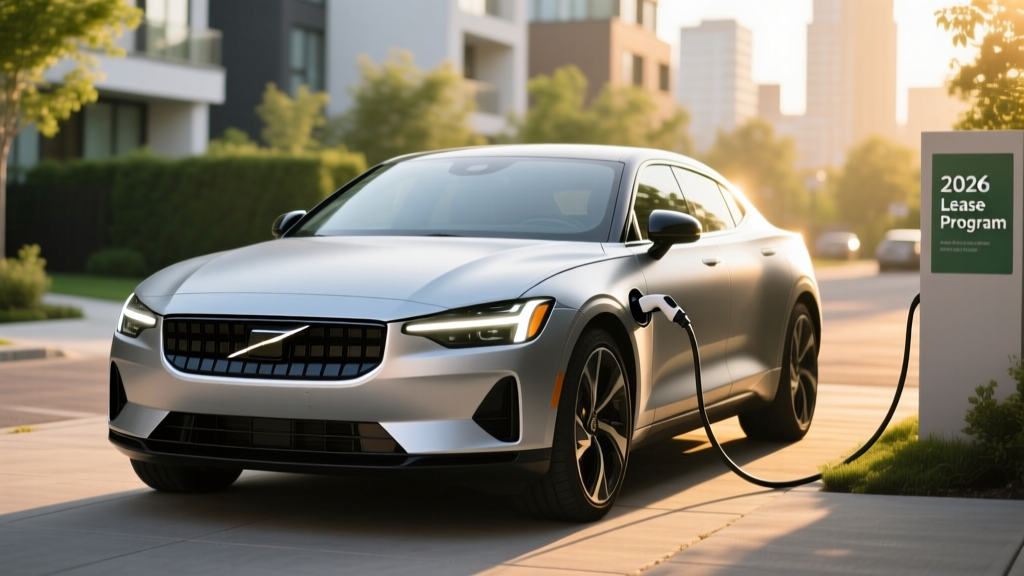
If you have been searching for polestar privatleasing information, you are likely weighing whether a Polestar 2 lease makes financial sense compared to buying outright or choosing a rival electric sedan. The Polestar 2 occupies a compelling middle ground: a premium, design-forward EV with legitimate fast-charging capability, a usable 320-mile EPA range, and a price structure that can drop significantly once federal incentives are applied. This guide breaks down every number that matters — from battery chemistry to charging-curve taper — so you can decide if a Polestar 2 lease is the right move in 2026.
Quick Verdict: Who Should Consider a Polestar 2 Lease?
The Polestar 2 is best suited for design-conscious commuters and small households who want a premium EV without the Tesla ubiquity. Its 320-mile EPA range (Long Range Dual Motor) covers most daily and weekend needs, and its 205 kW DC fast-charging peak makes road trips practical. Where a privatleasing (personal lease) arrangement shines is in shielding you from EV depreciation uncertainty while letting you capture the $7,500 federal tax credit through the lease-pass-through structure many lessors offer.
Choose a Polestar 2 lease if: You drive 10,000–15,000 miles per year, have Level 2 home charging access, and want a Scandinavian-designed EV with strong build quality. Look elsewhere if: You need maximum rear-seat space, regularly tow, or prioritize the lowest possible cost-per-mile over premium materials.
2026 Polestar 2 Specifications at a Glance
| Specification | Standard Range | Long Range Single Motor | Long Range Dual Motor |
|---|---|---|---|
| EPA Range | 276 mi | 320 mi | 320 mi |
| Battery (usable) | 69 kWh (LFP) | 82 kWh (NMC) | 82 kWh (NMC) |
| Horsepower | 299 hp | 299 hp | 421 hp |
| 0–60 mph | 5.9 sec | 5.9 sec | 4.3 sec |
| Drivetrain | RWD | RWD | AWD (Dual Motor) |
| Max DC Fast Charge | 135 kW | 205 kW | 205 kW |
| 10–80% DC Time | ~30 min | ~25 min | ~25 min |
| Level 2 Home Rate | 11 kW | 11 kW | 11 kW |
| MPGe (combined) | 114 MPGe | 119 MPGe | 109 MPGe |
| Efficiency | 29 kWh/100mi | 28 kWh/100mi | 31 kWh/100mi |
| Base MSRP (2026) | $49,900 | $53,400 | $56,900 |
Source: fueleconomy.gov and Polestar USA specifications.
Real-World Range: What the EPA Sticker Does Not Tell You
EPA Combined Range: 320 miles (Long Range variants)
Real-World Highway (70–75 mph, mild weather): ~260–280 miles
Real-World Cold Weather (below 32°F, mixed driving): ~210–240 miles
Worst-Case (highway, 20°F, cabin heat): ~190–210 miles
The Polestar 2's 82 kWh NMC battery delivers its rated 320 miles under EPA's mixed-cycle test, but real-world conditions tell a more nuanced story. Highway driving at sustained 70+ mph increases aerodynamic drag significantly on the Polestar 2's fastback shape, which is less slippery than the Hyundai Ioniq 6's teardrop profile. Expect roughly 260–280 miles on a warm-weather highway run.
Cold weather is where the NMC chemistry faces its biggest challenge. Unlike some competitors, the Polestar 2 does not offer a standard heat pump on all trims (it is included in the Plus Pack or as standard on higher trims depending on model year). Without a heat pump, resistive cabin heating can consume 3–5 kW continuously, cutting range by 25–35% in sub-freezing conditions. If you live in a cold climate and plan to lease, verify that your chosen trim includes the heat pump — it is the single most impactful cold-weather option.
For context, the Tesla Model 3 Long Range AWD achieves 346 miles EPA on a similar battery size, partly due to its superior thermal management and standard heat pump. The Polestar 2 trades some efficiency for its distinctive design and build quality.
Charging Speed: DC Fast, Level 2, and the Curve Reality
Charging performance is where the Polestar 2's Long Range variants show real competence. The 205 kW peak DC fast-charging rate is among the best in its class, but as with all EVs, the peak number is not the sustained rate.
| Charging Level | Power / Rate | Speed | Typical Use Case |
|---|---|---|---|
| Level 1 (120V) | ~1.4 kW | ~4 mi/hr | Emergency / overnight trickle |
| Level 2 (240V home) | 11 kW (48A) | ~32 mi/hr | Daily home charging |
| DC Fast Charge | Peak 205 kW | 10–80% in ~25 min | Road trips |
| DC Sustained (20–60% SoC) | ~150–180 kW avg | ~180 mi in 20 min | Typical highway stop |
Charge curve reality: The Polestar 2 hits its 205 kW peak between roughly 15–30% state of charge (SoC), then tapers progressively. By 60% SoC, power drops to approximately 100 kW, and above 80% it falls below 50 kW. This is typical for NMC batteries with aggressive thermal management, but it means that charging from 80–100% at a DC fast charger is painfully slow and expensive. For road trips, plan 10–80% stops and move on.
At home, the 11 kW onboard charger is excellent. A full 0–100% charge on a Level 2 wallbox takes roughly 8.5 hours for the 82 kWh battery — meaning you can arrive home at 10% and wake up to a full battery. Most owners will need a 48-amp (60-amp circuit breaker) Level 2 charger installed. Budget $800–$1,500 for the charger unit and $500–$2,000 for professional installation depending on your electrical panel's proximity to the garage.
The Standard Range model with its LFP battery charges at a lower 135 kW peak, but LFP chemistry tolerates regular 100% charging without degradation concerns — a practical advantage for daily use.
Pricing, Trim Levels, and the Federal Tax Credit Factor
Understanding Polestar 2 privatleasing economics requires mapping out the full price stack: MSRP, incentives, and how leasing affects your ability to capture the federal credit.
| Trim | 2026 MSRP | Federal Credit (§30D) | Effective Price | Est. Monthly Lease* |
|---|---|---|---|---|
| Standard Range | $49,900 | Up to $7,500 | ~$42,400 | $450–$550/mo |
| Long Range Single Motor | $53,400 | Up to $7,500 | ~$45,900 | $500–$620/mo |
| Long Range Dual Motor | $56,900 | Up to $7,500 | ~$49,400 | $575–$700/mo |
*Lease estimates based on 36-month/30,000-mile terms with typical money factors and residual values. Actual offers vary by region, credit score, and lessor.
IRS §30D Federal EV Tax Credit Requirements (2026):
- MSRP cap: Vehicle must be under $55,000 (sedans) — all Polestar 2 trims qualify
- Buyer income cap: AGI ≤ $150,000 (single) / $225,000 (head of household) / $300,000 (joint)
- Battery sourcing: Critical minerals and battery components must meet phased-in domestic/free-trade-partner thresholds (increases annually through 2029)
- Point-of-sale transfer: You can transfer the credit to the dealer for an upfront price reduction rather than waiting for tax filing
- Lease pass-through: On a lease, the lessor technically receives the credit (§30D commercial clean vehicle rules may apply); many lessors pass the savings to the lessee as a capitalized-cost reduction, but this is NOT guaranteed — confirm with the dealer
Source: IRS.gov — Credits for New Clean Vehicles. Tax rules change; consult a tax professional.
The Polestar 2's positioning below the $55,000 sedan MSRP cap is a significant advantage. However, battery sourcing requirements tighten each year. As of 2026, the critical-minerals threshold requires 80% of critical minerals to be extracted or processed in the US or a free-trade-agreement country, and 100% of battery components must be manufactured or assembled in North America to qualify for the full $7,500. Polestar has worked to localize battery supply chains for the US market, but always verify current eligibility at the point of purchase — the DOE's qualifying vehicle list is updated regularly.
Interior, Cargo, and Daily Livability
The Polestar 2's cabin is one of its strongest selling points. The vegan WeaveTech upholstery, minimalist center stack with an 11.2-inch portrait touchscreen, and available Harman Kardon audio create an environment that feels more premium than its price suggests. The Google Automotive OS infotainment system includes built-in Google Maps, Google Assistant, and the Google Play Store for third-party apps — a genuinely useful setup that avoids the frustration of wireless CarPlay latency (though Apple CarPlay is also available).
Space and cargo dimensions:
- Front legroom: 42.2 inches
- Rear legroom: 33.4 inches (tight for tall passengers)
- Cargo (rear seats up): 14.4 cu ft (liftback)
- Cargo (rear seats folded): 37.6 cu ft
- Frunk: 1.4 cu ft (cable storage only)
The rear seat is the Polestar 2's most commonly cited drawback. The 33.4 inches of legroom is tight compared to the Tesla Model 3 (35.3 inches) or Hyundai Ioniq 6 (38.4 inches). The transmission-tunnel-like center hump (a legacy of the CMA platform shared with Volvo XC40) further limits the middle seat. For families with rear-facing child seats, front passengers will need to compromise on legroom.
The 14.4 cu ft liftback cargo area is practical for groceries and luggage, and the wide hatch opening makes loading easier than a traditional sedan trunk. However, it falls short of the Model 3's 23 cu ft and the Ioniq 6's 12.3 cu ft (though the Ioniq 6's trunk is a conventional sedan lid, not a liftback).
Driver Assistance and Technology
The Polestar 2 comes equipped with Polestar's Pilot Pack, which includes adaptive cruise control with stop-and-go, lane centering, and Pilot Assist — a SAE Level 2 driver-assistance system. This means the system can handle steering, acceleration, and braking on highways, but the driver must remain fully engaged with hands on the wheel and eyes on the road at all times.
Important: Polestar Pilot Assist is a Level 2 driver-assist system, not autonomous driving. It does not handle traffic lights, stop signs, construction zones, or complex urban intersections without driver input. You are the driver at all times. Do not confuse this with Level 4 robotaxi services like Waymo.
The available 360-degree camera, Park Assist Pilot (automatic parallel/perpendicular parking), and run-off-road protection are practical features. However, the Polestar 2 does not currently offer an advanced hands-free highway driving system comparable to GM's Super Cruise or Ford's BlueCruise. If hands-free highway driving is a priority, this is a meaningful gap.
How the Polestar 2 Compares to Key Competitors
| Spec | Polestar 2 LR Dual Motor | Tesla Model 3 LR AWD | Hyundai Ioniq 6 SEL AWD |
|---|---|---|---|
| EPA Range | 320 mi | 346 mi | 316 mi |
| Battery | 82 kWh NMC | 75 kWh (est.) NMC | 77.4 kWh NMC |
| Peak DC Charge | 205 kW | 250 kW | 240 kW |
| 10–80% DC Time | ~25 min | ~20 min | ~18 min |
| 0–60 mph | 4.3 sec | 4.2 sec | 5.1 sec |
| MPGe (combined) | 109 | 132 | 117 |
| Rear Legroom | 33.4 in | 35.3 in | 38.4 in |
| MSRP (AWD) | $56,900 | $47,740 | $48,650 |
| Federal Credit | Up to $7,500 | Up to $7,500 | Up to $7,500 |
Best Range & Efficiency: Tesla Model 3 Long Range — 346 mi EPA and 132 MPGe are class-leading.
Best Charging Speed: Hyundai Ioniq 6 — 800V architecture delivers 10–80% in ~18 minutes.
Best Interior Quality: Polestar 2 — materials, fit-and-finish, and design outclass both rivals at this price.
Best Rear Seat Space: Hyundai Ioniq 6 — 38.4 inches of legroom is genuinely comfortable.
Pros and Cons: The Honest Summary
Pros
- Premium Scandinavian design and interior quality
- 205 kW DC fast charging is competitive
- All trims under $55K MSRP cap — eligible for full §30D credit
- Google Automotive OS with native Google Maps
- Strong build quality; Volvo-derived CMA platform safety pedigree
- LFP option (Standard Range) for daily 100% charging without degradation worry
- Available Performance Pack with Öhlins dampers and Brembo brakes
Cons
- Rear seat is cramped (33.4 in legroom)
- Efficiency trails Tesla Model 3 and Ioniq 6
- No hands-free highway driving system available
- Heat pump not standard on all trims — cold-weather range suffers
- Charging curve tapers aggressively above 60% SoC
- Relatively small frunk (1.4 cu ft)
- Higher MSRP than equivalently equipped Model 3 or Ioniq 6
Warranty and Long-Term Battery Confidence
Polestar provides a competitive warranty package:
- Basic vehicle warranty: 4 years / 50,000 miles
- Battery & powertrain warranty: 8 years / 100,000 miles
- Battery capacity retention threshold: 70% of original capacity at 8 years/100,000 miles
- Corrosion warranty: 12 years (unlimited mileage)
The 70% capacity retention guarantee is industry-standard (Tesla, Hyundai, and most others use the same threshold). For a lease, this is largely academic — you will return the vehicle well within the warranty period. However, it signals Polestar's confidence in the NMC pack's longevity. Real-world data from European Polestar 2 fleets suggests degradation of approximately 5–8% over the first 100,000 miles, well within the warranty floor.
If you opt for the Standard Range LFP variant, you gain an additional practical advantage: LFP batteries tolerate regular 100% charging and generally exhibit slower long-term degradation, though their lower energy density means less range.
Frequently Asked Questions
What is the real-world range of the Polestar 2?
The Long Range variants are EPA-rated at 320 miles. In real-world highway driving at 70–75 mph in mild weather, expect 260–280 miles. In cold weather (below freezing), range drops to 210–240 miles, or as low as 190 miles on highway-only trips in deep cold without a heat pump.
How fast does the Polestar 2 charge at home and on the road?
On a Level 2 home charger (240V, 48A), the Polestar 2 charges at 11 kW, adding roughly 32 miles per hour — a full charge takes about 8.5 hours. On DC fast chargers, the Long Range models peak at 205 kW and reach 10–80% in approximately 25 minutes. The Standard Range model peaks at 135 kW with a 10–80% time of roughly 30 minutes.
Does the Polestar 2 qualify for the $7,500 federal EV tax credit?
All 2026 Polestar 2 trims are priced below the $55,000 sedan MSRP cap, making them potentially eligible for the full $7,500 under IRS §30D. However, eligibility depends on your income (≤$150K single / ≤$300K joint), and the vehicle must meet battery-sourcing requirements that tighten annually. When leasing, the credit technically goes to the lessor — confirm that your lessor passes the savings through as a capitalized-cost reduction. Always check the DOE qualifying vehicle list before committing.
Is it worth leasing a Polestar 2 vs buying?
Leasing (privatleasing) makes sense if you want to avoid EV depreciation risk — which remains harder to predict than gas cars — and if your lessor passes through the federal tax credit as a cap-cost reduction. A 36-month lease with credit pass-through can yield monthly payments in the $500–$620 range for the Long Range Single Motor. Buying makes more sense if you drive over 15,000 miles per year (lease penalties add up) or plan to keep the car 7+ years to amortize the higher purchase price.
Is the Polestar 2 worth buying over a Tesla Model 3 or Hyundai Ioniq 6?
If interior quality, distinctive design, and Volvo-derived safety engineering are your top priorities, the Polestar 2 is worth the premium. If maximum range and efficiency matter most, the Tesla Model 3 Long Range (346 mi EPA, 132 MPGe) is objectively superior. If rear-seat space and charging speed are critical, the Hyundai Ioniq 6 (38.4 in legroom, ~18 min 10–80%) is the stronger choice. The Polestar 2 wins on cabin ambiance and build quality but trails on paper specs.
What are the biggest drawbacks of the Polestar 2?
The cramped rear seat (33.4 inches of legroom) is the most common complaint, followed by lower efficiency than rivals (109 MPGe for the Dual Motor). The lack of a hands-free highway driving system, the optional heat pump (on some trims), and the aggressive charging-curve taper above 60% SoC are additional considerations. The frunk is tiny at 1.4 cu ft.