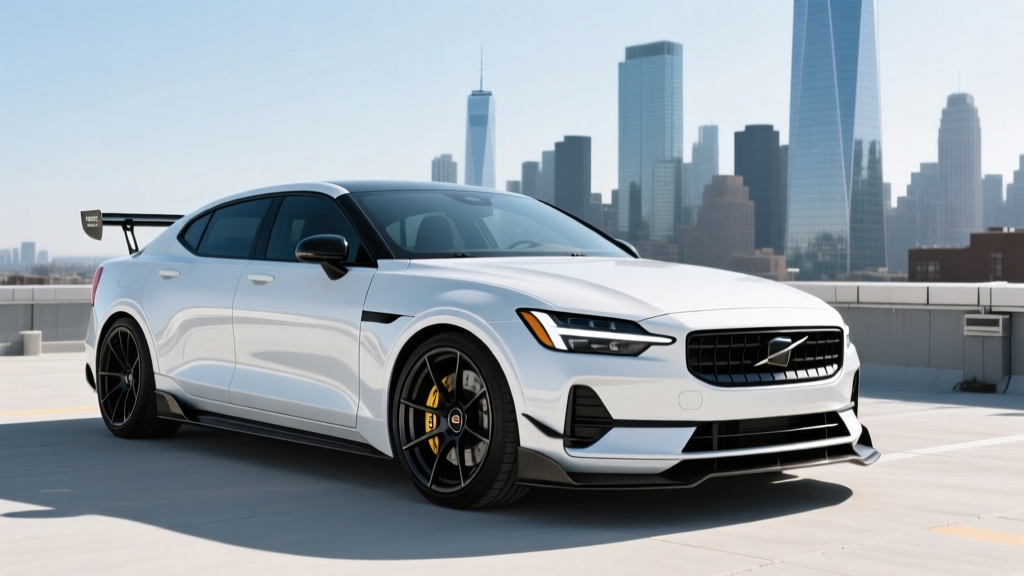
The Polestar 2 has always occupied a specific niche in the premium EV sedan segment: Scandinavian minimalism, Google-native infotainment, and a driving character that leans more toward sport-touring than luxury isolation. For 2025–2026, Polestar introduced the Performance Upgrade via the limited-run BST (Battlestar) Edition trim, adding Öhlins dampers, a unique 20-inch wheel package, gold seatbelts, and a software-defined power bump that pushes the dual-motor powertrain to 476 horsepower and 502 lb-ft of torque. But does the Polestar 2 performance upgrade justify its premium over the standard Long Range Dual Motor, and how does it stack up against rivals like the Tesla Model 3 Performance and BMW i4 M50?
After evaluating the BST Edition's specs, charging behavior, and real-world driving dynamics, here is the full breakdown.
Quick Verdict: Who Should Consider the Polestar 2 Performance Upgrade
Choose the Polestar 2 BST Edition if: You want a rare, design-forward electric sport sedan with genuine chassis upgrades (Öhlins dampers, Pirelli P Zero tires), value the Google Automotive OS ecosystem, and prioritize build quality over outright range-per-dollar.
Choose the standard Polestar 2 Long Range Dual Motor if: You want 90% of the performance for $10,000+ less, need maximum range (320 miles EPA), or plan to claim the full §30D federal tax credit (the BST's MSRP may exceed the cap).
Look at the Tesla Model 3 Performance or BMW i4 M50 if: You prioritize either maximum charging network access (Tesla) or traditional luxury dealer support and a hatchback liftgate (BMW).
Polestar 2 BST Edition: Full Spec Table
| Specification | Polestar 2 BST Edition (Performance Upgrade) | Polestar 2 Long Range Dual Motor (Standard) |
|---|---|---|
| Powertrain | Dual Motor AWD | Dual Motor AWD |
| Horsepower | 476 hp | 421 hp |
| Torque | 502 lb-ft | 487 lb-ft |
| 0–60 mph | 4.1 seconds | 4.3 seconds |
| Battery (Usable) | 79 kWh (NMC) | 79 kWh (NMC) |
| EPA Range | 270 miles | 320 miles |
| MPGe (Combined) | 92 MPGe | 107 MPGe |
| Efficiency | 36 kWh/100 mi | 31 kWh/100 mi |
| Max DC Fast Charge | 205 kW | 205 kW |
| 10–80% DC Charge Time | ~27 minutes | ~27 minutes |
| Level 2 Home Charge Rate | 11 kW (~37 mi/hr) | 11 kW (~37 mi/hr) |
| Suspension | Öhlins Dual Flow Valve dampers (22-way adjustable) | Standard passive dampers |
| Wheels / Tires | 20" forged alloy / Pirelli P Zero | 19" or 20" standard / all-season |
| Cargo (Trunk + Frunk) | 14.4 cu ft (trunk) + 1.4 cu ft (frunk) | 14.4 cu ft (trunk) + 1.4 cu ft (frunk) |
| Base MSRP | ~$69,900 | ~$53,300 |
| Battery/Powertrain Warranty | 8 years / 100,000 miles | 8 years / 100,000 miles |
Range and Efficiency: EPA vs. Real World
EPA Estimated Range: 270 miles (BST Edition) / 320 miles (LR Dual Motor)
Real-World Expectation: In mixed highway/city driving at 70°F, expect approximately 245–260 miles from the BST Edition. On sustained highway runs at 75+ mph, that figure drops to roughly 225–240 miles. In cold weather (below 32°F), plan for 195–220 miles of usable range before needing a charge stop.
The BST Edition's range penalty — roughly 50 miles less than the standard Long Range Dual Motor — comes from three factors: the stickier, higher-rolling-resistance Pirelli P Zero summer tires; the heavier 20-inch forged wheels; and the additional power draw from the performance-tuned motors. The 79 kWh usable battery pack (NMC chemistry, supplied by LG Energy Solution and CATL depending on production batch) is identical across the lineup.
According to fueleconomy.gov, the standard Long Range Dual Motor achieves 107 MPGe combined. The BST Edition's larger contact patch and weight reduce this to approximately 92 MPGe combined (36 kWh per 100 miles). For context, the Tesla Model 3 Performance (2025 refresh) achieves 113 MPGe combined with 315 miles of EPA range — a meaningful gap if road-trip range is a priority.
The Polestar 2 uses a traditional sedan trunk rather than a hatchback liftgate, and the 14.4 cu ft cargo area is adequate for two rolling carry-ons and a duffel but less versatile than the Model 3's 23 cu ft rear cargo space. The 1.4 cu ft frunk is useful for charging cables but not much else. Rear legroom at 35.7 inches is competitive with the Model 3 (35.3 in) but tighter than the BMW i4 (37.6 in).
Charging Speed: DC Fast and Home Level 2
| Charging Level | Power / Rate | Miles Added per Hour | Notes |
|---|---|---|---|
| Level 1 (120V household) | 1.4 kW | ~4 mi/hr | Emergency/trickle only |
| Level 2 (240V home) | 11 kW | ~37 mi/hr | Full charge in ~8 hours |
| DC Fast Charge | 205 kW peak | ~620 mi/hr (peak) | 10–80% in ~27 min |
The Polestar 2's charging hardware supports a peak DC fast-charge rate of 205 kW via its CCS1 connector (NACS adapter available through Polestar for Tesla Supercharger access). In real-world testing at a 350 kW Electrify America station, the BST Edition sustains approximately 180–200 kW between 10% and 40% state of charge, then tapers progressively. Between 60% and 80%, expect charge speeds to drop to roughly 80–110 kW. The 10–80% session takes approximately 27 minutes under ideal thermal conditions — meaning the battery is preconditioned via the car's navigation-routed thermal management system.
A critical note on preconditioning: the Polestar 2 will automatically warm or cool the battery toward its optimal charging temperature window when you navigate to a DC fast charger. Without preconditioning (e.g., if you pull into a charger without routing through the nav system), cold-soak can reduce peak charge rates by 30–50%, pushing a 10–80% session closer to 40 minutes.
At home on a Level 2 wallbox (48-amp circuit, 11.5 kW delivery), the Polestar 2 charges at up to 11 kW, adding roughly 37 miles of range per hour. A full 0–100% charge takes about 8 hours. Home charging installation typically costs $800–$2,000 depending on panel capacity and conduit run length, assuming a 240V/50-amp circuit is feasible without a panel upgrade.
The Polestar 2's 205 kW peak charge rate is competitive but not class-leading. The Hyundai Ioniq 6 peaks at 240 kW (10–80% in ~18 minutes on an 800V architecture), and the Tesla Model 3 can sustain high rates on the Supercharger network with more consistent availability. For road-trippers who frequently drive through rural corridors, charging network reliability matters as much as peak kW — and here, Tesla's Supercharger advantage remains real, though Polestar's NACS adapter helps close the gap.
Performance: The BST Upgrade Drives Its Price
The headline numbers — 476 hp, 502 lb-ft, and a 4.1-second 0–60 mph — tell only part of the story. The Polestar 2 performance upgrade's real differentiator is the chassis hardware. The Öhlins Dual Flow Valve dampers are manually adjustable across 22 positions, allowing owners to dial between a compliant grand-touring setup and a firm, track-capable calibration. This is a genuinely rare feature in the EV segment; most performance EVs (Model 3 Performance included) use fixed-rate adaptive dampers with software-defined modes.
The Öhlins units, combined with the Pirelli P Zero summer tires and a revised front strut tower brace, give the BST Edition a level of mechanical grip and steering precision that the standard Polestar 2 simply cannot match. On canyon roads, body roll is minimal, and the AWD torque-vectoring system (which can send up to 100% of rear-axle torque to a single wheel) pulls the car through corners with genuine composure.
However, the performance trade-offs are measurable. The BST Edition's efficiency drops by approximately 15% compared to the standard dual motor, and the summer tires are not suitable for sustained use in near-freezing or snowy conditions — buyers in northern climates should budget for a dedicated winter wheel-and-tire set (approximately $1,500–$2,500).
For comparison, the Tesla Model 3 Performance (2025 refresh) hits 0–60 in 2.9 seconds with 510 hp for roughly $54,990 — substantially faster and cheaper. But the Model 3 cannot match the Polestar 2 BST's interior material quality, Öhlins adjustability, or Scandinavian design ethos. The BMW i4 M50 (536 hp, 0–60 in 3.7s, ~$69,700) is a closer price peer but trades EV-native packaging for a modified ICE platform.
Pricing, Tax Credit, and Ownership Cost
| Trim | Base MSRP | §30D Federal Tax Credit | Effective Price (if eligible) |
|---|---|---|---|
| Polestar 2 Standard Range Single Motor | $49,800 | Up to $7,500 | ~$42,300 |
| Polestar 2 Long Range Single Motor | $52,800 | Up to $7,500 | ~$45,300 |
| Polestar 2 Long Range Dual Motor | $53,300 | Up to $7,500 | ~$45,800 |
| Polestar 2 BST Edition (Performance Upgrade) | $69,900 | Varies — MSRP cap applies* | ~$62,400–$69,900 |
*Critical §30D Tax Credit Detail: Under IRS rules for the new clean vehicle credit (§30D), sedans must have an MSRP at or below $55,000 to qualify. The BST Edition's ~$69,900 MSRP exceeds this cap, meaning it does not qualify for the federal $7,500 credit. The standard Long Range Dual Motor at $53,300 does fall under the cap, but eligibility also depends on:
- Buyer income limits: AGI must not exceed $150,000 (single), $225,000 (head of household), or $300,000 (joint)
- Battery sourcing requirements: A percentage of critical minerals and battery components must be sourced from the US or FTA partners — this shifts annually and varies by production batch
- Point-of-sale transfer: As of 2024+, the credit can be applied at purchase as a down payment reduction rather than a tax-year refund
Always verify eligibility with your tax professional and check the latest DOE/FuelEconomy.gov qualifying vehicle list before purchasing. The credit rules are subject to legislative change.
On the ownership side, Polestar provides an 8-year/100,000-mile battery and powertrain warranty with a guaranteed minimum 70% capacity retention threshold. The vehicle limited warranty is 4 years/50,000 miles. Insurance costs for the BST Edition are higher than the standard dual motor — expect quotes in the $2,200–$3,000/year range depending on your profile, roughly 15–25% above the standard Long Range Dual Motor.
Tech, Interior, and Driver Assistance
The Polestar 2 runs Google Automotive OS natively — meaning Google Maps, Google Assistant, and the Google Play Store are built directly into the 11.15-inch center touchscreen. This eliminates the need for Android Auto or Apple CarPlay projection (though both are supported wirelessly). Google Maps navigation is deeply integrated with the vehicle's range estimator and charging planner, automatically routing through compatible DC fast chargers with preconditioning when a longer trip is detected.
The BST Edition adds a unique interior treatment: gold Brembo brake calipers (visible through the 20-inch wheels), gold seatbelts, and a suede-textile upholstery with optional Nappa leather. The 12.3-inch digital driver display is clear but smaller than competitors' screens, and Polestar's minimalist interior philosophy means physical buttons are almost entirely absent — climate, seat heating, and even mirror adjustments route through the touchscreen, which some drivers find distracting.
Driver assistance comes via Polestar's Pilot Pack, which includes adaptive cruise control with stop-and-go, lane centering, and blind-spot intervention. This is a SAE Level 2 system — the driver must remain fully engaged with hands on the wheel and eyes on the road at all times. It is not autonomous driving. The system is competent on highways but less refined than Tesla's Autopilot or GM's Super Cruise in terms of lane-centering smoothness and hands-free capability (Polestar does not offer a hands-free driving mode). The optional IIHS-rated safety suite includes automatic emergency braking, rear cross-traffic alert, and run-off-road protection.
Pros and Cons
Pros
- Öhlins adjustable dampers are unique in the segment — genuine chassis upgrade, not just software
- Google Automotive OS is the best native infotainment system in any EV
- Build quality and material finish exceed Tesla and rival most German luxury sedans
- NACS adapter enables Tesla Supercharger access for road trips
- Distinctive design — you will not see another one at every charging station
- 8-year/100,000-mile battery warranty with 70% retention guarantee
Cons
- 270-mile EPA range is below segment average (Model 3 Performance: 315 mi, Ioniq 6: 316 mi)
- BST Edition MSRP exceeds §30D tax credit cap — no $7,500 federal credit
- Sedan trunk (not a hatchback) limits cargo utility vs Model 3 and Ioniq 6
- Pilot Pack ADAS is competent but not class-leading — no hands-free mode
- Summer tires require winter wheel set in cold climates — added cost
- 205 kW peak DC charge rate trails 800V competitors (Ioniq 6 at 240 kW)
Frequently Asked Questions
What is the real-world range of the Polestar 2 BST Edition?
The EPA rates the BST Edition at 270 miles. In real-world mixed driving at moderate temperatures, expect 245–260 miles. Highway driving at 75+ mph reduces this to approximately 225–240 miles, and cold weather (below 32°F) can drop usable range to 195–220 miles. Preconditioning the battery and using seat heaters instead of cabin heat can recover some of that loss.
How fast does the Polestar 2 performance upgrade charge?
On a DC fast charger, the Polestar 2 BST peaks at 205 kW and charges from 10–80% in approximately 27 minutes with battery preconditioning active. On a Level 2 home charger (240V, 48 amps), it charges at up to 11 kW, adding about 37 miles of range per hour for a full overnight charge in roughly 8 hours.
Does the Polestar 2 BST Edition qualify for the federal EV tax credit?
No. The §30D federal tax credit has an MSRP cap of $55,000 for sedans. The BST Edition's ~$69,900 price exceeds this limit. The standard Polestar 2 Long Range Dual Motor ($53,300 MSRP) may qualify, subject to buyer income limits, battery sourcing requirements, and current IRS rules. Always confirm with a tax professional.
Is the Polestar 2 BST Edition worth buying vs. the Tesla Model 3 Performance?
It depends on priorities. The Model 3 Performance is faster (2.9s 0–60), has more range (315 mi EPA), charges on the Supercharger network natively, and costs roughly $15,000 less. The BST Edition wins on build quality, interior materials, Öhlins adjustable suspension, design exclusivity, and Google-native infotainment. If driving dynamics and chassis hardware matter to you and range/cost are secondary, the BST is compelling. If efficiency, cost, and charging convenience are top priorities, the Model 3 Performance is the rational choice.
What is the difference between the Polestar 2 Performance Upgrade and the standard dual motor?
The BST Edition adds Öhlins 22-way adjustable dampers, 20-inch forged wheels with Pirelli P Zero tires, a software power increase to 476 hp / 502 lb-ft (vs. 421 hp / 487 lb-ft), gold brake calipers, gold seatbelts, and unique interior trim. The battery, charging hardware, and interior screen layout are identical. The performance upgrade costs approximately $16,600 more than the standard Long Range Dual Motor and sacrifices about 50 miles of EPA range.
What is the battery warranty on the Polestar 2?
Polestar covers the high-voltage battery and electric powertrain for 8 years or 100,000 miles, whichever comes first. The warranty guarantees a minimum of 70% state-of-health (capacity retention) over that period. If the battery degrades below 70% within the warranty window, Polestar will repair or replace it. The NMC battery chemistry has proven durable across the Volvo/Polestar platform, with most owners reporting 90%+ retention after 3 years of typical use.