If you own a Tesla — or any EV with a J1772/NACS adapter — the single most impactful upgrade to your daily routine is a home Level 2 charger. The Tesla Wall Connector is the most popular option in the U.S., but buyers consistently search for one thing: the true Tesla Wall Connector cost once you factor in the unit, electrician labor, permits, and potential panel upgrades. This guide gives you exact 2026 pricing, installation scenarios, and charging performance data so you can budget accurately before calling an electrician.
What the Tesla Wall Connector Costs in 2026: Hardware Pricing
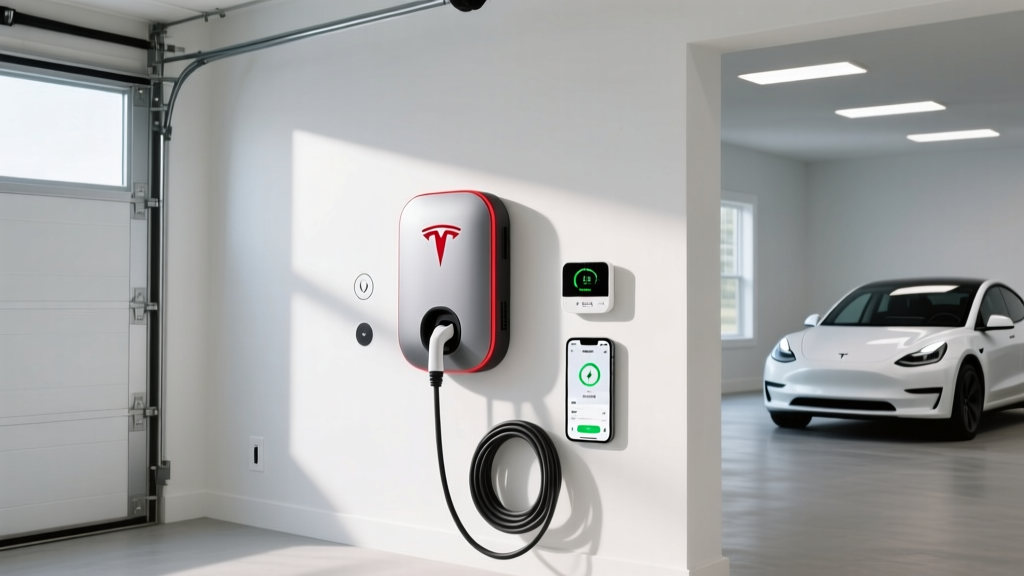
The Tesla Wall Connector (Gen 3, Wi-Fi-enabled) retails directly from Tesla at $475 for the standard 24-foot cable version. A 12-foot cable variant is sometimes available at the same price point depending on stock. Unlike the older Gen 2 units, the Gen 3 connects to Wi-Fi for over-the-air firmware updates and integrates with Tesla's app for energy monitoring and scheduled charging.
For non-Tesla EVs, Tesla also sells the J1772 Wall Connector at the same $475 price, which uses the universal J1772 plug and works with virtually every EV on the road (Chevy, Ford, Hyundai, BMW, Rivian, etc.). If you own a NACS-equipped vehicle (increasingly common as Ford, GM, Rivian, and others have adopted NACS for 2025-2026 models), the standard Tesla Wall Connector plugs in natively — no adapter needed.
Key hardware specs at a glance:
- Max output: 48 amps (11.5 kW) on a 60-amp circuit
- Voltage: 240V (hardwired, not plug-in)
- Cable length: 24 feet standard
- Connector: NACS (Tesla) or J1772 variant
- Wi-Fi: Yes (OTA updates, app integration)
- Load sharing: Yes — up to 6 Wall Connectors on one circuit
- Indoor/outdoor rated: Yes (NEMA 3R)
Installation Cost Breakdown: The Real Tesla Wall Connector Cost
The hardware is the easy part. Installation is where costs vary wildly based on your home's electrical panel, the distance from panel to garage or driveway, and local labor rates. Here's a realistic breakdown based on 2026 electrician quotes across U.S. metro areas:
| Cost Component | Simple Install | Moderate Install | Complex Install |
|---|---|---|---|
| Wall Connector (hardware) | $475 | $475 | $475 |
| Electrician labor (2-4 hrs @ $100-$175/hr) | $200-$400 | $400-$700 | $700-$1,400 |
| Materials (conduit, wire, mounting) | $50-$150 | $150-$400 | $400-$800 |
| Permit & inspection | $50-$150 | $100-$250 | $150-$400 |
| Electrical panel upgrade (200A service) | N/A | N/A | $1,500-$3,500 |
| Total estimated cost | $775-$1,175 | $1,125-$1,825 | $3,225-$6,575 |
What defines each scenario?
- Simple install: Your panel is 200A with spare capacity, located in the garage or on an exterior wall adjacent to where you park. Wire run is under 20 feet. No drywall repair needed.
- Moderate install: Panel is in the basement or on the opposite side of the house. Wire run is 30-60 feet through walls, attic, or conduit. Minor drywall patching required.
- Complex install: Your home has a 100A or 150A panel that needs upgrading to 200A, or the wire run exceeds 60 feet with trenching required (detached garage scenario).
Charging Speed: What You Actually Get at 11.5 kW
The Tesla Wall Connector delivers up to 48 amps / 11.5 kW on a 60-amp dedicated circuit. This is the fastest Level 2 charge rate available for residential installation without going to 80-amp circuits (which require 100-amp breakers and heavier gauge wire).
Here's what that translates to in real-world charging speed for popular EVs:
| Vehicle | Onboard Charger Limit | Actual Charge Rate | Miles Added per Hour | Overnight (10 hrs) |
|---|---|---|---|---|
| Tesla Model 3 Long Range | 11.5 kW | 11.5 kW | ~44 mi/hr | ~440 miles |
| Tesla Model Y Long Range | 11.5 kW | 11.5 kW | ~40 mi/hr | ~400 miles |
| Ford F-150 Lightning (extended) | 19.2 kW | 11.5 kW* | ~30 mi/hr | ~300 miles |
| Hyundai Ioniq 5 | 10.9 kW | 10.9 kW | ~37 mi/hr | ~370 miles |
| Chevy Equinox EV | 11.5 kW | 11.5 kW | ~36 mi/hr | ~360 miles |
*The F-150 Lightning with the 80A onboard charger option can accept up to 19.2 kW, but only if your Wall Connector is configured for 80A on a 100A circuit — a more expensive install. On a standard 48A circuit, it charges at 11.5 kW.
For most EV owners, overnight charging at 11.5 kW means you wake up with a full or near-full battery every morning. A Tesla Model 3 Long Range (EPA 363 miles, per fueleconomy.gov) needs roughly 8 hours from 10% to 100% on the Wall Connector — well within a typical overnight window.
Real-World Charging Costs: Wall Connector vs. Public Charging vs. Gas
One of the strongest arguments for investing in a Wall Connector is the cost-per-mile advantage. Here's how home Level 2 charging compares to alternatives based on 2026 average rates:
- Home electricity (U.S. average): $0.16/kWh → ~$0.043/mile in a Model 3 (28 kWh/100mi)
- Public DC fast charging (Electrify America, EVgo): $0.35-$0.55/kWh → ~$0.11-$0.15/mile
- Tesla Supercharger (average): $0.28-$0.40/kWh → ~$0.08-$0.11/mile
- Gasoline (30 MPG vehicle, $3.40/gal): ~$0.113/mile
At $0.043/mile on home power, a driver covering 12,000 miles per year spends roughly $516 annually on electricity. That same distance in a 30 MPG gas car costs about $1,360 — a savings of $844 per year. Even at a moderate install cost of $1,500, the Wall Connector pays for itself in under two years through fuel savings alone.
Tax Credits and Incentives That Reduce Your Wall Connector Cost
The federal Alternative Fuel Vehicle Refueling Property Credit (IRS Form 8911) can cover up to 30% of the cost of home EV charging equipment and installation, up to $1,000. This applies to the Wall Connector hardware AND the electrical work. However, there are important caveats for 2026:
- Eligibility is location-based: The credit is restricted to property placed in service in a census tract that is either a low-income community or a non-urban area, per the Inflation Reduction Act amendments. Check the IRS guidance on Form 8911 for qualifying tract maps.
- Income caps do not apply to this credit (unlike the §30D vehicle credit).
- The credit is non-refundable — it can reduce your tax liability to zero but won't generate a refund beyond that.
- Some states and utilities offer additional rebates (e.g., California's SGIP, utility companies offering $250-$500 rebates for smart charger installations). Check your local utility.
If you qualify, the $1,000 max credit on a $1,500 moderate install effectively brings your net cost to around $500 — a significant reduction.
Tesla Wall Connector vs. Competitors: ChargePoint, Emporia, and Grizzl-E
The Wall Connector isn't the only option. Here's how it stacks up against leading Level 2 home chargers in 2026:
| Feature | Tesla Wall Connector | ChargePoint Home Flex | Emporia Vue | Grizzl-E Smart |
|---|---|---|---|---|
| Hardware price | $475 | $599 | $399 | $449 |
| Max amps | 48A (11.5 kW) | 50A (12 kW) | 48A (11.5 kW) | 40A (9.6 kW) |
| Connector | NACS or J1772 | J1772 (NACS adapter avail.) | J1772 | J1772 |
| Wi-Fi/app | Yes | Yes | Yes | Yes |
| Load sharing (multi-unit) | Yes (up to 6) | No | No | No |
| Cable length | 24 ft | 23 ft | 24 ft | 24 ft |
| Hardwired required | Yes | No (NEMA 14-50 option) | Yes | Yes |
| Energy monitoring | Yes (via app) | Yes | Yes (panel-level) | Yes |
When the Tesla Wall Connector wins: If you drive a Tesla or any NACS-equipped vehicle, the native connector integration is seamless — no adapters, no dongles. The load-sharing feature (up to 6 units on one 60A circuit) is unique and valuable for multi-EV households. Build quality and cable management are excellent.
When a competitor may be better: The ChargePoint Home Flex offers a NEMA 14-50 plug option, meaning you can take it with you if you move — no hardwiring. The Emporia Vue bundles whole-home energy monitoring with EV charging, appealing to solar or energy-management enthusiasts. The Grizzl-E is built in Canada with extreme cold-weather durability and a simpler, lower-cost design.
Installation Tips: Avoiding Costly Mistakes
After reviewing hundreds of home charging installs, these are the most common errors that inflate costs or create safety issues:
- Skipping the load calculation. An electrician should perform a NEC Article 220 load calculation before recommending a circuit size. Installing a 60A breaker on an already-loaded 100A panel is a fire hazard and a code violation.
- Using undersized wire. A 48A continuous load on a 60A breaker requires 6 AWG copper (THHN) or 4 AWG aluminum. Some installers cut corners with thinner gauge wire on short runs — this causes voltage drop and heat buildup over long runs.
- Ignoring the NEMA 14-50 alternative. If you want portability or want to avoid hardwiring, a NEMA 14-50 outlet (50A circuit, 40A continuous) gives you 9.6 kW — about 83% of the Wall Connector's max output — and lets you use a Mobile Connector or take your charger when you move.
- Not planning for a second EV. If you think you'll add another EV within 3-5 years, running conduit with pull-string for a future second circuit during the initial install costs $100-$200 extra now but saves $1,000+ later.
- Overlooking utility time-of-use rates. Many utilities offer EV-specific TOU plans with rates as low as $0.05-$0.08/kWh during off-peak hours (10 PM - 6 AM). The Wall Connector's scheduled charging feature (via the Tesla app) automates this — set it once and save 40-60% on charging costs versus standard rates.
Frequently Asked Questions
Does the Tesla Wall Connector work with non-Tesla EVs?
Yes, in two ways. Tesla sells a J1772 variant of the Wall Connector that works with all EVs natively. Additionally, if you have the NACS version, any vehicle with a NACS inlet (2025+ Ford, GM, Rivian, Volvo, and others) can plug in directly. CCS vehicles can use a NACS-to-CCS adapter (Tesla sells one for ~$250), though adapter availability varies.
How long does installation take?
Most straightforward installs (panel in garage, short wire run) take 2-4 hours. Complex installs with panel upgrades or long conduit runs can take a full day or require two visits — one for the panel upgrade and one for the charger wiring.
Can I install the Tesla Wall Connector myself?
Tesla strongly recommends a licensed electrician, and most jurisdictions require a permit and inspection for a new 240V/60A circuit. DIY installation may void your homeowner's insurance coverage in the event of an electrical fire. The labor cost ($200-$700 for a simple install) is worth the safety and code compliance.
Is 48 amps necessary, or can I use a lower-amp circuit?
The Wall Connector can be configured during setup for any circuit size from 15A to 60A. If your panel can't support a 60A breaker, you can set it to 40A (32A continuous, 7.7 kW) or even 30A (24A continuous, 5.8 kW). You'll charge slower, but for overnight charging on a daily commuter, even 7.7 kW adds ~300 miles in 10 hours — more than enough for most drivers.
Does the Wall Connector qualify for the $7,500 federal EV tax credit?
No. The §30D New Clean Vehicle Credit applies to the EV itself, not charging equipment. However, the separate Alternative Fuel Vehicle Refueling Property Credit (Form 8911) covers up to 30% of charger hardware and installation, capped at $1,000, subject to census tract eligibility. Consult a tax professional and review current IRS guidance before filing.
What's the total Tesla Wall Connector cost for a typical homeowner?
For a home with a 200A panel and a garage install with a short wire run, expect to pay $800-$1,200 total (hardware + labor + permit). If your panel needs upgrading or the wire run is long, budget $2,000-$4,000+. After the potential $1,000 federal credit, the net cost for a standard install drops to roughly $500-$800 — an investment that typically pays for itself in fuel savings within 18-24 months.