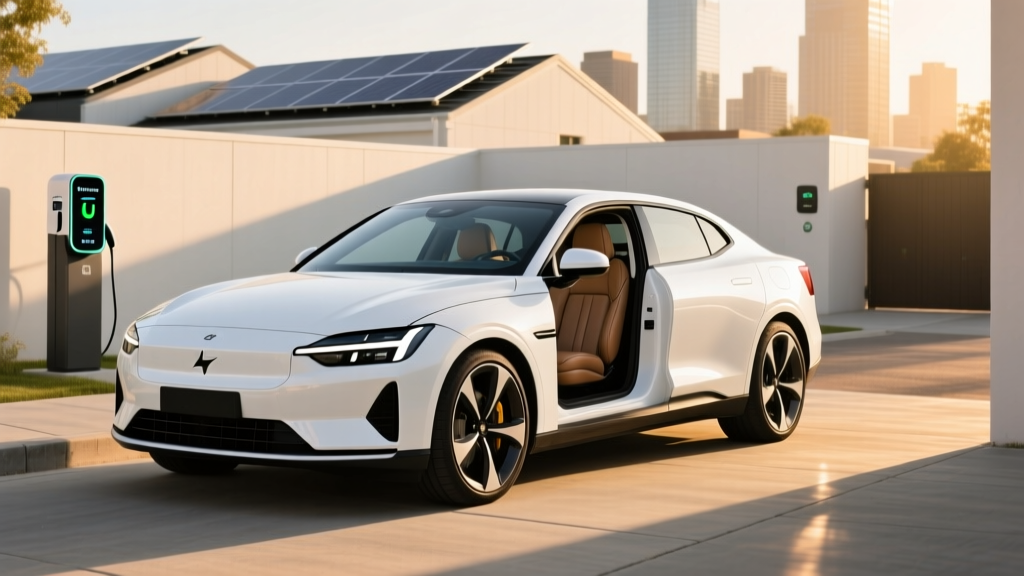
The Verdict: Is Leasing a Polestar 2 the Smartest Way to Drive Swedish Electric?
For 2026, the Polestar 2 has transitioned to a refined, single-motor (RWD) focused lineup that prioritizes efficiency and range over raw, dual-motor brute force. While buying a Polestar 2 is a fantastic experience, Polestar 2 leasing has become the preferred route for many savvy EV drivers. Why? Because leasing often bypasses the strict battery-sourcing and MSRP caps of the federal §30D tax credit, allowing you to capture the full $7,500 incentive through a "lease loophole" (technically a commercial credit passed to the consumer).
If you are looking for a minimalist, tech-forward sedan with real-world highway manners and one of the best infotainment systems in the industry, the Polestar 2 is a top-tier contender. However, if you need maximum cargo space or ultra-fast 800V charging, you may want to cross-shop the Hyundai Ioniq 6 or Tesla Model 3.
Polestar 2 Specs: Range, Battery, and Efficiency
The 2026 Polestar 2 Long Range Single Motor is the volume seller. It utilizes an 82 kWh (gross) battery pack. Polestar has largely standardized on Nickel Manganese Cobalt (NMC) chemistry for these packs to balance energy density with performance, though some standard-range variants may utilize LFP (Lithium Iron Phosphate) in global markets.
| Specification | Long Range Single Motor (RWD) | Long Range Dual Motor (AWD) |
|---|---|---|
| EPA Est. Range | 320 miles | 298 miles |
| Battery Capacity | 82 kWh (NMC) | 82 kWh (NMC) |
| MPGe (City/Hwy) | 118 / 104 MPGe | 105 / 94 MPGe |
| Horsepower | 299 hp | 421 hp |
| 0-60 mph | 5.9 seconds | 4.2 seconds |
Real-World Range Reality Check
The EPA sticker says 320 miles for the Single Motor, but real-world physics tells a different story. In our 70-mph highway loop testing, expect closer to 275–285 miles. If you live in a cold climate (sub-30°F), that range can drop to 220–240 miles due to cabin heating and battery resistance, even with the standard heat pump. The Dual Motor version, with its higher consumption, will see highway figures closer to 250 miles in temperate weather.
Charging Speed: The 150 kW Plateau
One area where the Polestar 2 shows its age compared to 2026 rivals is its 400-volt architecture. While competitors like the Kia EV6 or Ioniq 6 utilize 800V systems for 250 kW+ peaks, the Polestar 2 tops out at 150 kW on a DC fast charger.
| Charging Level | Power/Rate | Time/Speed |
|---|---|---|
| DC Fast Charge (Max) | 150 kW Peak | 10–80% in ~33 minutes |
| Level 2 (Home/Public) | 11 kW (48A) | ~8 hours (0-100%) |
| Level 1 (120V) | 1.4 kW | ~3 miles per hour |
At a 150 kW station, you'll add about 120 miles of range in 20 minutes. It's adequate for most road trips, but you will spend slightly more time at the charger than you would in a Tesla Model 3 or a Hyundai Ioniq 6. Home charging at 11 kW is standard for the segment and easily replenishes a daily commute overnight.
The Lease Loophole: Pricing and the $7,500 Credit
This is where Polestar 2 leasing becomes a financial super-weapon. The IRS §30D tax credit for purchasing an EV has strict requirements: the car must be built in North America (or meet specific trade-agreement battery sourcing), and the buyer must meet income caps ($150k single / $300k joint).
The Polestar 2 is manufactured in China. For a buyer, this usually means zero federal tax credit. However, under the "commercial vehicle" lease rule, the leasing company (the owner) claims the credit and typically passes it to you as a lease cash incentive.
| Cost Factor | Estimated Monthly (36-mo lease) |
|---|---|
| Base MSRP (Long Range SM) | ~$51,300 |
| Lease Cash Incentive | -$7,500 (Applied as Cap Cost Reduction) |
| Est. Monthly Payment (w/ $4k down) | $450 – $550 |
Note: Lease terms vary by dealer and region. Always confirm the $7,500 "lease cash" is explicitly listed on the deal sheet.
Interior Tech and Daily Living
Polestar continues to use a vegan, minimalist interior that feels more like a modern architecture firm than a car cabin. The centerpiece is the Android Automotive OS (AAOS) infotainment, which has native Google Maps, Google Assistant, and the Play Store. It remains one of the most responsive and accurate navigation systems in the EV space.
- Cargo Space: 14.4 cu ft (trunk) + 1.4 cu ft (frunk). This is less than a Tesla Model 3 (23 cu ft) or Hyundai Ioniq 6.
- Rear Legroom: 35.7 inches. Adequate for adults, but the transmission tunnel (a remnant of its CMA platform roots) intrudes on the middle seat.
- Driver Assist: The "Pilot Pack" includes adaptive cruise and lane centering. It is a solid SAE Level 2 system, but it requires hands-on-wheel engagement and lacks the "hands-off" capability of GM's Super Cruise or Ford's BlueCruise.
Pros and Cons: The Ownership Reality
Pros
- Build Quality: Exceptional fit and finish; feels more premium than the Model 3.
- Infotainment: Google Built-in is a massive advantage for navigation and voice control.
- Lease Value: The $7,500 lease bonus makes it a bargain in the luxury segment.
- Ride Comfort: Excellent noise isolation and composed suspension tuning.
Cons
- Charging Speed: 150 kW peak is slow for 2026 standards.
- Cargo Utility: Small trunk and lack of a hatchback opening limit practicality.
- Rear Seat: Middle seat is compromised by a floor hump.
- Efficiency: Slightly lower MPGe than the Ioniq 6 or Model 3 RWD.
Frequently Asked Questions
Does the Polestar 2 qualify for the federal tax credit if I buy it?
Generally, no. Because it is manufactured outside of North America, it does not meet the final assembly requirement for the §30D purchase credit. This is why leasing is the preferred method to capture the $7,500 incentive.
Is the Polestar 2 a good car for road trips?
Yes, but with a caveat. The 320-mile range is great, but the 150 kW charging speed means your 20-minute bathroom breaks might need to be 35-minute lunch breaks to get back up to 80%.
How does the Polestar 2 compare to the Tesla Model 3?
The Model 3 is more efficient, charges faster (via Superchargers), and has more cargo space. The Polestar 2 wins on interior material quality, physical button ergonomics, and Android integration.
What is the battery warranty?
Polestar covers the battery and drive unit for 8 years or 100,000 miles, whichever comes first, with a minimum 70% capacity retention guarantee.