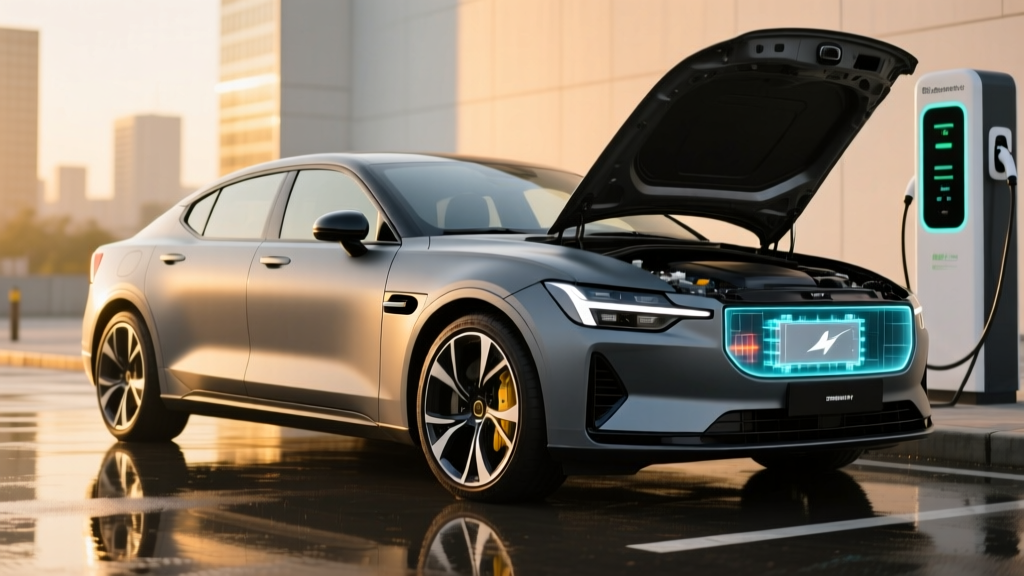
The Polestar 2 occupies a rare space in the electric-vehicle market: a premium fastback sedan that undercuts German rivals on price while delivering genuine performance and Scandinavian design. But beyond the sleek silhouette, buyers want hard numbers — how much room is inside, how far it really goes on a charge, and how fast it recovers electrons. This review breaks down the 2025 Polestar 2 dimensions, efficiency, charging behavior, and ownership economics with the precision you need before signing a purchase agreement.
2025 Polestar 2 Dimensions and Exterior Profile
The Polestar 2 is classified as a compact luxury fastback — think Volvo S60 proportions lifted slightly for a crossover-ish stance. Its footprint matters for urban parking, garage fitment, and interior packaging alike.
| Measurement | Specification |
|---|---|
| Overall Length | 181.3 in (4,606 mm) |
| Overall Width (mirrors folded) | 73.2 in (1,859 mm) |
| Overall Height | 58.0 in (1,473 mm) |
| Wheelbase | 107.7 in (2,735 mm) |
| Ground Clearance | 5.9 in (151 mm) |
| Curb Weight (LRSM RWD) | 4,396 lbs (1,994 kg) |
| Curb Weight (LRDM AWD) | 4,680 lbs (2,123 kg) |
| Cargo Volume (rear seats up) | 14.4 cu ft (407 L) |
| Cargo Volume (rear seats folded) | 38.7 cu ft (1,098 L) |
| Frunk Volume | 1.2 cu ft (35 L) |
The 5.9 inches of ground clearance is lower than crossover rivals like the Tesla Model Y (6.6 in) or Hyundai Ioniq 5 (6.1 in). You will not be tackling unpaved fire roads, but the lower center of gravity pays dividends in cornering composure. The 14.4 cu ft trunk is generous for a fastback — the liftback-style hatch opens wide, making it more usable than a traditional sedan's parcel shelf. The 1.2 cu ft frunk is small but useful for charging cables or a laptop bag.
Interior Space: Passenger Room and Practicality
Inside, the Polestar 2 uses Volvo's Compact Modular Architecture (CMA), shared with the XC40 Recharge. The cabin is snug but well-finished, with vegan textile or available Nappa leather upholstery.
| Measurement | Front | Rear |
|---|---|---|
| Headroom | 39.4 in | 37.0 in |
| Legroom | 42.2 in | 34.0 in |
| Shoulder Room | 54.6 in | 53.0 in |
| Hip Room | 54.0 in | 52.4 in |
Rear legroom at 34.0 inches is the Polestar 2's most significant packaging limitation. A six-foot adult behind a similarly sized driver will find knees brushing the seatback. Compare that to the Tesla Model 3's 35.2 inches or the Hyundai Ioniq 6's 36.5 inches. If you regularly carry rear-seat passengers over long distances, this matters. For couples or families with younger children, it is perfectly adequate.
The center rear seat is best reserved for short trips — the floor tunnel hump (a legacy of the CMA platform's AWD drivetrain packaging) compromises foot space for a middle occupant.
Battery, Range, and Real-World Efficiency
For the 2025 model year, Polestar offers the Long Range Single Motor (LRSM) and Long Range Dual Motor (LRDM) trims, both using the same 82 kWh usable battery pack (79 kWh for the Standard Range Single Motor, which was discontinued mid-cycle in some markets — verify with your dealer). The Long Range pack uses NMC (nickel manganese cobalt) lithium-ion chemistry, supplied by CATL and LG Energy Solution depending on production batch.
EPA Estimated Range:
• LRSM (RWD): 320 miles
• LRDM (AWD): 276 miles
Real-World Expectations:
• Highway (70-75 mph, mild weather): ~270-290 mi (LRSM), ~235-255 mi (LRDM)
• Cold weather (below 32°F, mixed driving): ~230-260 mi (LRSM), ~200-220 mi (LRDM)
• City/regenerative driving (55°F+): Close to EPA sticker or slightly above
The Polestar 2's heat pump (standard on Long Range trims) mitigates cold-weather range loss compared to EVs without one, but expect a 15-25% reduction in freezing temperatures. At sustained highway speeds above 75 mph, aerodynamic drag pushes consumption to roughly 32-35 kWh/100mi on the LRDM.
Efficiency figures from fueleconomy.gov rate the LRSM at 107 MPGe combined (31 kWh/100 mi) and the LRDM at 92 MPGe combined (37 kWh/100 mi). The single-motor variant's efficiency advantage is substantial — if maximum range is your priority, the RWD configuration is the clear choice.
Charging Speed: DC Fast Charging and Home Level 2
Charging capability often determines whether an EV works for road trips or becomes a garage ornament. The 2025 Polestar 2 received a meaningful charging-speed upgrade over earlier model years.
| Charging Level | Specification | Time / Rate |
|---|---|---|
| DC Fast Charge (peak) | 205 kW max (CCS1) | 10-80% in ~26 minutes |
| DC Fast Charge (sustained avg) | ~140-150 kW (10-80%) | Curve tapers significantly above 80% |
| Level 2 (240V, onboard charger) | 11 kW AC max | 0-100% in ~8 hours; ~32 mi/hr |
| Level 1 (120V household) | ~1.4 kW | ~4-5 mi/hr (overnight trickle only) |
The 205 kW peak DC charge rate is competitive with the segment but not class-leading — the Hyundai Ioniq 5 peaks at 240 kW on its 800V architecture, and the Tesla Model 3 Highland can pull 250 kW on V3 Superchargers. In practice, the Polestar 2's charging curve holds strong through 50% SoC, then progressively tapers. Plan for 26-30 minutes at a 350 kW Electrify America or Ionity station for a 10-80% session. Above 80%, expect the rate to drop below 50 kW — avoid charging past 80% on road trips unless you have time to spare.
For home charging, the 11 kW onboard charger is a strong point. On a 48-amp Level 2 circuit (hardwired, 60-amp breaker), you will recover roughly 32 miles of range per hour — a full overnight charge from 20% to 100% in about 6-7 hours. If your home electrical panel only supports a 32-amp circuit (common in older homes), expect roughly 22 mi/hr. Consult a licensed electrician for your specific installation requirements.
The Polestar 2 uses the CCS1 connector standard. With the industry's ongoing transition to NACS (Tesla's connector), Polestar has confirmed future models will adopt NACS natively. For now, CCS-to-NACS adapters allow access to Tesla Supercharger V2 stations that support Magic Dock, though coverage is not universal — check the Tesla app for station compatibility before relying on it.
Performance: Powertrain, 0-60, and Driving Dynamics
| Trim | Drivetrain | Power | Torque | 0-60 mph |
|---|---|---|---|---|
| Long Range Single Motor | RWD | 299 hp | 361 lb-ft | 5.9 sec |
| Long Range Dual Motor | AWD | 421 hp (with Performance Pack: 476 hp) | 546 lb-ft | 4.3 sec (Performance: 3.9 sec) |
The switch to rear-wheel drive for the single-motor variant (previous generations were FWD) transformed the Polestar 2's character. The LRSM feels balanced and eager, with the kind of tail-happy adjustability that enthusiasts appreciate. The LRDM with the optional Performance Software upgrade (a $2,000 OTA unlock) delivers 476 hp and a 3.9-second 0-60 — serious sports-sedan territory.
The available Öhlins dampers and Brembo brakes (included in the Performance Pack on the LRDM) sharpen handling further, though the ride becomes firm on pockmarked city streets. Without the Performance Pack, the standard suspension is compliant and well-suited to daily commuting.
Pricing, Trims, and Federal Tax Credit Eligibility
| Trim | Base MSRP | As-Tested (typical) | §30D Credit Eligibility |
|---|---|---|---|
| Long Range Single Motor | $51,300 | $53,800 (with Plus Pack) | Eligible — up to $7,500* |
| Long Range Dual Motor | $56,800 | $64,500 (with Performance Pack) | Eligible — up to $7,500* |
*Federal tax credit eligibility under IRS §30D is subject to multiple requirements:
- MSRP Cap: The Polestar 2 qualifies as a sedan (cap: $55,000). The LRSM base price clears this; the LRDM at $56,800 exceeds it at base — however, IRS classifies the Polestar 2 as an SUV for MSRP-cap purposes (cap: $80,000) due to its GVWR. Verify with your dealer and tax professional for the current classification.
- Buyer Income Cap: AGI must not exceed $150,000 (single), $225,000 (head of household), or $300,000 (joint filers).
- Battery Sourcing: The $7,500 credit splits into $3,750 for critical-minerals sourcing and $3,750 for battery-component assembly. Sourcing requirements tighten annually. The Polestar 2's CATL/LGES battery supply chain means eligibility for the full $7,500 varies by production batch and model year — confirm with Polestar directly before purchase.
- Point-of-Sale Transfer: As of 2024, the credit can be transferred to the dealer at purchase, reducing your out-of-pocket cost immediately rather than waiting for tax filing.
If you do not qualify for the federal credit, check your state's EV incentives — California, Colorado, Massachusetts, and several others offer additional rebates of $1,000-$5,000 that stack independently.
Technology, Driver Assistance, and Notable Drawbacks
The Polestar 2 runs Google built-in for its infotainment system — Google Maps navigation, Google Assistant voice control, and the Google Play Store are native to the 11.15-inch portrait touchscreen. Wireless Apple CarPlay is supported, but Android Auto is unnecessary since Google services are embedded. The system is responsive and logically organized, though the portrait screen requires more eye movement than a landscape layout for map-heavy navigation.
Driver assistance is branded as Pilot Pack (optional on LRSM, standard on LRDM) and includes:
- Adaptive cruise control with stop-and-go
- Pilot Assist (lane centering + ACC, SAE Level 2)
- 360-degree surround-view camera
- Blind-spot monitoring with rear cross-traffic alert
- Run-off road protection (a Volvo/Polestar safety specialty)
Pilot Assist is a Level 2 driver-assistance system. You must keep your hands on the wheel and eyes on the road at all times. It is not autonomous driving. The system will issue escalating warnings and eventually bring the vehicle to a stop if it detects driver inattention.
Notable drawbacks:
- Rear-seat legroom is tight for adults on long trips
- CCS1 connector limits Tesla Supercharger access without an adapter (and not all V2 stalls support Magic Dock)
- No rear wiper on the liftback glass — visibility degrades in rain
- The center tunnel hump compromises the rear middle seat
- Insurance premiums run 15-25% higher than comparable gas sedans (get a quote before committing)
Who Should Buy the Polestar 2?
- You prioritize range over acceleration (320 mi EPA, 107 MPGe)
- You want a premium sedan that stands apart from the Tesla ubiquity
- Your daily commute is under 60 miles round-trip with home charging
- You value build quality and Scandinavian interior design
- You need all-wheel drive for snow/ice climates
- You want sub-4-second 0-60 performance with the Performance Pack
- You are willing to trade ~44 miles of range for 122 additional horsepower
- You regularly carry four adults (rear legroom is limiting)
- You need maximum cargo volume (consider the Model Y or Ioniq 5)
- You rely exclusively on Tesla Superchargers for road trips
Warranty and Long-Term Ownership
| Coverage | Term |
|---|---|
| Limited Vehicle Warranty | 4 years / 50,000 miles |
| Battery & Drive Unit Warranty | 8 years / 100,000 miles |
| Battery Capacity Retention | Guaranteed ≥70% SoH over 8 yr/100k mi |
| Corrosion Perforation | 12 years / unlimited miles |
| Roadside Assistance | 4 years / 50,000 miles |
The 8-year/100,000-mile battery warranty with a 70% state-of-health floor is industry-standard and aligns with Tesla, Hyundai, and BMW. NMC batteries in the Polestar 2 are liquid-cooled with active thermal management, which historically supports strong long-term degradation curves. Independent data from Recurrent Auto suggests NMC packs with robust thermal systems retain 90%+ capacity at 60,000 miles under normal use.
2025 Polestar 2: Pros and Cons
- 320-mile EPA range on LRSM is highly competitive
- Premium build quality with distinctive Scandinavian design
- RWD single-motor delivers engaging driving dynamics
- Google built-in infotainment is seamless and fast
- 11 kW onboard charger enables fast Level 2 home charging
- Standard heat pump on Long Range trims
- Federal tax credit eligible (verify sourcing requirements)
- Rear legroom is tight for adult passengers
- CCS1 connector limits native Supercharger access
- 205 kW peak DC charge is slower than 800V rivals
- No rear wiper on the liftback glass
- Center floor hump compromises the rear middle seat
- Higher insurance premiums than gas equivalents
- LRDM base MSRP starts above the sedan tax-credit cap (SUV classification may apply)
Frequently Asked Questions
What is the real-world range of the Polestar 2?
The LRSM's EPA estimate is 320 miles. In real-world highway driving at 70-75 mph in mild weather, expect 270-290 miles. In freezing temperatures with mixed driving, plan for 230-260 miles. The heat pump helps, but cold weather and high speeds always reduce EV range. The LRDM delivers roughly 235-255 highway miles in mild weather and 200-220 in cold conditions.
How fast does the Polestar 2 charge at home and on the road?
On a DC fast charger capable of 205+ kW, the Polestar 2 charges from 10-80% in approximately 26 minutes, with the sustained average around 140-150 kW. At home on a 48-amp Level 2 charger (240V), the 11 kW onboard charger recovers about 32 miles of range per hour — a full charge in roughly 7-8 hours.
How much does the Polestar 2 cost after tax credits?
The LRSM starts at $51,300 MSRP. If you qualify for the full $7,500 federal tax credit (and transfer it at point of sale), your effective price drops to approximately $43,800 before state incentives. The LRDM starts at $56,800 — eligibility for the full credit depends on IRS vehicle classification (sedan vs. SUV cap) and battery-sourcing compliance. Always confirm with your dealer and a tax professional before purchase.
Does the Polestar 2 qualify for the federal EV tax credit?
The Polestar 2 is on the IRS list of eligible clean vehicles, but the amount — $3,750 or $7,500 — depends on battery critical-mineral sourcing and component assembly requirements that tighten each year. Your personal eligibility also depends on income caps ($150K single / $300K joint). Check the IRS §30D guidance and confirm with Polestar before relying on the credit.
Is the Polestar 2 worth buying vs. the Tesla Model 3 or Hyundai Ioniq 5?
Against the Tesla Model 3 Highland (341 mi EPA, $47,740 LR RWD), the Polestar 2 offers a more premium interior, distinctive design, and Google-native infotainment — but sacrifices some range, charging speed, and Supercharger network access. Against the Hyundai Ioniq 5 (305 mi EPA, $46,650 SEL), the Polestar 2 wins on interior materials and driving refinement but costs more and charges slower on DC. If exclusivity and build quality matter more than maximizing range-per-dollar, the Polestar 2 earns its premium.
What are the Polestar 2's biggest advantages and disadvantages?
Its strongest points are the 320-mile range (LRSM), 11 kW home charging, premium build quality, and engaging RWD dynamics. Its weakest points are cramped rear-seat legroom, CCS1-only charging (limiting Supercharger access), and a DC charge curve that trails 800V competitors. It is an excellent EV for design-conscious commuters who charge at home and take occasional road trips — less ideal for large families or high-mileage road-trippers who depend on the fastest possible charging.