The 2023 Polestar 2 occupies a distinct space in the premium electric sedan segment: Scandinavian minimalism, Google-native infotainment, and a chassis tuned with genuine enthusiasm. But with the EV market maturing rapidly, buyers need more than design appeal — they need hard numbers on range, charging, and total cost. This review dissects every 2023 Polestar 2 variant with the data-driven precision real buyers demand.
2023 Polestar 2 at a Glance: Full Spec Breakdown
| Specification | Standard Range Single Motor | Long Range Single Motor | Long Range Dual Motor |
|---|---|---|---|
| Drivetrain | FWD | FWD | AWD |
| Horsepower | 231 hp | 231 hp | 408 hp |
| Torque | 243 lb-ft | 243 lb-ft | 487 lb-ft |
| 0–60 mph | 7.0 sec | 7.0 sec | 4.5 sec |
| Battery (usable) | 69 kWh (LFP) | 78 kWh (NMC) | 78 kWh (NMC) |
| EPA Range | 249 mi | 276 mi | 249 mi (19" wheels) / 260 mi (18") |
| MPGe (combined) | 107 MPGe | 107 MPGe | 92–98 MPGe |
| Efficiency (kWh/100 mi) | 31 | 31 | 34–37 |
| Max DC Fast Charge | 135 kW | 150 kW | 150 kW |
| 10–80% DC Time | ~32 min | ~33 min | ~33 min |
| Level 2 Home Charging | 11 kW (~37 mi/hr) | 11 kW (~37 mi/hr) | 11 kW (~37 mi/hr) |
| Base MSRP | $49,800 | $52,900 | $56,900 |
Real-World Range: What the EPA Sticker Doesn't Tell You
The Standard Range Single Motor's 69 kWh LFP (lithium iron phosphate) battery trades some energy density for longevity and cost. Its 249-mile EPA rating holds up reasonably in city driving, but highway and cold-weather penalties hit harder on the smaller pack — expect 180–210 miles in winter highway conditions.
The Dual Motor's 249-mile rating (with 19-inch wheels) reflects the efficiency cost of 408 hp and all-wheel drive. The 18-inch wheel option bumps that to 260 miles, a worthwhile trade if you prioritize range over aesthetics. Real-world highway driving in the Dual Motor typically yields 210–230 miles in fair weather.
One factor working in the Polestar 2's favor: its heat pump (included on all 2023 trims) mitigates cold-weather cabin-heating energy draw compared to resistive heaters, partially offsetting winter range loss.
Charging Speed: DC Fast Charging and Home Setup
The 2023 Polestar 2 uses a CCS1 connector for DC fast charging (pre-NACS adoption). Peak charge rates differ by battery:
| Charge Level | Standard Range (LFP) | Long Range (NMC) | Miles Added per Hour |
|---|---|---|---|
| Level 1 (120V, 12A) | 1.4 kW | 1.4 kW | ~3–4 mi/hr |
| Level 2 (240V, 48A) | 11 kW | 11 kW | ~37 mi/hr |
| DC Fast Charge (peak) | 135 kW | 150 kW | N/A (10–80% in ~32–33 min) |
Charging curve reality: The 150 kW peak on Long Range models is not sustained. The charge rate peaks around 20–40% State of Charge (SoC), then progressively tapers. From 10–80%, the average rate is closer to 90–100 kW, which is why the full 10–80% session takes roughly 33 minutes rather than the ~20 minutes a sustained 150 kW would suggest. Above 80%, charging slows dramatically to protect the battery — a 10–90% session can take 50+ minutes.
The Standard Range LFP battery accepts a lower 135 kW peak. LFP chemistry tolerates frequent 100% charging better than NMC, so daily charging to full is acceptable — a practical advantage for commuters who need every available mile.
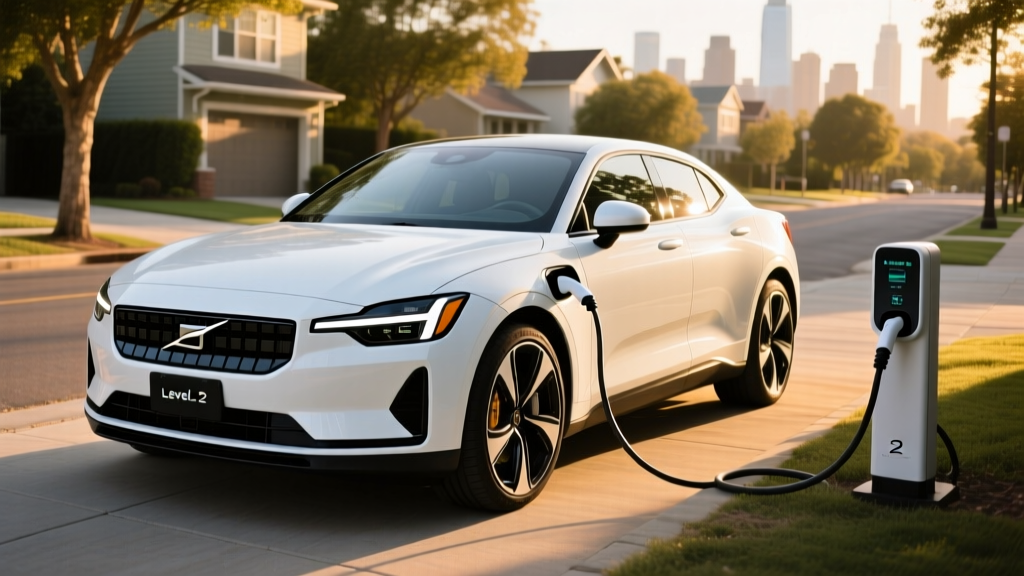
At home on a 48-amp Level 2 circuit (requiring a 60-amp breaker), the onboard 11 kW charger replenishes the Long Range battery from empty to full in roughly 8 hours — overnight charging is straightforward. Installation of a Level 2 home charger typically runs $500–$2,000 depending on panel capacity and wiring distance (consult a licensed electrician for your specific setup).
Performance and Driving Dynamics
The Dual Motor's 4.5-second 0–60 mph time puts it firmly in performance-sedan territory, and the instantaneous torque delivery makes it feel quicker than the number suggests. The Performance Pack ($5,500 option on the Dual Motor) adds Öhlins dampers, Brembo brakes, and 20-inch forged wheels, sharpening handling at the cost of roughly 10–15 miles of range and a firmer ride.
The Single Motor variants are less thrilling but perfectly adequate for daily driving. The FWD layout and 231 hp deliver smooth, predictable acceleration. The chassis — shared with Volvo's CMA platform — is well-sorted, with composed ride quality and precise steering that outclasses many crossover rivals.
Regenerative braking offers adjustable levels via the touchscreen, including a one-pedal driving mode that brings the car to a complete stop. The blending between regen and friction brakes is among the smoothest in the segment.
Pricing, Tax Credits, and Total Cost
The 2023 Polestar 2 launched with an aggressive MSRP structure, though destination charges ($1,300) and options quickly add up:
| Trim | Base MSRP | As-Tested (typical) | §30D Credit Eligibility |
|---|---|---|---|
| Standard Range SM | $49,800 | $51,100 (w/ destination) | Up to $7,500 (see caveats below) |
| Long Range SM | $52,900 | $55,000–$58,000 | Up to $7,500 (see caveats below) |
| Long Range DM | $56,900 | $60,000–$68,000 | Up to $7,500 (see caveats below) |
- MSRP cap: Sedars qualify up to $55,000 MSRP. The Standard Range ($49,800) and Long Range Single Motor ($52,900) clear this cap. The Dual Motor ($56,900 base) exceeds it and does NOT qualify at base — though Polestar restructured some 2023 pricing mid-year.
- Income cap: Modified AGI ≤ $150,000 (single), $225,000 (head of household), $300,000 (joint).
- Battery sourcing: The credit splits into $3,750 for critical minerals + $3,750 for battery component requirements. Sourcing rules tightened through 2023–2024; verify current eligibility on the IRS clean vehicle credit page before purchasing.
- Point-of-sale transfer: Starting 2024, buyers can transfer the credit to the dealer for an upfront price reduction rather than claiming it on their tax return.
Always confirm eligibility with a tax professional and the official IRS qualified vehicle list before committing to a purchase.
Interior, Cargo, and Technology
The Polestar 2's cabin is a study in restraint. Vegan WeaveTech upholstery is standard; Nappa leather is optional. Build quality is excellent, with tight panel gaps and premium materials throughout.
Cargo dimensions:
- Rear cargo (behind rear seats): 14.4 cu ft (liftback design aids usability)
- With rear seats folded: 37.5 cu ft
- Front trunk (frunk): 1.4 cu ft — small, but useful for charging cables
- Rear legroom: 33.4 inches — adequate but tighter than a Tesla Model 3 (35.2")
- Front headroom: 40.1 inches
The liftback hatchback design gives the Polestar 2 a practical edge over traditional sedans, though cargo volume trails SUV-shaped competitors like the Hyundai Ioniq 5 (27.2 cu ft rear) and Tesla Model Y (30.2 cu ft rear).
Infotainment: The 11.2-inch portrait touchscreen runs Android Automotive OS with Google Maps, Google Assistant, and Google Play Store built in. Navigation via Google Maps is excellent, with real-time traffic and EV-specific routing that factors in charge stops. Apple CarPlay is supported; Android Auto is redundant given the native Google integration. The 12.3-inch driver display is clear and configurable.
Driver assistance (SAE Level 2): The standard Pilot Pack includes adaptive cruise control, lane-centering, blind-spot monitoring, and rear cross-traffic alert. The optional Pilot Pack ($3,200) adds Pilot Assist with more refined lane-centering and automated lane changes. This is not autonomous driving — the driver must remain engaged with hands on the wheel at all times.
Pros, Cons, and Who Should Buy
Pros
- Excellent build quality and Scandinavian design
- Google Maps native navigation with EV routing
- Standard heat pump improves cold-weather efficiency
- Smooth, well-tuned chassis with optional Öhlins dampers
- LFP option on Standard Range allows daily 100% charging
- Liftback design adds cargo versatility
- Competitive pricing before options
Cons
- Rear seat space is tighter than Model 3 and Ioniq 6
- 150 kW peak DC charging trails 800V competitors (Ioniq 5: 240 kW)
- Dual Motor exceeds $55K MSRP cap — may lose tax credit
- No rear wiper on the liftback glass
- CCS1 connector as Tesla Supercharger network opens to NACS
- Firm ride on 20-inch Performance Pack wheels
Who the 2023 Polestar 2 Suits Best
Choose the Polestar 2 if: You want a premium electric liftback with distinctive design, Google-native tech, and satisfying driving dynamics. The Long Range Single Motor at $52,900 (under the tax-credit MSRP cap) is the sweet spot for commuters who value build quality and a composed highway ride.
Look elsewhere if: You need maximum rear-seat room (consider the Ioniq 6 or Model 3), fastest DC charging (Ioniq 5/6 with 800V architecture), or the broadest public charging access (Tesla Model 3 on the Supercharger network). Families needing cargo space should consider the Model Y or Ioniq 5.
Warranty Coverage
Polestar provides competitive warranty terms for the 2023 model year:
- Battery: 8 years / 100,000 miles (whichever comes first), with a minimum 70% capacity retention threshold
- Powertrain: 4 years / 50,000 miles
- Vehicle (bumper-to-bumper): 4 years / 50,000 miles
- Roadside assistance: 4 years / unlimited miles
The 70% battery retention threshold is standard for the industry. Real-world degradation data for the Polestar 2's NMC and LFP packs is still accumulating given the model's relative youth, but LFP chemistry generally shows slower long-term degradation than NMC, making the Standard Range an interesting longevity play despite its shorter range.
Frequently Asked Questions
What is the real-world range of the 2023 Polestar 2?
The Long Range Single Motor delivers 276 miles EPA, with real-world mixed driving yielding 250–265 miles in fair weather. Highway-only driving at 75 mph drops this to 220–240 miles. In freezing temperatures, expect 195–220 miles without preconditioning. The Standard Range (249 mi EPA) typically delivers 200–230 miles in moderate conditions.
How fast does the 2023 Polestar 2 charge?
On a DC fast charger, the Long Range models peak at 150 kW and charge from 10–80% in approximately 33 minutes. The Standard Range (LFP) peaks at 135 kW with a similar 10–80% time of ~32 minutes. At home on a 48-amp Level 2 charger (11 kW), a full charge takes roughly 7–8 hours, adding about 37 miles of range per hour.
Does the 2023 Polestar 2 qualify for the federal EV tax credit?
The Standard Range Single Motor ($49,800) and Long Range Single Motor ($52,900) fall under the $55,000 MSRP cap for sedans and may qualify for up to $7,500 under IRS §30D, subject to buyer income limits ($150K single / $300K joint), battery-sourcing requirements, and point-of-sale transfer rules. The Dual Motor ($56,900 base) exceeds the sedan MSRP cap and generally does not qualify. Always verify current eligibility on IRS.gov and consult a tax professional.
Is the 2023 Polestar 2 worth buying vs. a Tesla Model 3 or Hyundai Ioniq 6?
The Polestar 2 wins on build quality, design distinctiveness, and Google-native infotainment. The Tesla Model 3 offers longer range (358 mi LR), access to the Supercharger network, and faster DC charging. The Hyundai Ioniq 6 (361 mi SE LR) charges significantly faster (800V architecture, 10–80% in ~18 min) and offers more rear-seat space. If charging speed and range are your top priorities, the Ioniq 6 or Model 3 lead. If build quality and Scandinavian design matter most, the Polestar 2 stands apart.
What are the biggest drawbacks of the 2023 Polestar 2?
The primary limitations are its 150 kW peak DC charging rate (slower than 800V rivals), a snug rear seat (33.4" legroom), and the Dual Motor's MSRP exceeding the federal tax-credit cap. The CCS1 connector is also a consideration as the industry shifts toward NACS, though adapters are becoming available. The firm ride on Performance Pack 20-inch wheels may deter buyers prioritizing comfort.
How does the LFP battery in the Standard Range compare to NMC?
LFP (lithium iron phosphate) offers slower degradation, better thermal stability, and tolerance for daily 100% charging — a practical advantage for commuters. The trade-off is lower energy density (hence the smaller 69 kWh pack and 249-mile range) and slightly reduced cold-weather performance compared to the 78 kWh NMC packs in the Long Range models. For high-mileage commuters who charge at home nightly, the LFP battery's longevity characteristics are a genuine advantage.