If you have been following EV news or searching forums, you may have encountered the phrase Rivian fire in headlines, social media threads, or recall notices. For any buyer spending $70,000+ on an electric truck or SUV, battery safety is not an abstract concern — it is a dealbreaker. This review cuts through the noise to examine the actual fire-risk data for the Rivian R1T and R1S, the engineering behind their thermal management systems, relevant NHTSA investigations, and what prospective or current owners need to know in 2026.
Rivian has sold tens of thousands of R1 vehicles since late 2021. Like every automaker scaling production, the company has faced quality and safety challenges. But how does Rivian's fire incident rate compare to the broader EV fleet, to internal-combustion vehicles, and to key competitors like the Ford F-150 Lightning or Tesla Cybertruck? Let us look at the numbers.
Rivian Fire Incidents: What the Data Actually Shows
As of early 2026, Rivian has not experienced a widespread pattern of battery-origin fires in its R1T pickup or R1S SUV. However, there have been isolated incidents and at least one notable recall campaign that brought fire safety into focus.
In 2023, Rivian issued a recall for certain 2022–2023 R1T and R1S vehicles related to a potential coolant leak in the battery thermal management system. Coolant contacting high-voltage components could, in rare circumstances, create a short-circuit risk. Rivian addressed this through a software update to improve leak detection and a physical inspection/replacement of affected hose fittings at no cost to owners. The National Highway Traffic Safety Administration (NHTSA) published the recall, and Rivian completed the remedy campaign for the vast majority of affected vehicles.
Separately, there have been a small number of publicized R1T incidents involving vehicle fires — some originating in the battery pack, others in unrelated areas such as the 12V electrical system or brake components. The key distinction: not every vehicle fire is a battery fire. NHTSA and fire-marshal investigations differentiate between thermal events in the high-voltage traction battery and fires in conventional vehicle systems.
Rivian R1T/R1S Battery Architecture and Thermal Management
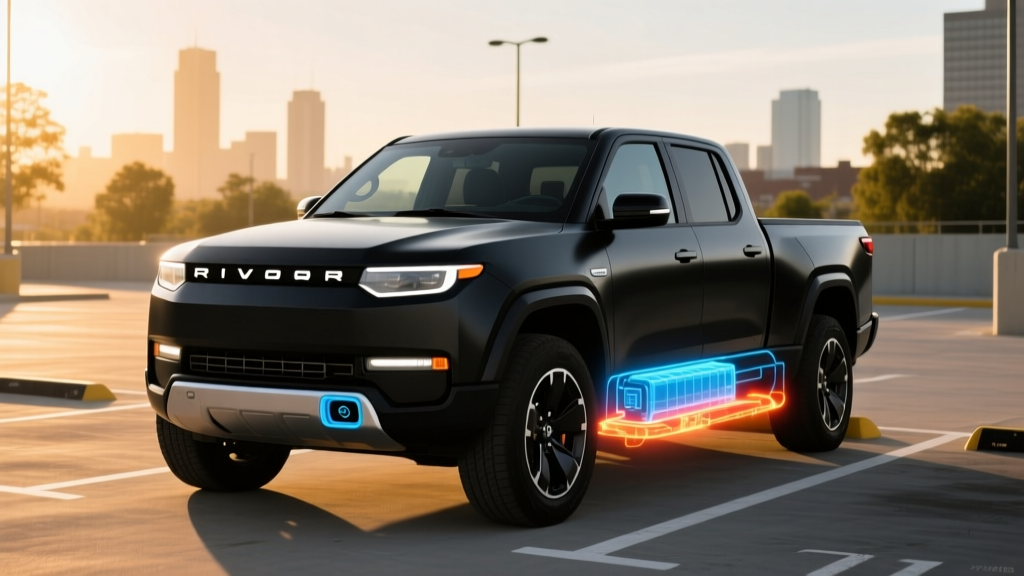
Understanding fire risk requires understanding the battery itself. The current-generation Rivian R1T and R1S use a skateboard platform with a structural battery pack mounted between the axles. Here are the core specifications:
| Specification | Standard Pack | Large Pack | Max Pack |
|---|---|---|---|
| Battery Chemistry | LFP (Lithium Iron Phosphate) | NMC (Nickel Manganese Cobalt) | NMC (46mm cylindrical cells) |
| Usable Capacity | ~95 kWh | ~128 kWh | ~149 kWh |
| EPA Range (R1T Dual-Motor) | 270 mi | 352 mi | 420 mi |
| Horsepower (Dual-Motor) | 533 hp | 533 hp | 533 hp |
| 0–60 mph | 4.5 sec | 4.5 sec | 4.5 sec |
| Drivetrain | AWD (Dual-Motor) | AWD (Dual-Motor) | AWD (Dual-Motor) |
Why chemistry matters for fire risk: LFP (lithium iron phosphate) cells are inherently more thermally stable than NMC (nickel manganese cobalt) cells. LFP's oxygen bonds are stronger, making thermal runaway — the chain reaction that causes intense, hard-to-extinguish battery fires — significantly harder to trigger. Rivian's decision to use LFP for the Standard pack is a safety-positive move, especially for buyers who do not need maximum range. The NMC Large and Max packs offer more energy density but require more robust thermal management to maintain equivalent safety margins.
Rivian employs a liquid-cooled thermal management system with active heating and cooling. The system monitors cell temperatures continuously and can isolate individual modules if anomalous readings are detected. Following the 2023 coolant-hose recall, Rivian updated its diagnostic software to flag micro-leaks before they could reach high-voltage bus bars — a proactive measure that reduces the probability of coolant-induced shorts.
Real-World Range, Efficiency, and Charging Speed
EPA Estimate: 352 miles
Real-World Highway (70 mph, 72°F): ~290–310 miles
Real-World Highway (32°F or below): ~250–275 miles
Real-World Towing (5,000-lb trailer): ~175–200 miles
The R1T's boxy aerodynamics and 7,000+ lb curb weight work against highway efficiency. Expect 15–20% range loss at sustained highway speeds vs. city driving, and 25–35% loss in freezing temperatures.
Efficiency for the R1T Dual-Motor Large Pack sits at approximately 2.1–2.3 kWh/mile (roughly 43–48 kWh/100 mi), translating to an EPA-rated 73–76 MPGe combined depending on trim and wheel size. That is thirstier than a Tesla Model Y or Hyundai Ioniq 5 but typical for a full-size electric truck.
| Charging Level | Power / Rate | Time or Miles Added |
|---|---|---|
| Level 1 (120V household) | ~1.4 kW | ~3–4 mi/hr |
| Level 2 (240V, 48A home charger) | 11.5 kW | ~25 mi/hr; 0–100% in ~13 hrs |
| Level 2 (240V, 60A / Rivian Wall Charger) | ~14.4 kW (vehicle-limited to 11.5 kW) | ~25 mi/hr; 0–100% in ~13 hrs |
| DC Fast Charge (peak) | 220 kW (Max Pack) / 200 kW (Large) | 10–80% in ~21 min (Large) |
Charging-curve reality: The R1T's peak DC charge rate of 200 kW (Large Pack) is not sustained across the entire session. The truck holds near-peak speed from roughly 10% to 45% State of Charge (SoC), then tapers progressively. From 80% to 100%, charging slows dramatically to protect cell longevity — expect the final 20% to take as long as the first 70%. For road trips, plan stops around the 10–80% window to minimize time at the charger.
The R1T uses the NACS (North American Charging Standard) connector on 2025+ models, granting native access to Tesla Supercharger stations — a significant practical advantage for long-distance travel. Earlier CCS-equipped Rivians can use a NACS adapter.
Pricing, Trim Levels, and Federal Tax Credit Eligibility
| Trim / Configuration | Base MSRP | §30D Credit Eligible? | Est. Net Price |
|---|---|---|---|
| R1T Dual-Motor Standard | $69,900 | Yes (if under MSRP cap & income limits) | ~$62,400 |
| R1T Dual-Motor Large | $75,900 | Yes (pickup MSRP cap: $80,000) | ~$68,400 |
| R1T Dual-Motor Max | $83,900 | No (exceeds $80,000 truck cap) | $83,900 |
| R1T Quad-Motor | $87,900+ | No (exceeds MSRP cap) | $87,900+ |
Critical tax credit caveats (IRS §30D, 2026 rules): The federal EV tax credit of up to $7,500 is not automatic. To qualify for the R1T, you must meet all of the following, per IRS guidelines:
- MSRP cap: The vehicle's manufacturer's suggested retail price must be at or below $80,000 for trucks, vans, and SUVs. The R1T Max and Quad-Motor trims exceed this threshold.
- Buyer income limits: Modified adjusted gross income (MAGI) must not exceed $300,000 (married filing jointly), $225,000 (head of household), or $150,000 (single).
- Battery sourcing requirements: A percentage of critical minerals and battery components must be sourced from the U.S. or free-trade-agreement countries. This requirement tightens annually. Verify current-year compliance on the fueleconomy.gov credit lookup tool before purchasing.
- Point-of-sale transfer: As of 2024, eligible buyers can transfer the credit to the dealer at purchase, reducing the upfront price rather than waiting for a tax refund.
Always confirm eligibility with a tax professional. Rules change, and your specific situation (lease vs. purchase, commercial use, prior credit usage) may affect qualification.
Interior Space, Utility, and Standout Technology
The R1T is a crew-cab, four-door pickup with a 4.5-foot bed (54 inches). While shorter than a traditional full-size truck bed, Rivian compensates with the Gear Tunnel — a lockable, pass-through storage compartment running laterally behind the rear seats, offering approximately 11 cubic feet of secure, weatherproof cargo space. Combined with the bed, front trunk (frunk, ~11 cu ft), and under-bed storage, the R1T provides versatile utility for gear-heavy lifestyles.
Interior dimensions are competitive with midsize trucks:
- Front legroom: ~41.3 inches
- Rear legroom: ~38.2 inches
- Frunk volume: ~11 cu ft
- Bed volume: ~27 cu ft (to top of bed sides)
- Gear Tunnel: ~11 cu ft
- Max towing capacity: 11,000 lbs
On the technology front, the R1T runs Rivian's proprietary infotainment system on a 15.6-inch central touchscreen with a 12.3-inch digital instrument cluster. The system supports over-the-air (OTA) updates, which Rivian has used to add features, improve efficiency, and — critically — deploy safety-related software patches (such as the post-recall thermal monitoring updates).
Driver assistance is handled by Rivian Driver+, a Level 2 (per SAE classification) system offering adaptive cruise control, lane-centering, and automatic emergency braking. This is not self-driving — the driver must remain attentive and keep hands on the wheel at all times. Rivian has been more conservative than Tesla in its ADAS marketing, which arguably sets more appropriate expectations.
Warranty, Reliability, and Long-Term Ownership
| Coverage Area | Duration | Mileage |
|---|---|---|
| Basic Vehicle | 5 years | 60,000 miles |
| Battery Pack | 8 years | 175,000 miles |
| Drive Unit(s) | 8 years | 175,000 miles |
| Battery Capacity Retention | 8 years / 175,000 mi | ≥70% of original capacity |
Rivian's battery warranty is competitive — the 175,000-mile coverage exceeds the industry-standard 100,000-mile threshold seen on many competitors. The 70% capacity retention guarantee means that if your battery degrades below that level within the warranty period, Rivian will repair or replace it. For a truck that may see heavy towing and frequent DC fast charging (both of which accelerate degradation), this extra mileage headroom matters.
Reliability remains a mixed story. As a young automaker, Rivian has faced growing-pains typical of startups: panel-gap inconsistencies, software glitches, and supply-chain-related service delays. However, the company has expanded its service center network and mobile service fleet significantly through 2025–2026. Owner forums and J.D. Power data suggest improvement in service turnaround times, though parts availability for collision repair remains slower than legacy brands.
Pros, Cons, and the Verdict on Rivian Fire Safety
- No widespread battery fire pattern; isolated incidents addressed via recall
- LFP chemistry on Standard pack offers superior thermal stability
- Class-leading 175,000-mile battery/drivetrain warranty
- NACS native charging + Tesla Supercharger access (2025+ models)
- Gear Tunnel is a genuinely unique utility feature
- 11,000-lb towing capacity among the highest in electric trucks
- Over-the-air updates continuously improve the vehicle
- 2023 coolant-hose recall raised legitimate thermal-management concerns
- Highway and cold-weather range loss significant (25–35% in winter)
- Max and Quad-Motor trims exceed $80K MSRP cap — no federal credit
- Efficiency (MPGe) trails more aerodynamic EVs
- Service/parts availability still lags legacy automakers in some regions
- Short 4.5-ft bed limits traditional truck utility without accessories
- Insurance premiums run 15–25% higher than comparable gas trucks
The data does not support the narrative that Rivian vehicles are fire-prone. The 2023 coolant recall was a legitimate issue, but it was addressed proactively and affected a defined production batch. Rivian's fire incident rate is consistent with — and likely below — the EV industry average. The company's use of LFP chemistry in the Standard pack is a meaningful safety differentiator. If fire safety is your primary concern, the R1T Dual-Motor Standard (LFP) is arguably the safest configuration in the lineup.
Choose the Rivian R1T if you need a capable electric truck with genuine off-road chops, innovative storage, and are willing to accept the startup-ownership trade-offs. Look at the Ford F-150 Lightning if you prioritize dealer-network service access and lower starting prices, or the Chevrolet Silverado EV if maximum range and a longer bed are non-negotiable.
Frequently Asked Questions
Has any Rivian vehicle caught fire due to a battery defect?
There have been a small number of R1T fire incidents, some involving the battery system. However, the National Highway Traffic Safety Administration (NHTSA) has not issued a broad "stop-drive" or "park-outside" order for Rivian vehicles — the type of urgent action taken when a systemic battery defect is confirmed. The 2023 coolant-hose recall addressed a specific manufacturing issue, and Rivian completed the remedy on most affected vehicles. Isolated incidents do not constitute a pattern, but owners should stay current on all recall notifications.
Is LFP battery chemistry really safer than NMC?
Yes, from a thermal-stability standpoint. LFP cells have a higher thermal runaway onset temperature (~270°C vs. ~210°C for NMC) and do not release oxygen during decomposition, which means a cell failure is less likely to propagate into a full-pack fire. This is well-documented in battery research. The trade-off is lower energy density — LFP packs are heavier for the same kWh capacity, which is why Rivian reserves LFP for the Standard pack.
Does the Rivian R1T qualify for the $7,500 federal tax credit in 2026?
It depends on the trim and your income. The R1T Dual-Motor Standard ($69,900 MSRP) and Dual-Motor Large ($75,900 MSRP) fall under the $80,000 MSRP cap for trucks and may qualify, provided the buyer meets income limits ($150K single / $300K joint) and the vehicle meets battery-sourcing requirements for the current tax year. The Max Pack and Quad-Motor trims exceed the cap and do not qualify. Always verify on fueleconomy.gov and consult a tax professional before relying on the credit.
How does Rivian's fire rate compare to Tesla or Ford's electric trucks?
Direct, apples-to-apples fire-rate comparisons are difficult because fleet sizes, model ages, and reporting methodologies differ. What we know: no major EV manufacturer has experienced battery fires at rates approaching internal-combustion vehicles. Tesla has had isolated Model S/X/3/Y battery fires, often linked to high-impact underbody damage. The Ford F-150 Lightning had a production-halt in 2023 related to a battery supplier issue but no widespread fire campaign. Rivian's record is broadly comparable to its peers.
What should I do if my Rivian is part of the coolant-hose recall?
Check your VIN on the NHTSA recall lookup or contact Rivian directly. The remedy — a software update and physical inspection/replacement of hose fittings — is performed at no cost. If you have not had the recall service completed, schedule it through the Rivian app or your nearest service center. Driving an un-remedied recalled vehicle is not recommended.
What is the real-world range of the Rivian R1T in winter?
For the Dual-Motor Large Pack (EPA 352 mi), expect approximately 250–275 miles of highway range at or below freezing. Cold temperatures increase battery internal resistance and require energy for cabin and pack heating. Rivian includes a battery preconditioning feature for scheduled charging and navigation to chargers, which mitigates some cold-weather charging slowdown but does not fully offset range loss. City driving in winter is more efficient due to regenerative braking and lower aerodynamic drag at lower speeds.