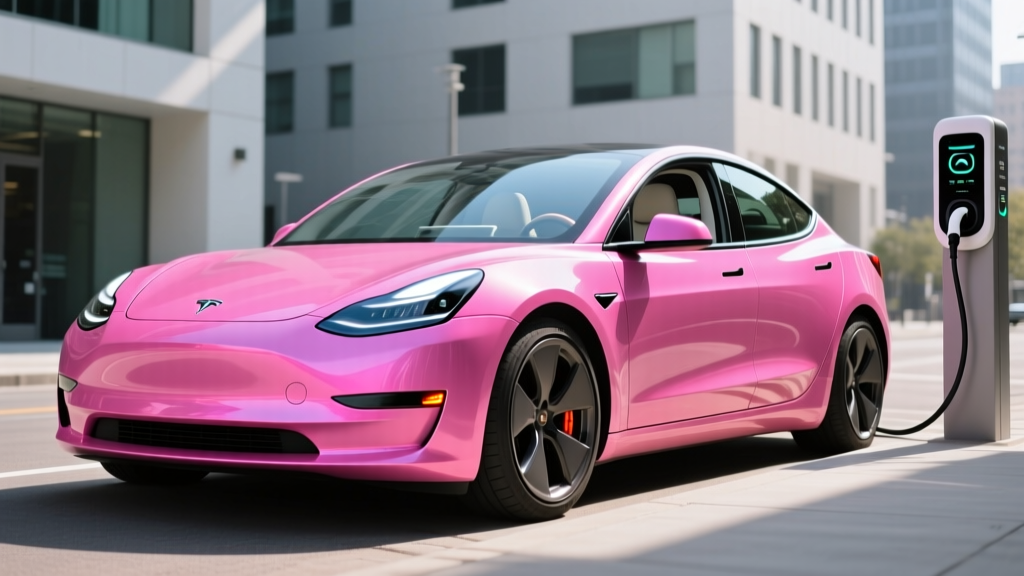
If you've searched for a pink Tesla Model 3, you already know the truth: Tesla doesn't offer pink from the factory. The Fremont and Shanghai paint shops produce exactly five colors for the 2026 Model 3 — Solid Black, Pearl White, Deep Blue, Ultra Red, and Quicksilver. Yet pink Model 3s are everywhere on Instagram, TikTok, and in driveways from Miami to Los Angeles. The route to one is a vinyl wrap or aftermarket paint, layered onto what remains one of the most efficient and best-charging electric sedans on the market.
This review covers the 2026 Tesla Model 3 in its two current trims — the Rear-Wheel Drive (RWD) and the Long Range AWD — with everything you need to know about range, charging, pricing, and tax credits before you order a base car and send it to the wrap shop.
2026 Tesla Model 3: Core Specifications at a Glance
| Spec | Model 3 RWD | Model 3 Long Range AWD |
|---|---|---|
| EPA Range | 272 miles | 341 miles |
| Battery (usable) | ~60 kWh (LFP) | ~79 kWh (NMC) |
| Drivetrain | Rear-Wheel Drive | Dual-Motor AWD |
| Horsepower | 271 hp | 346 hp |
| 0-60 mph | 5.8 sec | 4.2 sec |
| Max DC Fast Charge | 170 kW | 250 kW |
| 10-80% DCFC Time | ~25 min | ~22 min |
| Level 2 Home Charge | 11.5 kW (~37 mi/hr) | 11.5 kW (~44 mi/hr) |
| MPGe (combined) | 132 MPGe | 124 MPGe |
| Efficiency | 25 kWh/100 mi | 27 kWh/100 mi |
| Base MSRP | $38,990 | $45,990 |
| Battery Warranty | 8 yr / 100,000 mi | 8 yr / 120,000 mi |
Source: fueleconomy.gov and Tesla.com Model 3 design studio. Destination fee of $1,390 adds to all MSRPs listed below.
The Path to a Pink Tesla Model 3: Wrap vs. Paint
Tesla's factory paint is a frequent owner complaint — thin, prone to chips, and limited to five colors. Getting a pink Model 3 means going aftermarket, and you have two legitimate options:
Vinyl Wrap (Most Popular)
A full-body vinyl wrap in satin rose, hot pink, or metallic blush typically runs $2,500–$4,500 depending on material (3M, Avery Dennison, KPMF) and installer reputation. Wraps last 5–7 years, protect the factory paint underneath, and are fully removable — which preserves resale value. Most pink Model 3s you see on social media are wrapped, not painted.
Aftermarket Paint
A professional respray in a custom pink (think Barbie Pantera or a muted dusty rose) costs $5,000–$10,000+ at a quality body shop. The finish is permanent, can be ceramic-coated, and looks more OEM than vinyl at close range — but it will appear on vehicle-history reports as non-factory paint and may reduce trade-in value with Tesla or CarMax.
Real-World Range: What the EPA Sticker Doesn't Tell You
The EPA rates the 2026 Model 3 RWD at 272 miles and the Long Range AWD at 341 miles. Those numbers are legitimate benchmarks, but real-world range depends heavily on how and where you drive.
- City/suburban mixed driving (55-65°F): ~320-340 miles — regen braking helps recover energy.
- Highway at 75 mph (70°F): ~270-290 miles — aerodynamic drag dominates at speed.
- Highway at 75 mph (30°F, no heat pump advantage): ~230-260 miles — cold reduces battery efficiency and cabin heating draws power.
- Mountain passes / high elevation: Varies — uphill segments consume heavily; downhill regen recovers some.
The Model 3 RWD uses an LFP (lithium iron phosphate) battery, which Tesla recommends charging to 100% regularly. That means your daily usable range is closer to the full 272 miles. The Long Range uses an NMC (nickel manganese cobalt) chemistry that Tesla recommends keeping at 80% for daily use — giving you roughly 273 miles of daily range, with the full 341 available for road trips when you charge to 100%.
This is a critical distinction: the RWD's smaller battery but 100%-daily charging habit makes it surprisingly practical for commuters, while the Long Range's larger pack shines on road trips where you charge fully before departure.
Charging Speed: DC Fast Charging and Home Level 2
Charging speed is where the Model 3 platform still competes at the top of its class, thanks in part to the NACS connector native to Tesla's Supercharger network — now the industry standard that Ford, GM, Rivian, and others have adopted.
| Charging Level | Model 3 RWD | Model 3 Long Range AWD |
|---|---|---|
| Level 1 (120V, standard outlet) | ~1 kW / 3-4 mi/hr | ~1 kW / 3-4 mi/hr |
| Level 2 (240V, home Wall Connector) | 11.5 kW / ~37 mi/hr | 11.5 kW / ~44 mi/hr |
| DC Fast Charge (peak) | 170 kW | 250 kW |
| 10-80% DCFC time | ~25 minutes | ~22 minutes |
| Miles added in 15 min (DCFC) | ~130 miles | ~175 miles |
Charging-curve reality check: Neither trim sustains peak kW for the entire session. The Long Range hits 250 kW only at a low state of charge (roughly 10-25% SoC) and tapers progressively — dropping to ~100 kW by 60% and ~40 kW above 85%. That's why the 10-80% metric matters more than peak kW. On a V3 Supercharger (250 kW capable), plan for about 22-25 minutes for a practical road-trip charge stop.
At home, a Tesla Wall Connector on a 60-amp circuit delivers 11.5 kW to both trims. A full overnight charge (8 hours) adds roughly 250-300 miles — more than enough to replenish any single day of driving. Installation costs vary widely; expect $800-$2,000 depending on panel proximity and local permitting, or more if your home needs a 200-amp service upgrade.
Performance, Handling, and Daily Drivability
The 2026 Model 3 "Highland" refresh (introduced for the 2024 model year and carried forward) brought meaningful improvements to ride quality, cabin noise, and suspension tuning. The result is a sedan that finally matches its straight-line performance with legitimate comfort.
- Model 3 RWD: 271 hp, 5.8-second 0-60 mph, rear-wheel drive. Quick off the line, predictable in rain with traction control, and the most energy-efficient variant.
- Model 3 Long Range AWD: 346 hp, 4.2-second 0-60 mph, dual-motor all-wheel drive. Genuinely fast, confident in snow and wet conditions, and the better choice for mountain or four-season climates.
Both trims feature a lowered center of gravity from the under-floor battery pack, resulting in flat cornering and responsive steering. The Highland update added frequency-selective dampers and acoustic glass, noticeably reducing road noise at highway speeds compared to the pre-2024 Model 3.
Autopilot and FSD (Supervised)
Tesla Autopilot and Full Self-Driving (Supervised) are Level 2 driver-assistance systems, not autonomous driving. The driver must remain fully attentive, keep hands on the wheel, and be prepared to take over at any moment. No currently sold consumer vehicle is self-driving. Only Level 4 robotaxi services like Waymo operate without a human driver, and only in geofenced areas.
Autopilot (standard) includes adaptive cruise control and lane-centering on highways. FSD (Supervised), available as a $8,000 add-on or $99/month subscription, adds automated lane changes, traffic-light recognition, and city-street navigation — but its real-world performance varies significantly by geography and road-marking quality. For most buyers, standard Autopilot is sufficient for highway commuting.
Interior, Cargo, and Technology
The Model 3 cabin is minimalist by design — a single 15.4-inch center touchscreen handles navigation, media, climate, and vehicle settings. The 2024+ Highland refresh added ventilated front seats, ambient lighting, rear-seat ventilation, and a small 8-inch rear touchscreen for passengers.
Dimensions and Space
- Cargo volume: 23 cu ft (trunk + frunk combined)
- Front legroom: 42.7 inches
- Rear legroom: 35.2 inches
- Seating: 5 passengers (though the rear middle seat is best for short trips)
Cargo space is competitive with the Hyundai Ioniq 6 (12.3 cu ft trunk only, no frunk) but trails the BMW i4's liftback design. The Model 3's frunk adds practical space for charging cables or a small bag — useful on road trips.
Notable Drawbacks
- No physical stalks: Turn signals are now buttons on the steering wheel, and gear selection is via the touchscreen. This remains polarizing and takes real adaptation time.
- Rear visibility: The sloping roofline and small rear window limit over-the-shoulder sightlines. The backup camera is essential.
- No Apple CarPlay or Android Auto: Tesla's native infotainment is capable but closed. If you depend on phone projection, this is a dealbreaker.
Pricing, Tax Credits, and Total Cost
| Trim | Base MSRP | + Destination | Est. After §30D Credit |
|---|---|---|---|
| Model 3 RWD | $38,990 | $40,380 | ~$32,880* |
| Model 3 Long Range AWD | $45,990 | $47,380 | ~$39,880* |
*Estimated prices assume full $7,500 federal tax credit eligibility. Your actual credit depends on multiple factors below.
Federal EV Tax Credit (§30D) Eligibility
The Tesla Model 3 has been one of the more consistent qualifiers for the IRS §30D clean vehicle credit, but eligibility is not universal. Current 2026 rules require:
- MSRP cap: Sedans must be under $55,000 — both Model 3 trims qualify.
- Buyer income cap: Modified AGI must not exceed $150,000 (single), $225,000 (head of household), or $300,000 (joint).
- Battery sourcing: Critical minerals and battery components must meet phased-in percentages from US or free-trade-agreement countries. Tesla's supply chain has largely met these thresholds for the Model 3, but sourcing requirements tighten annually.
- Point-of-sale transfer: As of 2024, you can transfer the credit to the dealer at purchase, reducing your out-of-pocket cost immediately rather than waiting for tax filing.
- Assembly: Must be assembled in North America. The US-market Model 3 is built in Fremont, California.
Important: Tax credit rules change frequently, and specific battery-sourcing compliance can shift by model year and production batch. Consult a tax professional and check the latest fueleconomy.gov credit listings before purchasing.
Adding the Pink: Wrap Cost on Top
Budget an additional $2,500–$4,500 for a quality vinyl wrap after delivery. This is an out-of-pocket aftermarket expense — it does not affect your Tesla purchase price, tax credit calculation, or financing through Tesla. Some owners wrap through a third-party shop and add it to their insurance policy's custom-equipment endorsement (typically $5-$15/month extra).
Who Should Buy a Pink Tesla Model 3?
- You commute under 60 miles round-trip and charge at home nightly.
- You live in a mild climate (minimal cold-weather range loss).
- You want the lowest purchase price and highest MPGe (132 combined).
- You prefer LFP chemistry's longevity and 100% daily charging.
- You take regular road trips over 200 miles.
- You live in a four-season or mountain climate where AWD matters.
- You want sub-4.5-second acceleration and dual-motor traction.
- You need maximum range to offset cold-weather losses (341 mi EPA → ~260 mi real-world winter highway).
- You need a physical gear selector and turn-signal stalks (BMW i4, Hyundai Ioniq 6).
- You require Apple CarPlay/Android Auto (nearly every other brand).
- You want a hatchback/liftback for larger cargo (Polestar 2, BMW i4).
Pros and Cons of the 2026 Tesla Model 3
- Class-leading efficiency (132 MPGe RWD)
- Access to Tesla Supercharger network (17,000+ stalls in North America)
- Over-the-air updates continuously add features
- LFP battery on RWD allows daily 100% charging
- Highland refresh fixed ride quality and cabin noise
- Strong safety ratings (NHTSA 5-star, IIHS Top Safety Pick+)
- Lowest per-mile charging cost in its class
- No turn-signal stalks or physical gear selector
- No Apple CarPlay or Android Auto
- Rear-seat headroom is tight for passengers over 6'2"
- FSD ($8,000) remains Level 2 — not autonomous
- Panel gaps and paint quality still inconsistent at delivery
- Insurance premiums 15-30% above class average
- Factory color palette is limited (hence the wrap market)
Frequently Asked Questions
Can I order a pink Tesla Model 3 directly from Tesla?
No. Tesla offers five factory colors for the 2026 Model 3: Solid Black, Pearl White, Deep Blue, Ultra Red, and Quicksilver. To get a pink Model 3, order in a base color and apply a vinyl wrap ($2,500-$4,500) or aftermarket paint ($5,000-$10,000+) through a third-party shop after delivery.
What is the real-world range of the Tesla Model 3?
The EPA rates the Model 3 RWD at 272 miles and the Long Range AWD at 341 miles. In real-world driving, expect 250-260 miles from the RWD on the highway in fair weather, and 270-290 miles from the Long Range under the same conditions. Cold weather (below 40°F) reduces range by 15-25% depending on cabin heating use and driving speed.
Does the Tesla Model 3 qualify for the $7,500 federal tax credit?
The Model 3 has qualified for the full $7,500 §30D credit for multiple trims in recent years, but eligibility depends on battery-sourcing compliance (which changes periodically), your income (capped at $150K single / $300K joint), and the sedan MSRP cap of $55,000. Both the RWD and Long Range fall under the MSRP cap. Always verify current eligibility on fueleconomy.gov and with a tax professional before purchasing.
How fast does the Model 3 charge at home and on road trips?
At home on a Level 2 Tesla Wall Connector (240V, 48A), both trims charge at 11.5 kW, adding roughly 37-44 miles of range per hour — a full overnight charge covers any daily driving. On DC fast chargers, the RWD peaks at 170 kW (10-80% in ~25 minutes) and the Long Range peaks at 250 kW (10-80% in ~22 minutes) on V3 Superchargers.
Does wrapping my Model 3 void the Tesla warranty?
A professionally installed vinyl wrap does not void the vehicle's battery, powertrain, or general warranty. However, any paint damage caused during wrap installation or removal would not be covered. Tesla's battery warranty (8 years / 100,000 miles for RWD; 8 years / 120,000 miles for Long Range) remains fully intact regardless of exterior wrap.
Is the Model 3 worth buying over the Hyundai Ioniq 6 or BMW i4?
The Model 3 wins on charging infrastructure (Supercharger access), efficiency, and software. The Ioniq 6 offers comparable range (361 mi SE), 800V architecture for faster DC charging, and physical controls. The BMW i4 provides a more premium interior, a liftback cargo design, and Apple CarPlay — but at a higher price and with less DC charging speed. For most buyers prioritizing daily practicality and road-trip charging, the Model 3 remains the default recommendation in this segment.