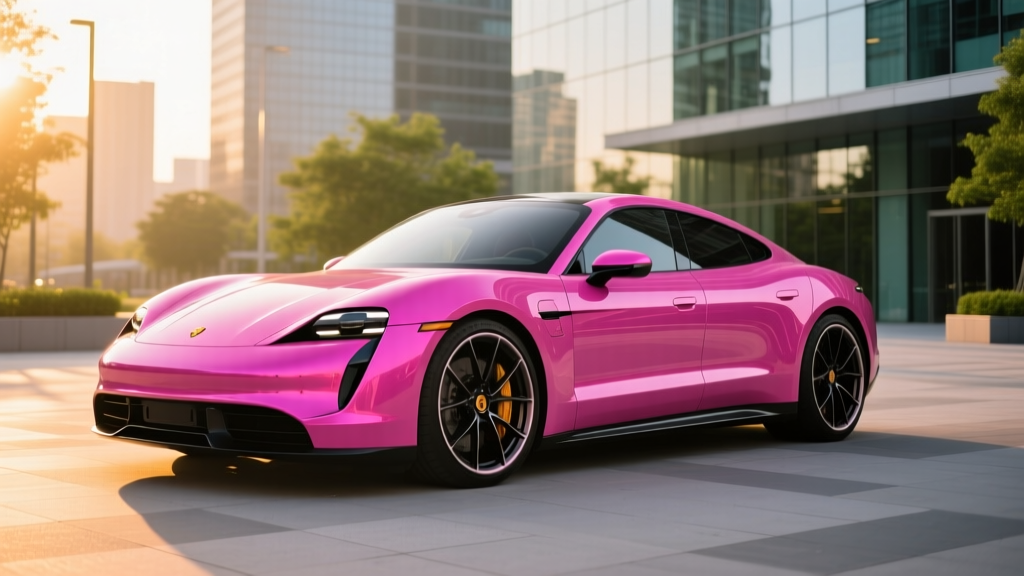
If you've seen a pastel-pink Porsche Taycan gliding through traffic and wondered whether the eye-catching paint hides a genuinely capable electric sports sedan — or just an expensive Instagram prop — you're asking the right question. The Porsche Taycan has evolved significantly since its 2020 debut, and the 2025 refresh brings updated battery chemistry, faster DC charging, and revised range figures that make it a more practical daily driver than ever. But what happens when you spec one in a custom pink?
This review covers every technical detail you need: EPA range versus real-world expectations, the Taycan's 800-volt charging architecture, performance across trims, cargo practicality, and the economics of ordering a Paint to Sample pink finish. We'll also address the federal tax credit question that surprises most luxury EV buyers.
The Pink Porsche Taycan: What You're Actually Ordering
Porsche does not currently offer a factory-standard pink in the Taycan's core color palette for the 2025 model year. To get a genuine pink Taycan, buyers pursue one of three routes:
- Paint to Sample (PTS): Porsche's custom color program lets you commission any historically offered Porsche color or request a unique shade. Pink options like Rose Quartz Metallic or a custom-matched pastel pink are available through this program. PTS adds roughly $12,000–$15,000 to the vehicle price and extends build lead time by 3–6 months.
- Exclusive Manufaktur: Porsche's higher-tier bespoke division can create a one-off pink through the Sonderwunsch (special wish) program, with pricing starting around $25,000+ above standard paint.
- Professional vinyl wrap: A high-quality color-change wrap in satin or gloss pink costs $4,000–$7,000 installed, is reversible, and protects the factory paint underneath. This is the route most pink Taycan owners actually take.
Regardless of exterior color, the underlying EV platform is identical. Let's get into the numbers that matter.
2025 Porsche Taycan Specs: Range, Battery, and Efficiency
| Specification | Taycan (Base RWD) | Taycan 4S | Taycan Turbo | Taycan Turbo GT |
|---|---|---|---|---|
| EPA Range | 292 mi | 277 mi | 283 mi | 269 mi |
| Battery (usable) | 89.0 kWh (NMC) | 89.0 kWh (NMC) | 89.0 kWh (NMC) | 89.0 kWh (NMC) |
| Horsepower | 402 hp | 590 hp (Launch Control) | 872 hp (Launch Control) | 1,019 hp (Launch Control) |
| 0–60 mph | 4.6 sec | 3.5 sec | 2.5 sec | 2.1 sec |
| Drivetrain | RWD, single motor | AWD, dual motor | AWD, dual motor | AWD, dual motor |
| MPGe (combined) | 88 MPGe | 84 MPGe | 82 MPGe | 78 MPGe |
| kWh/100 mi | 38 kWh | 40 kWh | 41 kWh | 43 kWh |
| Base MSRP | $103,800 | $123,800 | $175,800 | $240,000 |
The 2025 Taycan lineup uses an updated NMC (nickel manganese cobalt) lithium-ion battery with a gross capacity of 105 kWh and approximately 89 kWh usable, thanks to a larger top and bottom buffer than the pre-refresh pack. Porsche increased cell-level energy density and improved thermal management, which directly translates to the range bump over the 2024 model's 79.2 kWh Performance Battery and 93.4 kWh Performance Battery Plus options.
The EPA-estimated 292 miles for the base RWD Taycan is a legitimate figure for mixed city/suburban driving in moderate temperatures. However, expect the following adjustments:
- Highway cruising (75+ mph): ~230–250 miles before needing to charge. The Taycan's two-speed rear transmission helps highway efficiency, but aerodynamic drag still dominates above 70 mph.
- Cold weather (below 32°F): ~200–220 miles. The Taycan's heat pump (standard on 2025 models) mitigates cabin-heating energy draw, but battery chemistry inherently loses capacity in freezing temperatures.
- Optimal conditions (city, 55–65°F): You can approach or slightly exceed the 292-mile EPA figure thanks to aggressive regenerative braking recovery.
For the Turbo GT, real-world highway range drops to roughly 210–230 miles — the trade-off for 1,019 hp and sticky performance tires.
Charging Speed: 800-Volt Architecture at Work
The Taycan's 800-volt electrical architecture remains one of the best in the industry for DC fast charging. Here's how the numbers break down across charging levels:
| Charging Level | Power (kW) | Speed / Notes |
|---|---|---|
| Level 1 (120V household) | ~1.4 kW | ~4 miles per hour — emergency/top-up only |
| Level 2 (240V home, 48A) | 11.5 kW | ~32 miles per hour; full charge in ~8 hours |
| DC Fast Charge (peak) | 320 kW | 10–80% in ~18 minutes (optimal conditions) |
| DC Fast Charge (sustained avg.) | ~220–250 kW | Average rate 10–80%; charge curve tapers above 80% |
| DC Fast Charge (50 kW station) | 50 kW | 10–80% in ~70 minutes — typical older public charger |
The 2025 Taycan's peak 320 kW DC charge rate is a significant upgrade from the pre-refresh 270 kW. On a high-power Electrify America or IONITY stall (350 kW capable), the Taycan sustains above 250 kW through the 10–40% SoC range before tapering. The 10–80% sprint in approximately 18 minutes is among the fastest of any production EV in 2025.
Charge curve reality: Peak kW is not sustained kW. The Taycan's charge curve peaks early and tapers progressively above 60% SoC. Charging from 80–100% on DC adds roughly 20+ additional minutes — so plan your road trips around 80% stops, not full charges.
For home charging, the onboard 11.5 kW AC charger means a full charge from empty in about 8 hours on a 48-amp Level 2 circuit. Most owners plug in nightly and wake up with a full battery, making home charging the primary refueling method. A 240V/60A circuit installation typically costs $1,200–$2,500 depending on panel proximity, according to industry electrician estimates.
Performance: The Taycan Drives Like a Porsche First, EV Second
The Taycan's dual-motor AWD system (on 4S, Turbo, and Turbo GT) and rear-axle two-speed transmission set it apart from most EV competitors. The two-speed gearbox allows a shorter first gear for explosive launches and a taller second gear for highway efficiency — a mechanical solution that most EVs solve with single-speed reduction gears.
On the road, this translates to:
- Taycan 4S: 3.5-second 0–60 with Launch Control engaged. Sustained acceleration remains strong past 100 mph, where single-speed EVs typically lose urgency.
- Turbo GT: 2.1 seconds to 60 mph places it in hypercar territory. The Weissach Package deletes the rear seats for weight savings and adds a fixed carbon-fiber wing.
- Regen behavior: The Taycan offers up to 290 kW of regenerative braking force, but it does not provide true one-pedal driving to a full stop. You'll still use the friction brake pedal at low speeds — a deliberate Porsche engineering choice that some EV converts find unintuitive.
Handling remains the Taycan's strongest differentiator versus the Tesla Model S and Lucid Air. Rear-axle steering (standard on Turbo, optional on 4S), active anti-roll bars, and Porsche's 4D Chassis Control deliver a sports-sedan driving experience that happens to be electric.
Interior, Cargo, and Daily Practicality
The Taycan is a four-door sports sedan, not a crossover, and interior space reflects that priority:
- Front legroom: 41.5 inches — generous for any sedan
- Rear legroom: 32.7 inches — tight for adults over 6 feet; best for children or shorter passengers on longer trips
- Trunk (rear): 14.3 cubic feet (sedan) — sufficient for two carry-on bags and a garment bag
- Frunk (front): 2.9 cubic feet — enough for a charging cable bag and a small backpack
- Cross Turismo (wagon): Up to 42.8 cubic feet with rear seats folded — the practicality play for Taycan buyers who need cargo room
The 2025 Taycan's infotainment system uses a 12.6-inch curved driver display, a 10.9-inch central touchscreen, and an optional 10.9-inch front-passenger screen. Wireless Apple CarPlay and Android Auto are standard. The available passenger display is a conversation piece but adds $1,150 to the build.
Driver assistance: Porsche InnoDrive with Active Lane Keeping is the brand's Level 2 SAE driver-assist system. It handles adaptive cruise, lane centering, and predictive speed adjustment based on navigation data. It is competent on highways but not class-leading — Tesla's Autopilot and GM's Super Cruise offer more hands-free capability, though both still require driver attention.
Porsche InnoDrive is a SAE Level 2 driver-assistance system. The driver must keep hands on the wheel and eyes on the road at all times. It is not autonomous driving and does not handle construction zones, unmapped roads, or complex urban intersections reliably.
Pricing, Paint to Sample Pink Costs, and Tax Credit Reality
| Trim | Base MSRP | As-Tested (typical spec) | PTS Pink Add-On | §30D Federal Credit |
|---|---|---|---|---|
| Taycan (RWD) | $103,800 | $115,000–$125,000 | +$12,000–$15,000 | Not eligible (MSRP cap) |
| Taycan 4S | $123,800 | $140,000–$155,000 | +$12,000–$15,000 | Not eligible (MSRP cap) |
| Taycan Turbo | $175,800 | $190,000–$210,000 | +$12,000–$15,000 | Not eligible (MSRP cap) |
| Taycan Turbo GT | $240,000 | $250,000+ | +$12,000–$15,000 | Not eligible (MSRP cap) |
Does the pink Porsche Taycan qualify for the federal EV tax credit? No. Under current IRS §30D rules, the new clean vehicle credit has an MSRP cap of $55,000 for sedans. Every Taycan trim far exceeds this threshold. Additionally, the credit has modified adjusted gross income limits ($150,000 single / $300,000 joint) and critical-mineral/battery-component sourcing requirements. Even if the MSRP cap didn't apply, the Taycan's battery supply chain would likely not meet the domestic-sourcing thresholds. See the IRS §30D page for current eligibility rules.
For a pink Taycan via Paint to Sample, expect a total build price of $127,000–$140,000 for a well-equipped RWD model, or $155,000–$170,000 for a 4S. The vinyl-wrap alternative at $4,000–$7,000 is the cost-effective path and preserves resale value by protecting factory paint.
Porsche Taycan vs. Key Competitors
The pink Taycan doesn't exist in a vacuum. Here's how it stacks up against the electric luxury sedans it competes with:
| Attribute | 2025 Porsche Taycan 4S | 2025 Tesla Model S Plaid | 2025 Lucid Air Grand Touring |
|---|---|---|---|
| EPA Range | 277 mi | 359 mi | 516 mi |
| 0–60 mph | 3.5 sec | 1.99 sec | 3.0 sec |
| Peak DC Charge | 320 kW | 250 kW | 300+ kW |
| Base MSRP | $123,800 | $89,990 | $125,650 |
| Handling / Driving Dynamics | Class-leading | Competent | Comfortable GT |
| Custom Paint Options | Extensive (PTS) | Limited | Limited |
| Federal Tax Credit | No | No | No |
- Choose the Taycan if: Driving engagement, build quality, and brand cachet matter more than maximum range. You want a sports sedan that happens to be electric, and you value Porsche's dealer experience and PTS customization.
- Choose the Lucid Air if: Range is your top priority (516 mi EPA) and you prefer a more spacious rear seat and trunk.
- Choose the Tesla Model S if: You want the lowest entry price in this segment, access to the Supercharger network, and the fastest straight-line acceleration.
Battery Warranty and Long-Term Ownership
Porsche provides an 8-year / 100,000-mile warranty on the Taycan's high-voltage battery, guaranteeing a minimum of 70% state of health (SoH) retention over that period. If the battery degrades below 70% capacity within the warranty window, Porsche will repair or replace modules to bring it above the threshold.
The NMC chemistry in the Taycan is well-understood. Real-world degradation data from earlier Taycan model years (2020–2023) suggests approximately 5–8% capacity loss over the first 60,000 miles for drivers who predominantly use Level 2 home charging. Frequent DC fast charging and routinely charging to 100% accelerate degradation — Porsche recommends setting a daily charge limit of 85% and using the vehicle's built-in preconditioning before DC charging sessions.
For the 2025 model year, the standard vehicle limited warranty covers 4 years / 50,000 miles, which is typical for the luxury German segment but shorter than Hyundai/Kia's 10-year coverage. Scheduled maintenance is minimal (cabin air filter, brake fluid check, tire rotation), with estimated annual costs of $200–$400 — dramatically less than a comparable Panamera or 911.
Pros and Cons of the Pink Porsche Taycan
- Best-in-class handling and driving dynamics for an electric sedan
- 320 kW peak DC charging — 10–80% in ~18 minutes on capable chargers
- 800V architecture enables sustained high charge rates
- Paint to Sample program offers genuine customization (including pink)
- Two-speed rear transmission preserves high-speed acceleration
- Heat pump standard — better cold-weather range retention
- Build quality and materials exceed Tesla and match/exceed Lucid
- EPA range trails Lucid Air and Tesla Model S significantly
- No federal tax credit eligibility — MSRP far exceeds §30D cap
- Rear seat legroom is tight at 32.7 inches
- Paint to Sample adds $12,000–$15,000 and months of wait time
- No true one-pedal driving (regen doesn't hold to a full stop)
- Frunk is small at 2.9 cu ft
- InnoDrive ADAS is competent but behind Super Cruise and Autopilot
Frequently Asked Questions
What is the real-world range of the pink Porsche Taycan?
The EPA-estimated range is 292 miles for the RWD base model and 277 miles for the 4S. In real-world highway driving at 75 mph, expect 230–250 miles (RWD) or 220–240 miles (4S). Cold weather below freezing reduces range by roughly 20–25%, bringing highway range to approximately 200–220 miles for the base model. The color of the vehicle has no measurable impact on range.
How fast does the Taycan charge at home and on the road?
At home on a 240V Level 2 charger (48A), the Taycan charges at 11.5 kW, adding roughly 32 miles of range per hour and reaching a full charge in about 8 hours. On a 350 kW-capable DC fast charger, the Taycan peaks at 320 kW and charges from 10–80% in approximately 18 minutes. On older 50 kW public chargers, 10–80% takes roughly 70 minutes.
How much does a pink Porsche Taycan cost after tax credits?
There is no federal tax credit for the Taycan — it exceeds the $55,000 MSRP cap for sedans under IRS §30D rules. A base RWD Taycan in a Paint to Sample pink starts around $115,800–$118,800 before destination, and a typical well-equipped build lands between $127,000–$140,000. A vinyl wrap in pink over a standard-color Taycan is a $4,000–$7,000 alternative. Some states offer separate EV rebates that may apply — check your state's energy office for current programs.
Is the Taycan worth buying versus the Tesla Model S or Lucid Air?
If driving dynamics, build quality, and brand prestige are your top priorities, the Taycan is the strongest choice in the segment. If maximum range is paramount, the Lucid Air Grand Touring (516 mi EPA) wins decisively. If value and acceleration matter most, the Tesla Model S Plaid offers 1.99-second 0–60 times and 359 miles of range at a lower base price. The Taycan's advantage is its sports-car character — it's the EV that most convincingly drives like a Porsche.
Does a vinyl wrap void the Taycan's warranty?
A professionally installed vinyl wrap does not void the vehicle's mechanical or battery warranty. However, if wrap removal damages paint or trim, those repairs would not be covered. Using a reputable installer and documenting the pre-wrap paint condition with photos is recommended. Porsche dealers have confirmed that wraps do not affect powertrain or battery warranty claims.
What's the biggest regret Taycan owners report?
Based on owner forums and long-term reviews, the most common regrets are: (1) not opting for the Cross Turismo body style if cargo space is needed, (2) wishing for more rear-seat legroom on road trips with adult passengers, and (3) not spec'ing the larger 21-inch wheels with the understanding that they reduce range by 5–10% versus the standard 19-inch aero wheels.
The pink Porsche Taycan is ultimately a statement car backed by legitimate engineering. The 800-volt charging, sub-4-second acceleration (in 4S trim or above), and Porsche's chassis tuning deliver a driving experience that no competitor fully replicates. The range deficit versus Lucid and Tesla is real, and the tax-credit ineligibility is a given at this price point. But if you want an electric sports sedan that turns heads in pink and backs it up on a canyon road, the Taycan remains the benchmark.