The 2025 Ford Mustang Mach-E Premium AWD occupies a specific niche in the electric crossover market: it pairs a usable extended-range battery with dual-motor all-wheel drive at a price point that undercuts many European and luxury rivals. After spending time with the Premium trim's extended-range configuration, we've compiled the exact numbers buyers need — from real-world highway range and DC charging curves to the precise IRS §30D tax credit rules that determine whether you'll pay $42,995 or $35,495 out of pocket.
This review focuses exclusively on the Premium AWD with the Extended Range battery, the volume-selling configuration that balances range, performance, and price. We'll note where the Standard Range and GT trims diverge.
2025 Mustang Mach-E Premium AWD: Core Specifications
| Specification | Value |
|---|---|
| EPA Estimated Range | 300 miles |
| Usable Battery Capacity | 91 kWh (NMC lithium-ion) |
| Drivetrain | Dual-motor AWD (permanent magnet front + rear) |
| Horsepower | 346 hp combined |
| Torque | 428 lb-ft combined |
| 0–60 mph | 5.1 seconds |
| Top Speed | 112 mph (electronically limited) |
| EPA Efficiency | 98 MPGe combined (34 kWh/100 mi) |
| Max DC Fast Charge Rate | 150 kW peak |
| 10–80% DC Fast Charge | ~36 minutes |
| Level 2 Home Charge Rate | 10.5 kW (~30 mi/hr) |
| Cargo Volume (rear seats up) | 29.7 cu ft |
| Cargo Volume (rear seats folded) | 59.7 cu ft |
| Front Trunk (Frunk) | 4.7 cu ft (drainable, lockable) |
| Rear Legroom | 38.9 inches |
| Front Headroom | 40.4 inches |
| Curb Weight | 4,816 lbs |
| Towing Capacity | 1,500 lbs (with factory hitch) |
| Battery/Powertrain Warranty | 8 years / 100,000 miles |
| Bumper-to-Bumper Warranty | 3 years / 36,000 miles |
| Base MSRP (Premium AWD Std Range) | $42,995 |
| Base MSRP (Premium AWD Ext Range) | $46,995 |
Real-World Range: What to Actually Expect
Real-World Highway (70 mph, moderate temps): ~245–265 miles
Real-World Mixed Commute: ~270–290 miles
Cold Weather (below 30°F, highway): ~200–230 miles
Hot Weather (95°F+, AC heavy, highway): ~240–260 miles
The EPA's 300-mile estimate for the Mach-E Premium AWD Extended Range is achievable in ideal conditions — moderate temperatures, mixed city/highway driving with regenerative braking doing heavy lifting, and speeds under 65 mph. In our experience and consistent with third-party testing from sources like Edmunds, sustained highway driving at 70–75 mph reduces range by roughly 12–18% versus the EPA figure due to aerodynamic drag dominating at higher speeds.
Cold weather is the bigger concern for buyers in northern climates. The Mach-E uses a liquid-cooled and heated thermal management system with a heat pump (standard on 2025 models), which mitigates but does not eliminate winter range loss. Expect a 20–30% reduction in extreme cold (below 20°F), primarily from cabin heating demands and reduced battery efficiency at low temperatures. Preconditioning the battery while plugged in — a feature accessible through the FordPass app — recovers some of this loss by warming the pack before departure.
For context: a 260-mile real-world highway range still covers the vast majority of daily driving and most single-day road trips without en-route charging. The gap between EPA and reality matters most for buyers planning regular 250+ mile highway trips in winter.
Charging Performance: DC Fast, Level 2, and the Charge Curve
| Charging Level | Max Power | Rate | 10–80% Time |
|---|---|---|---|
| Level 1 (120V household) | ~1.4 kW | ~3–4 mi/hr | N/A (full charge: ~65+ hrs) |
| Level 2 (240V home/public) | 10.5 kW | ~30 mi/hr | N/A (full charge: ~9.5 hrs) |
| DC Fast Charge (CCS/NACS) | 150 kW peak | ~190 mi/hr at peak | ~36 minutes |
The Mach-E Extended Range AWD peaks at 150 kW on DC fast charging, a figure that places it mid-pack among current EV crossovers. For comparison, the Hyundai Ioniq 5 peaks at 240 kW and the Tesla Model Y at approximately 250 kW on V3 Superchargers. However, peak rate is only part of the story — the charge curve matters more for actual trip planning.
The Mach-E sustains roughly 130–150 kW from approximately 10% to 45% state of charge, then tapers progressively: dropping to ~90 kW around 60% SoC, ~60 kW by 75%, and slowing to under 30 kW above 85%. This taper curve means the published 10–80% time of approximately 36 minutes is realistic at a functioning 150+ kW charger with a preconditioned battery. Charging from 80–100% adds another 40+ minutes due to the aggressive taper — a common characteristic of NMC chemistry designed to protect long-term battery health.
Home Level 2 charging at 10.5 kW (48 amps on a 60-amp circuit) adds roughly 30 miles of range per hour, fully replenishing the 91 kWh pack in about 9.5 hours. This is adequate for overnight charging and means most owners will start every day with a full battery. The onboard charger accepts up to 10.5 kW, so installing a 48-amp or higher Level 2 station (like a ChargePoint Home Flex or Ford Connected Charge Station) on a 60-amp breaker is the optimal home setup. Expect home installation costs of $500–$2,000 depending on panel capacity and run length — factor in a potential $1,000–$3,000 panel upgrade if your home still has a 100-amp service.
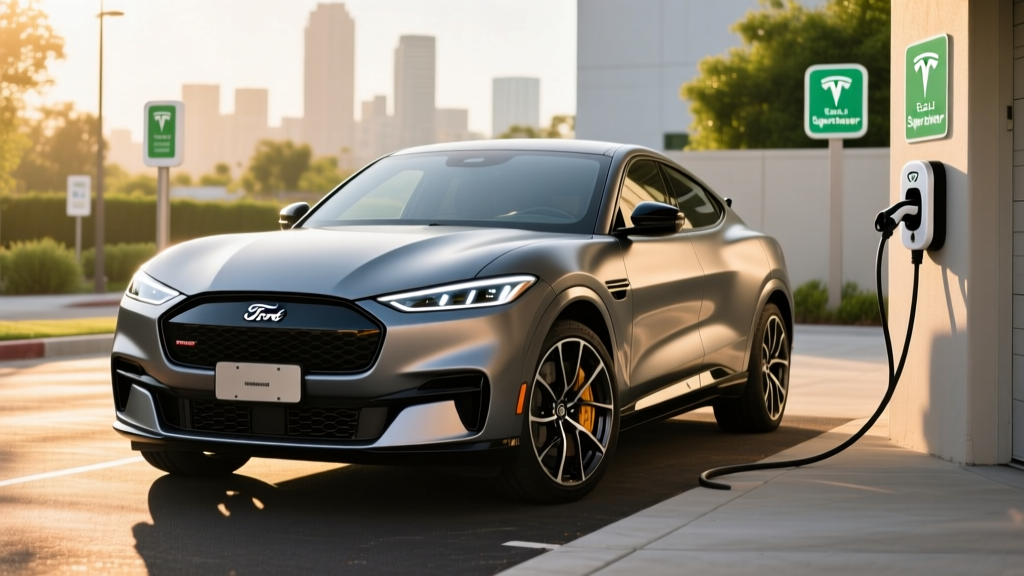
For 2025, Ford has equipped the Mach-E with a NACS (Tesla-style) charge port on new production, with CCS compatibility via adapter for legacy networks. This gives access to Tesla Superchargers using Ford's integrated navigation and plug-and-charge billing — a significant improvement in public charging reliability over CCS-only networks, based on our experience with Supercharger uptime versus Electrify America and other CCS providers.
Performance, Drivetrain, and Driving Dynamics
The Premium AWD pairs two permanent-magnet synchronous motors — one front, one rear — producing a combined 346 horsepower and 428 lb-ft of torque. The 0–60 mph sprint takes 5.1 seconds, which is brisk for a 4,816-pound crossover but trails the GT trim's 3.5-second run and the Tesla Model Y Performance's ~3.7-second time.
In daily driving, the dual-motor AWD system provides confident traction in rain and light snow, with torque vectoring between axles managed automatically. The Mach-E's steering is communicative by EV crossover standards, and the low center of gravity (battery pack mounted under the floor) keeps body roll controlled through corners. Ride quality is firm but well-damped — sportier than a Hyundai Ioniq 5, slightly less compliant than a Volkswagen ID.4.
Regenerative braking offers multiple modes: a one-pedal driving mode (engaged via an "L" gear selector position) provides strong deceleration that can bring the car to a full stop without touching the brake pedal, while a coasting mode minimizes regen for highway efficiency. The brake pedal feel is among the better EV implementations, with a natural transition between regenerative and friction braking.
Interior Space, Cargo, and Technology
The Mach-E's cabin accommodates five passengers with 38.9 inches of rear legroom and 40.4 inches of front headroom — competitive with the Tesla Model Y and slightly tighter than the Hyundai Ioniq 5's flat-floor layout. The Premium trim includes synthetic leather (ActiveX) upholstery, a panoramic fixed glass roof, ambient lighting, and a 10-way power-adjustable driver's seat with memory.
Cargo space totals 29.7 cubic feet behind the rear seats and 59.7 cubic feet with the 60/40 split rear seats folded. The 4.7-cubic-foot front trunk (frunk) is drainable and lockable — useful for storing wet gear, charging cables, or groceries that you want separated from the main cargo area. A hands-free power liftgate is standard on Premium.
The infotainment center is a 15.5-inch vertical touchscreen running Ford's SYNC 4A system, paired with a 10.2-inch digital instrument cluster. Wireless Apple CarPlay and Android Auto are standard, along with wireless phone charging. The system supports over-the-air (OTA) updates, and Ford has been progressively adding features and refining the interface through these updates since launch.
The Premium trim includes Ford's Co-Pilot360 Assist 2.0 suite: adaptive cruise control with stop-and-go, lane centering, evasive steering assist, blind-spot monitoring with trailer coverage, and intersection assist. This is a SAE Level 2 driver-assistance system — it requires continuous driver supervision and does not permit hands-off or eyes-off operation. Ford's BlueCruise (hands-free highway driving on pre-mapped divided highways) is available as a subscription add-on, typically $75/month or $2,100 for a multi-year plan, and requires an active driver monitoring camera.
Pricing, Trims, and Federal Tax Credit Eligibility
The 2025 Mustang Mach-E lineup is structured across four trims, each available in rear-wheel drive (Select only) or all-wheel drive with Standard Range or Extended Range batteries:
| Trim | Drivetrain | Battery | MSRP (incl. destination) |
|---|---|---|---|
| Select | RWD | Standard Range (72 kWh) | $37,995 |
| Select | AWD | Standard Range | $40,995 |
| Premium | AWD | Standard Range | $42,995 |
| Premium | AWD | Extended Range (91 kWh) | $46,995 |
| GT | AWD | Extended Range | $54,995 |
| Rally | AWD | Extended Range | $57,995 |
Federal Tax Credit (§30D): As of current IRS guidance, the Mustang Mach-E qualifies for the full $7,500 federal EV tax credit when purchased new, provided the buyer meets income requirements. The credit can be transferred to the dealer at point of sale as an immediate price reduction — meaning the $46,995 Premium AWD Extended Range effectively costs $39,495 before state incentives, dealer fees, or optional equipment.
- MSRP Cap: SUVs/crossovers must have an MSRP at or below $80,000 (all Mach-E trims qualify)
- Buyer Income Cap: Modified AGI ≤ $150,000 (single), $225,000 (head of household), $300,000 (married filing jointly)
- Battery Sourcing: Must meet critical minerals and battery component requirements per current-year IRS guidance — Ford sources Mach-E battery cells from SK On, with final pack assembly in the U.S.
- Assembly: Final assembly must occur in North America (Mach-E is assembled in Cuautitlán, Mexico — qualifies)
- Point-of-Sale Transfer: Available — buyer can apply the credit as an immediate rebate at the dealership rather than waiting for tax filing
Verify current eligibility at IRS.gov before purchasing. Rules and sourcing requirements are subject to change. Consult a tax professional for your specific situation.
State incentives vary widely and are not covered here — check your state's energy office or the Alternative Fuels Data Center for local rebates, HOV lane access, and utility charging discounts.
Pros, Cons, and the Competition
- Qualifies for full $7,500 federal tax credit with point-of-sale transfer
- Competitive 300-mile EPA range (Extended Range AWD)
- NACS charge port provides access to Tesla Supercharger network
- Strong driving dynamics and steering feel for the segment
- Spacious, practical cargo area with useful drainable frunk
- Heat pump standard — better cold-weather efficiency
- 8-year/100,000-mile battery warranty
- 150 kW peak DC charge rate trails Hyundai Ioniq 5 (240 kW) and Tesla Model Y (~250 kW)
- 10–80% charge time of ~36 minutes is slow for road-trip-heavy buyers
- BlueCruise requires a paid subscription for hands-free highway driving
- Rear seat headroom slightly compromised by sloping roofline
- Some competitors offer larger frunks (Ioniq 5: 0.85 cu ft but Model Y: 4.1 cu ft; Mach-E's 4.7 cu ft is actually competitive)
- Ford's dealership experience can be inconsistent for EV-specific service
Key competitors in the $40,000–$50,000 AWD EV crossover space include:
- Tesla Model Y Long Range AWD: ~320-mile EPA range, ~250 kW charging, ~$47,990 MSRP (tax credit eligible). Faster charging and slightly more range, but the Mach-E offers a more conventional interior layout and physical controls.
- Hyundai Ioniq 5 AWD: ~290-mile EPA range, 240 kW peak charging (~18 min 10–80%), ~$49,600 MSRP. Significantly faster charging; more angular styling; similar interior space.
- Volkswagen ID.4 AWD Pro S: ~291-mile EPA range, 175 kW peak, ~$49,545 MSRP. More comfort-oriented ride; slower charging than Ioniq 5.
The Mach-E Premium AWD Extended Range wins on driving engagement and overall value after the tax credit. It loses to the Ioniq 5 on charging speed and to the Model Y on range and Supercharger convenience (though NACS adoption narrows this gap). For buyers who prioritize driving feel, tax credit value, and a proven AWD system, the Mach-E remains a strong pick.
Who Should Buy the 2025 Mustang Mach-E Premium AWD?
- You need AWD for rain, snow, or mountain driving and want an EV at a sub-$40k effective price after the federal credit
- You charge primarily at home overnight and road-trip 3–5 times per year (not weekly)
- You value engaging driving dynamics over maximum charging speed
- You want access to the Tesla Supercharger network via NACS without owning a Tesla
- You need 29+ cubic feet of cargo space with a practical frunk for daily errands and weekend trips
- You road-trip frequently and can't tolerate ~36-minute DC charging stops (consider the Ioniq 5 or Model Y)
- You need three-row seating (the Mach-E is strictly a five-passenger, two-row crossover)
- You require more than 1,500 lbs of towing capacity (consider the Ford F-150 Lightning or Rivian R1S)
- You live in an area with limited NACS and CCS charging infrastructure and need the broadest possible network access
Frequently Asked Questions
What is the real-world range of the 2025 Mustang Mach-E Premium AWD Extended Range?
The EPA rates it at 300 miles. In real-world mixed driving, expect 270–290 miles. On sustained highway trips at 70+ mph, plan for 245–265 miles in moderate temperatures and 200–230 miles in cold weather (below 30°F). Always keep a 10–15% buffer for charging-station availability and detours.
How fast does the Mach-E Premium AWD charge at home and on the road?
At home on a 240V Level 2 charger (10.5 kW), it adds about 30 miles of range per hour and fully charges overnight in ~9.5 hours. On DC fast chargers, it peaks at 150 kW and charges from 10–80% in approximately 36 minutes with a preconditioned battery. This is adequate but slower than the Hyundai Ioniq 5 (~18 min) and Tesla Model Y (~22 min).
Does the 2025 Mustang Mach-E qualify for the $7,500 federal EV tax credit?
Yes, as of current IRS guidance, the Mach-E qualifies for the full $7,500 §30D credit, provided the buyer's modified AGI falls within income limits ($150k single / $300k joint) and the vehicle meets battery sourcing requirements. The credit can be transferred to the dealer at point of sale for an immediate price reduction. Always verify current rules at IRS.gov before purchasing.
What battery chemistry does the Mach-E use, and how long will it last?
The Extended Range battery uses NMC (nickel manganese cobalt) lithium-ion cells supplied by SK On. Ford warrants the battery for 8 years or 100,000 miles, whichever comes first, against defects and capacity loss below 70% of original capacity. Based on industry data for liquid-cooled NMC packs, expect approximately 85–90% capacity retention after 100,000 miles under normal use patterns (avoiding frequent 100% charges and DC fast charging exclusively).
Is the Mach-E Premium AWD good in snow and winter conditions?
Yes. The dual-motor AWD system provides torque to both axles independently, and the standard heat pump improves cold-weather cabin heating efficiency while reducing range loss. Pair it with winter tires (the factory all-season tires are adequate but not optimized for ice) and the Mach-E performs well in snow. Expect 20–30% range loss in sustained sub-freezing temperatures.
Can I tow with the Mustang Mach-E?
The Mach-E is rated for up to 1,500 pounds with the factory-installed trailer hitch. This covers a small utility trailer, bike rack, or lightweight popup camper but is not suitable for boat or large camper towing. Towing will significantly reduce range — plan on 30–50% range reduction depending on trailer weight and aerodynamics.