The Bottom Line on Peugeot Electric Vehicles in 2026
Peugeot does not sell cars in the United States. The brand withdrew from the US market in 1991, and as of 2026, its parent company Stellantis has announced no plans to reintroduce Peugeot to American dealerships. Peugeot's electric lineup — the e-208, e-308, e-2008, e-3008, and e-5008 — is built on the STLA Medium platform and uses a mix of NMC and LFP battery chemistries with ranges spanning 210 to 410 miles on the European WLTP cycle. For US-based EV shoppers researching Peugeot electric vehicles, this guide translates European specs into EPA-equivalent estimates, compares them against US-available alternatives, and provides a decision framework for what to buy instead.
Peugeot's 2026 Electric Lineup at a Glance
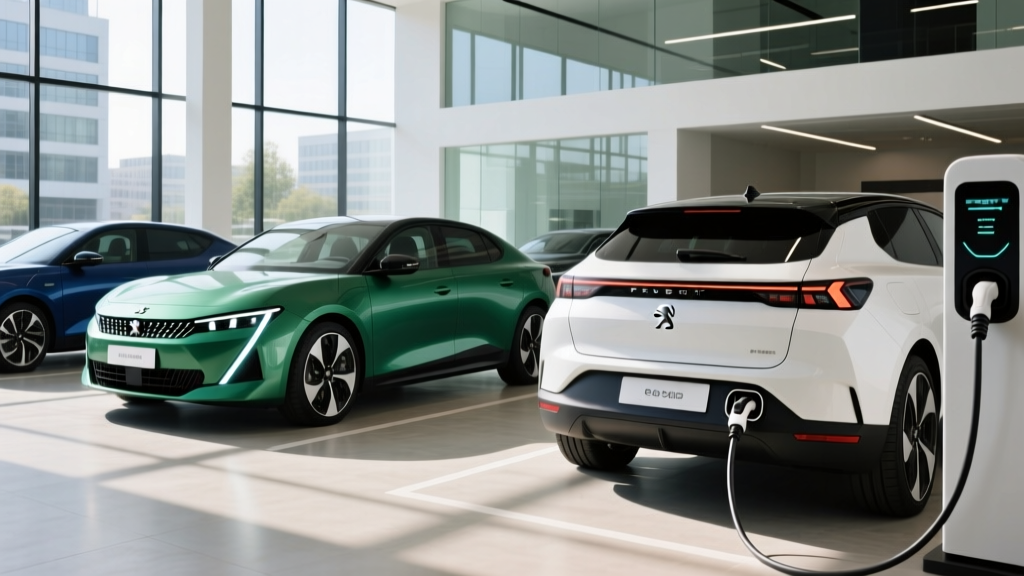
Peugeot has been steadily electrifying its range under Stellantis's "Dare Forward 2030" strategy. By 2026, the brand offers full battery-electric versions of most core models. Here is the current lineup with WLTP and estimated EPA-equivalent figures.
| Model | Battery (kWh usable) | Chemistry | WLTP Range | Est. EPA Range | Peak DC Charge | 10–80% Time | HP | 0–62 mph | Est. EU Price |
|---|---|---|---|---|---|---|---|---|---|
| e-208 | 51 kWh | NMC | 248 mi (400 km) | ~210 mi | 100 kW | ~25 min | 156 hp | 8.1 sec | €34,600 |
| e-2008 | 54 kWh | NMC | 267 mi (430 km) | ~225 mi | 100 kW | ~27 min | 156 hp | 9.1 sec | €38,400 |
| e-308 | 54 kWh | NMC | 260 mi (418 km) | ~218 mi | 100 kW | ~25 min | 156 hp | 8.4 sec | €42,800 |
| e-3008 | 73 kWh (LFP) / 98 kWh (NMC) | LFP / NMC | 326–410 mi (525–660 km) | ~275–345 mi | 160 kW | ~22–30 min | 210–320 hp | 6.4–8.8 sec | €44,990–€55,000 |
| e-5008 | 73 kWh (LFP) / 98 kWh (NMC) | LFP / NMC | 310–410 mi (500–660 km) | ~260–345 mi | 160 kW | ~22–30 min | 210–320 hp | 6.8–8.9 sec | €49,990–€59,000 |
Note: WLTP range figures run approximately 15–20% higher than EPA estimates due to different testing protocols. "Est. EPA Range" is an approximate conversion based on historical WLTP-to-EPA ratios for similar Stellantis vehicles. EU prices include VAT and are approximate MSRP figures as of early 2026.
WLTP vs. EPA: What the Range Numbers Really Mean
European buyers see Peugeot's range advertised under the WLTP (Worldwide Harmonised Light Vehicle Test Procedure) standard, which tends to produce more optimistic figures than the US EPA cycle. For context:
- WLTP includes more low-speed urban driving, lower average speeds, and milder climate assumptions.
- EPA factors in higher sustained highway speeds, aggressive acceleration profiles, and accounts for real-world accessories like HVAC use.
If Peugeot were to certify these vehicles for the US, the e-3008 with the 98 kWh NMC pack — rated at 410 miles WLTP — would likely sticker around 340–345 miles EPA. That is competitive with the Tesla Model Y Long Range (EPA 320 miles) but behind the Hyundai Ioniq 5 Long Range RWD (EPA 318 miles in a lighter, more efficient package).
Real-World Range Expectations
EPA-equivalent estimates are still best-case scenarios under mixed driving. In practice, expect:
- Highway driving at 75 mph: Subtract 10–15% from the EPA estimate.
- Cold weather (below 32°F / 0°C): Subtract 20–30% due to battery chemistry limitations and cabin heating demands.
- Combined real-world mixed driving: The e-3008 98 kWh would likely deliver 270–310 miles in moderate conditions, dropping to 230–250 miles in winter for northern US climates.
Charging Speeds and Infrastructure Reality
Peugeot's electric vehicles use the CCS2 connector standard in Europe. If imported to the US, they would require CCS1 (the North American standard) or, increasingly, the Tesla NACS connector that Ford, GM, Rivian, and others have adopted for 2025+.
| Charging Level | Power | e-208 / e-308 (51–54 kWh) | e-3008 / e-5008 (98 kWh) | Miles Added per Hour |
|---|---|---|---|---|
| Level 1 (120V household) | ~1.4 kW | ~4 mi/hr | ~4 mi/hr | 3–5 mi |
| Level 2 (240V home/public) | 7.4–11 kW | ~20–30 mi/hr | ~25–35 mi/hr | 20–35 mi |
| DC Fast Charge | 100 kW (small) / 160 kW (large) | 10–80% in ~25 min | 10–80% in ~22–30 min | 150–250 mi in 20 min |
The 100 kW peak DC rate on the smaller Peugeot models (e-208, e-2008, e-308) is a notable limitation. Competitors like the Hyundai Ioniq 5 and Kia EV6 accept up to 240 kW on 800V architectures, completing a 10–80% charge in roughly 18 minutes. The e-3008/e-5008 at 160 kW is more competitive but still trails the 250–350 kW peak rates of Tesla, Lucid, and Porsche.
Charging curves matter: Peugeot's 100 kW peak is typically sustained only between roughly 10–50% State of Charge (SoC). Above 60%, the rate tapers significantly, meaning the 10–80% time is an average, not a sustained rate.
Peugeot Electric Vehicles vs. US-Available Alternatives
Since Peugeot is not purchasable in the US, here is how its EVs compare to stateside equivalents in the same segments.
| Attribute | Peugeot e-3008 (98 kWh) | Tesla Model Y LR (US) | Hyundai Ioniq 5 LR (US) | VW ID.4 Pro S (US) |
|---|---|---|---|---|
| EPA Est. Range | ~345 mi (est.) | 320 mi | 318 mi | 291 mi |
| Battery (usable) | 98 kWh NMC | 75 kWh NMC | 77.4 kWh NMC | 82 kWh NMC |
| Peak DC Charge | 160 kW | 250 kW | 240 kW (800V) | 175 kW |
| 10–80% DC Time | ~30 min | ~20 min | ~18 min | ~29 min |
| 0–60 mph | ~6.4 sec (est.) | 5.0 sec | 5.1 sec | 7.7 sec |
| US MSRP | N/A (not sold in US) | $44,990 | $46,650 | $46,290 |
| Federal Tax Credit (§30D) | N/A | $3,750–$7,500* | $7,500* | $7,500* |
| Connector | CCS2 (EU) | NACS | CCS1 / NACS (2026) | CCS1 / NACS (2026) |
*Federal tax credit amounts reflect 2026 IRS §30D rules including battery sourcing and critical mineral requirements. Eligibility depends on MSRP caps, buyer income limits, and component sourcing. Always verify with a tax professional.
Cost of Ownership: What If Peugeot Were Available?
While you cannot buy a Peugeot EV in the US, understanding the cost profile helps contextualize how it would compare if Stellantis ever brought the brand stateside.
| Cost Category | Peugeot e-3008 (est. US equiv.) | Tesla Model Y LR | Gas Equiv. (Peugeot 3008 Hybrid) |
|---|---|---|---|
| Purchase Price (MSRP) | ~$48,000 (est.) | $44,990 | ~$38,000 (est. EU hybrid) |
| Federal Tax Credit | N/A (not US-sold) | $3,750–$7,500 | $0 |
| Net Purchase Cost | ~$48,000 | ~$37,490–$41,240 | ~$38,000 |
| Fuel/Energy (5 yr, 12k mi/yr) | ~$3,200 (home L2 @ $0.14/kWh) | ~$2,900 | ~$7,500 (gas @ $3.50/gal, 30 MPG) |
| Maintenance (5 yr) | ~$1,500 (est.) | ~$1,200 | ~$3,500 |
| Insurance (5 yr avg.) | ~$9,000 (est.) | ~$10,500 | ~$7,500 |
| 5-Year Total Cost | ~$61,700 | ~$53,100–$55,900 | ~$56,500 |
The fundamental EV cost advantage — cheaper fueling and lower maintenance — holds regardless of brand. However, Peugeot's lack of US availability means no federal tax credit, no state incentives, and no established service network, all of which severely erode any potential cost parity with US-available EVs.
Battery Chemistry and Longevity: LFP vs. NMC in Peugeot's Lineup
For the 2026 model year, Peugeot has introduced LFP (lithium iron phosphate) battery options on the e-3008 and e-5008 alongside the standard NMC (nickel manganese cobalt) packs. This is a significant strategic shift worth understanding.
| Attribute | LFP (73 kWh, e-3008/e-5008) | NMC (98 kWh, e-3008/e-5008) |
|---|---|---|
| Energy Density | Lower (heavier pack for less range) | Higher (more range per kg) |
| Range (WLTP) | 326 mi (525 km) | 410 mi (660 km) |
| Cycle Life | 3,000+ cycles (superior longevity) | 1,500–2,000 cycles |
| Cold Weather Performance | More range loss in freezing temps (~30–35%) | Better cold retention (~20–25% loss) |
| Charging to 100% | Recommended regularly for calibration | Best kept at 80% daily; 100% for trips only |
| Cost | Lower (cobalt-free) | Higher |
| Warranty | 8 yr / 100,000 mi (70% SoH) | 8 yr / 100,000 mi (70% SoH) |
The LFP option makes the e-3008 more affordable (starting around €44,990 in Europe) and offers superior long-term cycle life, but trades off range and cold-weather performance. US buyers in northern climates would likely prefer the NMC variant if available.
Common Misconceptions About Peugeot EVs
| Myth | Fact |
|---|---|
| "Peugeot is coming back to the US soon." | Stellantis has made no official announcement about reintroducing Peugeot to the US market. The brand's US focus remains on Jeep, Ram, Dodge, Chrysler, and Alfa Romeo. Stellantis brand page confirms Peugeot's markets are Europe, Africa, Middle East, and select Asian markets. |
| "WLTP range is the same as real-world range." | WLTP overstates range by roughly 15–20% compared to EPA testing and up to 30% versus aggressive highway driving. A 410-mile WLTP rating translates to roughly 345 miles EPA and 270–310 miles real-world mixed. |
| "You can import a Peugeot EV to the US." | Federal motor vehicle safety standards (FMVSS), EPA emissions certification, and DOT requirements make personal importation of a non-conforming Peugeot effectively impossible for road use. The 25-year import exemption applies only to vehicles manufactured before 2001. |
| "Peugeot EVs charge as fast as a Tesla." | Peugeot's peak DC rate of 100–160 kW is substantially slower than Tesla's 250 kW (V3 Supercharger) or Hyundai/Kia's 800V architecture at 240+ kW. A 10–80% charge takes 22–30 minutes versus 15–20 minutes for the fastest competitors. |
| "All Peugeot EVs use the same battery." | The 2026 lineup spans two platforms: CMP (e-208, e-2008, e-308 with ~51–54 kWh NMC) and STLA Medium (e-3008, e-5008 with 73 kWh LFP or 98 kWh NMC options). |
What First-Time EV Buyers Should Know (If You're Researching Peugeot)
If you have landed on this guide because you are drawn to Peugeot's design language or European engineering, here are the practical realities of EV ownership that apply regardless of brand:
- Home charging is essential for convenience. Level 2 home charging (240V, 7.4–11 kW) adds 20–35 miles of range per hour and costs $500–$2,500 to install depending on electrical panel capacity and run length. Without home charging, EV ownership becomes significantly less convenient.
- Public DC fast charging is for road trips, not daily use. Frequent DC fast charging accelerates battery degradation. Plan to do 80%+ of your charging at home or work on Level 2.
- Cold weather reduces range. All EVs lose 15–35% of range in freezing temperatures. A heat pump (standard on most 2026 Peugeots) helps but does not eliminate the loss.
- The federal tax credit has strict rules. Under IRS §30D, the $7,500 credit requires meeting battery component sourcing (100% North American for 2026), critical mineral thresholds, MSRP caps ($55,000 for SUVs, $50,000 for sedans), and buyer income limits ($300K joint / $150K single). Even US-available vehicles may qualify for only $3,750 or nothing at all.
- Insurance costs more for EVs. Expect 15–25% higher premiums versus equivalent gas cars due to higher repair costs and specialized parts.
Decision Framework: What to Buy Instead
If You're Considering Peugeot, Here's What to Buy Based on Your Priority
Choose the Tesla Model Y Long Range if: You want the closest US equivalent to the e-3008 with superior charging speed (250 kW), access to the Supercharger network, competitive range (320 mi EPA), and potential §30D tax credit eligibility. Starting at $44,990.
Choose the Hyundai Ioniq 5 Long Range if: You value the fastest charging in the segment (18 min 10–80% at 240 kW on 800V), retro-modern design, and a full $7,500 federal tax credit. EPA 318 miles, starting at $46,650.
Choose the VW ID.4 Pro S if: You want European engineering sensibilities (ride quality, build), competitive range (291 mi EPA), and a $7,500 credit. Starting at $46,290 with US manufacturing.
Choose the Chevy Equinox EV if: You want a practical compact SUV with strong range (319 mi EPA on 3RS trim), a full $7,500 credit, and an affordable entry point around $43,000 before incentives.
Choose the Peugeot 3008 Hybrid (PHEV) — if available in your market — if: You are outside the US, have a short commute, can charge at home, and want to reduce range anxiety with a gas backup. The PHEV variant offers ~50 miles of electric-only range.
Frequently Asked Questions
Will Peugeot ever return to the United States?
There is no confirmed timeline or announcement. Stellantis CEO Carlos Tavares (through 2024) and his successors have focused Peugeot on European and emerging markets. The brand's last US sale was the 505 in 1991. While Stellantis has discussed expanding brands globally, the US regulatory environment, dealer network requirements, and competitive intensity make a Peugeot return unlikely before 2028 at the earliest.
Can I import a Peugeot e-208 or e-3008 to the US personally?
Practically, no. The vehicle would need to comply with all applicable Federal Motor Vehicle Safety Standards (FMVSS), EPA certification, and DOT requirements. Peugeot's EU-spec vehicles are not built to these standards, and the conversion cost would far exceed the vehicle's value. The 25-year import exemption only applies to pre-2001 vehicles.
How does the Peugeot e-3008 range compare to the Tesla Model Y?
The e-3008 with the 98 kWh NMC battery achieves 410 miles on the WLTP cycle, which translates to approximately 340–345 miles EPA. The Tesla Model Y Long Range AWD is EPA-rated at 320 miles. So the Peugeot has a slight theoretical edge, but the Model Y charges significantly faster (250 kW vs. 160 kW) and benefits from the extensive Supercharger network.
What is the best Peugeot electric vehicle?
The e-3008 with the 98 kWh NMC battery is the standout of the lineup, offering the longest range (410 mi WLTP / ~345 mi EPA est.), the fastest charging (160 kW peak), and the most spacious interior. The LFP variant at €44,990 offers better value and longer cycle life if range is less critical.
Do Peugeot EVs qualify for any tax incentives?
In the US, no — because they are not sold here. In Europe, incentives vary by country: France offers up to €4,000 via the bonus écologique (income-dependent), Germany eliminated its EV subsidy in December 2023, and the UK offers no direct purchase grant but provides company car tax (BIK) advantages. Always check current government sources for your jurisdiction.
What connector do Peugeot EVs use?
In Europe, Peugeot EVs use CCS2 (Combined Charging System Type 2) for both AC and DC charging. The AC portion uses the Type 2 (Mennekes) connector. If Peugeot ever enters the US market, vehicles would need CCS1 or, increasingly likely by 2027+, the NACS (North American Charging Standard) connector adopted by Tesla and most major automakers.