Buying an electric vehicle in Oregon means navigating a layered incentive landscape: federal tax credits, state rebates, utility programs, and the real-world math of charging versus fueling. The sticker price is only the starting point. What actually determines whether an EV saves you money is how those incentives stack, what you pay per mile to drive, and how the vehicle holds its value over time.
This guide breaks down the full 5-year ownership picture for an Oregon EV buyer in 2026, with concrete numbers, current incentive rules, and the costs that catch buyers off guard.
Oregon EV Rebates: What's Available in 2026
Oregon offers several incentive layers that can meaningfully reduce the effective purchase price of a new or used EV. Unlike some states with a single flat rebate, Oregon's programs are distributed across state agencies, utilities, and federal policy — which means stacking is possible but requires homework.
Oregon Incentive Landscape (2026)
- Oregon Clean Vehicle Rebate Project (CVRP): Oregon's state rebate program has undergone legislative changes and funding cycles. Check Oregon DEQ's Clean Vehicle Rebate page for current availability, as funding windows open and close. Historically, rebates ranged from $2,500 for standard-income buyers to higher amounts for income-qualified applicants purchasing new or used EVs.
- Charge Ahead Oregon (Income-Qualified): Lower- and moderate-income Oregon residents have historically been eligible for larger rebates — sometimes up to $7,000–$9,000 on used EVs — through the Charge Ahead program. Eligibility is tied to household income relative to the federal poverty level.
- Utility Rebates: Portland General Electric (PGE), Pacific Power, and Eugene Water & Electric Board (EWEB) have offered rebates for home Level 2 charger installation (typically $250–$500) and, in some cases, time-of-use rate discounts for EV charging. Check your specific utility's current EV programs.
- No State Sales Tax: Oregon has no state sales tax, which immediately saves buyers roughly 6–10% compared to neighboring states. On a $45,000 EV, that's $2,700–$4,500 kept in your pocket at purchase.
Incentive amounts, eligibility, and program availability change frequently. Always verify current terms with the administering agency before relying on a specific rebate in your purchase budget.
Federal EV Tax Credit: §30D Rules for 2026
The federal IRS §30D Clean Vehicle Credit remains the single largest incentive available to most Oregon EV buyers — up to $7,500 for qualifying new EVs and up to $4,000 for qualifying used EVs. But eligibility depends on a matrix of requirements that eliminate many popular models.
§30D New Vehicle Credit Checklist (Up to $7,500)
- MSRP Cap: Vans, SUVs, and pickup trucks must have an MSRP at or below $80,000. Sedans and other passenger cars are capped at $55,000.
- Buyer Income Cap: Modified adjusted gross income (MAGI) must not exceed $300,000 (married filing jointly), $225,000 (head of household), or $150,000 (single filers). Applies to the tax year of delivery or the prior year, whichever is lower.
- Battery Component Sourcing: A percentage of battery components must be manufactured or assembled in North America (threshold increases annually — 100% by 2029). This determines eligibility for the $3,750 component half of the credit.
- Critical Minerals Sourcing: A percentage of critical minerals must be sourced from the U.S. or a free-trade-agreement partner (threshold increases annually). This determines eligibility for the other $3,750 mineral half.
- Final Assembly: Vehicle must undergo final assembly in North America.
- FEOC Restriction: Vehicles with battery components or critical minerals from a Foreign Entity of Concern (FEOC) — primarily Chinese suppliers — are disqualified, with phase-in timelines for components (2024+) and minerals (2025+).
- Point-of-Sale Transfer: As of 2024, buyers can transfer the credit to the dealer at purchase, reducing the sale price directly rather than waiting to claim it on their tax return. The dealer must be IRS-registered.
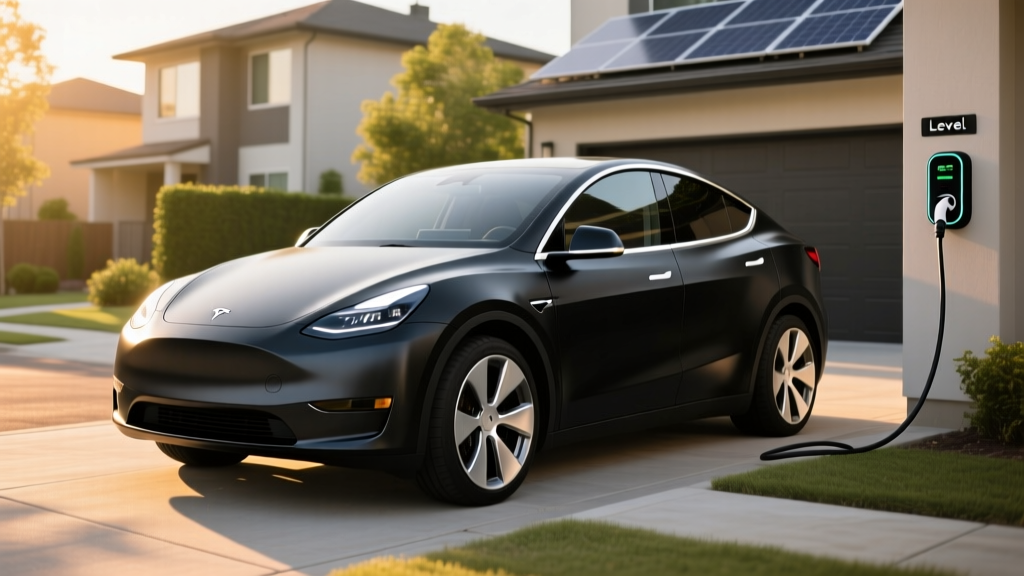
In practice, this means a Tesla Model Y Long Range (MSRP ~$44,990, assembled in Texas) may qualify for the full $7,500 if its battery sourcing meets current thresholds, while a Hyundai Ioniq 5 (assembled in Georgia with SK On battery cells) may qualify for partial credit depending on the mineral-sourcing percentage for the model year. Always check the fueleconomy.gov credit lookup tool for the specific trim and model year you're buying.
Tax credit rules are subject to legislative change. Consult a tax professional for your specific situation. This is not tax advice.
5-Year Total Cost of Ownership: EV vs. Gas in Oregon
To make the math concrete, let's compare a popular Oregon EV — the 2026 Tesla Model Y Long Range AWD — against a comparable gas SUV (2026 Toyota RAV4 AWD) over 5 years and 75,000 miles (15,000 miles/year).
| Cost Category | 2026 Tesla Model Y LR AWD | 2026 Toyota RAV4 AWD (Gas) |
|---|---|---|
| Base MSRP | $44,990 | $33,500 |
| Federal Tax Credit (§30D) | –$7,500 (if eligible) | $0 |
| Oregon Rebate (CVRP est.) | –$2,500 (standard, if funded) | $0 |
| Oregon Sales Tax | $0 (no state sales tax) | $0 (no state sales tax) |
| Effective Purchase Price | ~$34,990 | ~$33,500 |
| Fuel/Energy (75,000 mi) | $2,813 (home charging, $0.13/kWh) | $7,500 (28 MPG avg, $3.50/gal) |
| Maintenance (5 yr) | ~$1,200 | ~$3,200 |
| Insurance (5 yr avg) | ~$10,500 ($2,100/yr) | ~$7,500 ($1,500/yr) |
| Estimated Depreciation | ~$17,500 (50% of effective) | ~$13,400 (40% of MSRP) |
| 5-Year Total Cost | ~$67,003 | ~$65,100 |
| Cost Per Mile | ~$0.89 | ~$0.87 |
Assumptions: 15,000 mi/yr, Oregon residential electricity at $0.13/kWh, gas at $3.50/gal, Model Y efficiency at 3.5 mi/kWh (EPA combined ~122 MPGe), RAV4 at 28 MPG combined. Insurance and depreciation are estimates based on industry averages; actual figures vary by driver profile, location, and market conditions. Oregon CVRP rebate included as estimate — verify current funding and eligibility.
The takeaway: with full incentive stacking, the Model Y's effective purchase price nearly matches the RAV4's, and the fuel and maintenance savings are substantial. The higher insurance cost and steeper depreciation narrow the gap, but the total cost per mile is competitive — and if Oregon's income-qualified Charge Ahead rebate is available to you, the EV pulls decisively ahead.
Charging vs. Gas: The Per-Mile Math
| Scenario | Cost Per Mile | Annual Cost (15k mi) |
|---|---|---|
| Home Level 2 charging ($0.13/kWh, 3.5 mi/kWh) | $0.037 | $563 |
| Home charging with PGE Smart Charging rate ($0.08/kWh off-peak) | $0.023 | $343 |
| Public DC fast charging ($0.40/kWh avg) | $0.114 | $1,714 |
| Gas SUV (28 MPG, $3.50/gal) | $0.125 | $1,875 |
| Gas SUV (28 MPG, $4.50/gal — CA/WA pricing) | $0.161 | $2,411 |
Home charging is where the EV economics work best. At Oregon's average residential rate of roughly $0.13/kWh, you're paying about 3.7 cents per mile — roughly 70% less than a comparable gas SUV. If your utility offers a time-of-use EV rate (PGE's Smart Charging plan, for example), off-peak charging can push that below 2.5 cents per mile.
The caveat: public DC fast charging is not cheaper than gas. At $0.35–$0.48/kWh (common on Electrify America and EVgo networks in Oregon), you're paying $0.10–$0.14 per mile — roughly equivalent to a fuel-efficient gas car. The economics only work if you charge at home most of the time. Oregon buyers without access to home or workplace charging should factor this into their decision honestly.
Maintenance Savings: Where EVs Win Clearly
| Maintenance Item | Gas Vehicle (5 yr / 75k mi) | EV (5 yr / 75k mi) |
|---|---|---|
| Oil Changes | ~$600 (6–8 changes) | $0 |
| Transmission Fluid | ~$200 | $0 (single-speed reduction gear) |
| Brake Pads/Rotors | ~$800 (1–2 replacements) | ~$100 (regen braking extends life 2–3x) |
| Engine Air Filter | ~$150 | $0 (cabin filter only) |
| Spark Plugs | ~$300 | $0 |
| Coolant Flush | ~$200 | ~$150 (battery thermal management) |
| Tire Rotation/Replacement | ~$1,200 | ~$1,400 (EVs are heavier; tires wear faster) |
| Cabin Air Filter | ~$150 | ~$150 |
| Total Estimated | ~$3,600 | ~$1,800 |
EVs have roughly 20 moving parts in their drivetrain versus 2,000+ in an internal combustion engine. The maintenance savings are real and measurable: no oil changes, no spark plugs, no transmission fluid, and regenerative braking dramatically extends brake pad life. A Tesla Model Y owner might go 100,000 miles on the original brake pads.
The offset: EV tires tend to wear 15–25% faster due to the vehicle's additional weight (a Model Y weighs ~4,400 lbs vs. ~3,600 lbs for a RAV4) and the instant torque delivery. Budget for premium all-season or EV-specific tires (like the Michelin Pilot Sport EV or Hankook iON) at $250–$350 per corner.
Insurance Reality: The Cost Buyers Underestimate
EV insurance premiums are typically 15–30% higher than equivalent gas vehicles. For a 2026 Tesla Model Y in Oregon, expect annual premiums in the $1,800–$2,400 range depending on your driving record, age, ZIP code, and coverage level. A comparable RAV4 might run $1,300–$1,700.
Why the gap? Three factors:
- Repair costs: EV battery packs and power electronics are expensive to replace after a collision. Even minor rear-end damage can total a vehicle if the battery enclosure is compromised.
- Specialized labor: High-voltage system repairs require certified EV technicians, which are still in shorter supply than general mechanics.
- Vehicle price: Higher MSRP means higher collision/comprehensive payouts, even after incentives reduce your effective purchase price. Insurers base premiums on replacement cost, not what you paid after credits.
Some insurers now offer specific EV policies or discounts. Tesla Insurance (available in Oregon) uses real-time driving data and can be competitive for safe drivers. Shop at least three quotes before finalizing your purchase — the spread between insurers for the same EV can be $500+/year.
Depreciation and Resale Value Trends
EV depreciation has been a moving target. In 2023–2024, aggressive Tesla price cuts rippled through the used EV market, depressing resale values across all brands. By 2026, the market has stabilized somewhat, but EVs still depreciate faster on average than comparable gas vehicles.
Expect a mainstream EV (Model Y, Ioniq 5, Equinox EV) to retain roughly 45–55% of its effective purchase price (after incentives) at the 5-year mark. A comparable gas SUV like the RAV4 typically retains 55–65% of its MSRP. The gap is narrowing as battery longevity data accumulates and the used EV market matures.
Key factors influencing your specific EV's resale:
- Battery State of Health (SoH): Most modern LFP and NMC packs degrade 8–15% over 5 years / 75,000 miles. A vehicle with 90%+ SoH commands a premium on the used market.
- Charging connector: NACS-equipped vehicles (now the industry standard for 2025+ models) will likely hold value better than CCS-only vehicles as the Supercharger network becomes the de facto national standard.
- OTA updates: Vehicles from manufacturers that continue delivering meaningful over-the-air software improvements (Tesla, Rivian, Hyundai/Kia) tend to age better in the used market.
- Battery warranty transferability: The federal mandate requires 8 years / 100,000 miles of battery warranty coverage. This transfers to subsequent owners and supports resale value.
Stacking Oregon EV Rebates: A Practical Decision Framework
Choose an EV in Oregon if:
- You have access to home Level 2 charging (garage, driveway, or landlord-approved installation)
- Your household income falls within §30D limits and the vehicle you want qualifies for the full or partial credit
- Oregon's CVRP or Charge Ahead rebate is currently funded and you meet eligibility requirements
- You drive 12,000+ miles per year (higher mileage amplifies the per-mile fuel savings)
- Your utility offers a time-of-use EV rate for off-peak charging
Consider a PHEV or wait if:
- You live in an apartment or condo without charging access and public charging is sparse in your area
- The EV you want doesn't qualify for the federal credit (check fueleconomy.gov)
- Your annual mileage is under 8,000 miles (fuel savings won't offset higher insurance and depreciation as quickly)
- You need maximum towing capacity frequently — EV range drops 30–50% under heavy towing loads
Frequently Asked Questions
How much does it really cost to own an EV over 5 years in Oregon?
For a mainstream EV like the Tesla Model Y Long Range with full incentive stacking (§30D + Oregon CVRP), expect a 5-year total cost of roughly $65,000–$70,000 including purchase, energy, insurance, maintenance, and depreciation over 75,000 miles. That translates to approximately $0.87–$0.93 per mile. A comparable gas SUV comes in at $0.85–$0.90 per mile. The EV wins decisively if you qualify for income-based Charge Ahead rebates or drive significantly more than 15,000 miles per year.
Do I qualify for the federal §30D EV tax credit?
Eligibility depends on your filing status and MAGI (single: under $150,000; head of household: under $225,000; joint: under $300,000), the vehicle's MSRP (under $55,000 for cars, under $80,000 for SUVs/trucks/vans), North American final assembly, and battery sourcing requirements. Many popular models qualify for the full $7,500, but the FEOC mineral-sourcing restrictions have disqualified some trims. Check the specific VIN on fueleconomy.gov and consult a tax professional.
How much do I save on fuel and maintenance with an EV in Oregon?
Home charging at Oregon's average rate ($0.13/kWh) costs roughly $0.037 per mile versus $0.125 per mile for a 28 MPG gas SUV — a savings of about $0.088 per mile, or $1,313 per year at 15,000 miles. Maintenance savings add another $350–$400 per year (no oil changes, fewer brake replacements). Combined, expect $1,650–$1,750 in annual operating savings versus a comparable gas vehicle.
Are EVs more expensive to insure in Oregon?
Yes, typically 15–30% more than a comparable gas vehicle. For a Model Y in Oregon, budget $1,800–$2,400 per year versus $1,300–$1,700 for a RAV4. Higher repair costs, specialized labor, and the vehicle's replacement value drive the premium gap. Shop multiple insurers and ask about EV-specific policies or usage-based programs.
How well do EVs hold their value?
Modern EVs from major manufacturers retain approximately 45–55% of their effective purchase price at 5 years. This is improving as battery longevity data strengthens buyer confidence and the NACS connector standardizes charging access. The 8-year/100,000-mile federally mandated battery warranty, which transfers to second owners, provides additional resale support. Expect gas SUVs to retain 55–65% over the same period — the gap is real but narrowing.
Does Oregon's lack of sales tax make EVs more attractive?
Absolutely. Oregon's 0% state sales tax saves EV buyers $2,500–$5,000+ compared to purchasing the same vehicle in Washington (6.5% + local), California (7.25%+), or Idaho (6%). This is an often-overlooked advantage that effectively functions as an additional incentive, especially on higher-priced EVs.
Can I stack the federal credit with Oregon state rebates?
Yes. The federal §30D credit and Oregon's state/utility rebates are separate programs with independent eligibility requirements. A buyer who qualifies for both could potentially stack $7,500 (federal) + $2,500+ (state CVRP) + $250–$500 (utility charger rebate) for total incentives exceeding $10,000. Income-qualified buyers may stack even higher through Charge Ahead. Always verify current program status before committing to a purchase.
The bottom line for Oregon EV buyers: the incentive stack is among the most favorable in the country when you combine no sales tax, federal credits, state rebates, and low electricity rates. The math works best for home-charging households with moderate-to-high annual mileage who qualify for §30D. Run your specific numbers — your utility rate, insurance quote, and the exact vehicle's credit eligibility — before signing, and the ownership picture becomes clear.